October 12, 2026
Cleaning Office Prices: A Practical Pricing Guide for 2026
Learn how cleaning office prices really work in 2026. Compare per square foot, hourly, and monthly models, plus tips to estimate and present winning quotes.

Tuesday, July 14, 2026
Decode medical office cleaning rates for 2026. Learn to price per sq ft or hour, factor in compliance costs, and create profitable estimates that win contracts.
Medical office cleaning rates are higher for one reason that gets missed in bad estimates. Infection control slows labor, and labor is where these jobs are won or lost.
A clinic can look simple on a walkthrough and still burn far more time than a standard office of the same size. Crews change gloves, isolate tools by area, apply disinfectant to the right surfaces, wait out dwell times, handle waste correctly, and complete logs a property manager may ask to see later. Those steps are not optional. They are part of the job.
That is the hidden math. Medical cleaning is priced on reduced production, not on a small premium for better chemicals.
I have seen new bidders miss this by treating medical work like office cleaning with a slightly higher square foot rate. The result is predictable. The scope gets sold cheap, the crew falls behind, quality slips, and the account turns into a margin problem within weeks. Strong pricing starts with the actual time required to clean, disinfect, protect against cross-contamination, and prove the work was done.
That proof matters too. Medical clients do not just buy a cleaner building. They buy consistency, defensible procedures, and fewer preventable mistakes. A clear cleaning quality assurance process supports the price because it shows exactly what your crew is doing differently from a basic janitorial vendor.
New operators usually lose money in medical work for one reason. They assume the job is basically the same as office cleaning, just with stricter products and a slightly higher rate.
That assumption wrecks estimates.
Medical office cleaning changes how a crew moves through a building. Staff can't rush from room to room using standard office routines. They have to control cross-contamination, manage PPE, apply disinfectants correctly, respect dwell time, and document what happened. Those steps slow production in a way that basic square-foot pricing doesn't capture.
A medical facility may look small on paper and still take far longer than a larger traditional office. Exam rooms, treatment spaces, touchpoints, waste handling, and documentation all eat time. A segmented floor plan with multiple clinical rooms almost always performs worse than an open office at the same size.
That's why underbidding usually starts with a bad labor assumption, not with overhead.
Practical rule: If your estimate starts with standard office production rates and then adds a small premium, you're probably bidding too low.
The strongest estimators work backward from scope. They ask how many rooms require disinfection, what level of risk exists in each area, who supplies regulated products, how logs are maintained, and what tasks must happen every visit whether the building looks dirty or not.
Profitable medical bidders don't sell “cleaning.” They sell a controlled process.
That means the estimate has to reflect:
Rookies often try to stay “competitive” by shaving labor. Experienced operators know that the low number is often the risky number. In medical cleaning, missing your labor target doesn't just hurt profit. It can force crews to skip steps, rush dwell times, or cut documentation. That's how a seemingly good account turns into a problem account.
Medical office cleaning rates aren't random. Most profitable estimates fall into one of three structures. Each has a place, but each works best under different conditions.
Medical office cleaning rates in 2026 typically range from $0.13 to $0.20 per square foot per visit for general and specialty practices, with recurring service averaging $0.12 to $0.25 per square foot per visit. Those rates are 25% to 60% higher than standard office cleaning, which generally runs $0.09 to $0.17 per square foot, while hourly pricing for medical cleaning typically ranges from $25 to $80 per hour, with an average of $60 per hour, according to CleanQuote's 2026 medical office cleaning cost guide.
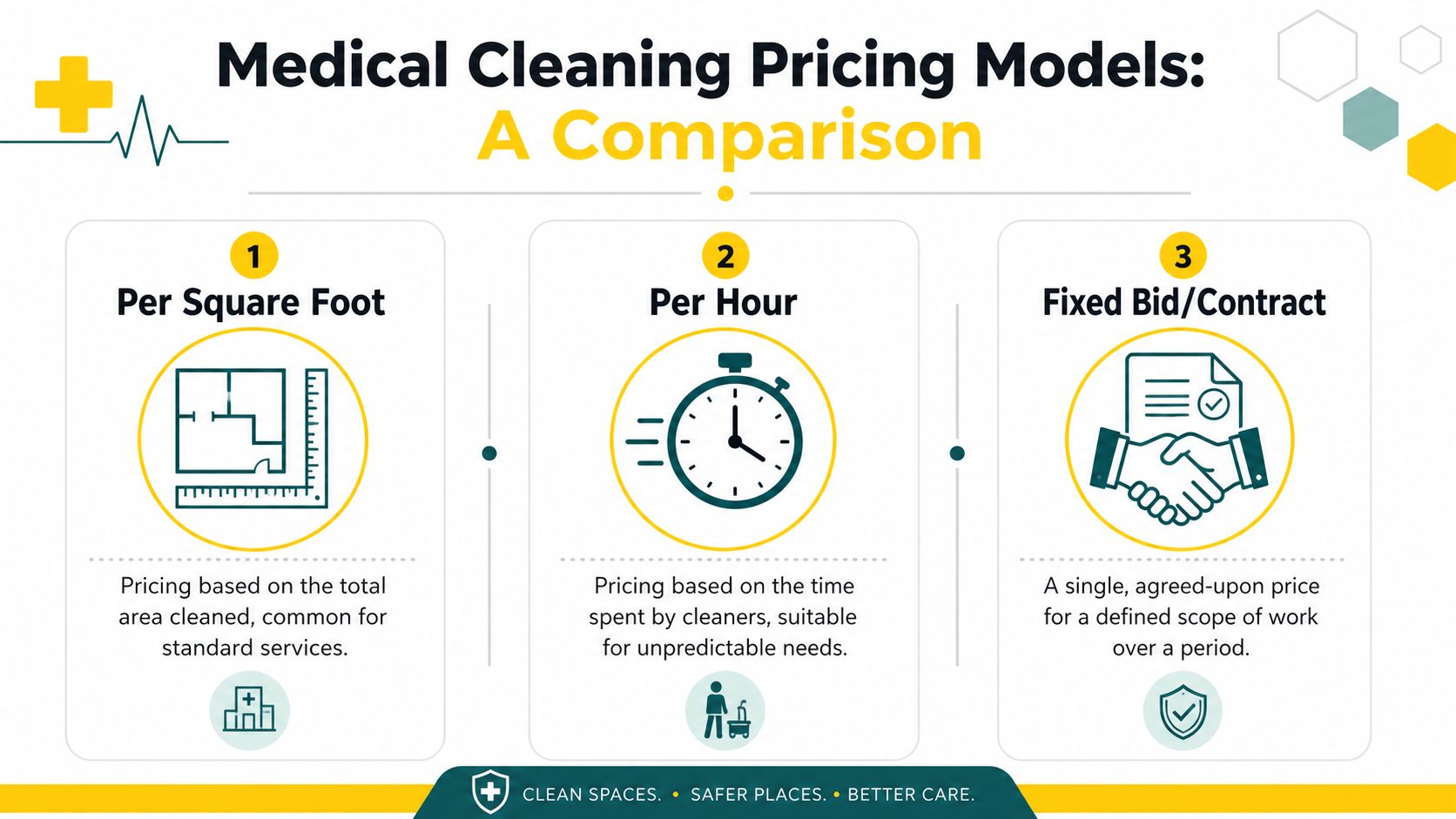
This is the easiest model to discuss with buyers because they already understand the building size. It works well for recurring service in stable facilities where the scope is well-defined.
The danger is obvious. Square footage alone doesn't tell you how many exam rooms exist, how many touchpoints need disinfection, or how segmented the layout is. A simple footprint can hide a slow job.
Use this model when:
Hourly pricing fits facilities with variable needs. It's also useful for one-time work, catch-up cleaning, uncertain schedules, and accounts where the buyer hasn't defined the true scope yet.
The strength of hourly billing is flexibility. The weakness is client anxiety. Buyers don't like open-ended labor when they need budget certainty.
This model works best when:
For most recurring medical accounts, this is the strongest model. It protects your margin if you've scoped correctly and gives the client a predictable number.
It also forces discipline on your side. If you miss labor assumptions, the fixed rate locks in the pain. That's why this model belongs after a detailed walkthrough, not before.
A useful benchmark comes from broader service pricing references like this cleaning service price list guide, but medical contracts need tighter scope language than general commercial work.
The pricing model should follow the risk and the variability. Don't force every medical account into the same structure because it's easier to sell.
A small dental or physician office with a stable weekly routine often fits square-foot or flat monthly pricing. An urgent care site with unpredictable traffic and occasional higher-risk cleaning may need a blended approach. Many strong medical estimates use a fixed recurring charge for routine work and separate charges for deep or terminal events.
That combination keeps the base service predictable while protecting you from absorbing extra labor that wasn't part of routine maintenance.
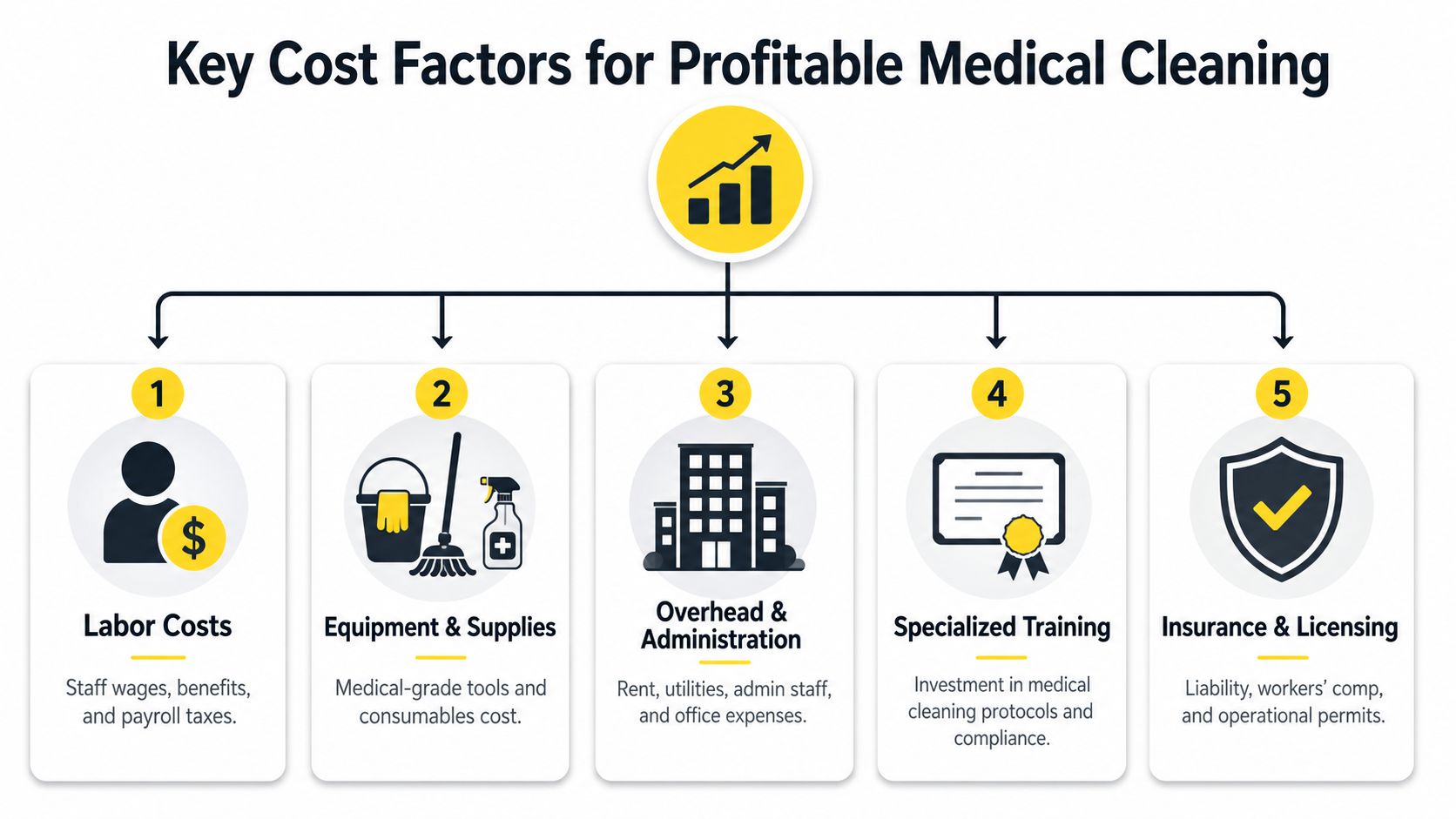
A rate sheet is only the starting point. Medical cleaning gets profitable when you understand what changes the labor load inside the building.
Monthly medical office cleaning costs can vary widely by facility size and complexity. Small doctor's offices with 2 exam rooms range from $240 to $400 per month, larger offices with 8 exam rooms run $960 to $1,200 per month, outpatient clinics with 15 exam rooms typically spend $2,000 to $2,500 per month, and surgical centers or emergency rooms may run $0.20 to $0.30 per square foot per month, according to CleanerMatch's medical office cleaning service guide.
A basic physician office, a dental office, an outpatient clinic, and a surgical environment may all use the phrase “medical cleaning,” but they are not the same job.
A two-room office may be compact and manageable. A larger clinic with more exam rooms adds repeated disinfection cycles, more touchpoints, and more documentation. Surgical and emergency environments add a different level of disinfection rigor and usually a tighter tolerance for shortcuts.
The biggest pricing swings usually come from how often you clean and what “clean” means in that account.
Routine recurring service is one thing. Terminal cleaning, deeper disinfection, regulated waste concerns, and stricter room turnover expectations are another. If the client says “we just need nightly cleaning,” you still need to unpack what happens in each room and what must be logged every visit.
Here's the way seasoned estimators think about scope:
Medical work requires a different supply conversation. You're not just counting microfiber, liners, and mops. You're accounting for regulated disinfectants, PPE use, equipment separation by area, and the labor required to use those materials correctly.
Many estimates fall apart. A company budgets the visible labor but ignores the recurring cost of doing the work in a documented, compliant way.
If a bidder can't explain how room count, risk level, and documentation affect labor, the price is probably a guess.
A practical way to tighten this is to calculate labor first, then pressure-test it against actual operating cost. In this context, a solid labor cost per hour method becomes useful. It forces you to stop treating payroll, training, supervision, and admin as background noise.
What works is a scope that separates low-risk areas from clinical areas, prices recurring tasks differently from intensive tasks, and spells out who provides products and logs.
What doesn't work is a single blended rate with no room-level logic behind it. That kind of estimate looks clean in a proposal and gets ugly in operations.
The fastest way to understand medical office cleaning rates is to build the estimate the way an operator would. Not as a generic formula. As a scope-driven job.
For high-intensity work, terminal cleaning visits for medical facilities range from $250 to $1,000+ per visit, while one-time deep cleaning runs $0.25 to $0.50 per square foot. The same source places low-traffic areas at $0.15 to $0.20 per square foot and high-traffic or critical care zones at $0.20 to $0.30 per square foot in Sunny Spark Cleaning's medical facility cleaning cost guide.
A dental office can be compact and still carry a heavier cleaning burden than a typical small office. Multiple operatories, aerosol-prone work areas, and frequent touchpoints push labor up.
For a 2,500 square foot dental office with three weekly visits, I'd start by separating the facility into two buckets. First, low-traffic support areas such as admin, staff space, and some circulation space. Second, the higher-sensitivity operatories, restrooms, and waiting areas.
A practical estimate structure looks like this:
If the buyer wants periodic deeper disinfection beyond nightly routine work, I'd keep that outside the base agreement rather than bury it in the monthly number.
An 8,000 square foot urgent care clinic is a different animal. Daily traffic is heavier. Waiting areas get hit harder. Exam rooms turn over more often. If the clinic also wants periodic terminal cleaning, the estimate needs a recurring component plus an event-based component.
Many operators frequently underbid. They use one simple square-foot number and forget that urgent care combines routine janitorial tasks with healthcare-grade disinfection expectations.
A stronger structure is:
“If the scope can spike, the estimate needs a line item that can spike with it.”
Below is a clean way to present both scenarios.
| Metric | Example 1: Dental Office | Example 2: Urgent Care Clinic |
|---|---|---|
| Facility size | 2,500 sq ft | 8,000 sq ft |
| Service pattern | 3 visits per week | Daily recurring service |
| Layout concern | Multiple operatories and tight room segmentation | High patient flow, exam rooms, waiting area pressure |
| Best pricing structure | Fixed recurring estimate with defined add-ons | Recurring contract plus separate terminal-cleaning line |
| Risk area pricing | Blend of routine clinical and support-area pricing | Higher weighting for high-traffic and critical zones |
| Deep or terminal work | Kept outside standard recurring scope | Separate event pricing based on visit or area |
| Main profit risk | Treating operatories like standard offices | Hiding intensive disinfection inside a flat base rate |
A reusable commercial cleaning estimate template helps here because it forces you to write scope by area instead of relying on memory during a walkthrough.
Medical cleaning contracts are not won by being the cheapest. They are won by making the hidden labor visible.

A buyer will accept a higher number if the scope explains where the time goes. In medical space, that extra time comes from protocol. Staff cannot move room to room like they would in standard office work. They have to follow dwell times, change cloths to prevent cross-contamination, document completion, handle waste correctly, and clean around active patient use without cutting corners. That is the hidden math rookies miss, and it is exactly why underbidding medical work gets expensive fast.
I have found that buyers respond best when the proposal explains labor in plain language. Do not defend your price with square footage alone. Square footage is only the shell. The actual cost sits in room turnover, touchpoint density, compliance tasks, and the time lost to infection-control procedures that slow production on purpose.
That is what your estimate needs to show.
Medical clients want proof that your price is based on process, not guesswork. A strong estimate spells out the work in a way a practice manager can defend internally.
Include the parts that usually get buried:
Clients do not need a lecture on compliance. They need to see why your crew takes longer and why that extra time reduces risk.
A vague price invites shopping. A specific price creates confidence.
If your bid is higher, tie the premium to business risk the client already understands. Missed disinfection in a billing office is a service issue. Missed disinfection in an exam room can become a patient safety issue, a complaint, or a contract problem for the facility manager who hired you. That difference matters, and experienced buyers know it.
Say it clearly. Your company is pricing for trained labor, controlled procedures, and documented performance. You are not pricing for a basic janitorial pass.
Documentation helps close that gap. If your team captures proof of completion, inspection notes, or before-and-after photos, those records can also drive revenue with documentation because they give the client something concrete to review instead of forcing them to trust a promise.
A polished service proposal template also helps because it turns your estimate into a scope-controlled agreement. That matters when a prospect is comparing three vendors who all say they "disinfect high-touch areas" but mean very different things.
Buyers compare exposure, supervision, and proof of performance before they sign. Price is part of that decision, but it is not the whole decision.
This short video is a useful reminder that contracts close when the offer is clear and confidence is high.
Winning proposals do three things well.
First, they define the scope tightly enough that the client can see what is included and what triggers extra charges. Second, they explain why medical cleaning takes more labor hours than standard office cleaning. Third, they show a control system, who checks the work, how issues are logged, and how service stays consistent when staffing changes.
That is how you protect your margin and still win the contract. You stop sounding like a low-price janitorial vendor and start sounding like the contractor who understands the cost of getting medical cleaning wrong.
Standardized estimating protects margin in medical cleaning. Without it, two estimators can look at the same clinic and produce numbers that are hundreds apart because one prices visible tasks and the other prices the labor behind infection control, documentation, and room-by-room handling.
That hidden math is where medical bids are won or lost.
A rookie estimator sees square footage. An experienced estimator sees hand-contact surfaces that need a defined process, exam rooms that reset slower than private offices, waste handling rules, logged checks, and extra travel time between task zones. Those details stretch labor time, and labor is the part that gets underpriced first.
Hand-built estimates fail for a simple reason. They depend too much on memory.
One estimator remembers dwell time requirements and cloth changes. Another remembers restroom restocking but skips the inspection log. A third uses a production rate borrowed from general office cleaning and never adjusts for exam rooms, treatment spaces, or stricter touchpoint work. The bid goes out looking clean on paper, then operations inherits a scope that cannot be serviced at the quoted price.
That creates three expensive problems:
Strong estimating systems spell out what counts, what adds time, and what changes the price. Base square footage is only one layer. Room count, exam room turnover, disinfection frequency, day porter coverage, floor type, regulated waste touchpoints, and documentation requirements all need rules attached to them.
I price medical work with one question in mind. "What labor is required to do this safely and repeatedly without cutting corners?" That question keeps estimates grounded in operations instead of sales optimism.
Use a repeatable workflow, not gut feel. Tools built for AI estimates software for cleaning can help turn your pricing logic into a system your whole team follows the same way.
Buyers notice consistency. A fast estimate with a tight scope reads like a contractor who understands the building, the risk, and the labor behind the work.
It also makes training easier. New sales reps do not have to invent pricing logic from scratch, and account managers are less likely to discover missing tasks after the contract is signed. In medical cleaning, one missed compliance step can wipe out the profit from an account that looked fine at bid stage.
Standardization does not make your pricing rigid. It makes your decisions deliberate. You can still adjust for building access, local wages, or specialty areas, but you are adjusting from a controlled baseline instead of guessing every time.
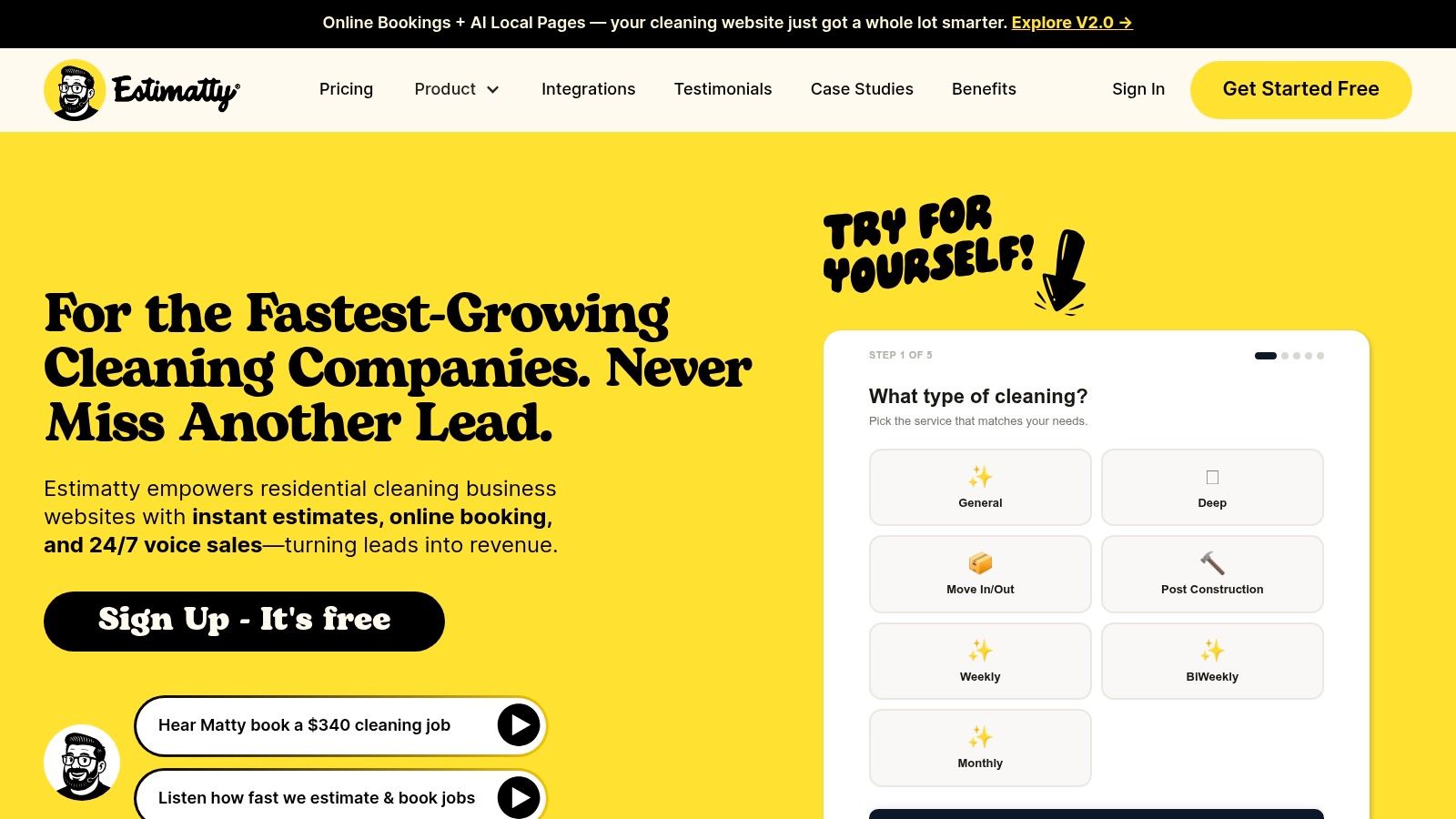
If you want to stop underbidding medical work, Estimatty helps you standardize estimates around your real rules, not guesswork. You can build in square-foot pricing, room-level adjustments, compliance-related labor, and recurring service logic so every lead gets a fast, consistent estimate that protects your margin.