October 12, 2026
Cleaning Office Prices: A Practical Pricing Guide for 2026
Learn how cleaning office prices really work in 2026. Compare per square foot, hourly, and monthly models, plus tips to estimate and present winning quotes.
Saturday, July 11, 2026
Streamline operations & boost conversions with our top-rated data collection software. Turn inquiries into booked jobs efficiently in 2026. Get started!
You're probably living this right now. The phone rings while you're inside a job, gloved up, vacuum running, or walking a crew through a last-minute issue. By the time you call back, the prospect has already moved on, or they still answer but now want a fast price and you're piecing together details from memory.
That's not a hustle problem. It's a capture problem.
For cleaning companies, data collection software isn't some abstract back-office tool. It's the system that catches lead details the moment they come in, turns scattered information into usable estimating inputs, and helps you respond before the buyer cools off. In this industry, that difference shows up in booked jobs, cleaner schedules, and fewer hours wasted chasing incomplete inquiries.
A common pattern looks like this. A homeowner calls during business hours. Nobody answers because the owner is cleaning, driving, or handling a team issue. The caller leaves a partial voicemail with a first name, maybe a zip code, and a rushed “need a deep clean this week.” Later, someone calls back, misses them, texts them, waits, and then sends an estimate based on thin information. That lead was interested enough to call. The business still made the buying process hard.
Cleaning owners often blame themselves for that breakdown. They shouldn't. This is what happens when lead intake depends on one person being available at exactly the right moment.
Most owners think of missed calls as a sales issue. They're also a data issue. When intake is weak, the business collects incomplete square footage, vague room counts, missing service frequency, unclear surfaces, and no urgency level. That leads to callbacks, slower estimates, and pricing errors.
While 72% of SMBs cite data quality as a top barrier to growth, most guides about data collection software don't explain how weak intake raises costs for service businesses through callbacks and bad estimates, which is exactly where cleaning companies leak revenue (Bain on the small business growth gap).
Practical rule: If your team has to call back just to ask the same intake questions every time, your problem isn't lead volume. It's lead capture quality.
The owners who fix this stop treating every inquiry like a custom rescue mission. They build a process that gathers the right details up front, every time, whether the inquiry comes from the website at lunch or by phone at night.
The businesses that tighten this up don't just “answer faster.” They create a system that captures, organizes, and acts on lead data automatically. That means the prospect gets a response immediately, the business gets structured information, and the estimate process starts without waiting for a human bottleneck.
A lot of owners start by improving phone coverage. If after-hours response is a weak point, a practical place to start is looking at a 24 hour phone answering service for cleaning companies. That at least stops voicemail from being your default sales process.
What works is simple. Every inquiry should create usable information. Not just a missed call notification. Not just a contact form email. Usable information that helps your team price, follow up, and book.
For cleaning businesses, data collection software captures lead details, organizes them into a usable format, and pushes the inquiry toward an estimate or follow-up without relying on someone to piece everything together by hand.
A basic contact form gives you a name and a message. Data collection software gives you the information needed to price and book the job: property type, service requested, size, frequency, timeline, access notes, and the best way to follow up.
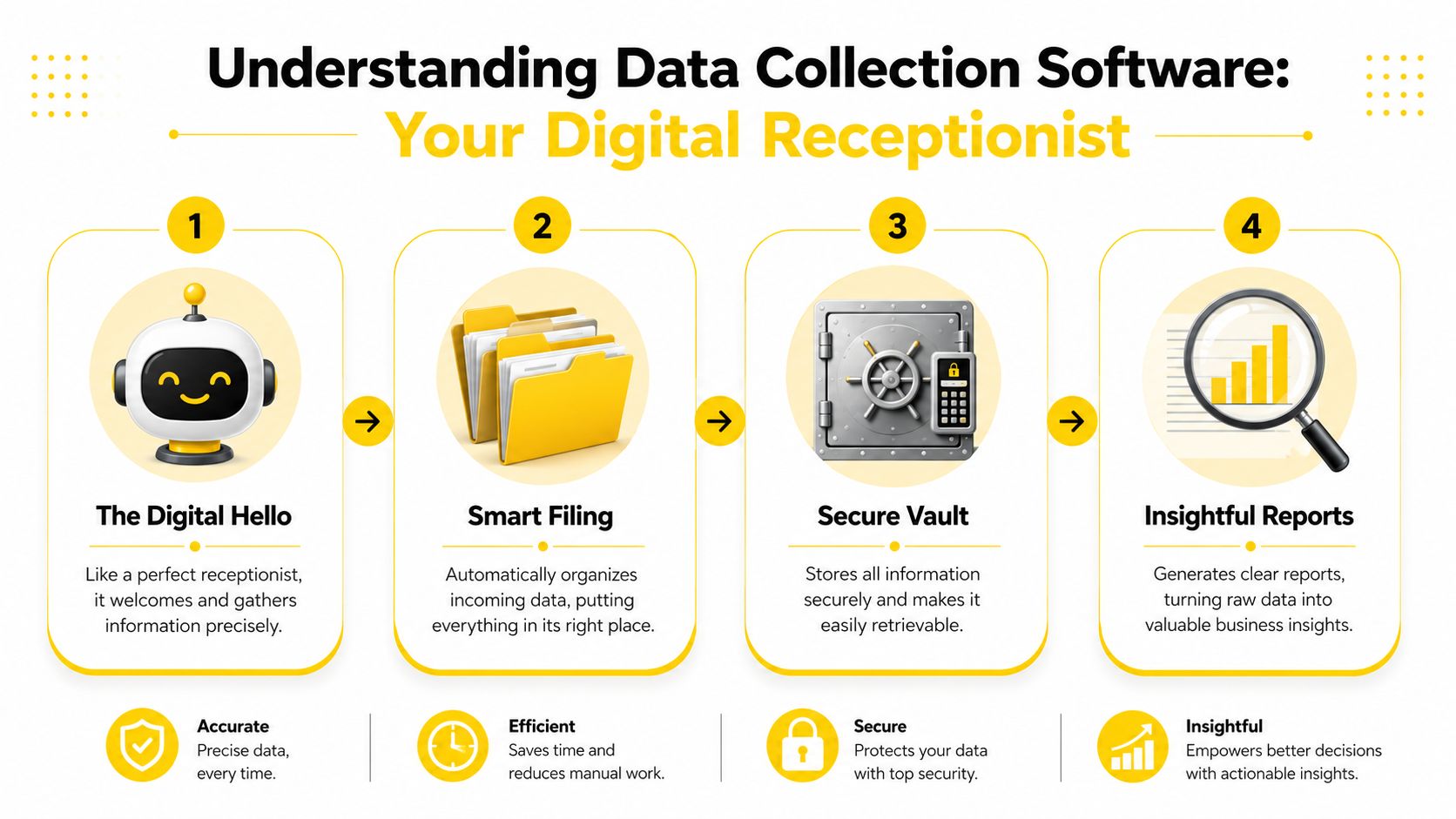
Cleaning leads come in through more than one channel. Some prospects fill out a form during work. Some call after putting the kids to bed. Some want a quick quote for recurring maid service. Others need a walkthrough for a commercial account.
Good software handles those entry points in one intake process, so your office is not stitching together voicemail, web forms, text messages, and handwritten notes. That matters because scattered intake creates pricing delays, missed callbacks, and inconsistent quotes.
That broader shift toward structured intake is showing up across service operations. This guide to market research outsourcing for 2026 is useful because it shows how companies are building repeatable ways to collect and organize information instead of relying on ad hoc admin work.
Value is not storage. It is structure.
If a lead comes in asking for a move-out clean, your team should not have to read a vague message and start a second round of questions from scratch. The software should convert answers into fields your team can use right away, such as job type, square footage, bathrooms, add-ons, urgency, and location.
That is the difference between collecting data and collecting work for your staff. A lead record that still needs cleanup, clarification, and manual re-entry is only half finished.
Once the information is captured, the system should help your team act on it. That could mean sending an instant acknowledgment, assigning the lead, creating a task, or preparing estimate details for the office.
For cleaning companies, speed matters, but consistency matters just as much. Fast replies do not help much if the intake is incomplete and the estimate goes out wrong. The best systems improve both.
If you are comparing options, review tools built for field-service intake and quoting, not generic office forms. This overview of service business software for operators is a practical place to start.
Not every feature list matters. Cleaning companies need software that helps them win inquiries, price consistently, and move fast without turning the office into a data-entry department.
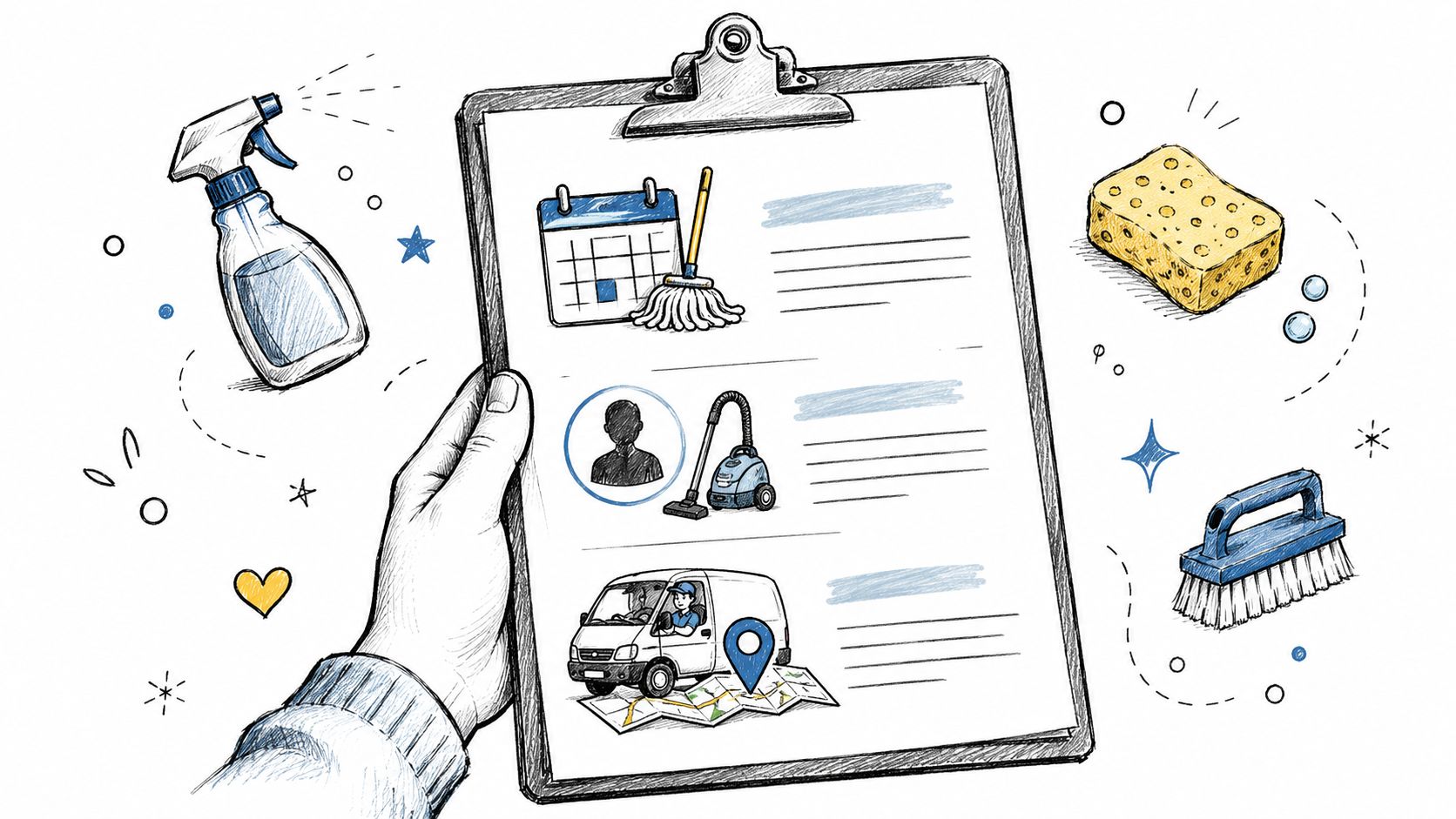
If your software only handles website forms, it's incomplete for cleaning. For cleaning businesses where over 40% of new leads arrive via phone, voice intake matters. Most articles miss that point, even though voice-channel automation lets businesses collect details and provide conversational estimates without staffing a receptionist around the clock (field services voice intake reality).
That matters for solo cleaners and larger teams alike. A caller can say what they need in plain language. The system should capture square footage, service urgency, surfaces, and job type without forcing the buyer through a clunky script.
What doesn't work is splitting intake into disconnected tools:
That setup creates delays and pricing mistakes.
Many cleaning businesses continue to rely on gut feel. One staff member prices by square footage. Another prices by bedrooms and bathrooms. The owner gives one price on the phone and the office sends another later.
A useful system standardizes that. It should let you define your pricing logic once, then apply it consistently. That includes recurring service, deep cleaning, move-in or move-out work, commercial jobs, and add-ons.
Here's the practical distinction that matters. An estimate is a non-binding price projection based on current information and assumptions, while a quote is a fixed-price offer with a defined scope and validity window (estimate software guide). For cleaning businesses, using estimates during intake keeps you fast without locking yourself into a bad price before the details are confirmed.
Speed changes outcomes. If a prospect has to wait until the end of your shift to get pricing, you've already lost ground.
A strong workflow should:
Below is a useful walkthrough of how digital intake and follow-up can fit together in a real workflow.
If new leads don't flow into your CRM, scheduler, or automation stack, your team goes back to copy-paste work. That's why integrations matter. Zapier connectivity, CRM syncing, and clean handoffs are not “nice to have” features. They keep intake from becoming another admin chore.
If you're also tightening the handoff between inquiry and booking, this article on online booking software for cleaning businesses is worth reviewing because booking friction usually starts with weak intake.
Owners usually focus on software cost first. In cleaning, the bigger number is what slips away each week through missed calls, slow estimates, inconsistent pricing, and office time spent chasing details that should have been captured at first contact.
Automated lead capture improves revenue in three places at once. More inquiries get a response. Estimates come out with fewer pricing mistakes. Office staff spend less time retyping the same information into multiple tools.
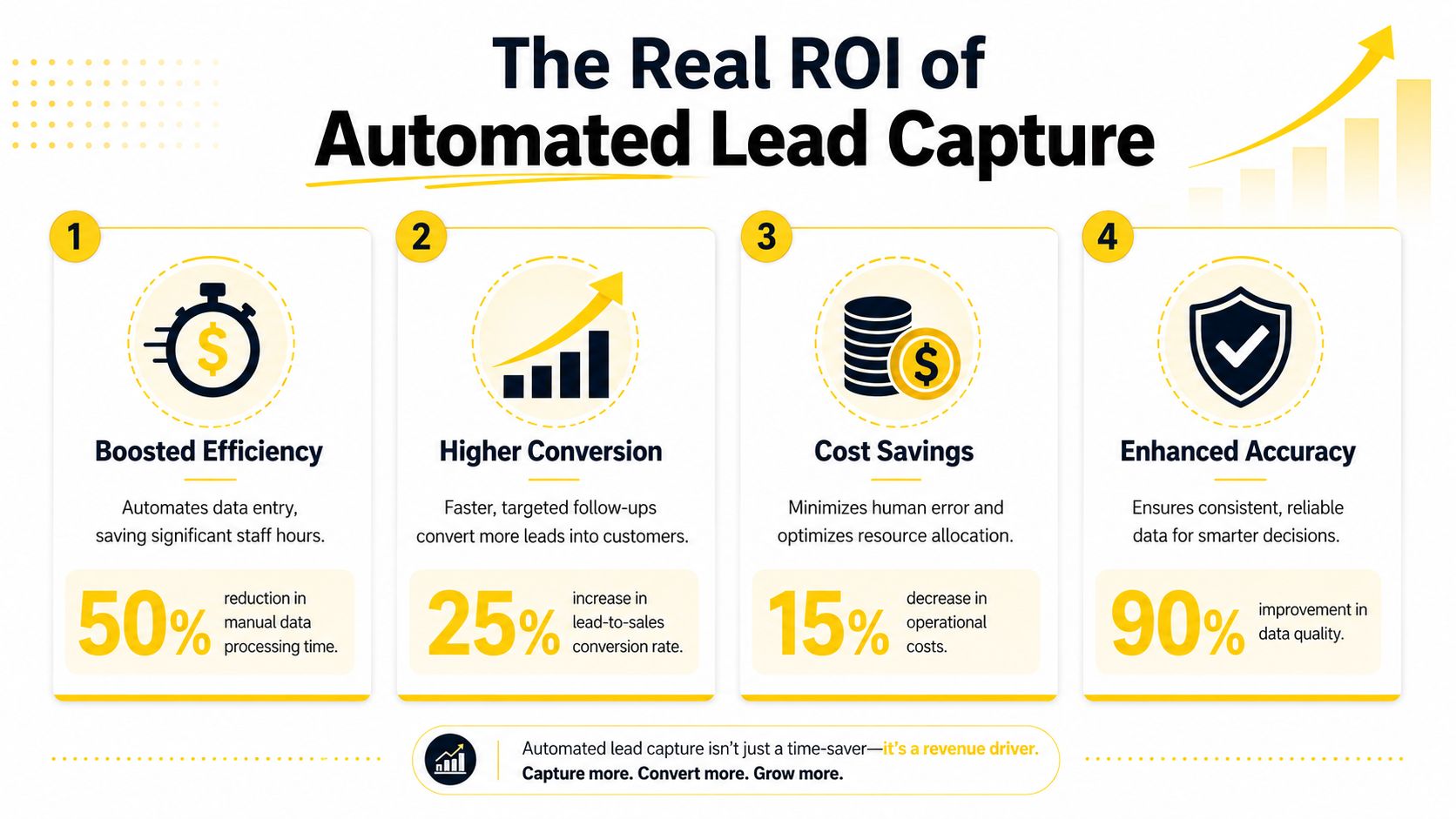
A cleaning lead often comes in at the worst possible time. Your team is on-site. The office is busy. The owner is driving between jobs. If that caller hits voicemail and never gets a useful follow-up, the marketing worked and the intake failed.
The strongest return usually comes from recovering demand you already paid to generate. A better form, call workflow, or automated qualification step can produce more booked jobs before you spend another dollar on ads.
For owners working on both traffic and conversion, it helps to learn lead generation techniques that make the first inquiry easier to capture and qualify.
A lot of margin loss starts before the crew arrives.
One estimator asks about pet hair, first-time condition, and add-ons. Another gives a quick number without asking about square footage, extra bathrooms, or access issues. Both jobs get booked, but only one was priced with enough context to protect margin.
A structured intake fixes that. Every lead goes through the same questions, the same service logic, and the same pricing guardrails. That does not remove judgment. It gives your team a better starting point, so final pricing is based on facts instead of memory.
Field note: Bad intake does not always lose the job. It often wins work that should have been priced higher.
Manual intake creates hidden payroll drag. Someone checks voicemails, sends a text, calls back, asks follow-up questions, drafts an estimate, then enters the same details into the CRM or scheduling system. None of that work is hard. It is just expensive when repeated all day.
Good automation cuts out the duplicate steps. The lead enters once. The details follow the job through estimating, follow-up, and booking. Staff can spend their time on exceptions, close questions, and schedule decisions instead of basic data entry.
A simple comparison shows the trade-off:
| Process | What staff spend time on | What gets delayed |
|---|---|---|
| Manual intake | voicemail checks, callbacks, retyping, chasing missing details | estimate delivery, follow-up, booking |
| Automated intake | exceptions, warm lead follow-up, schedule decisions | much less |
Fast capture is only part of the return. Owners also need to know which channels bring in leads that book and hold margin.
That is why source visibility matters. If Google Local Services brings high-intent house cleaning leads while a directory sends price shoppers, your intake and follow-up should reflect that. This guide to lead source tracking for cleaning companies is useful for tightening that part of the operation.
Customers do not care what system runs in the background. They care that someone responded quickly, asked the right questions, and sent a clear estimate without making them repeat themselves.
For cleaning businesses, that is the return. More captured leads. Better-priced jobs. Less office waste.
Different operators use data collection software in different ways. The common thread is simple. They stop relying on memory and availability, and they start building a repeatable intake machine.
A solo operator usually has one major constraint. They can't answer every call while cleaning. So the software becomes their front desk. It captures the inquiry, gathers job details, and keeps the business responsive even when the owner is on-site.
That changes how the business looks to buyers. Instead of sounding like one person juggling everything, the company feels organized and available. The owner gets time back and spends less of the evening returning calls that should have been handled at first contact.
As soon as a company has office help, multiple estimators, or field supervisors giving prices, inconsistency shows up. One person asks better questions. Another forgets exclusions. Another sends vague pricing with no assumptions.
Standardized estimates matter. A professional estimate should reflect a clear service description, assumptions, timeline, and the cost range based on current information, rather than a rushed verbal number with no structure (estimate elements guide).
Owners who want more examples of automation in this stage should review AI sales automation for cleaning services. It's the same operational principle. Standardize the first response so humans can focus on exceptions and closing.
Cleaning companies don't scale by answering more calls manually. They scale by making intake consistent enough that any lead can move forward without the owner touching every step.
Once you're operating in several territories, local improvisation becomes expensive. One branch logs lead details well. Another misses follow-up fields. A third keeps notes in text threads. Leadership can't compare demand cleanly because intake quality changes by location.
That's one reason field-focused tools are growing fast. The global field data collection app market was valued at USD 1,966.7 million in 2024 and is projected to reach USD 7,419.9 million by 2034, with a CAGR of 14.20% (field app market projection). For cleaning businesses, that shift reflects the value of mobile, on-the-ground capture for distributed teams.
When the intake side is under control, owners can spend more time on capacity, territory planning, and hiring. That's where operational resources like estimatty.com/blog and get.pipehirehrm.com/blog become useful reading, especially if you're also tightening recruiting through pipehirehrm.com.
Most cleaning companies don't need more software. They need fewer gaps between inquiry, estimate, and booking. The wrong tool adds another login and another inbox. The right one removes handoffs.
A generic platform demo can look polished and still fail in real use. Cleaning operators should evaluate software around the intake situations they deal with every day.
Use this checklist:
Some tools look modern but create new problems.
| Red flag | Why it hurts |
|---|---|
| Form-only intake | callers stay outside the workflow |
| No pricing customization | staff go back to manual estimates |
| Weak integrations | duplicate entry returns |
| Complicated setup | adoption stalls |
| Generic workflows | your team starts using side notes and workarounds |
That's the test I use. After implementation, does the tool remove steps or add steps?
If it's right, your team won't talk about the software much. They'll notice fewer missed calls, cleaner lead records, and faster estimate turnaround. That's what good data collection software should do. It should disappear into the operation and make the business run tighter.
Don't start with a software demo. Start with a one-week audit of your current intake process.
Track every missed call. Count every inquiry that came in after hours. Time how long it takes your team to send each estimate. Note how many times someone has to follow up because the original lead details were incomplete. That small exercise usually exposes the actual cost of manual intake faster than any pitch deck.
If you want another practical lens on the phone side, review VoIP performance analytics and look at your call patterns. You'll quickly see where response delays and missed opportunities are stacking up.
The reason this category is growing is simple. The global data collection software market is projected to grow from $4.8 billion in 2024 to over $10 billion by 2032, with a CAGR of 8.5% (data collection software market outlook). Businesses are adopting these systems because manual collection no longer holds up when speed and consistency decide who gets the job.
For cleaning businesses, this doesn't need to become a giant tech project. The best next move is usually small and specific. Fix missed calls. Standardize estimates. Make website and phone intake feed one process. Then build from there.
If you want more practical operations content, estimatty.com/blog and get.pipehirehrm.com/blog are both worth keeping in your reading rotation.
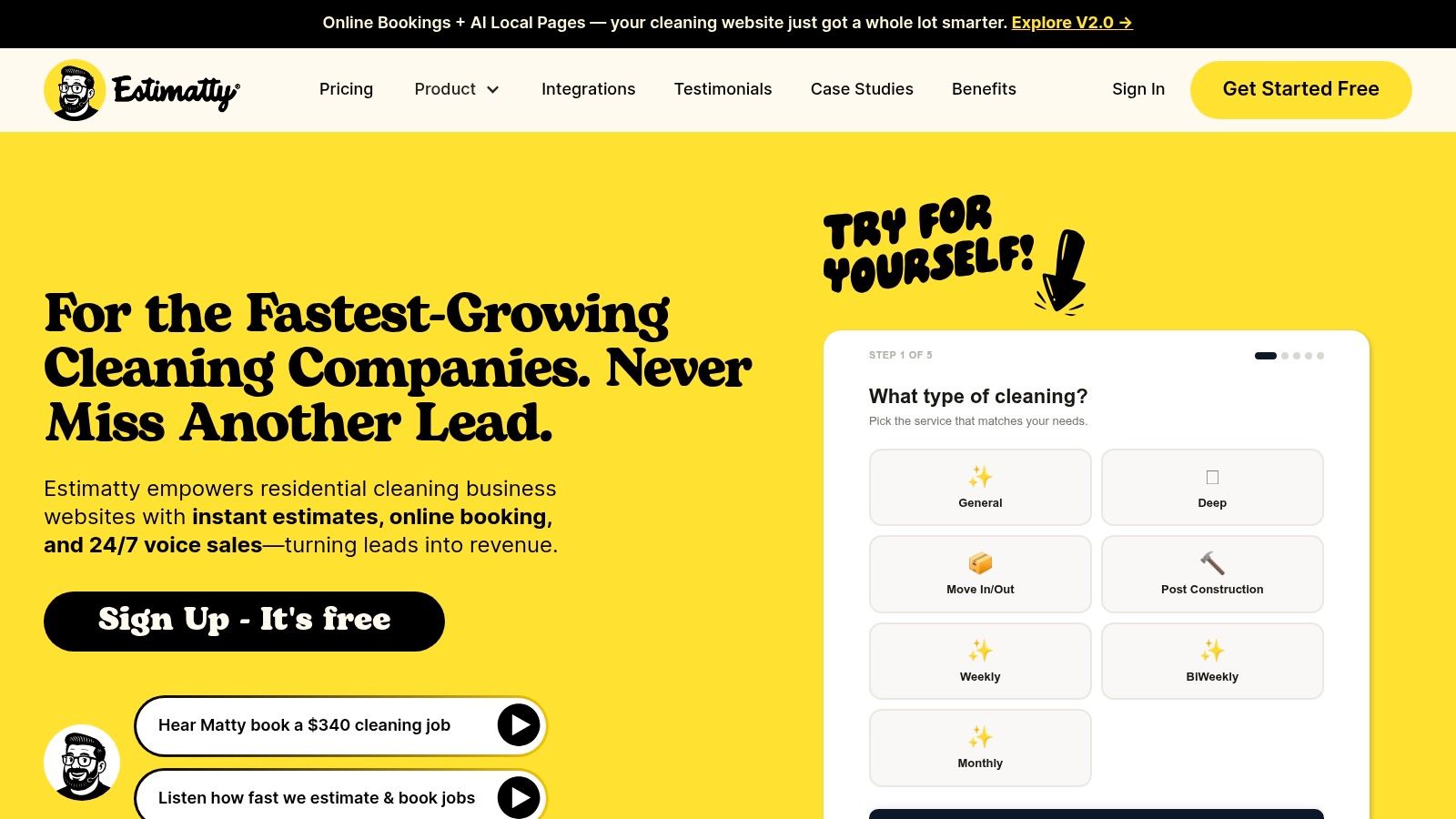
If you're ready to stop losing jobs to missed calls and slow estimates, take a look at Estimatty. It's built for residential and commercial cleaning companies that need instant web and voice intake, fast estimates, and a cleaner path from inquiry to booked job.