
September 21, 2026
Inside and Out Cleaning: A Practical Pricing Guide
Learn what inside and out cleaning really includes, how pricing works, and which add-ons actually pay off for residential and commercial estimates.

Monday, March 23, 2026
Unlock growth for your cleaning business with our guide to lead source tracking. Learn to identify your best leads, optimize spend, and book more jobs.

Lead source tracking is simply the process of figuring out how new customers found you. It’s about drawing a straight line from a specific marketing effort—whether it was a Google ad, a Facebook post, or that flyer you dropped off at the local coffee shop—directly to a paying client.

Let's be real—spending your hard-earned cash on marketing without knowing what actually works is one of the biggest stressors for any cleaning business owner. You’re running Google Ads, you're active on Facebook, maybe you even invested in some old-school local flyers. But can you confidently point to which one brings in the most profitable jobs?
This "spray and pray" approach is more than just frustrating; it's a direct leak in your revenue pipeline. You end up feeding money into a channel that brings you tire-kickers and price-shoppers, while a goldmine source sits underfunded. Without solid lead source tracking, even businesses that generate many new leads for specific services might just be throwing good money after bad.
The damage from not tracking your leads goes way beyond a bruised marketing budget. It cripples your ability to scale your business, forecast your income, and make smart strategic moves. In the hyper-competitive cleaning industry, a $61 billion market in the US alone, this kind of guesswork is a significant reason why so many businesses stagnate or fail.
The proof is in the numbers. A study of over 500 small cleaning operations revealed something huge: firms that used lead source reporting saw their qualified lead volume jump by 35% year-over-year. Even better, that led to a 28% direct increase in booked jobs. That’s a massive leg up on the competition you can’t afford to pass on.
When you don't track your leads, every dollar you spend on marketing is a gamble. When you do, every dollar becomes a calculated investment with a predictable return.
This is the whole game right here: shifting from gambling to investing. It's what allows you to confidently double down on what works and ruthlessly cut what doesn't, turning your marketing line item into a reliable growth engine. You can also dig deeper with our guide on estimatty.com/blog for more strategies.
Getting a lead tracking system in place isn't some complex, technical beast reserved for giant corporations. It's a completely practical solution that takes your strategy from being based on gut feelings to being driven by cold, hard data. The goal is simple: create a crystal-clear line of sight from every marketing dollar spent to the revenue it brings in.
Stick with me, and I’ll show you exactly how to:
Whether you're a one-person show or a growing brand with multiple teams, knowing where your best customers come from is the absolute key to unlocking predictable success. This is how you ensure every marketing dollar you spend becomes a smart investment in your company's future.
Tired of guessing which of your marketing dollars are actually turning into booked jobs? Let's build a system that gives you real answers. This isn't about becoming a tech wizard; it's about putting a simple, solid foundation in place for lead source tracking that any cleaning business owner can manage.
It all starts with getting organized. Before you even think about software, you need a clear and consistent way to label your marketing efforts. A straightforward campaign naming convention is the single most important habit to build. Think of it as giving every ad, flyer, and email a unique name tag so you can see exactly who's performing.
If you skip this, you’re left with a messy pile of data. "Facebook" or "Email" tells you almost nothing. Was it that new video ad? A boosted post? Your monthly newsletter? The goal is to look at any new lead and know its entire journey to your doorstep.
For anything you do online, UTM parameters are your new best friend. They're just little bits of code you tack onto the end of a URL. While they don’t change the webpage a person lands on, they secretly pass a ton of valuable information into your analytics.
Think of it this way: your website is the destination, and the UTM code is the turn-by-turn navigation history of how that visitor got there. It tells you:
You don't have to code this by hand. Google has a free Campaign URL Builder that makes it incredibly simple.
Here’s what that looks like in action. We're creating a link for a summer promotion we're running as a paid ad on Facebook.
See how we filled in the source, medium, and campaign? Now, when someone clicks this link from our ad, our analytics will credit the "facebook_cpc_summer_promo" campaign. That’s the kind of clarity you need.
The real power of lead tracking is in the details. Knowing a lead came from "Facebook" is one thing. Knowing it came from your "Summer Deep Clean Special" paid ad is how you actually make profitable decisions.
This is what turns raw data into business intelligence. Now you can see that your summer ad didn't just bring in 10 leads; it brought in 10 leads that turned into $5,000 in booked jobs. That’s a result you can take to the bank.
So, what happens when a lead doesn’t click a link? Your truck wraps, door hangers, and local print ads are working for you 24/7, but measuring their impact feels like a shot in the dark.
The answer is surprisingly simple: dedicated call tracking numbers.
By assigning a unique phone number to each offline campaign, you can finally connect calls to their source. Services that provide these numbers will show you exactly how many calls your vehicle wrap generated versus the flyers you dropped off at the local coffee shop. You're no longer guessing about the ROI on your offline spend.
Relying on your team to ask, "How did you hear about us?" is better than nothing, but it’s inconsistent. People forget, and customers often give vague answers. The best way to get accurate data is to capture it automatically the second a lead engages with your website.
This is done with hidden fields in your online forms. Your website visitors can't see them, but they're working in the background, grabbing those UTM parameters or other referral data from the visitor's session. When a prospect submits your form, that source data gets submitted right along with their contact info.
This is where the Estimatty booking widget shines as part of your tracking system. It’s built to automatically capture this source information. When a visitor who clicked your Google Ad gets an instant estimate, Estimatty snatches that "Google Ads" source data and permanently attaches it to their lead profile. No manual entry, no guesswork.
This automated capture ensures every single person who requests an estimate is tagged with their origin, and that data can then flow right into your other tools. If you're trying to figure out which systems to connect, our guide on the best CRM for cleaning businesses is a great place to start. Nailing this foundation of naming, tracking, and capturing is your first big step toward building a marketing machine that’s fully accountable.
Grabbing lead data is one thing, but making it actually work for you is where the magic happens. This is the part where you connect the dots between your marketing spend and your bank account, creating a single, undeniable source of truth for your business. It’s all about getting your software to talk to each other so you don't have to play middleman.
Think about it. A potential customer sees your Google Ad, clicks through, and gets an instant estimate from your Estimatty widget. Seconds later, all that rich lead data—including the specific utm_source and utm_campaign you so carefully created—lands in your CRM as a new contact. This isn't some far-off tech fantasy; it's what a well-integrated system does for you automatically.
This is how you finally kill the soul-crushing chore of manual data entry. Not only is it slow, but it's a breeding ground for mistakes that can completely throw off your numbers. When the data flows automatically, your lead source tracking is always accurate and up-to-date.
We can break down this whole setup into three core activities: naming your campaigns, tracking the interactions, and capturing the data.
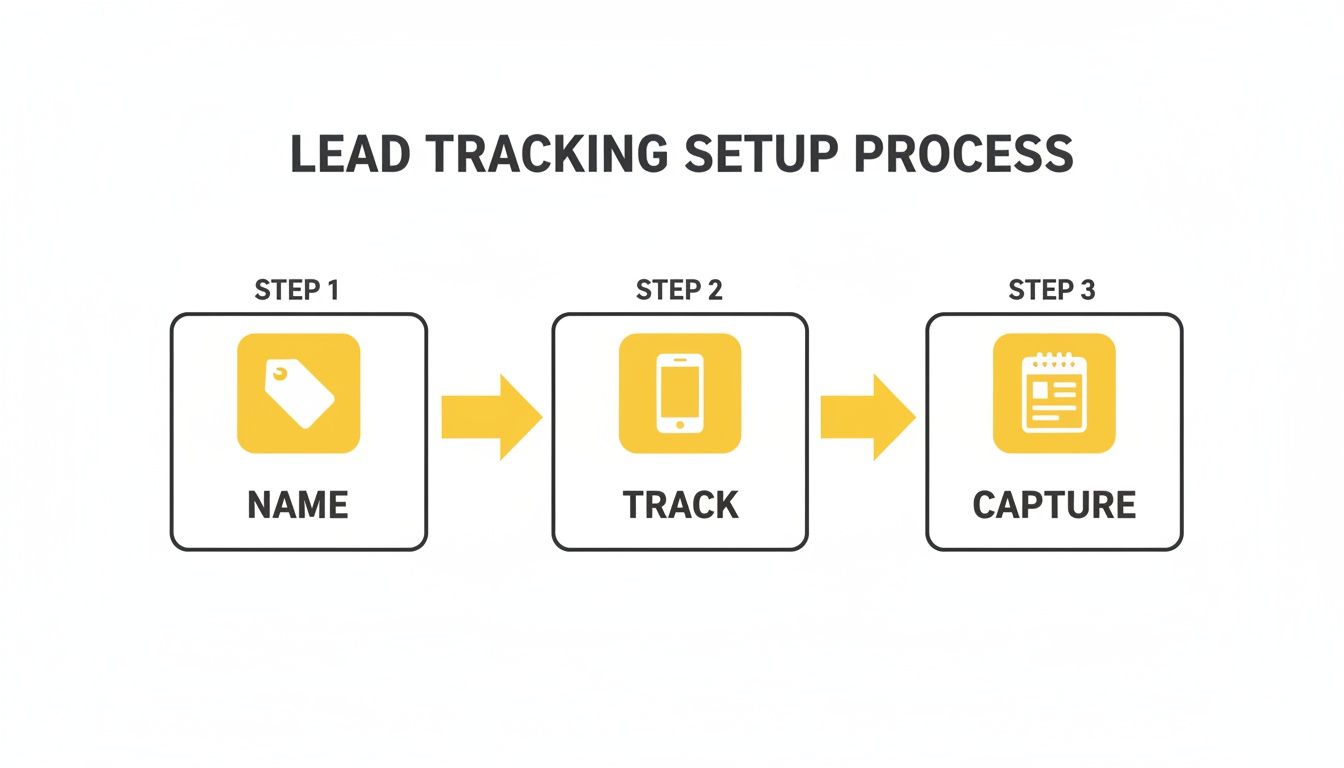
It really is that simple in principle. You need a consistent naming system, tools to do the tracking, and a way to get that information into your main system.
So, how do you actually build these bridges between your apps? For most cleaning businesses I've worked with, the hero is an automation tool like Zapier. Think of it as a universal translator for your software. It lets you create simple "Zaps"—automated workflows—that shuttle information from one place to another without any code.
Because Estimatty has a native Zapier integration, you can connect it to pretty much any CRM, email platform, or even a simple Google Sheet you might be using.
The possibilities are almost endless. Here are a few practical workflows I see business owners set up all the time:
And it's not just about web forms. To get a complete picture, you need to track phone calls, too. Integrating your phone system with your CRM is a huge step, a topic covered well in "Mastering CRM with VoIP Integration for Sales Success."
The secret to making these automations work perfectly is field mapping. It sounds technical, but it’s not. It's just you telling Zapier, "Hey, take this piece of information from Estimatty and put it in this specific box in my CRM."
For example, you'll map the utm_source field from Estimatty to the custom Lead Source field you created in your CRM. That’s it. Getting this right is what makes a lead source tracking system truly reliable.
The goal is to build a system where lead data flows effortlessly from the first touchpoint to your final sales report, giving you an unbroken chain of attribution for every single customer.
This is what separates the businesses that are just busy from the ones that are strategically growing. You can even create very specific connections, like the one we detail in our guide on Estimatty’s direct integration with Jobber. By taking a bit of time to set this up now, you're building a hands-off system that will pay you back with invaluable insights for years to come.
Alright, you've done the hard part. Your tracking system is up and running, collecting all that juicy data. But data is just noise until you use it to make smarter decisions. This is where the magic really happens—where you turn numbers on a screen into actual profit for your cleaning business.
The whole point of tracking is to finally get clear answers to your biggest questions. Which ads are actually working? Where should I spend my next marketing dollar? The answers are sitting right there in your reports. Let's dig in and find them.
It’s easy to get excited about a high volume of leads, but that can be a total vanity metric. A hundred leads that ghost you after the first email are worth less than one lead who books a recurring service. To really grow, you need to look deeper.
By pulling together the data from your CRM, Estimatty, and your call tracking software, you can finally see the complete picture.
Here are the numbers I look at every single month to see what's really driving revenue:
Once you start watching these metrics, you stop thinking of marketing as an expense. It becomes an investment. You're no longer just spending money; you're strategically putting it where you know you'll get the best return.
You don't need fancy, expensive software to get started. Honestly, a simple spreadsheet or a basic dashboard in your CRM is more than enough to give you the clarity you need.
Let's walk through a sample report. This is the kind of data that should guide your marketing meetings and budget decisions.
This table shows a sample comparison of different lead sources, highlighting key metrics to track for making informed marketing decisions.
| Lead Source | Leads This Month | Conversion Rate (to Booked Job) | Average Job Value | Total Revenue |
|---|---|---|---|---|
| Google Ads | 45 | 18% | $350 | $2,835 |
| Google Business Profile | 32 | 41% | $425 | $5,576 |
| Facebook Ads | 60 | 9% | $250 | $1,350 |
| Customer Referrals | 12 | 58% | $550 | $3,828 |
See the story the data is telling? Facebook Ads brought in the most leads (60), but it was your worst performer for actual revenue. Meanwhile, your Google Business Profile (your free local listing!) brought in fewer leads but generated nearly 4x the revenue with a killer 41% conversion rate.
This immediately tells you to double down on what’s working. Why is your Google profile performing so well? How can you get even more out of it? Maybe it’s time to pull some of that budget from Facebook and invest it in your local SEO.
Time and time again, the data proves that not all leads are created equal. For cleaning companies, some channels just naturally attract people who have their credit card out and are ready to book a cleaning today.
In fact, for most service businesses, Google Search and Local SEO are the undisputed champs, accounting for 55-65% of all estimate requests in major U.S. markets. We've seen cleaning companies in the top 3 of Google's local pack get 42% of their total leads from these organic spots alone, converting at an incredible 40-50% rate.
This is exactly why Estimatty was built to capitalize on that traffic. It instantly attributes those high-value website visitors and gives them an AI-powered estimate in under a minute—locking in the lead before they can click away. We've seen this single change boost qualified leads by 35% for our users.
By focusing your time and budget on high-performing sources like organic search and referrals, you're not just getting more leads—you're getting better leads that convert faster and pay you more.
This is the cycle of smart growth. You set up the system, you connect the data, and now you're turning that information into real-world business intelligence. For more ideas on how to improve your website's booking engine, check out our guide on the best conversion rate optimization tools. Your next step is to use these insights to fine-tune your marketing machine for maximum profit.
Figuring out where your best leads come from is a huge first step. But the real money is made when you take that knowledge and use it to dominate your local market. Once your lead source tracking data points you to the goldmines, it’s time to grab a shovel and start digging.
This isn’t about chasing some new, shiny marketing trend. It’s about taking what already works—the channels that consistently deliver high-quality leads—and making them even better. It’s about doubling down on your winners to create a predictable flow of profitable jobs.
For most cleaning businesses, referrals are the undisputed king of lead quality. These folks arrive ready to buy, already trust you, and are way less likely to haggle on price. The question is, are you actively generating them, or just passively hoping they trickle in?
Referrals are the gold standard, often converting at rates up to 60% higher than leads from other channels. In a study of 300 US-based cleaning companies, those who diligently tracked referrals saw a 52% jump in repeat business referrals over 18 months. On average, each happy client referred 3.2 new prospects. You can find more details on these powerful lead sources for cleaning businesses.
To turn this from a passive source into a proactive sales machine, you need a formal referral program.
When you systematize this, you essentially turn your happiest customers into a highly motivated, commission-based sales team that works for you 24/7.
Your tracking data is more than just numbers; it’s a content roadmap. If you see that your most profitable jobs come from people Googling "deep cleaning services for move-outs," that’s a huge clue. It's telling you exactly what to do next.
Start creating content around that exact topic. Write a blog post about your move-out cleaning checklist. Film a short video showing your team in action. Build a dedicated service page on your website that answers every possible question a person might have about move-out cleaning.
Each piece of content you create around a proven, high-value keyword strengthens your authority and pulls in more of the exact customers you want. It's a much smarter approach than creating generic content and just hoping for the best. And if you're putting money into paid ads, our guide on Google Ads for cleaning businesses can help you laser-focus your keyword targeting.
Your lead source data is your ultimate guide to what your best customers are searching for. Stop guessing what content to create and let your own sales data tell you what works.
Not all leads are created equal. A prospect who just filled out your Estimatty widget after searching "emergency cleaning service" is a hot lead with a burning problem. They need a different approach than someone who downloaded your free spring-cleaning checklist.
Use your lead source data to create different follow-up cadences.
This tailored approach means your team spends its valuable time on the leads most likely to close today, while still building a pipeline of future customers.
Finally, remember that good marketing creates a demand that your operations have to meet. As you successfully scale up your best channels, you’ll need a solid team to handle the new work. Optimizing your hiring with a service like pipehirehrm.com ensures you have qualified cleaners ready to go, so you don't become the bottleneck to your own success. You can also visit get.pipehirehrm.com/blog for more great articles on hiring.
Even with the best plan, diving into lead source tracking can feel a little intimidating. Let's walk through some of the most common questions I hear from cleaning business owners, so you can get started with total confidence.
That’s a common worry, but honestly, it’s not. You don't have to boil the ocean on day one.
The simplest, most powerful first step? Just start asking every single person who calls, "How did you hear about us?" Seriously. Log their answers in a basic spreadsheet. This one small change is a massive leap forward from flying blind.
When you're ready to track your website, tools are built to handle the heavy lifting. An AI-powered estimator like Estimatty can automatically grab the source data from every visitor who requests an estimate. The key is just to begin. Even the most basic tracking will give you more clarity than you have now and start shaping smarter marketing decisions right away.
You’ll start collecting data the second you flip the switch. But the real magic—the actionable patterns you can bet your budget on—starts to show up after about one to three months. That's usually enough time to get a steady flow of leads and see a clear, reliable picture emerge.
After a couple of months, you might discover your Google Business Profile generates more booked jobs than your Facebook page. This isn't just interesting data; it's a bright, flashing sign telling you exactly where to invest your time and money for the best return.
Great question. Think of it this way: Google Analytics gives you the big-picture view. It tells you where your website traffic came from in broad strokes, like Google search, social media, or another website. It’s the "channel."
UTM parameters, on the other hand, are your magnifying glass. They give you the granular, nitty-gritty details within those channels. They let you track a specific ad, a particular email, or even an individual link. For instance, you can see if a new job came from your 'Summer 2026 Promo Email' or from the link in your general monthly newsletter. That deep-dive data is what helps you figure out which marketing efforts are actually bringing in revenue, not just clicks.
You have to track these! Referrals are often your absolute best leads, so you can't afford to leave them to chance.
The easiest method is to train your team—whether it's you or your office admin—to always ask new clients, “Who can we thank for sending you our way?” Then, make sure that information gets recorded in your CRM every single time. Consistency is everything.
For a more hands-off approach, you can set up a unique referral link or a special discount code for your happy customers to share. When a new prospect clicks that link to get an estimate on your site, the source is tracked automatically. This does more than just measure the impact of your biggest fans; it makes it easy to reward them, which will only encourage more referrals.
Ready to stop guessing and start growing? Estimatty not only delivers instant, accurate estimates to your customers 24/7 but also automatically captures lead source data, giving you the clarity you need to scale your cleaning business. See how it works.