October 13, 2026
Squeaky Clean Window Cleaning: The Pro Technique
Master squeaky clean window cleaning with this step-by-step guide. Learn the tools, techniques, and safety tips pros use for streak-free windows every time.

Monday, July 13, 2026
Stop guessing your post construction cleaning pricing. Learn our step-by-step framework to create profitable, consistent estimates for any job size.

Residential post construction cleaning pricing usually lands at $0.15 to $0.60 per square foot. For a typical 1,500 to 2,500 square foot home, most homeowners pay $300 to $800.
That answer helps, but it doesn't solve the main problem most cleaning owners are dealing with. You're standing in a half-finished property, one trade is still inside, windows are stickered up, dust is everywhere, and someone wants a number fast. If you price by instinct, you'll undercharge one job, overprice the next, and train your team to make the same mistake.
Profitable post construction cleaning pricing comes from a repeatable estimating system, not from having “good instincts.” The strongest operators don't just know what to charge. They know how to break the job into phases, how to calculate labor pressure, how to protect margins when the site isn't ready, and how to standardize estimates so every lead gets the same logic every time.
A superintendent calls at 4:30 and wants a number before the end of the day. The house looks almost done. Floors are in, paint is fresh, and the cabinets are installed. Then your crew arrives and finds stickers baked onto glass, drywall dust packed into vents, trades still working, and no dumpster space for debris. That estimate can go bad fast.
Post-construction jobs go sideways when they get priced like regular house cleanings. Square footage helps, but it does not control labor by itself. Profit gets decided by site readiness, scope boundaries, return trips, surface condition, and how clearly your team defines what is included before the job starts.
The common residential price ranges give owners a rough frame of reference. They do not give you a quoting system. A profitable estimate needs the same inputs every time, entered in the same order, with the same labor rules behind them. Without that structure, two people on your team will price the same site two different ways, and one of them will be wrong.
I see the same pricing mistakes over and over because they come from the same habit. Someone walks the site, makes a fast judgment, and throws out a number before the scope is controlled.
That usually shows up as:
Practical rule: If your estimator cannot explain the labor hours behind the price in two minutes, the number is still a guess.
That problem hurts in both directions. Underbidding cuts margin. Overbidding costs you the job, even when your company could have won it with a tighter scope and better phase breakdown.
A stronger system fixes both. It standardizes the site walk, defines each cost bucket, assigns labor assumptions by task, and turns exceptions into add-ons instead of surprises. If your current process still depends on memory and handwritten notes, tighten up how you build cleaning service estimates before you try to increase sales volume.
Treat post-construction estimating like an operating procedure, not a judgment call.
Start with a fixed inspection checklist. Separate the work by cleaning phase. Assign labor targets to each phase. Add clear rules for glass, adhesives, floor protection removal, high dusting, appliance interiors, and touch-up returns. Then build approval checkpoints for site readiness, change orders, and after-hours access.
That is how chaotic bids become consistent quotes. It also gives you something better than a price. It gives you a repeatable system your office can train, your sales team can follow, and your crews can deliver profitably.
A superintendent calls and says, “We just need a post-construction clean.” That phrase sounds simple until you walk the site and find three different jobs hiding inside one scope. There is debris removal, there is detailed finish cleaning, and there is the return trip after other trades leave fingerprints, dust, and fresh damage behind.
That is why I price post-construction work in phases first, then build labor around each phase. It gives the office a standard way to quote, gives the crew a clear scope, and keeps the builder from treating a touch-up return like free warranty work.
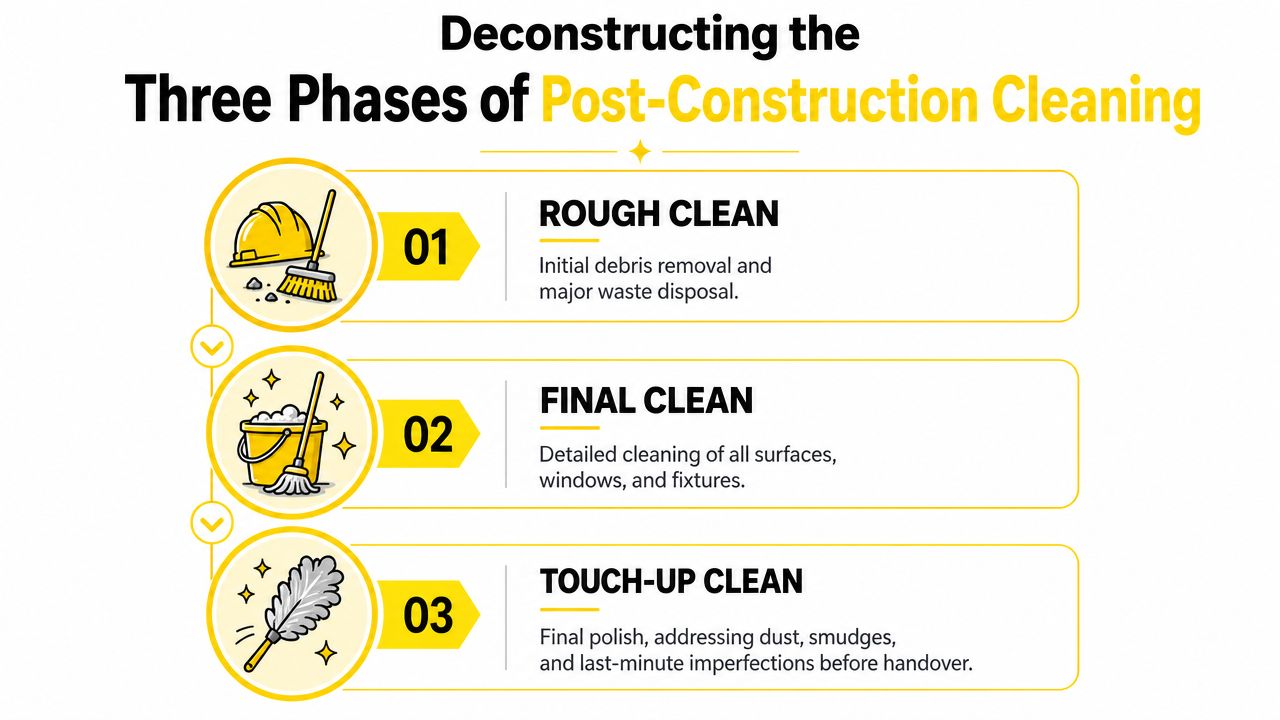
Rough clean clears the site for the next step. The goal is access, safety, and removal of the heavy mess that slows every trade behind you.
Typical scope includes:
Production can be fast on an open commercial shell. It can also stall fast in a custom home with stairs, narrow rooms, protected flooring, and trim everywhere. That is the trade-off estimators miss when they use one blanket rate.
I treat rough clean like a production phase. The estimate should answer three questions: how much debris is leaving the site, how much square footage needs first-pass dust removal, and what access limits slow the crew down. If your team prices rough clean without those three checks, labor drifts early.
Final clean is detail work on finished surfaces. This phase usually decides whether the job makes money.
Scope often includes:
This phase needs a different crew pace than rough clean. Detail cleaning slows down around glass, stickers, paint specks, grout haze, and delicate finishes. The labor target has to reflect that. A square-foot number by itself will not catch the extra time hiding in window grids, closet shelving, or adhesive removal.
For consistency, build final clean estimates from task groups, not memory. Assign labor assumptions for glass, bathrooms, kitchens, floor finish type, and high dusting. Then verify those assumptions against your cleaning labor cost per hour formula so the quote still holds when wages, burden, and crew mix change.
Touch-up clean is a separate visit, not a favor.
It happens after final clean, near punch list, inspection, or handover. Other trades come back. Floor protection gets pulled. Dust settles again. Smudges show up on glass and stainless. Someone patches a wall after your crew already finished the room.
Sloppy estimating gives profit back to the jobsite. Price touch-up as its own phase, with its own dispatch minimum, labor minimum, and scope limit. If the builder wants more than dust, prints, and light debris correction, write a change order.
If you need a market reference point while building your phase matrix, review average post-construction cleaning rates and then compare them against your actual production speed, not just local averages.
Phased pricing does more than make the quote easier to read. It creates an operating system for the job.
First, the client sees exactly what is included in each visit. That cuts down the usual argument over whether sticker removal, inside cabinets, floor protection pickup, or return trips were part of the original price.
Second, scheduling gets cleaner. Rough clean can go to a production crew. Final clean goes to detail techs. Touch-up gets booked with a short-duration return window and a tighter scope. That crew planning matters because the labor profile is different in each phase.
Third, your estimate becomes easier to standardize and automate. Each phase gets its own checklist, labor assumptions, exclusions, and approval rules. Once that framework is built, your team stops quoting from memory and starts quoting from a repeatable template that scales.
A superintendent calls at 4:30 p.m. The painters are wrapping up, the glass still has stickers on it, and he wants a number before morning. Estimators who price that job from memory usually miss the same things every time. Return visits, labor mix, site friction, and the difference between a rough production crew and a final-clean detail crew.
Profitable estimating starts with one rule. Every job goes through the same math, in the same order.
Base labor hours x loaded labor rate + supplies + site overhead + risk reserve = internal job cost
Internal job cost x target gross margin = selling price
That formula does two things a square-foot shortcut cannot do by itself. It shows whether the job is worth taking, and it gives your team a repeatable framework they can standardize in a worksheet, quoting tool, or CRM.
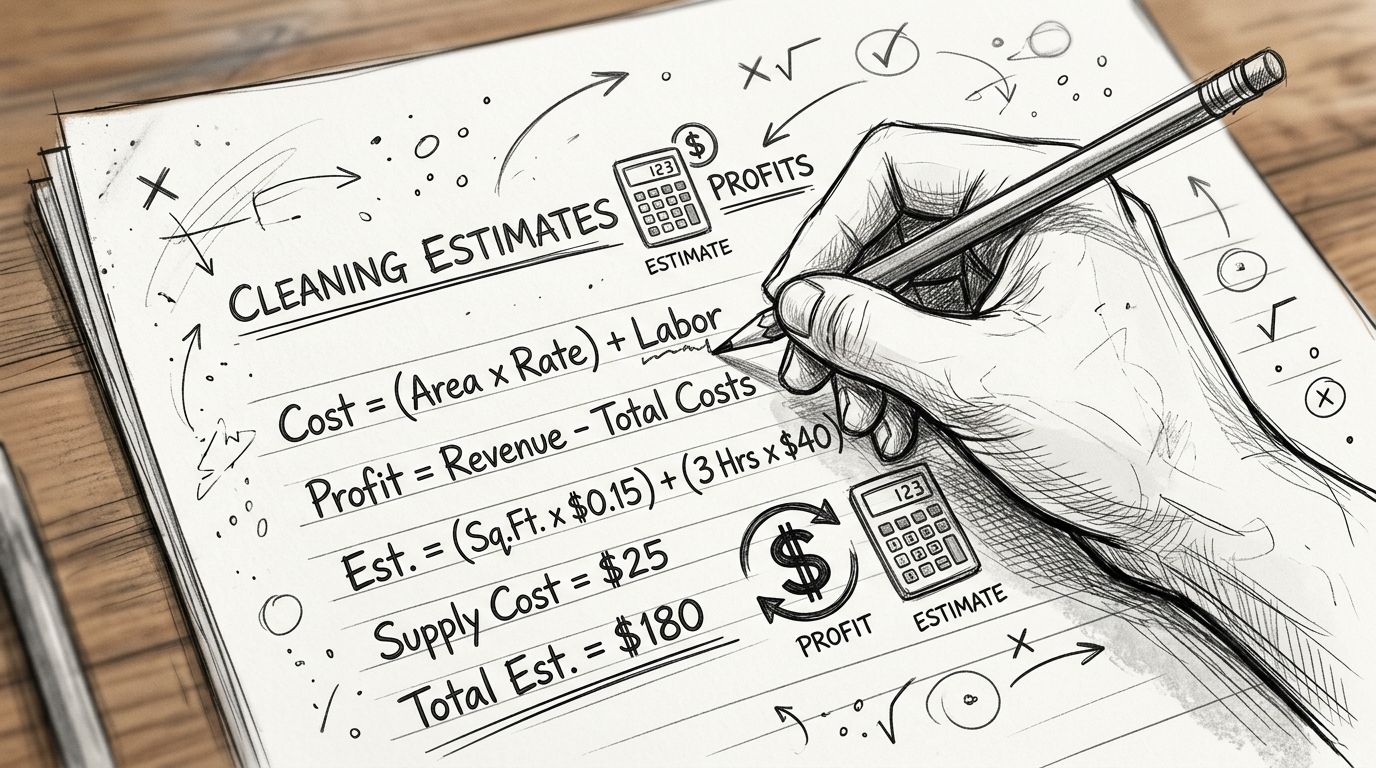
Square footage is a pricing wrapper. Production is the engine underneath it.
Start by assigning expected labor hours to the actual scope. How many labor hours will rough clean take? How many for final? Is touch-up a two-hour return with a two-person minimum, or a half-day dispatch because access is slow and the builder wants three punch items handled in different areas?
Once those hours are realistic, multiply them by your loaded labor rate, not just hourly pay. Payroll tax, workers' comp, supervision, callbacks, and idle time all belong in that number. If your team has never broken that out properly, this guide on how to calculate labor cost per hour will help tighten the labor side of your estimate.
After labor, add the costs that get forgotten during rushed bidding:
That gives you your internal job cost. Margin gets added after that, not guessed somewhere in the middle.
Estimating should work like an intake system, not a creative exercise. I want every estimator answering the same questions in the same order so prices stop bouncing around based on who picked up the phone.
| Estimate input | What to record |
|---|---|
| Cleanable area | Square footage that will actually be cleaned |
| Phase package | Rough, final, touch-up, or a bundled scope |
| Production rate | Expected sq ft or task volume per labor hour |
| Crew mix | Lead techs, detail cleaners, helpers |
| Site readiness | Percent complete, active trades, punch status |
| Detail load | Glass, stickers, adhesive, cabinet interiors, trim detail |
| Access friction | Stairs, elevators, parking, lockbox, loading distance |
| Risk items | Floor protection removal, debris haul-off, return visits |
This is the framework that makes automation possible. Once those fields are fixed, you can attach labor assumptions, minimum charges, exclusions, and approval rules to each one. That turns a chaotic bid desk into a system.
Clients usually want a square-foot number because it is easy to compare. Your company needs the labor-backed version behind it.
A practical workflow looks like this:
If your labor-based selling price lands far outside your normal range, stop and diagnose the reason. The site may have heavy glass detail, poor readiness, limited access, or a scope gap that needs a change order before you quote.
For calibration only, compare your numbers against published average post-construction cleaning rates. Then return to your own production data. Market averages help you sanity-check. They do not protect margin on a difficult site.
Hourly pricing works for undefined punch work, warranty callbacks, and small return visits with an uncertain scope. It creates problems on full post-construction cleans because it shifts the conversation toward speed instead of scope, access, and finish level.
For larger jobs, sell a defined scope at a fixed price and keep the hourly math internal. For small touch-up or micro-scope work, use an hourly method with a dispatch minimum, a labor minimum, and written limits on what is included.
Here's another habit that improves both close rates and field execution. Build two versions of every estimate:
That separation matters. Sales needs a clean proposal. Operations needs the job-costing detail that keeps the work profitable.
A quick visual walkthrough can also help when training office staff on how to think through job costing before they talk numbers:
A formula is only as good as the production assumptions behind it. If one crew closes finals cleanly and another misses details, your estimate model has to reflect that difference. Otherwise your office sells one version of the job and your field team delivers another.
That is why estimating, staffing, and quality control need to share the same operating assumptions. Keep crew roles, expected production rates, and common failure points documented in one place. Estimators should price from that playbook, not from memory and not from whatever happened on the last bid.
A 2,000 square foot job can beat up your margin faster than a 10,000 square foot job if the smaller site has stickered glass, paint on hardware, floor protection still down, and a superintendent who calls for three return visits. That is why I do not let size set the price by itself. Size gives you a starting point. Type, finish level, access, and phase count determine whether the job pays.
The goal is not to memorize market ranges. The goal is to turn job type into a repeatable estimate model your office can use the same way every time.
A clean estimating system groups post-construction work into production classes. That keeps sales from treating every project like a one-off.
Sample Post-Construction Cleaning Estimate Ranges (2026)
| Job Type | Typical Square Footage | Average Price Range ($/sq ft) |
|---|---|---|
| Residential post-construction interior | 1,500 to 2,500 sq ft | $0.15 to $0.60 |
| Commercial post-construction interior | Varies | $0.20 to $0.80 |
| Rough clean phase | Varies | $0.10 to $0.30 |
| Final clean phase | Varies | $0.30 to $0.75 |
| Touch-up clean phase | Varies | $0.10 to $0.20 |
Use a table like this as a screening tool, not a final price sheet. If the site fits the baseline assumptions, the range holds. If it has premium finishes, active trades, heavy glass, or tight turnover timing, move it into a different production class and rebuild the labor.
Here is the practical breakdown I use:
That classification step matters more than the raw square footage.
Residential jobs usually price tighter when the finish level is predictable. Commercial jobs spread wider because layouts, debris load, and access vary more. A small storefront with glass, partitions, millwork, and restroom detail can take longer than a larger empty suite.
The fix is simple. Standardize what changes.
For each estimate template, set these fields before sales puts out a number:
Once those fields are locked in, size becomes one input instead of the whole pricing method.
On bigger sites, a single square foot number starts hiding the detailed work involved. Industry guidance from the Building Service Contractors Association International points operators toward task-based production standards and job costing methods for larger commercial cleaning scopes, rather than relying on one flat blended rate across every task and area. BSCAI's operations and estimating resources are useful here because they reflect how contractors build labor plans for commercial work.
The same principle shows up on high-end residential work. Case studies from established restoration and specialty cleaning contractors regularly show that large custom homes and complex commercial facilities are priced in stages, crews, and specialty tasks, not with one generic per-square-foot figure. That matches field reality. Glass, detailed millwork, floor finish protection removal, and return touch-ups do not scale at the same rate.
So for larger projects, break the estimate into parts:
That structure gives your office a cleaner estimate and gives operations a job plan they can staff.
If you want consistency, stop writing post-construction estimates from scratch.
Create one template for each of these common categories:
Each template should include default production assumptions, standard exclusions, phase options, and upgrade line items. Then your estimator only adjusts the variables that truly changed on that site.
For commercial teams building that process out, this guide on how to price a commercial cleaning job without guessing lays out a practical structure for turning field conditions into consistent estimate logic.
The companies that stay profitable in post-construction do not just know the going rate. They know which job type they are looking at, which production template applies, and where the estimate needs to split into separate labor buckets. That is how chaotic bids turn into a system you can train, audit, and scale.
Most bad post-construction jobs weren't bad at the estimate stage because the rate was too low. They went bad because the scope moved after the estimate was approved.
That usually happens when trades are still active, access changes, handover dates slide, or the client treats touch-up work like it was included all along. If your pricing doesn't account for that, your crew ends up subsidizing someone else's schedule problem.
A common pricing pitfall is underestimating labor hours due to construction chaos, where cleaners wait for contractors to finish, leading to an average 15% margin erosion if that time isn't billed. Benchmarks also suggest adding a 10% to 15% contingency margin to initial estimates, based on this operator discussion of large post-construction pricing.

Three habits matter more than anything else:
Field note: The fastest way to lose money on a construction clean is to let “while you're here” become part of the original estimate.
It also helps to tighten your internal accounting. If you can't see where labor hours drifted or which add-ons produced margin, you can't improve the next estimate. Consequently, disciplined cleaning business accounting stops being back-office work and starts protecting sales quality.
The cleanest way to increase ticket value is to offer services that fit naturally with turnover timing.
Consider these add-ons when they match the site:
The key is operational fit. Upsells work when they solve a handover problem the builder already has. They fail when they're bolted onto the estimate without a clear reason.
A builder calls at 7:40 p.m. and needs a price before the superintendent leaves the site. If your estimator has to hunt through old proposals, text a crew lead, and rebuild the quote by memory, you are not running a pricing system. You are gambling with margin.
Manual estimating holds up for a while. Then lead volume rises, office staff starts quoting, and every estimator prices the same scope a little differently. That is where profit starts leaking. One rep charges for debris haul-off. Another folds it in. One includes a return touch-up. Another forgets to ask. The problem is not speed alone. The problem is uncontrolled variation.
Automation fixes that only if the rules underneath it are sound.
A useful estimating setup should do five jobs every time:
That is the difference between a real sales system and a prettier contact form.

The biggest gain is consistency. Contractors and property managers notice when your team asks better questions and sends estimates with clear line items, exclusions, and phase options. They also notice when one person quotes one number and the next person quotes another for the same scope.
That consistency sharpens sales management too. If every estimate follows the same structure, you can see which lead sources produce approved jobs, which job types carry healthy margins, and where close rates fall apart. If you are buying leads or spending on outreach, understanding your marketing CPA helps connect ad spend to booked revenue instead of treating marketing as a separate bucket.
For companies ready to standardize this, Estimatty's pricebook system for cleaning estimates gives you a practical way to build your own pricing logic into a repeatable workflow. You can define phase rules, labor assumptions, add-ons, and exclusions once, then let staff quote from the same playbook instead of rebuilding each bid from scratch.
That is how post-construction estimating becomes scalable. The goal is not to send quotes faster for the sake of speed. The goal is to make every quote easier to audit, easier to train, and easier to profit from.
If you want a faster, more consistent way to deliver post-construction cleaning estimates, Estimatty can turn your pricing rules into a 24/7 sales estimator for web and phone leads. It helps cleaning companies standardize estimates, capture scope details instantly, and respond while the lead is still ready to book.