September 21, 2026
Inside and Out Cleaning: A Practical Pricing Guide
Learn what inside and out cleaning really includes, how pricing works, and which add-ons actually pay off for residential and commercial estimates.

Sunday, June 28, 2026
Learn how to calculate labor cost per hour for your cleaning business. Get a step-by-step guide covering wages, taxes, & non-billable time for accurate
.png)
You're probably in one of two spots right now. Either you're setting prices for residential cleaning jobs and wondering why the bank balance still feels tight, or you've hired help and realized the hourly wage on payroll doesn't match what that cleaner costs your business.
That gap is where a lot of home cleaning companies get hurt.
When owners first learn how to calculate labor cost per hour, they usually start with the paycheck. That's understandable, but it's incomplete. In residential cleaning, the primary oversight usually isn't just taxes or insurance. It's the non-productive time between homes, the setup before the first job, the daily restocking, and the paid hours that never become billable cleaning time.
If you don't account for that, your estimates look fine on paper and still lose money in real life.
If you only use a cleaner's hourly wage, you're pricing blind. The wage is the visible part. The rest sits in payroll reports, insurance bills, supply orders, admin time, and little expenses that feel harmless until they stack up across a full schedule.
For a residential cleaning business, labor cost per hour starts with direct pay and then expands into everything you spend to keep that cleaner ready, legal, equipped, and on the road to the next home.
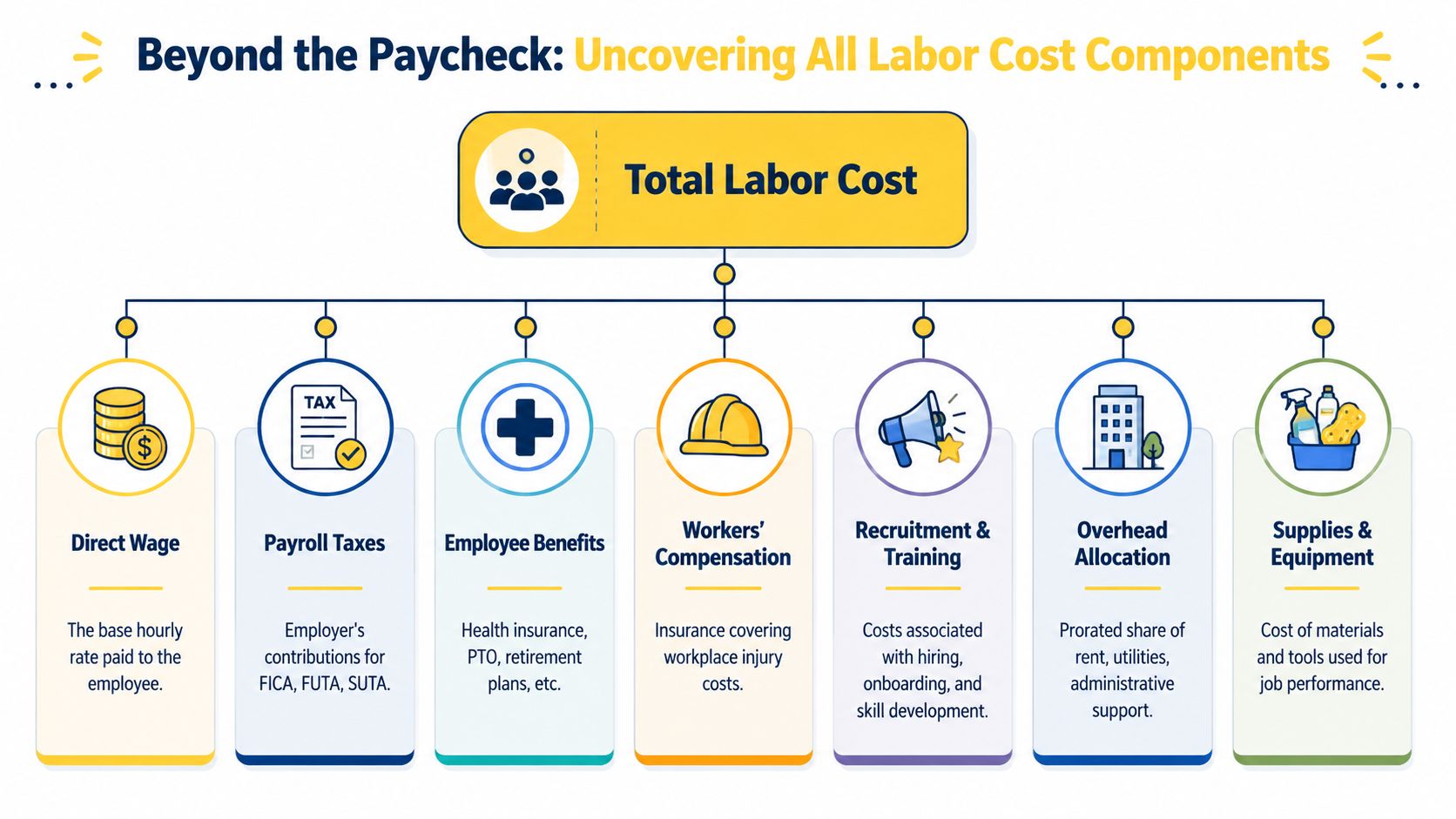
Here's the short version. If the cleaner can't do the job without it, or you wouldn't incur it without employing that person, it deserves review.
Practical rule: If you leave out a cost because it feels small, check how often it happens. Repeated small costs distort pricing faster than one large bill.
In residential cleaning, people often remember taxes and forget the daily support costs. They price labor like the cleaner magically appears at the front door with a full caddy, clean uniforms, a working vacuum, and no setup time.
That's not how the day works.
A useful next step is to separate what belongs in labor burden versus broader business overhead. If you need help drawing that line, this guide on how to calculate overhead costs is worth reading alongside your labor review.
Don't average everything too early. One cleaner may have a different wage, a different insurance classification, different supply usage, or more paid training time than another. Build the cost by employee first. You can group people later if their roles are truly similar.
That discipline matters because residential cleaning businesses often grow unevenly. One veteran lead cleaner and one brand-new hire shouldn't automatically carry the same labor assumptions.
Once you've gathered the components, stop thinking hourly for a moment. Put everything into an annual labor cost for one employee. That gives you a cleaner, more honest starting point.
Most pricing mistakes happen because owners jump straight from wage to estimate. They skip the annual rollup, and then they never see the full investment attached to each cleaner.
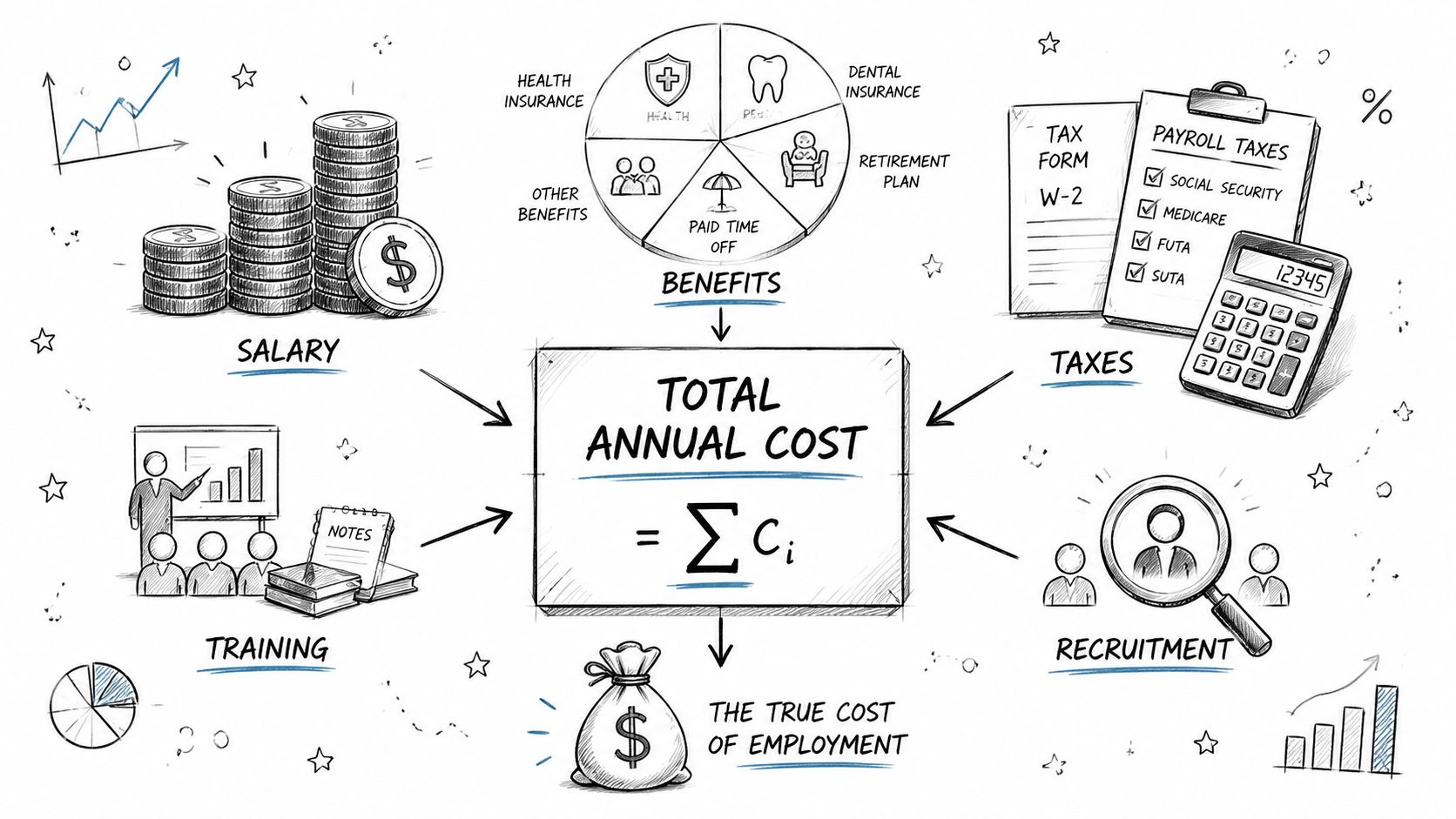
Take a single cleaner and total up every labor-related cost you expect over a year.
A simple framework looks like this:
If your bookkeeping is messy, don't wait for perfect records before you begin. Use your best documented estimates, then tighten them over time. Clean systems beat perfect intentions.
Annual math forces you to include costs that don't show up every pay period. Hiring costs don't happen weekly. Uniform replacement doesn't happen every Friday. Training may spike at onboarding and then taper off.
When you zoom out to a full year, those costs stop hiding.
A cleaner can be affordable on payroll and expensive in practice. The annual view exposes that difference fast.
If you need a second lens for organizing support costs around your operation, this resource on formulas for calculating OpEx can help you sort what belongs in operating expenses versus direct labor support. For residential cleaning owners who want to tie the math back to bookkeeping, this article on cleaning business accounting is a useful companion.
Do this per cleaner before you create team averages. A solo operator with one employee can still do this well in a spreadsheet. Larger teams may want separate templates for lead cleaners, regular cleaners, and trainees.
The goal is simple. You want one all-in annual cost per person before that person cleans a single home.
Consequently, most residential cleaning companies underprice their work.
They take the annual labor cost and divide it by standard paid hours. On paper that looks neat. In the field it falls apart, because home cleaning is full of paid time that doesn't become direct client cleaning time.
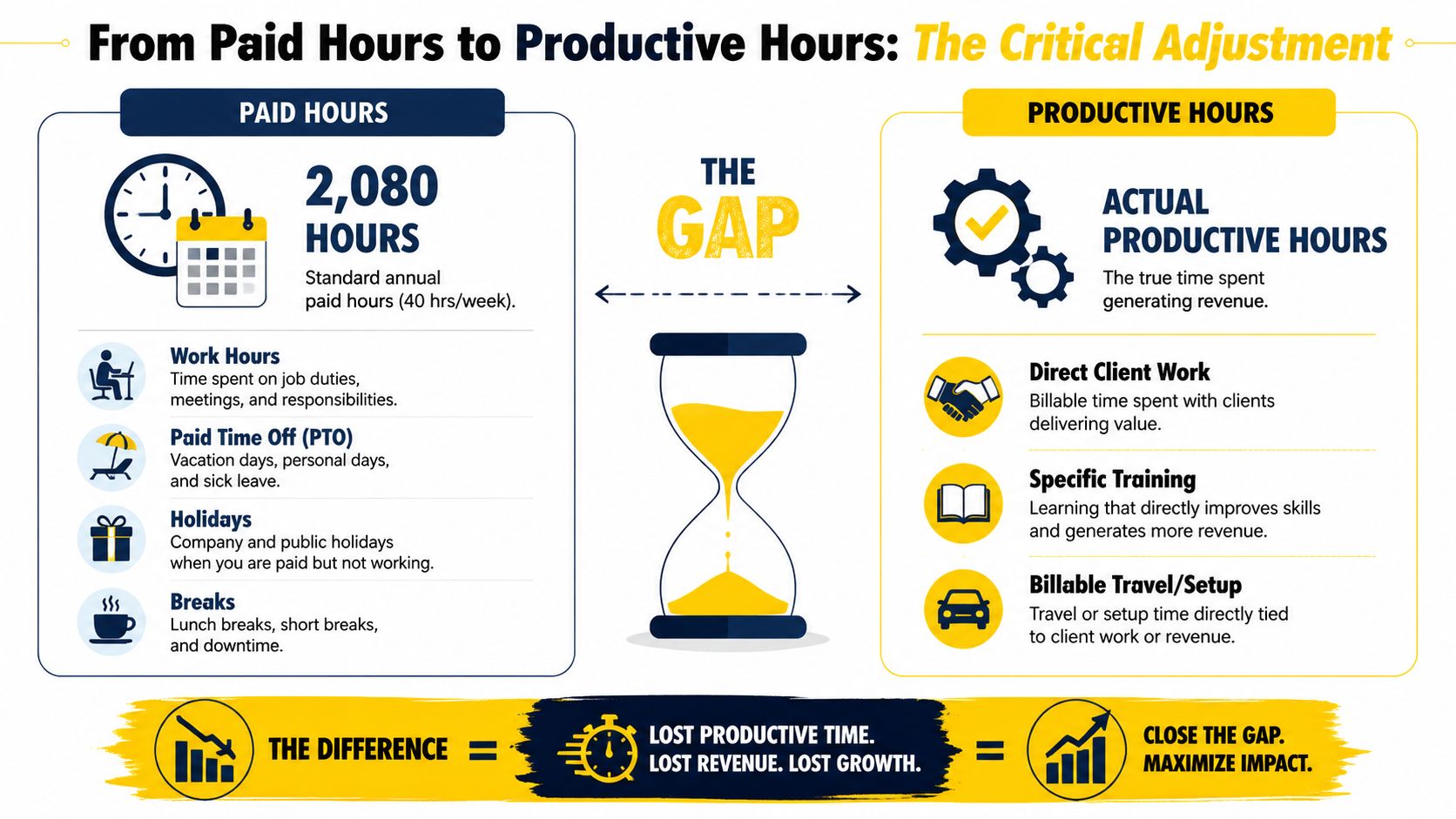
Your cleaner may be on the clock while doing any of the following:
None of that is fake time. You're paying for it. But it's not the same as hands-on productive cleaning inside a client's home.
That difference is the core of how to calculate labor cost per hour accurately for residential service.
Instead of dividing by paid hours, divide by productive hours. In a home cleaning business, productive hours are the hours that generate service value tied to a client job.
For most owners, the cleanest way to estimate productive hours is to start with paid working time, then subtract the categories that regularly remove a cleaner from direct revenue work.
Look at:
If your team is paid for a full day but only part of that day is direct cleaning, your true labor cost per productive hour is higher than your payroll math suggests.
Commercial contracts sometimes have long, continuous shifts in one location. Residential cleaning usually doesn't. The day gets chopped into addresses, traffic, lockouts, pet notes, key handling, laddering around family schedules, and small reset windows that eat time.
That's why house cleaning owners can't borrow labor formulas from other industries without adjusting them.
If you want the clearest picture, pair payroll data with time tracking so you can see where paid hours go. This guide to time and attendance software is useful if you're still relying on memory, text messages, or handwritten route notes.
A few habits cause repeated underpricing:
| Habit | Why it fails |
|---|---|
| Using scheduled hours as productive hours | Schedules assume smooth days. Residential routes rarely run that cleanly. |
| Ignoring travel because clients “expect it” | Client expectations don't pay payroll. Your estimate still has to cover the cost. |
| Averaging the whole team into one neat number | Strong routes and weak routes get blended, so weak profitability stays hidden. |
The cleaner way is to accept the messiness, track it accurately, and price from reality.
Let's make this practical with a fictional cleaner named Maria. She works in residential homes only. She's reliable, good with recurring clients, and fast enough that you're tempted to think her wage tells the whole story.
It doesn't.
The point of this example isn't the exact figures. Your numbers will differ. The point is the sequence. Build the annual cost first, then reduce paid time down to productive time, then divide.
| Item | Calculation | Result |
|---|---|---|
| Base pay | Maria's hourly wage x her annual paid hours | Annual gross wages |
| Payroll taxes | Employer payroll tax costs assigned to Maria | Annual payroll tax cost |
| Workers' compensation | Annual workers' comp cost for Maria's role | Annual workers' comp cost |
| Paid time off | Cost of Maria's paid vacation, sick time, and holidays | Annual PTO cost |
| Benefits | Employer-paid benefits tied to Maria | Annual benefits cost |
| Supplies and uniforms | Maria's share of cleaning chemicals, cloths, gloves, shirts, and replacement gear | Annual supply and uniform cost |
| Hiring and training | Maria's onboarding and training allocation | Annual hiring and training cost |
| Fully loaded annual labor cost | Add all annual labor-related costs above | Total annual labor cost |
| Paid hours | Total hours Maria is paid during the year | Paid annual hours |
| Less non-productive time | PTO, travel between homes, prep, restocking, meetings, and daily wrap-up | Removed from paid hours |
| Productive hours | Paid hours minus non-productive hours | True productive annual hours |
| True labor cost per productive hour | Fully loaded annual labor cost divided by productive hours | Maria's real hourly labor cost |
Start with Maria's actual payroll records and your documented business costs. Don't guess when a bill exists. Pull the workers' comp invoice. Review the supply purchases. Check the hours she was paid for onboarding. Look at route patterns and note how much time disappears between homes.
Then do the subtraction accurately.
A common owner mistake is to admit travel exists but treat it as a separate nuisance rather than labor. In residential cleaning, travel is labor-adjacent time that directly affects the cost of delivering the service. If Maria is paid while moving from one home to the next, that time belongs in the calculation.
Two cleaners can produce the same checklist result inside a home and still carry different real labor costs. One may have a tighter route, lower retraining needs, and less supply waste. Another may need more supervision, longer drive times, or a richer benefits package.
That's why broad “my cleaners cost about this much per hour” thinking causes pricing leaks.
The number you want isn't what Maria earns. It's what one productive hour of Maria's cleaning time costs your business.
If you want a simple worksheet-style starting point before building your own spreadsheet, a residential cleaning calculator can help you structure the inputs.
Once you know your real labor cost per productive hour, pricing gets simpler. Not easy, but simpler.
You stop asking, “What are competitors charging?” and start asking, “What must this job produce to cover labor, carry overhead, and leave profit behind?” That shift is what separates busy cleaning companies from stable ones.

Your true labor cost per productive hour is not your selling price. It's the floor under one part of your price.
To build profitable residential cleaning estimates, layer in:
If a home takes longer than expected, your estimate needs enough margin to absorb normal variation without turning the job into charity work.
Many owners often lose control. They know their numbers in theory, then a lead comes in while they're cleaning, driving, or handling team questions. They rush the estimate from memory. They round down to win the job. They forget the route is spread out that day. They miss the difference between maintenance cleaning and a catch-up clean.
That's how profitable pricing turns into inconsistent pricing.
I've seen owners build careful spreadsheets and still undercharge because the spreadsheet only works when they're sitting calmly at a desk. Residential sales rarely happen that way.
A better workflow looks like this:
That consistency matters in any route-based service business. If you're interested in how operational pricing discipline shows up in neighboring industries, this guide to starting local delivery is an interesting comparison because route efficiency shapes profitability there too.
For cleaning companies that want a cleaner sales workflow, a cleaning estimate calculator can help standardize the way job inputs turn into estimates.
Owners rarely lose money because they can't do math. They lose money because they can't apply the math consistently at the exact moment a lead asks for pricing.
The questions below come up constantly in residential cleaning because the math seems straightforward until real life interferes. The easiest way to handle them is by looking at the mistake first, then the fix.
You pay a cleaner one wage, so you build estimates from that wage alone. That leaves out employer burden and support costs.
Fix: Use fully loaded labor cost, not paycheck labor cost. Include payroll taxes, workers' comp, paid time off, benefits if offered, training, supplies, uniforms, and role-specific support costs before you ever divide by hours.
This is the most expensive error in home cleaning. Your cleaners don't spend every paid hour inside a client's home producing billable work.
Fix: Reduce paid time down to productive time. Remove the hours consumed by travel between houses, setup, restocking, meetings, paid leave, and other non-productive time. Then calculate your true labor cost per productive hour.
A solo owner often says, “I don't have labor cost because it's just me.” That sounds practical, but it leads straight to underpricing and burnout.
Fix: Pay yourself on paper, even if owner pay moves through draws instead of payroll. Give your labor a realistic service value, then add your business costs and profit target on top. If you skip this, you'll build a company that only works when you underpay yourself.
You blend all cleaners and all routes into one number, then wonder why some neighborhoods or service windows feel unprofitable.
Fix: Review labor by role and route pattern. A cleaner with tight recurring homes may have a very different productive-hour profile than someone handling scattered first-time cleans. Don't force one average where the work isn't average.
Good hiring helps labor math because stable teams produce cleaner time data. If you're building your staff, resources like pipehirehrm.com can help with recruiting workflows, and both estimatty.com/blog and get.pipehirehrm.com/blog are useful places to keep learning about operations and hiring systems for cleaning businesses.
The big lesson is simple. Your hourly wage is not your labor cost per hour. In residential cleaning, the difference can be large enough to wipe out profit without looking dramatic on the surface.
A sound process starts by collecting every labor-related expense tied to one cleaner. Then you total it into an annual figure. After that, you divide by productive hours, not just paid hours. That last adjustment matters most because home cleaning includes travel, prep, restocking, and other paid time that never becomes direct cleaning revenue.
Here are three final answers worth keeping in front of you:
When you know how to calculate labor cost per hour the right way, you stop guessing. You stop pricing from hope. You start building estimates that reflect how a residential cleaning business runs.
If you want to turn this labor-cost math into fast, consistent estimates without doing it manually for every lead, Estimatty is built for that. It helps residential cleaning businesses automate estimates around the clock, standardize pricing logic, and respond to prospects right when they're ready to book.