September 21, 2026
Inside and Out Cleaning: A Practical Pricing Guide
Learn what inside and out cleaning really includes, how pricing works, and which add-ons actually pay off for residential and commercial estimates.

Saturday, March 28, 2026
Discover how time and attendance software boosts profit, streamlines payroll, and ensures compliance for your cleaning business. Your essential 2026 guide.
.png)
Relying on manual timesheets is like trying to carry water in a leaky bucket. You’re constantly losing profit from inaccurate hours, missed clock-ins, and the sheer administrative waste of it all. For a cleaning business with teams out in the field, this isn't just a small drip—it's a flood threatening your bottom line. Time and attendance software is the tool that finally plugs those leaks for good.
If you're still juggling paper timesheets or tangled spreadsheets to manage employee hours, you are leaving money on the table. Every single day. The old way of tracking time is just riddled with problems that quietly suck the profitability out of your business, especially when your team is spread across multiple client sites.
Frankly, it's a system built on guesswork, a bit of trust, and a mountain of paperwork.
This manual chaos leads directly to some serious financial drains:
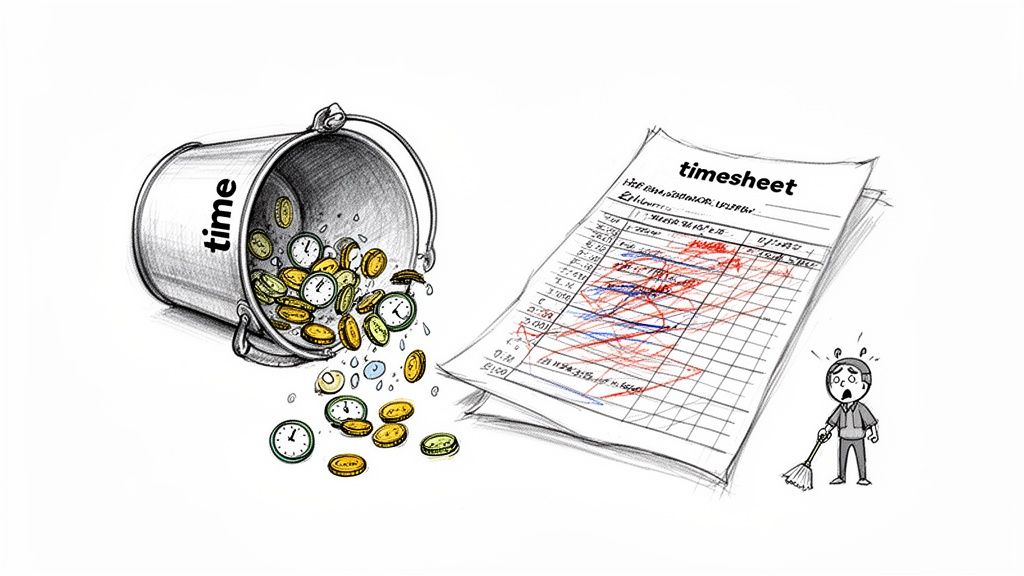
Manual time tracking is a breeding ground for errors that create payroll nightmares, from accidental overpayments to serious compliance issues. Learning how to set up payroll for your small business is a critical first step, but your payroll is only as good as the data you feed it. Bad data means costly mistakes and potential legal headaches down the road.
The right software isn't just a digital punch clock. It’s a competitive advantage that directly boosts your bottom line and gets your business ready to scale. It turns messy, unreliable data into clear, actionable insights.
This shift to automation isn't just some passing trend; it's a massive market movement for a reason. The time and attendance software market was valued at $3.72 billion in 2025 and is projected to hit $4.11 billion by the end of 2026.
For cleaning businesses, this growth highlights a huge opportunity. Finally, you can accurately track your field teams' hours across dozens of job sites, cutting errors by up to 90% and stopping revenue leaks from untracked overtime.
If you’re running a cleaning company, does this sound familiar? It’s payroll day, and you’re drowning in a sea of crumpled, coffee-stained timesheets. You’re trying to decipher one cleaner’s handwriting, chase down another who forgot to log their hours for three different job sites, and then manually calculate overtime for five separate employees—all while hoping you don't make a costly mistake.
This isn’t just an administrative headache. It’s a genuine drag on your business. Every minute you spend wrestling with paperwork is a minute you aren't spending on finding new clients, improving service quality, or sharpening the job estimates that determine your profitability.
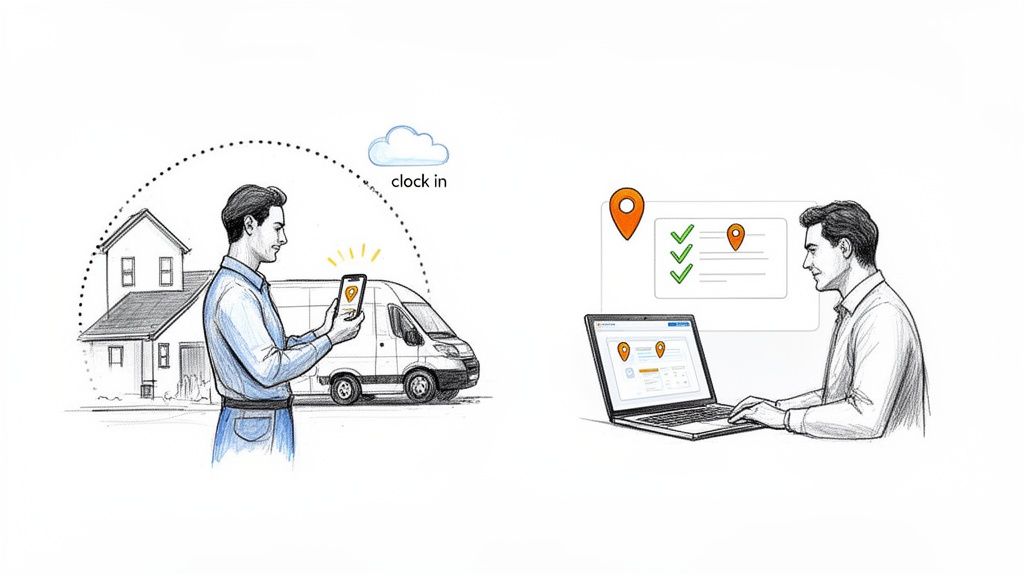
Now, picture this instead. Your cleaner pulls up to a client's house and clocks in with a quick tap on their phone. The app instantly verifies their location, the job timer starts, and you see their status flip to "On-Site" on your dashboard in real-time. This isn’t some futuristic dream; it’s the control and clarity you get with proper time and attendance software.
Moving past paper isn't just about convenience. It’s about having a real-time, bird's-eye view of your entire operation, especially when your team is always on the move. Good cloud-based software becomes your central command center, accessible from anywhere.
To see just how big the difference is, let's compare the old way with the new way.
| Feature | Manual Tracking (Paper/Spreadsheets) | Cloud-Based Software |
|---|---|---|
| Clock-In/Out | Illegible timesheets, forgotten entries, "buddy punching." | GPS-verified mobile clock-in, geofencing, biometric scans. |
| Accuracy | Prone to human error, rounding, and guesswork. | Accurate to the second, eliminating time theft and rounding issues. |
| Payroll Processing | Hours of manual data entry, complex overtime calculations. | One-click export to payroll; automated overtime and break rules. |
| Job Costing | Difficult to track actual labor hours vs. quoted estimates. | Precise labor data for every job, enabling accurate profitability analysis. |
| Manager Oversight | No real-time visibility; relies on phone calls and texts. | Live dashboard showing who is on-site, late, or on a break. |
| Dispute Resolution | "He said, she said" arguments over hours worked. | A digital, indisputable record of all time and location data. |
The table makes it pretty clear. One path leads to constant headaches and profit leaks, while the other paves the way for a more efficient, scalable business.
The bottom line is that automation isn't just about saving time; it's about making your business smarter. For an in-depth look at how to automate business processes, this is a great resource. By making this switch, you’re adopting a more resilient and profitable way to operate.
The move from manual chaos to automated clarity is what separates a struggling business from a thriving one. It gives you the power to manage your company by the numbers, not by a stack of messy paper.
Plus, this kind of tool works hand-in-glove with other essential software. See how it fits into the bigger picture in our complete guide to scheduling software for cleaning businesses.
Let's be honest. Choosing the right time and attendance software isn't about finding a fancy digital punch clock. It’s about arming your cleaning business with the specific tools you need to manage a crew that's always on the move. Not all software is the same, and if you want to see a real return on your investment, you have to focus on the features that solve real-world problems.
Think of it this way: you wouldn't bring a household vacuum to a massive commercial cleaning job. The same idea applies here. You need software built for the fast-paced, on-the-go reality of the cleaning industry.
For most cleaning businesses, the biggest drain on payroll comes from fuzzy clock-in data. Was your employee in the parking lot? At home? Or actually inside the client's building? With paper timesheets, you're just guessing and hoping for the best. GPS verification stops the guesswork for good.
When a cleaner clocks in or out on their phone, the app captures a GPS stamp. Suddenly, you have an undeniable record of where they were and when. This immediately solves two massive headaches:
Geofencing takes this a huge step further. This feature creates a virtual perimeter around a job site. When an employee walks into that zone, the app can automatically remind them to clock in. When they leave, it can prompt them to clock out. It makes tracking time practically effortless and dead-on accurate.
Your cleaners are the face of your company, and they're almost never sitting in an office. A clunky system that only works on a desktop is completely out of touch with how you operate. For any modern cleaning business, a clean, simple-to-use mobile app isn't just a feature; it's a necessity.
For a team that's always on the move, a mobile app isn't a "nice-to-have"—it's the entire system. If the app is a pain to use, your team won't use it. And if they don't use it, the software is worthless.
A great mobile app gives your staff the power to manage their own information, which takes a huge administrative weight off your shoulders. Your employees can:
Giving your team this kind of control not only makes their lives easier but also frees you up to focus on finding new clients and growing the business. In an industry that depends on hiring great cleaning employees, giving them modern tools is a serious competitive edge. If you're looking to step up your hiring game, resources from platforms like pipehirehrm.com can make a world of difference.
Trying to keep up with labor laws, especially the tricky rules around overtime and mandatory breaks, is a huge compliance risk. One small miscalculation can lead to massive penalties and frustrated employees. Good time and attendance software basically acts as your digital compliance expert.
You set up the system once with your state and local labor rules. From then on, the software automatically tracks every hour and applies the correct overtime pay, whether that's time-and-a-half after 40 hours a week or after 8 hours a day. It takes human error completely out of the picture.
This automation guarantees every single paycheck is accurate and compliant. It protects your business from expensive legal trouble and gives you incredible peace of mind, turning a complex, high-risk task into something you barely have to think about.
Let's be honest. A new piece of software, even a great time and attendance tracker, is only as good as its ability to play nicely with the other tools you already use. If it doesn't connect, it's just another data island—a separate program that forces you to manually copy and paste information, creating more work, not less.
The whole point is to build a connected system where information flows automatically from one tool to the next.
Think of it like a perfectly coordinated relay team. Your time tracker captures the hours, running the first leg of the race. It then needs to pass that baton—the timesheet data—to your payroll system without a hitch. If someone has to stop, manually write down the info, and then run it over, you’ve lost all your momentum.
For a cleaning business, getting this flow right is the key to true automation. When your systems are integrated, you can create a seamless path from the very first job estimate all the way to the final paycheck.
To make this automated workflow a reality, your time and attendance software needs to talk to three specific areas of your business. These connections are what separate a merely helpful tool from a game-changing asset.
This kind of connectivity is built on a foundation of solid features, from GPS verification to mobile access.
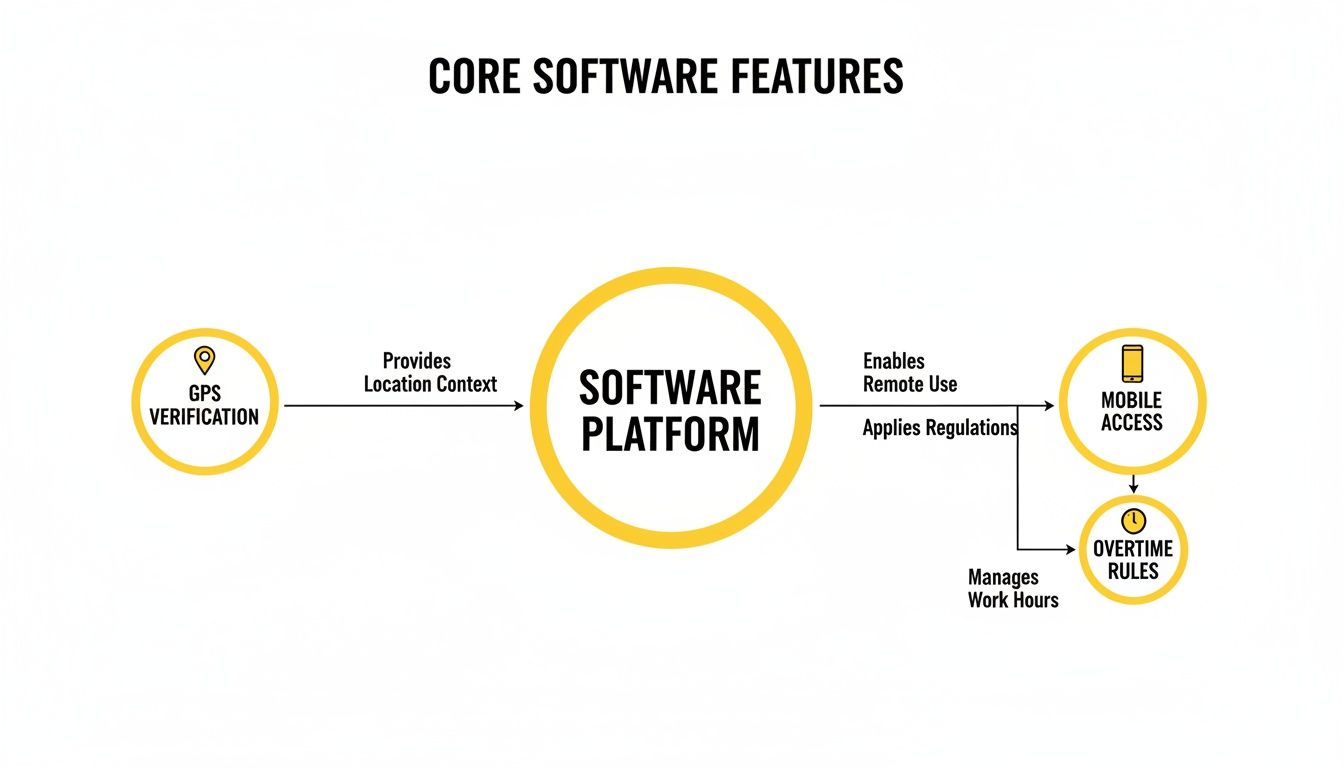
As you can see, core functions like location tracking and managing overtime aren't just standalone features; they're the engine that powers a smarter, more integrated operation.
When these systems work in harmony, they create a powerful, self-correcting loop of information. A lead comes from your website and gets an instant estimate via a tool like Estimatty. The job is booked, and the schedule syncs to your team's phones. They clock in, their hours are approved, and that data shoots directly to payroll.
A connected tech stack means data is entered once and then used everywhere it's needed. This is the foundation of an automated, scalable cleaning business that can run with minimal manual intervention.
This interconnected system doesn't just give you back hours of administrative time; it gives you a crystal-clear dashboard of your business's financial health. You can see your labor costs in real-time and measure them against revenue with pinpoint accuracy.
If you're ready to see how these pieces fit together, you can learn more about how smart integrations work. Ultimately, connecting your tools is what finally allows you to step away from the paperwork and get back to growing your business.
If you’re looking at time and attendance software as just another monthly bill, you're making one of the biggest mistakes a cleaning business owner can. This isn’t a cost center; it’s a profit-generating machine hiding in plain sight. To see the real value, you have to look past the subscription fee and calculate its true return on investment (ROI) by focusing on where it stops the money from leaking out of your business.
Think of it like buying professional-grade cleaning equipment. Sure, there’s an upfront cost. But the efficiency, better results, and time savings quickly pay for that tool many times over. The exact same logic applies to your time tracking system.
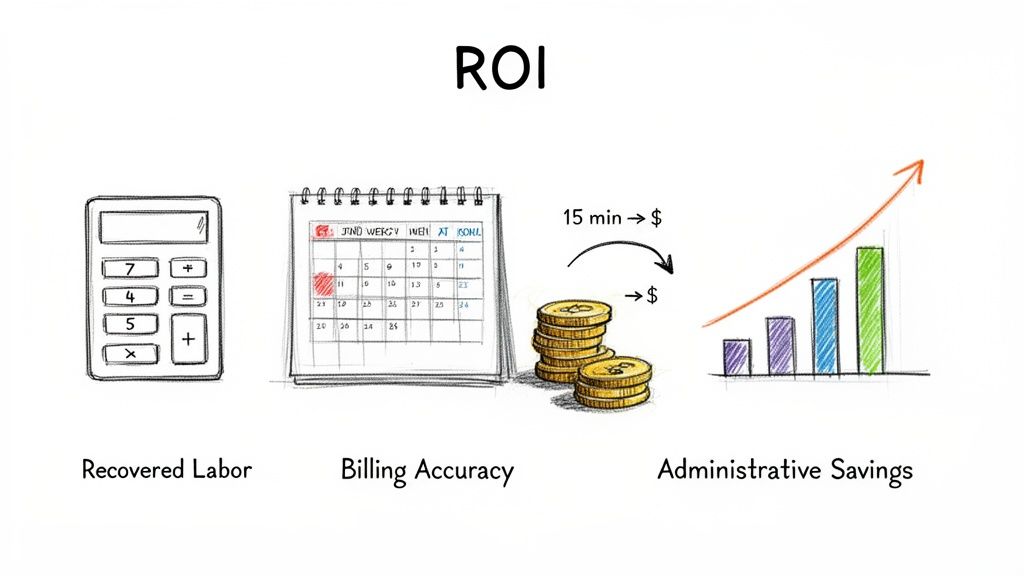
The first and fastest financial win you'll see is plugging payroll leaks. Time theft—whether it’s on purpose or not—is a silent killer of your profit margins. It’s everything from "buddy punching," where one cleaner clocks in for a late friend, to the simple habit of rounding up hours on a paper timesheet.
It all adds up faster than you'd think. Just look at this breakdown:
GPS-verified clock-ins put a stop to this overnight. When your crew has to be at the actual job site to start their timer, you can be confident that every dollar you spend on labor is for time they’re actually working.
Let's be honest, how many hours do you or your office manager waste chasing down timesheets, trying to read messy handwriting, and manually punching hours into your payroll system? Studies show that automating these tasks can slash payroll processing time by up to 80%. This isn't just about getting a few hours back; it's about reclaiming expensive administrative time that could be spent growing the business.
If your admin spends six hours every two weeks on manual payroll at a rate of $25/hour, that's $3,900 a year just to get people paid. Cutting that down to one hour saves you over $3,250 annually in pure overhead.
By automating time tracking and payroll integration, you aren't just buying software. You are buying back your most valuable asset: time you can reinvest into sales, client relationships, and strategic growth.
This newfound efficiency lets you take on more jobs and hire more cleaners without immediately having to hire more office staff. You can scale your operations without getting buried in a mountain of paperwork. To see more proof of how automation can fuel growth, you can read a case study where sales doubled after implementing instant estimates.
For any cleaning company that bills by the hour, accurate tracking is everything. Every minute you don't track is revenue you earned but gave away for free. Modern time and attendance software makes sure every second your team is on-site is tracked, accounted for, and ready for invoicing.
Let's run the numbers one more time. Say you have a team of five cleaners, and you accidentally fail to bill just 10 minutes of their time per day at a billing rate of $50/hour:
You could be leaving over $10,000 on the table every year, simply because your tracking isn't totally precise. This software closes that gap, ensuring your invoices reflect the true value you deliver. It also gives you the hard data to back up your charges if a client ever questions an invoice, protecting both your revenue and your reputation.
Alright, you see the potential. Now it's time to turn that knowledge into action. The good news is that picking the right time and attendance software doesn't have to be a drawn-out headache. It’s really just a matter of following a few common-sense steps to find the perfect fit for your cleaning business.
This isn't about becoming a tech wizard. It’s about finding a tool that solves your real-world problems. Let's break down the exact four-step process you can use to make a smart, confident choice.
Before you even glance at a vendor's website, stop and think. What are your biggest operational headaches right now? The number one reason software projects go sideways is because the goals weren't clear from the start. Nail them down now, and you'll stay on track.
Be specific to your cleaning business. Ask yourself:
This list becomes your compass. It will immediately help you rule out systems that simply aren't built for a business like yours.
Your business isn't a standard 9-to-5 office. You're managing a mobile team, juggling constantly changing locations, and working on tight margins. A generic piece of software built for desk jobs just won’t do the trick.
Seek out providers who already speak your language. Their websites should be talking about features for field service or cleaning companies. Their success stories should feature businesses you can relate to. This is crucial because a vendor who gets the cleaning industry has likely already solved the exact problems you’re facing.
Choosing a software vendor is a lot like hiring an employee. You want someone with relevant experience who doesn't need to be taught the basics of how your world works.
For a deeper dive into tools built for this industry, check out this guide on the best cleaning business software.
Once you've narrowed your list down to two or three solid contenders, it’s demo time. But don't just passively watch a sales pitch. You need to drive the conversation.
Give them a real-life scenario you deal with every week. Try something like this: "Show me exactly how I would schedule a three-person team for a one-time deep clean. I need to make sure they clock in at the right address and then see how I approve their hours for payroll."
This simple request forces them to move beyond canned presentations and show you how their system actually functions for you. It’s the fastest way to see if the tool is a genuine solution or just marketing hype.
Finally, remember this isn't just about installing an app. You're introducing a new way of working for your entire team. A smooth rollout is all about clear communication and simple training.
Keep your plan short and sweet:
Making this switch is one of the highest-impact decisions you can make. By following these steps, you’ll find a time and attendance software that does more than just track hours—it will build a stronger, more profitable, and more scalable cleaning business.
Even when you've done your homework, bringing a new tool like time and attendance software into your business can stir up some questions. Let's tackle the big ones I hear most often from fellow cleaning business owners.
Let's talk money. The good news is, this isn't a massive, upfront investment. Most modern systems run on a per-user, per-month subscription, usually somewhere between $2 and $10 per employee.
This model is perfect for us because it grows with you. You can start small, maybe just with yourself and one other cleaner, and then add people as you land more contracts. Plus, almost every provider offers a free trial, so you can kick the tires before you ever pull out your credit card. Most cloud-based tools have little to no setup fees, which keeps your initial costs down while you make sure it's the right fit.
This is probably the biggest worry I hear, but trust me, it’s easier to handle than you think. The secret is picking a system with a dead-simple mobile app. If your team can use Facebook, they can use this.
The key is to frame it as a win for them, not just for management. When you introduce it, don't talk about oversight; talk about benefits. Point out things like:
Pro-tip: Bring one of your most trusted cleaners into the decision-making process. Let them help you test a couple of options. When your team sees that the software actually makes their day-to-day work easier, you'll get buy-in instead of pushback.
If you're looking for more great advice on building and managing your crew, you can find some fantastic articles over on the Pipehire blog.
Yes, but it's not the "Big Brother" you might be picturing. Most systems use GPS tracking in a very specific, respectful way. They simply grab a location stamp at the exact moment a cleaner clocks in and clocks out.
This isn't about watching their every move. It's just a simple way to confirm they're at the right client site when they start their shift and when they leave. It protects you, the client, and the cleaner by providing a clear record.
Some of the better systems also offer geofencing. Think of it as a virtual fence around a job site. The app can then automatically remind your staff to clock in when they arrive or clock out when they leave that area. It takes the guesswork out of it and ensures every billable minute is logged against the correct job estimate.
Ready to turn more website visitors and phone calls into booked jobs? Estimatty provides instant, accurate estimates 24/7, capturing leads you might otherwise miss. Stop chasing down voicemails and start automating your sales process.
Discover how Estimatty can grow your cleaning business today!