September 21, 2026
Inside and Out Cleaning: A Practical Pricing Guide
Learn what inside and out cleaning really includes, how pricing works, and which add-ons actually pay off for residential and commercial estimates.

Friday, May 15, 2026
Starting a cleaning business? Learn which cleaning business license you need, how to get it, and the costs involved. Your complete guide for 2026.
.png)
You've probably already completed the step that is frequently overthought. You know how to clean. You know what customers care about. You may even have a few people ready to hire you.
Then the momentum stalls when someone asks, “Are you licensed?”
That question trips up a lot of new owners because they assume a cleaning business license is just paperwork. It isn't. It's the first proof that you're building a real company instead of taking cash jobs and hoping nothing goes wrong. Once you understand that, the process gets a lot less frustrating.
A cleaner I've seen this happen with many times usually starts in the same place. They've done side work for friends, maybe picked up recurring residential clients, and now they want to put a name on the business, open a bank account, and start advertising. Then they search “cleaning business license” and get ten different answers.
That confusion makes people hesitate. They delay filing. They keep operating informally. They wait until a commercial prospect asks for documents they don't have.
That's backwards.
A cleaning business becomes professional the moment you decide to build it on a legal foundation. The industry is large enough that this isn't a small administrative detail. One industry snapshot estimates the global cleaning services market at about $370.56 billion in 2022, with projected annual growth of 6.6% through 2030, and notes there were over 1 million janitorial services businesses in the U.S. in 2021 (SBDCNet cleaning services industry snapshot). In a market that crowded, legitimacy matters.
Clients may not ask for your paperwork on the first residential job. Many still look for the signals. They notice whether you operate under a business name, whether your invoices look formal, and whether you can answer basic compliance questions without sounding unsure.
That's why licensing works better when paired with the rest of your business setup. If you're also sorting out insurance for cleaning companies, you're building the kind of operation that can survive mistakes, win referrals, and move into better work.
Practical rule: If a business can't prove it exists properly, buyers assume everything else is improvised too.
A lot of owners treat licensing as the last thing to do before launch. In practice, it should sit near the beginning. It affects your business name, your tax setup, your city approval, and sometimes whether you can legally offer certain add-on services.
If you're still in the early planning stage, the guide on how to start a cleaning business is a useful companion to the licensing process because it helps you line up the business basics in the right order.
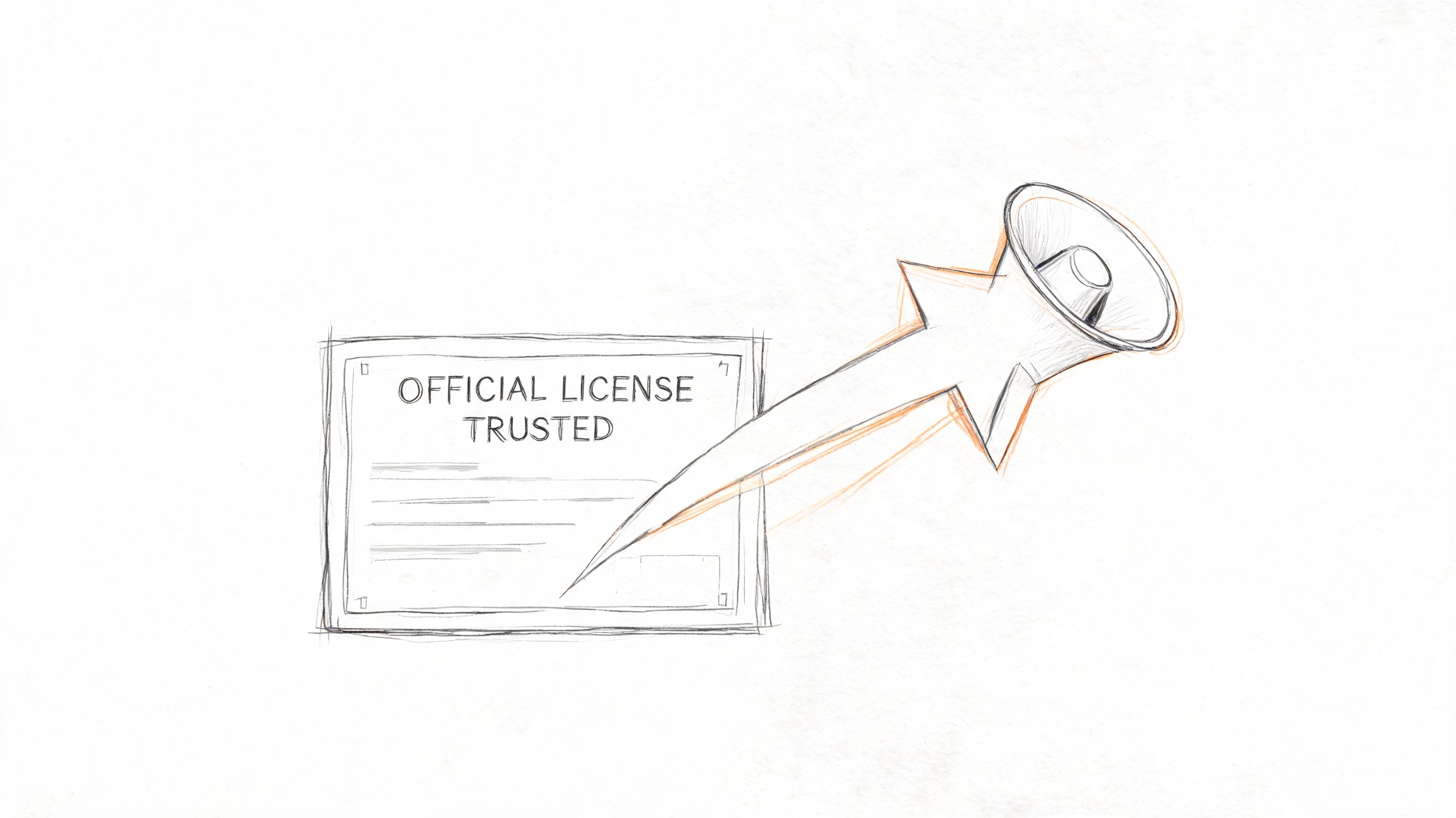
Most owners think marketing starts with a logo, yard signs, or social posts. It starts earlier than that. It starts when a prospect decides whether you look safe to hire.
A valid cleaning business license helps you answer that question before the customer even asks it directly. It gives your brand weight. It makes your pricing easier to defend. It separates you from the cleaner who says, “I can do it cheaper,” but can't show any business documentation.
A license supports your positioning in ways ads alone can't.
This is one reason brand work matters more than many cleaners realize. The presentation layer only works when there's substance behind it. If you're tightening that side of the business, branding for cleaning services is worth reviewing alongside your legal setup.
There's also a lesson here from outside the cleaning industry. Strong local-service companies don't market from scratch each time. They stack trust signals and repeat them everywhere. That's one reason broader service-business playbooks, like these marketing strategies for roofers, can still be useful. The industries are different, but the buyer psychology is similar. People hire the company that looks established, reachable, and accountable.
Here's a useful walkthrough on the trust side of licensing and professional presentation:
A license won't close every sale. It will stop you from losing the easy ones for avoidable reasons.
“Do I need a cleaning business license?” is the wrong first question.
The better question is, “What approvals apply to my city, my state, and my exact service mix?” That's where most of the confusion comes from. There usually isn't one universal license that covers every cleaner in every market.
One of the clearest realities new owners need to understand is that licensing requirements are fragmented. States such as Kentucky and Texas do not require a general state business license for cleaning services, while Tennessee and Utah do have state-level requirements, which is why checking with your own city and county clerk's office is essential (Next Insurance on cleaning business license requirements by state).
Some of these are required almost everywhere. Others only come into play if you operate under a trade name, work from home, collect tax, or offer regulated services.
| Permit / License Type | What It Does | Typically Issued By |
|---|---|---|
| General business license | Allows you to legally operate a business in the local jurisdiction | City or county |
| DBA or fictitious name registration | Lets you operate under a business name that isn't your personal legal name or registered entity name | State, county, or local agency |
| State business registration | Registers your entity if your state requires business formation or state-level business activity registration | State |
| Sales tax permit or tax registration | Allows you to collect and remit tax when your services are taxable in your area | State revenue or tax department |
| Home occupation permit | Approves business activity from a residential address when local zoning requires it | City or county |
| Specialty permit | Applies to specific work such as discharge-sensitive cleaning, hazardous material handling, or other regulated activities | Local or state agency, depending on service |
The biggest mistake is assuming all cleaning falls into one category. It doesn't.
A straightforward residential cleaning operation may only need basic local registration. Once you add carpet cleaning, pressure washing, waste handling, laundering, or contamination-related services, the rules can change quickly. Some localities care about water discharge. Others care about zoning, chemical handling, or whether the service crosses into a regulated category.
That's why broad online advice often frustrates people. It gives a general answer to a local question.
If your service list is expanding, it helps to think like a contractor, not just a cleaner. The same issue shows up in trades where licensing depends on the work performed and the jurisdiction where it's sold. That's why this overview of requirements for a contractor's license is relevant. The lesson is the same. Service category matters.
Use this order:
If you do that before printing cards, building a website, or taking deposits, you avoid a lot of expensive rework.
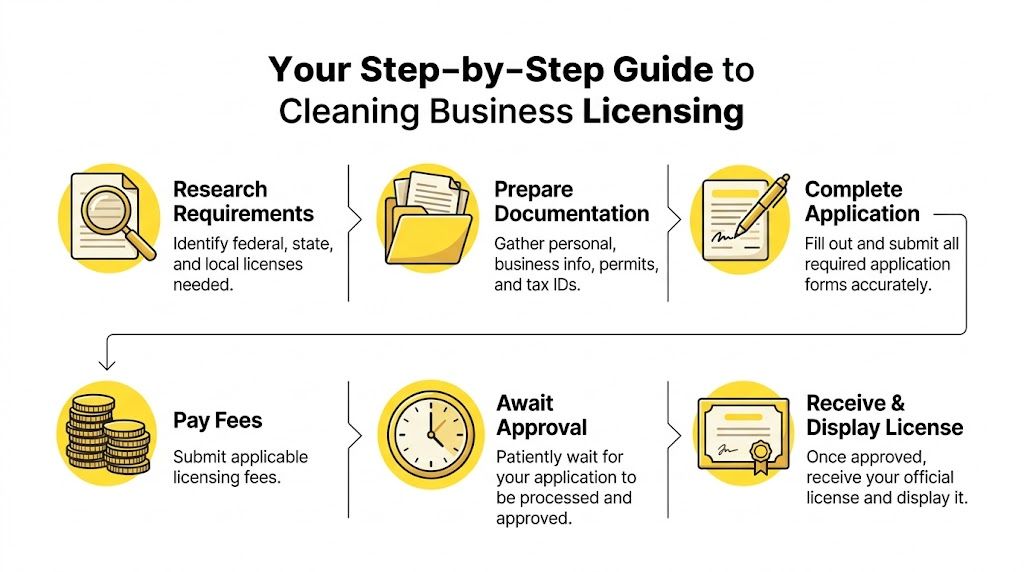
A new owner usually hits the same wall around week two. The website is half built, the name is picked, a friend wants a quote, and then the licensing question stops everything.
The fastest way through it is to decide the business before you touch the application. Owners who do that tend to get approved with fewer delays, and they set themselves up for the full legitimacy stack later: license, insurance, and bonding. That stack is what helps you win better clients, charge like a real company, and run cleaner systems.
Pick your legal structure first. Sole proprietorship is simple. An LLC usually gives a more professional presentation and cleaner separation between personal and business matters.
There is a trade-off. A sole proprietorship is faster and cheaper to start. An LLC takes more setup, but it often makes banking, contracts, and commercial client conversations easier.
If you plan to grow beyond solo work, make that decision now. It is much easier to build your paperwork once than to clean it up after you already have clients, invoices, and tax registrations tied to the wrong setup.
New owners waste time because they ask one office a broad question and assume the answer covers everything. It usually does not.
Check the city or county first for the basic business license. Then confirm state registration, tax accounts, and any local zoning rules tied to your address. If you operate from home, ask that question directly. Home-based businesses trigger extra rules in some places.
Write down these four items before you apply:
That one-page note sheet saves a lot of backtracking.
Every jurisdiction asks for a slightly different set of documents, but the core information is usually predictable. Keep it in one folder, either digital or printed, so you are not hunting through emails while an application is open.
Include:
If you are already lining up protection, get familiar with liability insurance for a cleaning company early. In some areas it supports the application. In every area it strengthens how your business looks to serious clients.
One caution here. Keep your service description accurate and narrow. If you only provide recurring residential cleaning, say that. Do not list specialty work you are not ready or approved to perform.
Because they often do.
Names, addresses, and service descriptions need to match across your formation record, tax registration, insurance paperwork, and license application. Small mismatches cause slowdowns. I have seen owners lose a week over a missing suite number and a DBA written one way on one form and another way on the next.
Be specific about the work. "Cleaning services" may pass in one jurisdiction and raise follow-up questions in another. "Residential cleaning, move-in and move-out cleaning, and small office cleaning" is clearer and easier to process.
After you apply, do not disappear. Save confirmation emails, note reference numbers, and check the status if the timeline starts stretching.
Use that waiting period to set up the parts of the business that make you look established on day one:
Process-minded owners position themselves for success. If your forms, estimates, and onboarding already match what you are legally allowed to sell, adding software later is much easier. Tools like Estimatty work best when the foundation is clean.
Once the license is approved, store it properly and use it. Keep a digital copy. Keep a printed copy if your locality requires display. Add the business details to your estimates, agreements, and onboarding documents where appropriate.
A license should do more than satisfy a clerk. It should support how you present the company. When your registration, insurance, documents, and estimating process all line up, clients see a legitimate business instead of someone testing the waters.
A cleaning business license makes you legal. It doesn't make you protected.
That's why serious operators build what I call the legitimacy stack. It has three core pieces: license, insurance, and bonding. When those pieces line up, you stop looking like a solo cleaner trying to get by and start looking like a company clients can trust with keys, access codes, and recurring service.
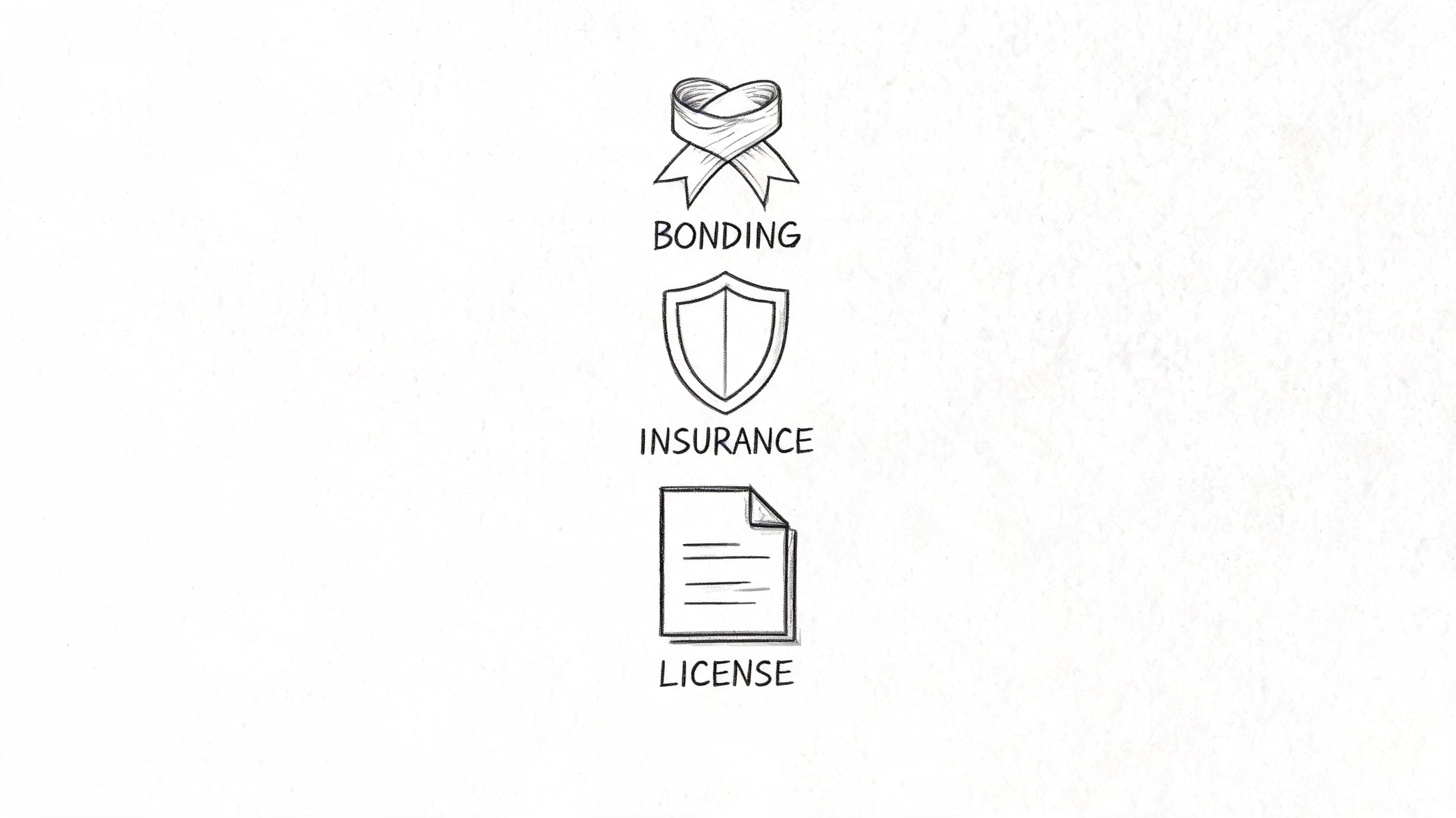
Here's the practical version.
Many commercial buyers don't review your business casually. They often screen vendors before any real conversation about price. Industry guidance notes that many commercial clients expect proof of licensing, insurance, and sometimes bonding before signing contracts, and that higher-risk work such as biohazard cleanup or medical-facility cleaning brings stronger documentation demands because liability exposure rises (Housecall Pro on licenses and permits for cleaning businesses).
A residential client may just want to know you'll show up. A property manager, medical office, or commercial account usually wants documents first.
That changes the sales process in a big way. Without the stack, you spend time chasing work you can't fully qualify for. With it, you can submit paperwork quickly, pass vendor checks faster, and compete for better accounts without scrambling at the last minute.
If you're tightening the protection side of the business, this guide to liability insurance for a cleaning company is the right next read because insurance decisions should match the type of work you're licensed to perform.
The cleaners who win better contracts usually aren't the cheapest. They're the easiest to approve.
Six months after getting licensed, a lot of cleaning owners hit the same wall. They add a helper, take jobs in a neighboring city, offer a new add-on service, and keep selling under the assumption that the paperwork still fits the business. That is usually where preventable problems start.
Long-term growth depends on keeping your legitimacy stack current. The license gets you in the door. Insurance protects the work you perform. Bonding supports trust when clients care about access, keys, and accountability. If one piece falls behind, the whole operation looks less professional than it really is.
Treat compliance like a repeating admin system inside the business.
Small gaps create bigger friction later.
I tell owners to build one compliance folder before they think they need it. Keep your business license, registration documents, insurance certificates, bond paperwork, tax IDs, renewal confirmations, and signed client agreements in one organized place. A cloud folder works fine if it is labeled clearly and someone on the team can find documents fast.
That file becomes part of sales, not just admin. Commercial buyers, property managers, landlords, and even some residential clients will ask for proof. Fast answers build confidence. Slow answers raise doubts.
Contracts belong in that same operating system. If your paperwork is still pieced together from old emails and verbal scope changes, tighten it now with this guide to cleaning services contracts. Clean compliance and clean contracts usually grow together.
The payoff is bigger than avoiding fines. A current, organized business is easier to hire for, easier to insure, easier to bond, and easier to run through software. That matters once you start using quoting, scheduling, and job-costing tools like Estimatty. Automation works better when the business behind it is documented correctly.
Here are the questions I hear most from solo cleaners and small residential teams.
| Question | Answer |
|---|---|
| Do I always need a cleaning business license to start? | You usually need some form of local or state business approval, but it may not be a single license called a “cleaning business license.” Start with your city and county, then confirm state requirements. |
| If I only clean houses, can I skip the paperwork at first? | That's a bad habit to build your business on. Even if the requirement is simple, get legal before you market heavily or take on recurring clients. |
| Is a license enough to look professional? | No. The strongest setup includes the license, the right insurance, and sometimes bonding. That stack helps you win better clients and avoid preventable problems. |
| Do I need new approvals if I add services later? | Possibly. Add-ons like pressure washing, laundering, hazardous cleanup, or other specialty work can change what's required. Always re-check before selling the new service. |
| What if I want to hire cleaners soon? | Get your business structure, tax setup, and documentation organized early. Hiring is much easier when the foundation is already clean and documented. |
A cleaning business license isn't glamorous, but it's one of the most effective moves you can make. It tells clients you're serious, helps you qualify for stronger insurance and bonding, and gives your company room to grow without constant cleanup behind the scenes.
If you want your business to look as professional on the front end as it is on paper, Estimatty helps cleaning companies deliver fast, consistent estimates through web and voice so leads don't sit waiting while your team is out in the field.