October 25, 2026
Pressure Cleaning Prices in 2026: Rates by Job and Size
Compare pressure cleaning prices for homes and commercial jobs in 2026, with size bands, per-square-foot rates and sample estimates you can use.
Saturday, March 7, 2026
Get the definitive guide to liability insurance for cleaning company. Learn what coverage you need, how to lower costs, and protect your business from day one.
.png)
Liability insurance isn’t just another line item on your budget—it’s the single most important investment you can make to protect your cleaning business from financial disaster. It covers the costs of accidents like client slips, property damage, or other on-the-job mishaps, ensuring one simple mistake doesn’t put you out of business.
Don't think of liability insurance as just another bill. See it for what it is: the essential tool that guarantees your company can survive and grow.
Picture this: your employee is mopping a commercial lobby when a visitor slips on the wet floor. The fall results in a serious injury and a six-figure lawsuit. Or imagine a much simpler mistake, where a new cleaning solution accidentally bleaches a client’s expensive custom rug.
Without insurance, that one moment could force you to shut down for good. Your business assets, and maybe even your personal ones like your home or savings, would be on the line. This is exactly where liability insurance for a cleaning company acts as your ultimate shield. It steps in to handle the legal fees, settlements, and medical bills, letting you breathe and keep your doors open.
These days, having insurance isn't optional; it's the very foundation of a professional operation. Homeowners and corporate facility managers won't even look at your estimate without seeing proof of insurance first. It has become a non-negotiable requirement for earning their trust and winning their business.
Having solid insurance coverage tells potential clients you're a serious, professional business. It shows you're prepared, responsible, and trustworthy—instantly setting you apart from uninsured competitors who pose a much bigger risk.
The core of this protection is your general liability insurance, which is absolutely fundamental for any cleaning company. This policy is your ticket to:
As your business grows, so does your risk. Every new employee you hire and every client you bring on adds another layer of potential liability. Your protective measures have to scale right along with your ambitions.
Just as powerful tools like Estimatty can automate your sales process to land more jobs, insurance protects the entire business you've worked so hard to build. To learn more about formalizing your client agreements, our guide on cleaning services contracts offers some incredibly useful insights. For more great content, check out the estimatty.com/blog.
Ultimately, insurance gives you the confidence to go after those larger, more lucrative opportunities, knowing your business is secure no matter what comes your way.
Let's be honest, insurance can feel overwhelming. The different policies, the jargon, the fine print—it's a lot to take in when you're focused on running your cleaning business. But getting this right isn't just about ticking a box. It's about building a fortress around the company you've worked so hard to create.
And you’re not alone in this. The market for liability insurance for cleaning company owners is huge—valued at $659 million in 2024 and expected to balloon to $1,016 million by 2034. That’s a 6.4% annual growth rate, which tells you one thing loud and clear: professional cleaners are taking protection seriously.
If you only get one policy, make it this one. General Liability is the bedrock of your insurance coverage. It’s designed to protect you from the classic "oops" moments that can happen on any job site. Think of it as your primary defense against claims involving people or property that aren’t yours.
This is the coverage that kicks in for those all-too-common scenarios:
Without it, you’re on the hook for every dollar of medical bills, legal fees, and replacement costs. A single bad accident could wipe you out. It's the absolute bare minimum for any professional cleaning service.
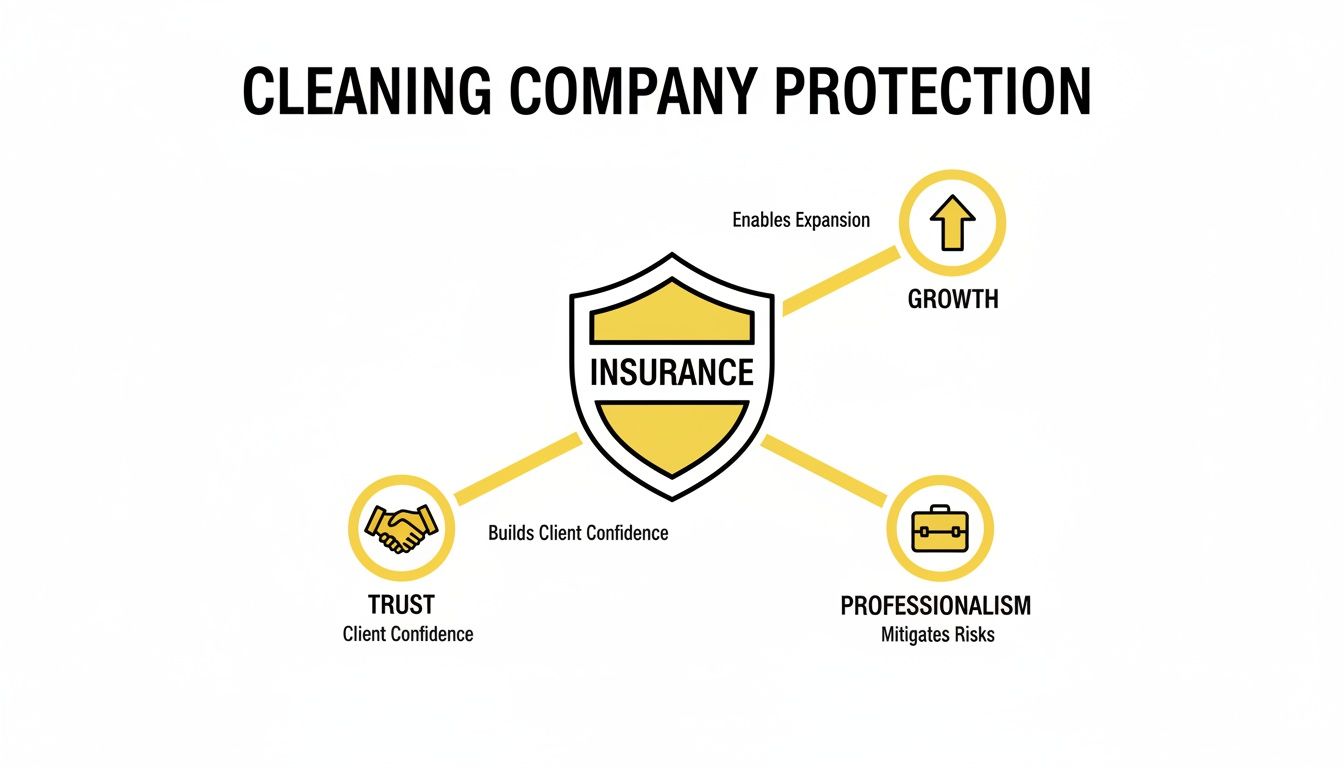
As you can see, solid insurance isn't just a safety net. It’s a tool for growth that builds trust and signals your professionalism to potential clients.
While general liability handles physical accidents, Professional Liability is all about the quality of your service itself. Often called Errors & Omissions (E&O) insurance, this policy protects you from claims that your work (or a mistake in your work) caused a client a financial loss.
For example, your team uses the wrong chemical on a high-end marble floor, leaving a permanent stain that requires a costly replacement. That’s not a simple accident; it's a professional error. General liability might not touch it, but your professional liability policy is built for exactly this situation.
Think of it this way: General liability protects you if you break something. Professional liability protects you if your service itself causes the problem.
Getting these foundational pieces right from day one is critical. If you're just launching, you might find our full guide on how to start a cleaning business helpful for putting all the pieces together.
Once you hire your first employee, the game changes. Protecting your team isn't just a good idea—it's your legal and moral duty. If you're looking to hire cleaning employees, resources like pipehirehrm.com and their blog at get.pipehirehrm.com/blog are invaluable.
Workers' Compensation Insurance is the most important policy for your employees. If a cleaner slips on a freshly mopped floor or injures their back lifting equipment, this policy covers their medical bills and a portion of their lost wages. In nearly every state, it's legally mandatory as soon as you have employees on payroll. Don’t skip this.
Commercial Auto Insurance is another non-negotiable if you use vehicles for work. Your personal car insurance policy won't cover an accident that happens while you or an employee is driving to a client's site. A commercial auto policy is essential to cover any damages or injuries from a work-related crash.
Finally, look into getting a Janitorial Bond. While it isn't technically insurance, it works hand-in-hand with your policies. A bond protects your clients from theft by one of your employees. Being bonded is a powerful trust signal that can help you land bigger, more lucrative contracts because it gives clients total peace of mind.
Choosing the right amount of insurance isn't a shot in the dark—it’s one of the most critical decisions you'll make for the financial health of your cleaning business. The "right" number isn't one-size-fits-all. It hinges entirely on the scale of your operation, the kinds of clients you serve, and where you plan on taking your company.
Get this wrong, and you could be leaving the business you've worked so hard to build completely exposed.
For most new and small cleaning businesses, there’s a solid, industry-standard starting point. This applies to you if you’re a solo operator cleaning residential homes or a small team of 2-5 tackling a mix of houses and local offices.
Your foundation should be a general liability policy with a $1,000,000 limit per occurrence and a $2,000,000 aggregate limit. Think of it this way: the “occurrence” limit is the maximum your policy will pay for a single claim, like a client slipping on a just-mopped floor. The “aggregate” limit is the total amount the policy will pay out for all claims during that policy year.
This $1M/$2M structure is the baseline you need to handle the most common—and often surprisingly expensive—risks in our line of work.
A million dollars sounds like a lot of money, but it can vanish in a flash when a serious lawsuit comes knocking.
Let's walk through a scary—but very real—scenario. Imagine your business has that standard $1 million liability policy. A severe accident happens at a client’s property, a lawsuit follows, and the court hands down a $1.6 million judgment against your company. Your insurance will pay its maximum of $1 million, but what about the other $600,000?
That’s on you. If you’re not structured as an LLC or corporation, that $600,000 can be collected from your business assets, your personal savings, and even your home.
Being underinsured is like sailing with a known leak. You might be okay in calm waters, but you're just one storm away from going under completely. True asset protection means making sure your coverage shield is always bigger than your potential risk.
As your business grows, so does your liability. Every new hire, every company van on the road, and every new contract you sign adds a fresh layer of risk. This is never more true than when you start landing bigger, more profitable commercial accounts.
Corporate clients, property management firms, and government contracts almost always come with stricter insurance demands. It’s common for them to require liability limits of $2 million per occurrence or even higher. They'll also typically ask to be listed as an "additional insured" on your policy, which simply extends your coverage to protect them from any lawsuits stemming from your work on their property.
As you begin winning bigger and more complex jobs, perhaps by understanding house cleaning costs better and bidding more competitively, your risk profile changes. Your insurance has to keep pace.
To make it easier to see where you might stand, here’s a general guide to coverage limits based on your business size.
This table serves as a strong starting point, but always talk to your insurance broker to fine-tune the numbers for your specific situation.
Ultimately, reviewing and increasing your coverage limits isn't an unnecessary expense. It's a core business strategy that protects the success you're building and ensures your company has the resilience to last for the long haul.
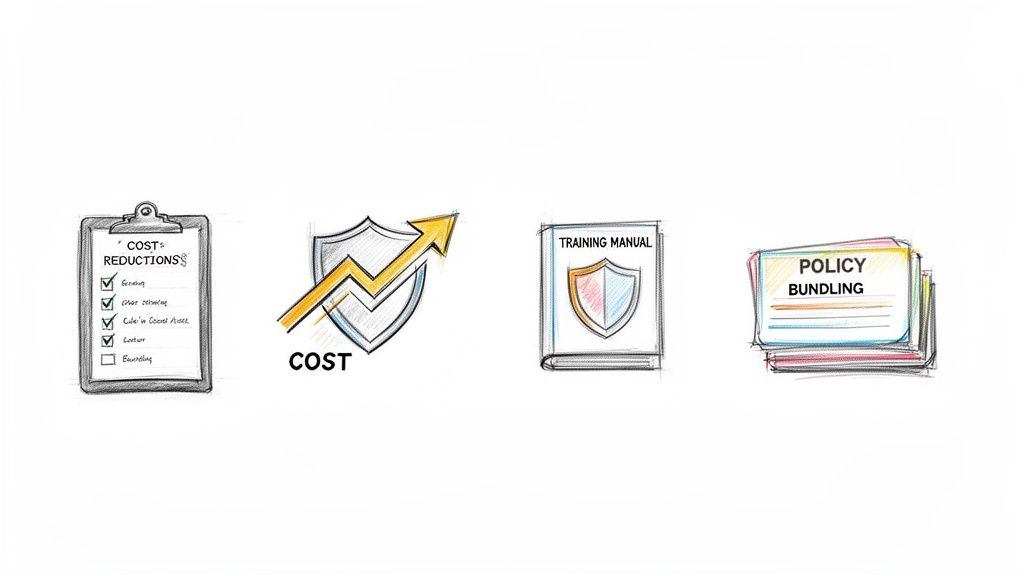
When you get your first insurance estimate, it's easy to feel like the price is set in stone. It’s not. Think of your insurance premium as a reflection of how much risk an underwriter sees in your business. The more you can do to prove you're a safe, professional operation, the less you'll pay.
Insurers aren’t just guessing. They're looking at concrete details: your location, the size of your team, and the specific services you offer. A crew doing high-rise window washing is obviously a higher risk than one that sticks to standard office cleaning. But the most important factor? Your claims history. A clean record speaks volumes and is your best bargaining chip for better rates.
This is your single biggest lever for lowering your premiums. Creating a formal, written safety program shows an insurer you're serious about preventing accidents before they happen. It’s tangible proof that risk management is baked into your company culture, not just an afterthought.
This doesn't have to be some massive, hundred-page manual. A straightforward document that your team actually uses is far more valuable. Your program should clearly outline:
A well-documented program is like getting a "good student discount" for your business. It tells insurers you’re a pro, and they'll reward you for it. For a deeper dive on how smart client intake can head off trouble, check out our guide on how better intake systems can protect your team.
Your employees are your greatest asset, but without proper training, they can quickly become your biggest liability. A solid training regimen is one of the surest ways to reduce the kind of mistakes and injuries that lead to claims—and that’s exactly what insurers want to see.
Invest in training that goes beyond just cleaning techniques. Cover critical safety protocols, from proper ladder use to ergonomic lifting practices that prevent back injuries. Your goal is to build a team that operates safely on autopilot. A well-trained crew is a safer crew, which leads directly to fewer claims and, ultimately, lower insurance costs.
Just like with your personal car and home insurance, bundling your business policies is one of the easiest wins. When you buy multiple types of coverage—like General Liability, Commercial Auto, and Workers' Comp—from the same insurance carrier, they’ll almost always give you a multi-policy discount.
Insurers love seeing bundled policies. It signals that you run a stable, organized operation and plan to be a long-term customer. In return for your loyalty, you can often knock 10-15% off your total premium.
This is a fantastic way to immediately cut your costs without sacrificing an ounce of coverage. Whenever you're shopping for estimates, make it a point to ask about bundling options. The demand for these policies is huge—the commercial cleaning business insurance market hit $7.2 billion globally in 2024, proving just how essential this protection is.
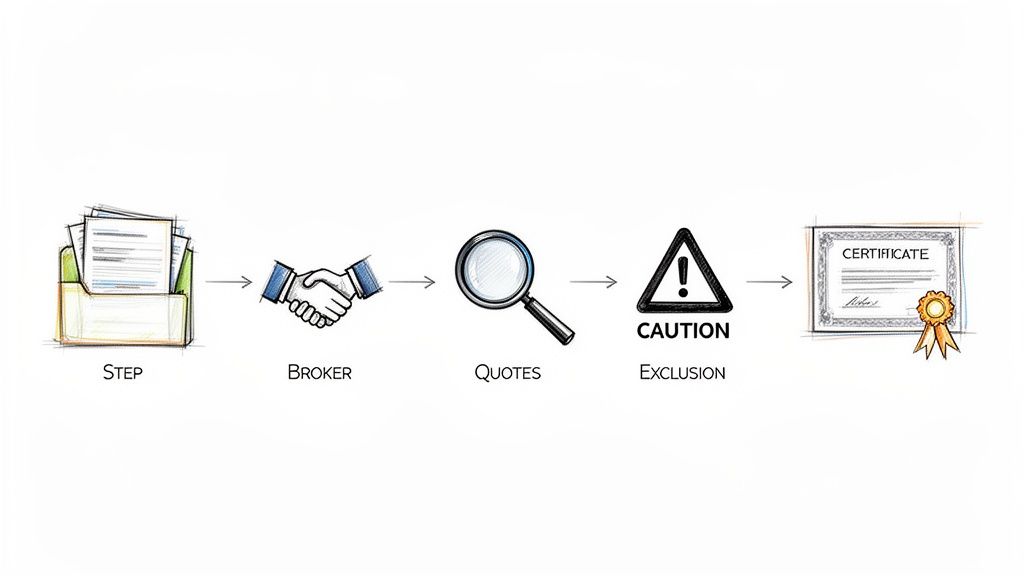
Alright, let's talk about getting your cleaning business insured. It might feel like a mountain of paperwork, but it’s not as bad as it looks. The key is to break it down into a simple, step-by-step process.
Think of it as your financial armor—you just have to assemble it piece by piece. Follow these steps, and you’ll go from feeling exposed to being fully protected and ready to win bigger contracts.
First things first, you need to get your house in order. Before you even pick up the phone to call a broker, you need all your business details organized. An insurance agent can’t give you an accurate estimate without a clear picture of what they’re insuring.
Pull together the following details. Having them ready makes you look professional and speeds everything up.
This is a big one. Not all insurance brokers are the same. You absolutely need to work with someone who specializes in the janitorial and cleaning industry. A generalist broker who sells car insurance one minute and a cleaning policy the next just won’t understand your world.
A specialist knows the risks unique to your business, like accidental chemical spills or the liabilities that come with cleaning commercial properties. They’re your advocate, connecting you with carriers that actually want to insure cleaners and helping you read between the lines of a policy. Honestly, finding the right broker can make or break this entire experience.
Don't ever take the first offer you get. Your goal here is to get at least three different estimates from three different sources. This lets you compare everything—the price, the coverage limits, the deductibles—on an apples-to-apples basis.
Think of shopping for insurance like you'd shop for a new work van. You wouldn't just buy the first one you test-drive. Comparing estimates helps you spot the best value, not just the rock-bottom price.
When you have a few estimates in hand, you can easily see if one is way too low (it’s probably missing something critical) or too high. This gives you real leverage and helps you make a truly informed decision.
The most important part of any insurance contract isn’t what’s covered; it’s what’s not covered. These are the exclusions, and they are often buried deep in the policy's fine print. You have to read them.
Common exclusions for cleaning businesses might include things like mold remediation, pollution from certain chemicals, or damage caused by what they call "faulty workmanship." If you handle niche jobs, you have to be 100% certain your policy doesn’t exclude the very services that make you money. For those in specialized fields, this is non-negotiable; for example, there's a step-by-step guide to ensuring adequate insurance and liability coverage for biohazard cleanup that highlights these complexities.
Once you've paid for the policy, your insurer will give you a Certificate of Insurance (COI). This one-page document is pure gold. It’s the official proof you can show to any client, proving you’re a legitimate, insured, and professional operation.
And here’s a pro tip: don’t just have it on file. Make it part of your sales process. Attach your COI to every bid and proposal you send out. It immediately builds trust, separates you from the uninsured competition, and shows potential clients you’re serious about protecting them, not just yourself. It's a simple move that helps close deals.
Let’s be honest—thinking about liability insurance for a cleaning company is never the most exciting part of running your business. But treating it as just another expense is one of the biggest mistakes a growing company can make. It's not a cost; it’s the bedrock of a stable, professional operation.
Think of it this way: a single accident, one slip on a freshly mopped floor or an expensive vase knocked over, could completely wipe out your progress. The right insurance turns that potential disaster into a manageable problem, letting you focus on what really matters: delivering fantastic service and building your reputation. It’s the safety net that lets you operate with confidence.
While smart tools like Estimatty can help you send out perfect estimates and win jobs, your insurance policy is what makes sure you actually get to keep the profits from all that hard work. It's the ultimate proof to clients that you're a serious professional they can trust in their homes and offices.
Your insurance policy is what gives you the confidence to stop playing small. It’s the green light to chase those big, lucrative commercial contracts without lying awake at night worrying about what could go wrong.
Don't wait for a close call or a costly claim to get this sorted out. Use this guide to look at your current coverage with fresh eyes and plug any gaps you find. Once you know your business is protected, you can focus on the next big step. Learning how to grow a cleaning business is a lot less intimidating when you know you’ve built on solid ground.
When you're running a cleaning business, insurance can feel like a maze of confusing terms and what-ifs. Let's cut through the noise. Here are plain-English answers to the questions I hear most often from owners just like you.
Yes, and it's not even a close call. As a one-person operation, you have the exact same risk of a client slipping on a wet floor or an expensive vase getting knocked over.
The scary part? Without business insurance, there's no firewall between a lawsuit and your personal life. Your car, your house, your savings—it could all be on the line. Getting a simple general liability policy is often surprisingly affordable, but more importantly, it instantly makes you look like a serious professional. It’s a key that unlocks better clients and higher rates, right from day one.
They’re often talked about together, but they do two completely different jobs. It’s crucial to know the difference.
Serious commercial clients won't just ask for one or the other; they'll often require both before even looking at your estimates. Having both tells them you’re a pro who’s prepared for anything.
This part is easy. Your insurance provider will give you a document called a Certificate of Insurance (COI). It’s a clean, one-page summary that lays out what policies you have and your coverage limits.
My best advice? Don't wait to be asked. Make sending your COI a standard part of your process. Attach it to every single estimate you send out. This one small step builds instant credibility and puts you miles ahead of any uninsured competitors.
Don't let this phrase intimidate you; it's a completely normal request, especially when you start bidding on larger commercial jobs. When you add a client as an "additional insured," you're simply extending your liability coverage to protect them from lawsuits related to your work.
Imagine a visitor at an office building slips on a floor you just mopped. They'll likely sue both you and the building owner. If the building owner is an additional insured on your policy, your insurance will step in to defend them, too. It’s a simple, low-cost (or even free) add-on to your policy that is absolutely essential for winning those big, lucrative contracts.
Ready to stop worrying about manual follow-ups and start converting more leads automatically? Estimatty provides an AI-powered sales agent that delivers instant, accurate estimates to your website visitors and callers 24/7. See how you can book more jobs and grow your business at https://www.estimatty.com.