October 16, 2026
Journeyman Electrician License Requirements Explained
Understand journeyman electrician license requirements, training hours, and reciprocity rules. Learn how jurisdiction impacts scope and hiring decisions.

Thursday, February 26, 2026
Discover how cleaning services contracts protect your business by drafting, negotiating, and managing strong agreements that attract clients.
Relying on handshakes might feel easier, but I can tell you from experience that verbal agreements are one of the costliest mistakes you can make in the cleaning business. A professional cleaning services contract isn't just a piece of paper; it’s the single best tool you have for locking in predictable revenue, managing client expectations, and building a business that lasts. Without one, you’re gambling with your income and your reputation.
When you’re trying to grow your business, it’s easy to get caught up in the moment. You've done the walkthrough, the client loves your price, and everyone’s eager to get started. Why bog things down with paperwork? I get it. But that thinking is a fast track to headaches, lost money, and a tarnished name. The second a disagreement pops up, a verbal agreement isn't worth the air it was spoken on.
Think about this—it happens all the time. You land a recurring gig cleaning a small office. The handshake deal is for a "standard clean" every Friday. The first month goes great. Then the client asks, "Hey, while you're here, can you clean out the inside of the breakroom fridge?" They assume it's included. The next week, they point out smudges on the conference room windows. Suddenly, you’re dealing with "scope creep," and the job has grown by 25%, but your paycheck hasn't. Without a contract that spells out exactly what a "standard clean" includes, you're stuck.
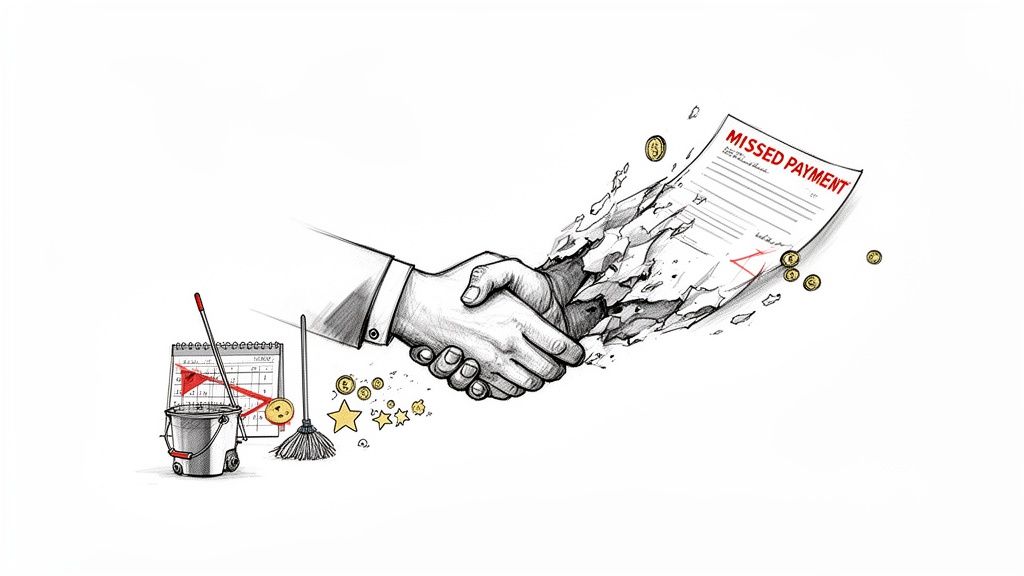
This is where things really go south. When you finally bring up the extra work and ask to be paid for it, the client is caught off guard. In their mind, it was all part of the service. Now you’ve got friction, which leads to late payments, awkward conversations, and a client relationship that’s quickly turning sour. Your only options are to eat the cost of the extra work or risk losing the client and getting a bad review online.
A formal cleaning services contract shuts down this kind of ambiguity from the start. It immediately elevates your business from a casual side gig to a serious, professional operation by setting crystal-clear boundaries for both you and your client.
A contract isn't about planning for a legal battle. It's about creating a mutual understanding so clear that you never have to fight in the first place. Think of it as the blueprint for a great client relationship.
Every solid contract starts with a detailed, accurate estimate. This is where modern tools can give you a huge advantage. An AI-powered estimator from a platform like Estimatty, for example, can produce consistent and thorough estimates that become the financial core of your agreement. When the pricing in your contract is backed by a transparent, data-driven estimate, it builds trust right away and ensures you're profitable from the get-go. For more on this, check out our guide on creating a free cleaning estimate template.
The demand for professional cleaning isn't slowing down. The global market is expected to explode from USD 418.7 billion in 2025 to a massive USD 823.6 billion by 2035. That growth is coming from homes and businesses looking for reliable, long-term cleaners—the kind of pros who use contracts. By making formal agreements a standard part of your process, you position your business to win a piece of that pie, making sure every job is profitable and every client relationship is built to last.
A handshake and a smile are great, but they don't protect your business. This is where you graduate from a promising estimate to a solid, predictable revenue stream. Your cleaning services contract is the foundation of every client relationship—it clearly defines the service you’re providing, how you’ll get paid, and what happens when things don’t go as planned.
Forget those generic, one-size-fits-all templates you find online. A powerful contract is built with specific clauses designed for the realities of the cleaning world. These aren’t just stuffy legal formalities; they are your best tools for preventing misunderstandings, managing expectations, and making sure you get paid for every bit of work you do.
Let's walk through how to build your contract from the ground up, focusing on the essential pieces that will protect and professionalize your business.
This clause is the absolute heart of your agreement. Nine times out of ten, disputes start right here, with a vague scope of work. Phrases like "general cleaning" mean wildly different things to different people. You have to get incredibly specific.
Your goal is to create a crystal-clear checklist that leaves zero room for assumptions. That means detailing not just what you'll clean, but how often you'll do it.
Think about the difference between a residential "Standard Clean" and a "Deep Clean." Your contract needs to spell out that difference in black and white.
Example Language for Scope of Work
This level of detail nips scope creep in the bud before it can even start.
A well-defined Scope of Work is your guarantee. It shows clients exactly what they’re paying for and gives your team a clear roadmap to follow, ensuring you deliver consistent quality every single time.
Once the work is defined, you need to be just as clear about how and when you get paid. Any fuzziness here directly threatens your cash flow. Your contract must plainly state your rates, payment schedule, and what happens if a payment is late.
For recurring services, automating payments is the way to go. Getting clients set up on a recurring billing cycle (like charging them on the 1st of the month for that month's services) makes your income predictable and slashes your admin time.
Your payment clause needs to cover these bases:
This clarity turns the payment process into a standard business procedure, not an awkward conversation.
Every agreement needs a clear beginning and a clear end. The "Term" of the contract simply specifies how long it lasts. It could be a flexible month-to-month agreement, a fixed six-month term, or an annual contract.
Just as important is the "Termination" clause, which explains how either you or the client can end the agreement fairly. This clause stops clients from vanishing without a word and protects you from getting stuck in an unprofitable or difficult relationship.
A fair termination clause usually just requires written notice. For instance: "This agreement may be terminated by either party for any reason with 30 days written notice." This gives you enough runway to adjust your schedule and find a replacement client, smoothing out any potential bumps in your revenue. To make sure your contracts are solid, it’s worth familiarizing yourself with potential breach of contract remedies so you understand the landscape if terms aren't met.
Think of this clause as your professional shield. It shows you’re a serious, responsible business owner and protects both you and your client from accidents. It’s not enough to just have insurance—you need to state it clearly in your contract.
You should always include proof of:
Putting this in your contract builds a massive amount of trust. It tells clients you've taken the right steps to operate professionally and protect their home or office. The initial chat about your services is a great time to bring this up, and our guide on how to master cleaning service estimates can help you frame that conversation perfectly.
Finally, a strong contract explains what you need from the client to do your job well. This isn’t about making demands; it’s about setting the stage for a smooth, efficient service every time.
This clause should cover the practical details that can otherwise throw your whole day off schedule.
By outlining these responsibilities, you prevent lockouts, wasted time, and safety issues, freeing up your team to focus on what they do best: delivering a fantastic clean.
To pull all of this together, here’s a quick-reference guide to the must-have clauses that form the backbone of a strong cleaning service agreement.
This table isn't just a checklist; it's a blueprint for building trust and professionalism. By including these clauses, you’re not just creating a legal document—you’re setting clear, professional boundaries that lead to better, longer-lasting client relationships.
Let's be honest: a fantastic contract doesn't mean much if getting it signed is a pain. A clunky, slow-moving signing process can completely derail the excitement you've built with a new client. The real goal is to make the entire experience feel smooth and professional, guiding them from "I'm interested" to "Where do I sign?" without any friction.
This all starts the moment a potential client asks for an estimate. The accuracy of that first estimate is the bedrock of your cleaning services contracts. When you use a tool like Estimatty to give an instant, precise price, you're doing more than just crunching numbers. You're laying the financial groundwork for the entire relationship. This gets rid of the guesswork, prevents awkward pricing adjustments later, and builds a foundation of trust that makes signing the contract feel like the obvious next step.
Today's clients expect things to be fast and easy. The days of printing, mailing, or hand-delivering paper contracts are long gone. Electronic signatures (e-signatures) are now the standard, and for good reason—they get deals closed quickly and securely.
E-signature platforms are legally binding and provide a clear digital paper trail, logging who signed the document, when, and from where. This simple piece of tech can completely transform your sales process. Instead of anxiously waiting days for a signed contract to come back in the mail, you can often get a digital signature in a matter of hours, if not minutes.
Think of the workflow as a simple, three-part journey that flows directly from your estimate into the final contract.
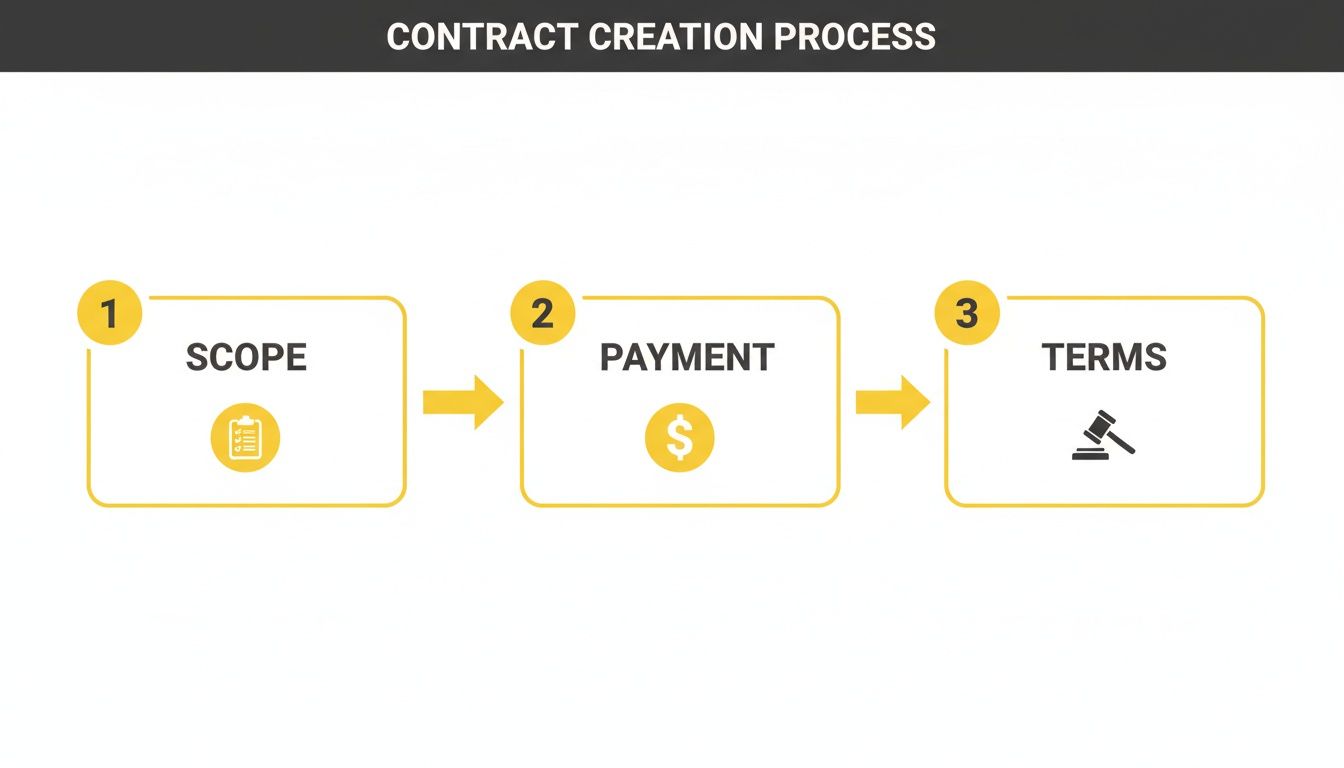
When you frame your process around these three pillars—Scope, Payment, and Terms—you give your clients a clear, logical path to follow.
This isn’t just about saving time. It’s about reinforcing your image as a modern, organized business that respects the client’s time as much as your own. Integrating this workflow is crucial, and you can learn more about how house cleaning booking software can put much of this on autopilot for you.
How you present the contract matters just as much as what's inside it. Never just email the document as a silent attachment and hope for the best. You need to guide your client through it. A quick, confident walkthrough can make all the difference.
When you send the contract over for a signature, add a short, personal message that points them to the key details you already talked about:
This kind of proactive communication clears up potential confusion and shows you're transparent and there to help.
Once the contract is signed, the job isn't quite finished. You absolutely need a reliable and secure place to store these critical documents. Just dropping them into a random folder on your computer is asking for trouble.
A messy filing system is a ticking time bomb. You need to be able to pull up any client's contract instantly to double-check the scope, confirm payment terms, or handle a cancellation request.
Cloud storage services like Google Drive or Dropbox are perfect for this. Get into the habit of using a consistent naming system for your files (like "ClientName_Contract_StartDate.pdf"). It’s a simple trick that makes everything searchable. This ensures that you—or anyone on your team—can access any agreement from anywhere, keeping your operations running like a well-oiled machine.
You can have the most beautifully written contract in the world, but if it doesn't hold up in your specific city or state, it's not worth the paper it's printed on. Think of it this way: your cleaning services contracts aren't just about defining the job; they have to perfectly sync up with local regulations to have any real legal muscle. Skipping this step is one of the fastest ways to expose your business to some serious, and often surprising, liabilities.
Now, I'm not a lawyer, but I’ve seen enough to know that the rules for service providers can be wildly different from one place to the next. Some states, for instance, have strict consumer protection laws that spell out exactly what you need to include, like mandatory "cooling-off" periods for cancellations or crystal-clear pricing disclosures. Miss one of those, and a judge could throw out a key part of your agreement when you need it most.
It's so tempting to just grab a generic template off the internet and run with it, but that's a huge gamble. A contract designed for a business in Florida might completely miss crucial requirements for a cleaner in California, where the rules around worker classification are a legal minefield.
Speaking of worker classification, this is one area where you absolutely cannot afford to make a mistake, especially as you start to grow and bring on other cleaners. Misclassifying someone as an independent contractor when the law sees them as an employee can bury you in back taxes, steep fines, and messy legal fights.
It really boils down to how much control you have over the person doing the work.
When you're ready to build a team, you've got to nail this distinction from day one. It's why many growing cleaning companies turn to specialized hiring platforms. For example, finding pros on a site like pipehirehrm.com connects you with people who are already used to the contractor model. But remember, the ultimate responsibility for complying with labor laws still falls squarely on your shoulders.
Paying a lawyer to review your contract template is not an optional expense. It’s a foundational investment in your business, just like your equipment. A small upfront cost can save you from a catastrophic financial blow later.
Your contract is the perfect place to show off that you're insured, but first, you have to be sure you have the right kind of insurance. Being underinsured is almost as bad as having no insurance at all. Picture this: one of your crew accidentally uses the wrong chemical and completely ruins a client's brand-new $10,000 hardwood floor. If your general liability policy only covers up to $5,000, guess who's paying the rest? You are.
Here’s what I consider the bare minimum for any serious cleaning business:
When your contract is legally sound and backed by solid insurance, you're doing more than just protecting yourself. You're building a professional, trustworthy business that's ready for long-term growth. For more on setting up your business correctly from the get-go, our guide on how to start a cleaning business is the perfect next step.
You’ve put in the work and drafted a rock-solid contract. Now for the moment of truth: walking the client through it. This conversation is where you turn a piece of paper into the foundation of a real partnership. How you handle this stage with confidence and transparency is what separates the seasoned pros from the rest.
The trick is to frame the contract as a mutual "blueprint for success." You’re not just handing over a document; you’re guiding them through a shared understanding of how your professional relationship will work. When you approach it this way, a potentially stuffy legal step becomes an exercise in building trust.
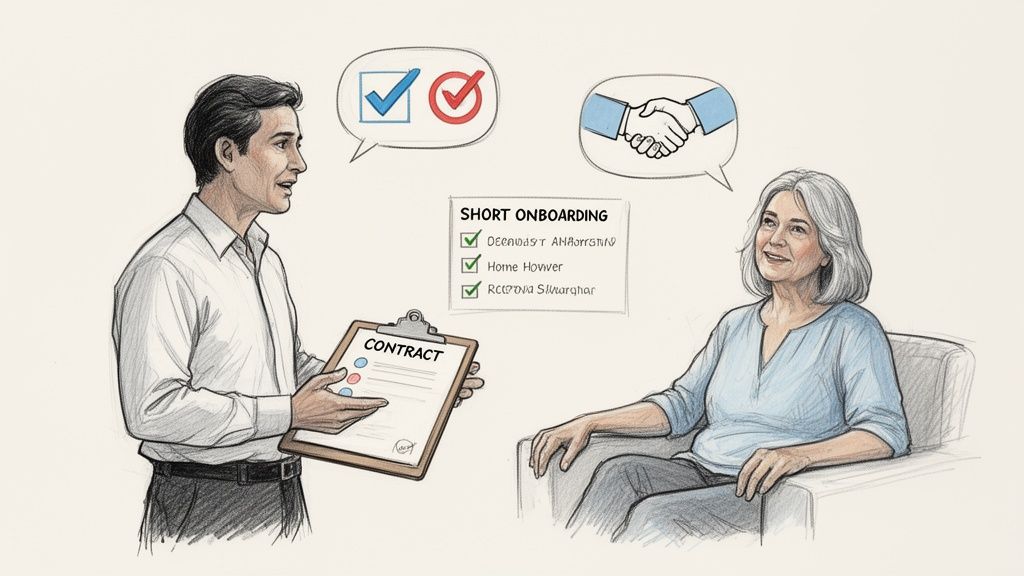
When you present your cleaning services contract, most clients will zero in on a few specific areas. Your job is to be ready to explain them in simple, reassuring terms. Ditch the legalistic language and focus on the practical "why" behind each clause.
Take the cancellation policy, for example. Don't just point to the fee. Give them the context from your business's perspective.
Suddenly, a potentially harsh rule becomes a reasonable practice that supports your staff. The same logic applies to liability—frame it as proof of your professionalism and a commitment to their peace of mind.
Every so often, a client will ask for a change. Don't panic. This is a completely normal part of doing business. The key is to listen carefully to their concern and, more importantly, to know your non-negotiables before you even start the conversation.
Most negotiations will circle around a few common points:
If a client pushes back hard on standard, protective clauses like your liability limits or late fees, consider it a potential red flag. A great client understands that you’re running a legitimate business and need to protect it.
Securing cleaning services contracts is a massive driver of profitability. This is especially true in North America, which accounts for 36.8% of the global market. Residential cleaning business owners report that recurring contracts can boost client retention by a staggering 40-50%, locking in revenue and guaranteeing work. You can find more industry data in the cleaning services market analysis on Research Nester.
Getting that signature is a huge win, but your work isn't done. A smooth, organized onboarding process immediately validates the client's decision and sets you up for a flawless first clean. The contract is signed; now it’s time to deliver.
Here’s a simple checklist to run through right after the ink is dry:
This structured onboarding shows you're organized and ready to make good on your promises. It’s also the perfect moment to think about tools that make client management easier. Exploring how AI sales automation for cleaning services can help you manage these initial communications is a great next step. By mastering this final phase, you’re not just starting a new job; you're kicking off a valuable, long-term relationship built on clarity and trust from day one.
Even the most iron-clad agreement is going to spark a few questions. That's just part of the business. Let's walk through some of the most common curveballs cleaning business owners face and how to handle them with confidence.
Think of this as your playbook for those "what if" scenarios. Having solid answers ready not only makes you look like a pro but also shows your clients that your agreement is fair, transparent, and built to handle real-world situations.
You know the one. You're just finishing up, and the client asks, "While you're here, could you just quickly wipe down the inside of the kitchen cabinets?" That's scope creep in a nutshell, and your contract is your best friend in this moment.
The trick is to have a clause ready for exactly this situation. Your agreement should make it clear that any work falling outside the original Scope of Work is considered an add-on and will be billed accordingly. You can handle it with a quick addendum sent via email for their approval or a more formal change order. This simple process turns a potentially awkward moment into a straightforward business transaction, protecting your time and your bottom line.
It's tempting, I get it. Grabbing a generic template online seems like a quick, free win. But honestly, it's a huge gamble. These one-size-fits-all documents often leave you exposed because they don't account for your specific state or local laws, which can make entire sections of your contract useless.
A free template is a starting point, not a finished product. It's missing the specific protections your cleaning business needs—things like how you'll handle client keys, alarm codes, or what happens if a pet is underfoot.
Treat any template as a rough draft. Your non-negotiable next step should always be to have a lawyer review the final version. That small investment upfront is what ensures your contract actually protects your business when you need it most.
Last-minute cancellations can throw your entire week's schedule—and your revenue—into chaos. This is why a crystal-clear Cancellation or Termination clause in your cleaning services contract isn't just nice to have; it's essential.
Get specific. Lay out the exact notice period a client must provide to cancel services without a penalty, like 30 days written notice. It's also smart business to outline any fees for bailing on the agreement early or for last-minute appointment changes. For instance, charging 50% of the service fee for any cancellation within 24 hours is a pretty standard practice. This policy doesn't just protect you from lost income; it compensates you for the spot you held open for them.
Of course, to fulfill these contracts as you grow, you need a team you can count on. Finding great cleaners can feel like a huge hurdle, but specialized platforms like pipehirehrm.com are built to connect growing businesses with experienced pros. You can find more tips on building a killer team over on the Pipehire blog.
Ready to stop chasing leads and start closing deals automatically? Estimatty is the AI-powered sales agent that delivers instant, accurate estimates to your prospects 24/7, turning website visitors and callers into booked jobs. Standardize your pricing, eliminate guesswork, and build the professional foundation your cleaning services contracts need. Learn more and see how Estimatty can transform your sales process today!