
If you’re running a cleaning business, grabbing a free cleaning estimate template is one of the smartest first moves you can make. It immediately elevates your game. You’re no longer the person scribbling numbers on a notepad; you're a professional who's organized, serious, and ready to deliver.
Why A Basic Template Is Just The Starting Point
A good template is your foundation, no doubt about it. But let's be honest—looking professional is only half the battle. Winning the job is what really counts. And that often comes down to three things: speed, accuracy, and consistency. Sticking with a manual template can, without you even realizing it, create frustrating bottlenecks that cost you clients.
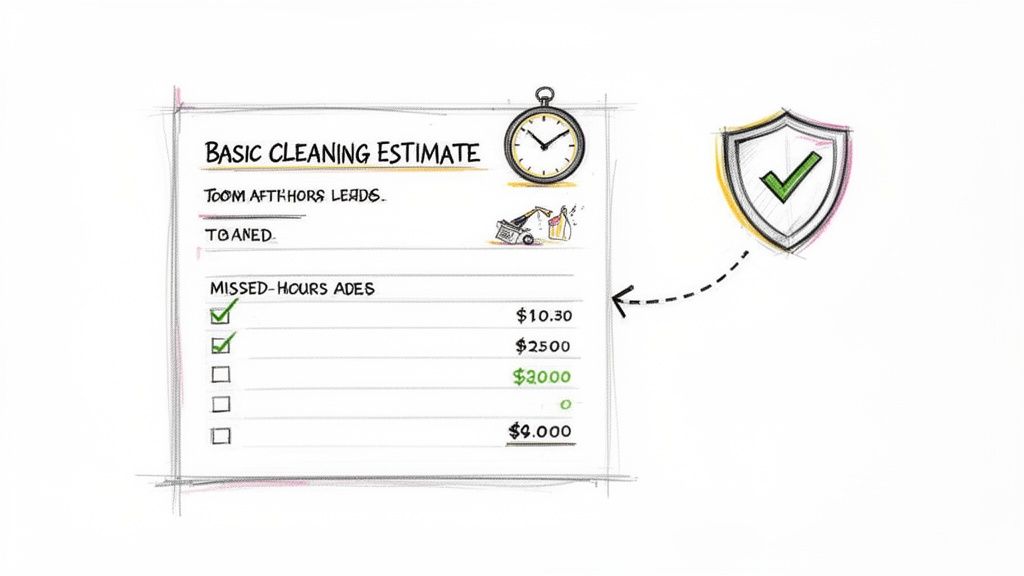
Think about this common scenario: A potential customer calls you at 8 PM on a Tuesday. They’re motivated and ready to book, but you're at home, away from your computer. You tell them you'll get them an estimate in the morning. By the time you wake up, they’ve already booked with a competitor who gave them a price on the spot. It happens all the time—some data suggests up to 70% of after-hours inquiries get lost in the shuffle without an instant response.
The Real Cost of Manual Estimates
When you rely on a static PDF or Excel sheet, every single estimate is a manual chore. This cracks the door wide open for inconsistencies, especially if you have more than one person sending out estimates.
Maybe one team member forgets to add your standard fee for homes with pets. Another might calculate the square footage costs a bit differently. These little mistakes seem minor, but they add up fast, eating into your profits and chipping away at your professional reputation.
The problem isn't the template itself; it's the manual process behind it. The goal should be to deliver a fast, accurate, and professional estimate every single time, which is nearly impossible to scale by hand.
The cleaning industry is incredibly competitive. In the US, the janitorial services market is on track to hit $112 billion in revenue this year, with over 1.25 million businesses all fighting for the same clients. In a market that crowded, speed is your secret weapon.
Let's break down the real-world differences between using a static template and an automated system for your cleaning estimates.
Manual Estimates Vs Modern Solutions A Quick Comparison
As you can see, while a manual template gets the job done, an automated system is built to help you grow.
Moving Beyond Basic Tools
Think of a free cleaning estimate template as your entry ticket—it gets you in the door. It’s perfect for structuring your services and getting your pricing organized. But to really scale your business, you need a system that works for you around the clock.
Modern solutions put the entire process on autopilot, making sure every single lead gets an accurate, professional estimate in minutes, not hours. This does more than just capture business you might have otherwise lost. It frees you up to focus on what truly matters: delivering amazing cleaning services. In fact, some companies have seen their sales double after implementing instant estimates.
Building Your Perfect Free Cleaning Estimate Template
Let's be honest, that generic template you downloaded is just a starting point. To turn it into a tool that actually wins you jobs, you need to infuse it with your own brand of professionalism. Think of your estimate as more than just a price list; it's your silent salesperson, working to build trust and show off your expertise before you even start scrubbing.
Every single field on that page has a job to do. It’s either there to protect your business, manage client expectations, or make that potential customer feel completely confident they’re hiring the right pro. If you skimp on the details now, you're just setting yourself up for headaches and disputes later on.
The Must-Have Components for a Killer Estimate
To make your template work for you, it needs to be rock-solid. Each piece plays a part in communicating your value and spelling out exactly what the client is getting for their money.
Here are the non-negotiables your template absolutely needs:
- Your Company Branding: Get your logo, company name, phone number, and email right at the top. Make it look sharp and make it easy for them to call you back.
- Client Information: You need dedicated spots for the client's name, the service address, their phone number, and email. Getting this right from the jump is crucial for everything that follows.
- The Nitty-Gritty Details: Give every estimate a unique number for your own records. Also, include a "Date Issued" and, this is important, a "Valid Until" date. Stating that the price is good for 30 days creates a little urgency without being pushy.
- A Crystal-Clear Scope of Work: This is where the magic happens. Don’t just write "clean kitchen." That’s a recipe for disaster. Break it down into a checklist of what you'll actually be doing.
For instance, under "Kitchen," you should have separate line items like "Clean and sanitize countertops," "Wipe down cabinet exteriors," "Clean inside of microwave," and "Mop floor." This level of detail isn't just about covering your bases; it shows the client exactly what they're paying for. If you're looking to master this, we've got more in-depth strategies on how to estimate cleaning jobs that can really help you dial in your process.
A detailed scope of work does more than just list tasks; it visually demonstrates the thoroughness and high standard of care you bring to every job. It justifies your pricing and leaves no room for ambiguity.
How to Structure Your Pricing and Add-Ons
Nothing kills trust faster than confusing pricing. Your free cleaning estimate template needs to lay out the costs so clearly that a client can immediately connect every dollar to a specific service. It’s all about transparency.
Here’s a simple way to present your pricing:
- Itemized Service List: Break down the costs. If you charge a flat rate, you can list the total for each major area (e.g., Kitchen - $75, Bathrooms - $100).
- Subtotal: Add up the cost of all the main services. Simple.
- Optional Add-On Services: This is your secret weapon for boosting the value of a job. Have a separate section for extras people always want, like cleaning inside the oven, washing interior windows, or deep cleaning baseboards. Put a price next to each so the client can build their perfect clean.
- Taxes and Fees: Be upfront about any sales tax. No one likes surprises.
- Grand Total: The final, all-in number. Make it bold and easy to find.
Don't Forget the Fine Print (Your Terms and Conditions)
This little section is your safety net. You don’t need a lawyer to write a novel here, but a few key points can save you from major problems down the road.
Tuck in a few brief statements covering the basics:
- Payment Terms: When do you expect to get paid? A simple "Payment due upon completion of service" works perfectly.
- Cancellation Policy: What happens if they cancel at the last minute? A common practice is: "A fee of $50 will be charged for cancellations made less than 24 hours before the scheduled service."
- Satisfaction Guarantee: This is a huge selling point. Something like, "We offer a 24-hour satisfaction guarantee," shows you stand by your work and builds instant confidence.
- Service Limitations: Be clear about what you don't do. Maybe you don’t handle biohazards or lift objects over 25 pounds. Stating this upfront manages expectations and prevents awkward situations.
By baking these elements directly into your template, you're creating a document that does so much more than provide a price. It markets your business, protects you legally, and lays the groundwork for a fantastic, long-lasting client relationship.
How To Price Your Cleaning Services For Profit
Let's talk about the single most important decision you'll make for your cleaning business: pricing. Get it right, and you build a thriving company. Get it wrong, and you're stuck in a cycle of being overworked and underpaid.
If you price too high, you might struggle to land jobs. But price too low, and you'll burn out without ever turning a real profit. It's time to stop guessing and start calculating. A good free cleaning estimate template is a fantastic starting point, but its real power comes from the numbers you plug into it.
This isn't just about covering your costs—it's about building a business that lasts.
Think of it as a simple, three-part process. You gather the details, define the scope, and then you can nail the pricing.
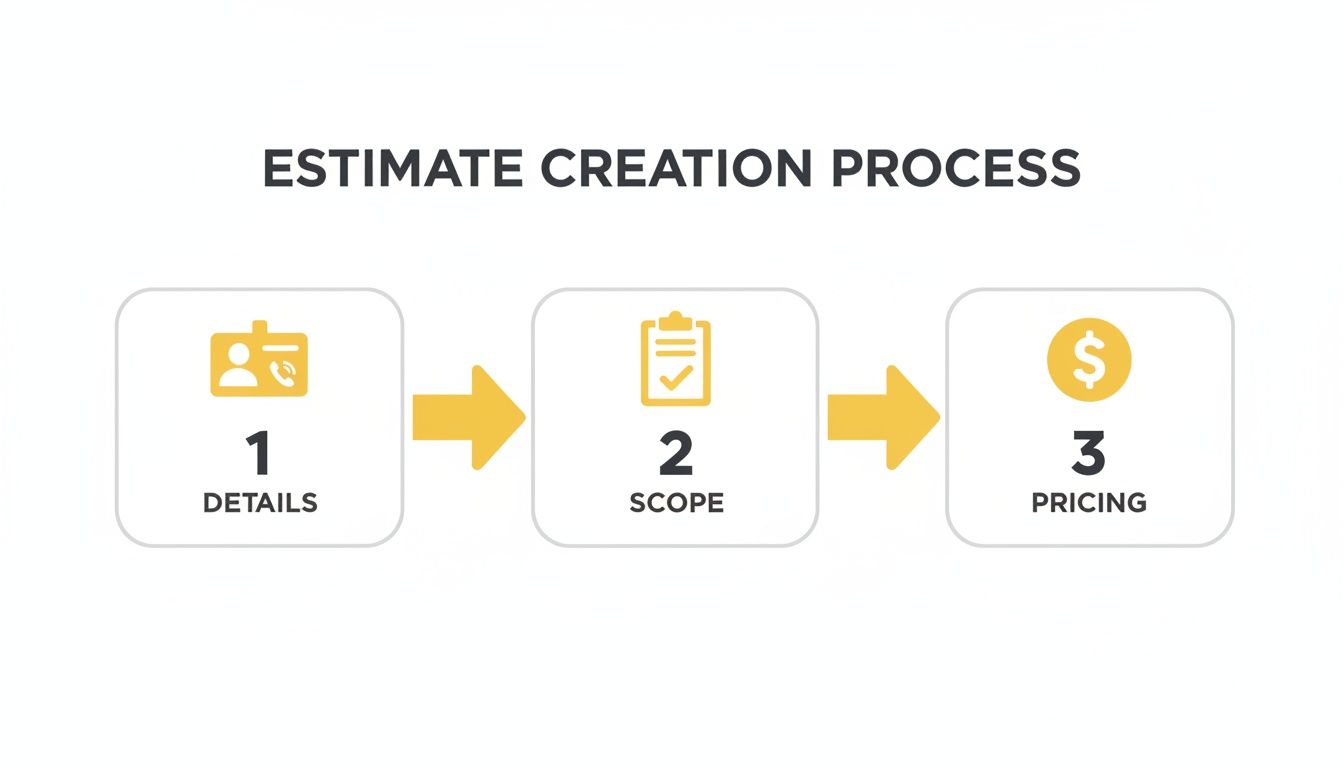
As you can see, accurate pricing is the final, critical step that pulls everything together. It all depends on how well you've done your homework on the client's needs and the specifics of the job.
Finding Your Profitable Pricing Model
In my experience, most cleaning jobs fall into one of three pricing models. Picking the right one for the situation makes all the difference.
- Hourly Rate: This is your best friend for jobs with a lot of unknowns. Think first-time deep cleans, hoarding situations, or post-construction messes. It protects you and ensures you get paid for every single minute of hard work.
- Flat-Rate Pricing: Once you know a space, a flat rate is the way to go. It's perfect for those recurring residential gigs where you can predict your time down to the minute. Clients absolutely love the predictability, which makes closing the deal that much easier.
- Per-Square-Foot Rate: This is the gold standard for most commercial contracts. It’s a clean, straightforward way to bid on large offices, warehouses, or retail stores.
Key takeaway: Whichever model you lean on, your price must cover every single business expense. I'm talking about supplies, insurance, marketing, gas for your vehicle, and even the cost of finding and keeping great cleaning employees.
The Simple Formula For Your Hourly Rate
Even if you plan to offer flat rates, you absolutely need to know your baseline hourly rate. It’s the foundation for every estimate you send, guaranteeing that every job is actually making you money.
Here's a bare-bones way to figure it out: (Your Desired Salary + Business Expenses) / Billable Hours = Your Base Hourly Rate.
From there, you need to add your profit margin. A healthy margin is typically between 15-30%. This is what you'll add to your base rate to get the final price you show your clients. This is how you move from just breaking even to actively growing your business.
For a much deeper look at the numbers, check out our complete guide on how to price cleaning services to maximize your profits.
Don't underestimate the opportunity here. Projections show that North America will command 31.55% of the entire global cleaning services market in 2025—a market valued at a staggering $425.645 billion. The U.S. alone accounts for over 80% of that regional market share.
Standardizing your pricing strategy isn't just about making a living; it's about claiming your piece of this massive growth. Nailing this from day one is how you build a real, profitable business.
Tailoring Estimates For Residential vs. Commercial Clients
If you’re using the same estimate template for a suburban home and a downtown office building, you’re leaving money on the table. It’s a rookie mistake. The simple truth is, a homeowner and a facility manager are looking for completely different things, and your estimate needs to speak their language.
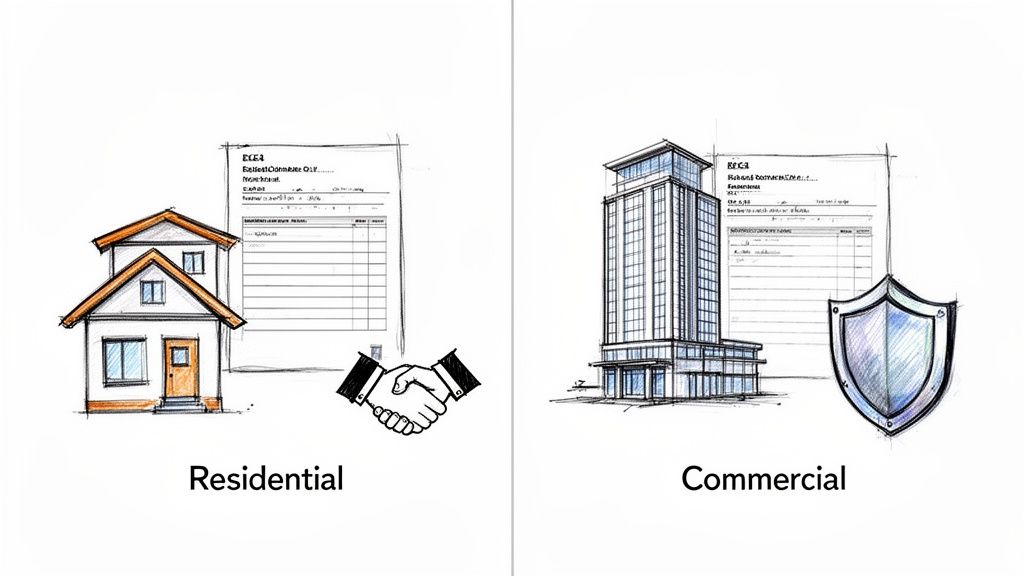
The difference isn't just about the size of the space; it’s about the mindset of the buyer. For a homeowner, it’s a personal, emotional decision. For a business, it’s a practical line item in a budget, driven by liability and reliability. Your free cleaning estimate template has to be flexible enough to nail both.
Connecting with Residential Clients
When you're writing an estimate for a homeowner, you're not just selling a service; you're asking for an invitation into their sanctuary. Your estimate needs to build trust from the first line.
Forget cold, corporate jargon. Use language that shows you understand what they care about. Instead of a generic "clean kitchen" line item, get specific: "sanitize countertops and sinks," "wipe down cabinet fronts," and "clean inside of microwave." This isn’t just padding; it’s proof that you’re meticulous and professional.
Here’s what to focus on for residential jobs:
- Build Trust Immediately: Put your satisfaction guarantee front and center. Mentioning that your teams are background-checked is a huge selling point.
- Offer Customization: Give them control. Present optional add-ons like "deep clean oven" or "interior window washing" so they can build the perfect clean for their budget.
- Keep It Simple: Your terms should be straightforward. No legalese. Just the basics on your cancellation policy and how they can pay you.
Winning Over Commercial Clients
Okay, now let's talk business—literally. Commercial estimates are a different beast entirely. Here, the decision-maker is all about professionalism, compliance, and the bottom line. Your proposal must be buttoned-up, formal, and leave zero room for interpretation. They need to know you're a serious vendor, not a side hustle.
Your commercial estimate isn’t just a price; it’s a business proposal. It needs to show you get their operational needs, from security protocols to the specific cleaning standards their industry demands.
For these clients, your estimate is incomplete without:
- Proof of Insurance: Don't make them ask. Prominently display your liability insurance and bonding information. For most businesses, this is a non-negotiable.
- A Detailed Service Schedule: Be explicit. Clearly define the cleaning frequency—daily, weekly, bi-weekly—and what gets done on each visit.
- Professional Language: Stick to industry-standard terms. This isn't the time for casual chatter; maintain a formal tone from top to bottom.
- Rock-Solid Contract Terms: Include specifics on contract length, how to terminate the agreement, and the process for handling special requests or resolving issues.
A commercial client is looking for a partner who makes their job easier, not harder. As you grow, having a reliable team is everything. Using resources like Pipehire can help you find and manage the kind of professional staff that commercial clients demand, a point often emphasized on their hiring and management blog. Ultimately, your ability to adapt your proposals will determine whether you can successfully tap into both of these lucrative markets.
From Estimate to Booked Job: The Art of the Follow-Up
You’ve put in the work. You walked the property, crunched the numbers, and sent off a sharp, professional-looking estimate. So, you’re done, right? Not even close. Hitting ‘send’ is just the starting gun.
The real difference between a pile of ignored estimates and a booked schedule is a solid follow-up game. I’ve seen countless cleaning businesses drop the ball here. They create a perfect proposal and then just wait, letting a red-hot lead turn ice-cold because they don’t have a simple plan.
Remember, a great follow-up isn’t about being annoying. It's about being helpful. Your potential client is juggling a dozen other things. They probably got a few estimates and are trying to decide. A simple, well-timed nudge from you can be the thing that pushes them over the edge and gets you the job.
A Simple Follow-Up Timeline That Works
You don't need some complex, high-pressure sales system. All you need is a simple, repeatable timeline. Consistency here can boost your booking rates more than you’d think.
Here's a battle-tested sequence I've used for years:
The 24-Hour Check-In: The day after you send the estimate, a quick, friendly message is all it takes. A text or email like, "Hi [Client Name], just wanted to make sure you received the estimate we sent over yesterday. Let me know if you have any questions!" is perfect. It's low-pressure and confirms they got it.
The 3-Day Nudge: If you still haven’t heard anything after a few days, it’s time for another touchpoint. This time, add a little value. Try something like, "Hi [Client Name], just following up on the cleaning estimate. Are there any adjustments you'd like to discuss? We're happy to tailor the service to fit your exact needs." This opens the door for a conversation.
The 7-Day Final Touch: If a week goes by with silence, it’s time for one last polite check-in. "Hi [Client Name], checking in one last time. We'd love the opportunity to work with you. If you've decided to go another direction, no problem at all!" This shows you’re professional and closes the loop without burning a bridge.
Here's a hard truth: The speed of your initial estimate and follow-up is critical. Sticking to manual estimating can cause a 40-50% spike in callbacks and lost leads, especially for after-hours inquiries. Owners who nail this process often see booking rates jump by 25-35%.
The Smart Move: Automating Your Follow-Up
Let's be real—running a business is chaotic. Manually tracking every single follow-up is a recipe for missed opportunities. This is exactly why automation tools like Estimatty are so powerful. They can instantly deliver your estimate and then run that follow-up sequence for you without you lifting a finger.
An automated system acts as your perfect assistant, making sure no lead ever slips through the cracks. It engages them at just the right time, freeing you up to focus on what you do best: providing an amazing cleaning service.
Of course, getting those leads in the first place is key. Having a solid online presence with good house cleaning SEO gets you found, and knowing how to advertise your cleaning services will keep that pipeline full.
When It's Time to Ditch the Templates for an Automated System
That free cleaning estimate template has probably been a real workhorse for you. It's gotten your name out there, helped you look professional, and kept your pricing organized. But if you’re growing, there comes a point where that trusty template starts feeling less like a helpful tool and more like an anchor holding you back.
So, how do you know you've hit that wall? The signs are usually pretty obvious. You're suddenly spending hours every week bogged down in paperwork, punching numbers into a spreadsheet instead of leading your crew. Or worse, you're losing out on hot leads that inquire after hours because you can't get an estimate to them fast enough.
Are You Hitting These Growth Bottlenecks?
The turning point isn't just about feeling busy; it's when your manual process starts costing you real money. It's when you're losing jobs you should have won.
Take a hard look at your current process and ask yourself:
- Is my pricing always consistent? Can you say with 100% certainty that every estimate going out the door has the correct pricing, with all the right add-ons and fees, no matter who creates it?
- Am I catching every single lead? What happens when a potential customer is ready to book at 9 PM on a Friday? Are they leaving a voicemail you won’t hear until Monday morning, or are they getting an instant, professional estimate that lets them book on the spot?
- How many hours are truly spent on estimates? Tally up the time you and your team spend on this one task. That time has a real dollar value—a value that could be poured back into marketing, training, or just about anything else that grows your business.
If those questions make you a little uncomfortable, that's a good sign. It means you've officially outgrown your templates. It's time to stop being the bottleneck and build a system that works for you 24/7.
The goal isn't to replace your expertise. It's to give you a powerful tool that helps you scale your business smarter, not just work harder. Automation frees you up to focus on delivering amazing service and managing your team—that's where the real growth happens.
Think of an automated tool like Estimatty as your new, round-the-clock sales agent. It’s on your website, ready to engage every visitor instantly, delivering perfectly accurate estimates based on your specific rules. It even knows how to upsell your most profitable add-on services, all on its own.
You’ll no longer have to sweat over missed calls or worry that a team member sent out an estimate with the wrong pricing. To see how a system like this fits into your bigger picture, check out our guide on the best CRM for cleaning businesses.
This isn't just a small upgrade for convenience's sake. It's about creating a modern, seamless customer experience that turns curious visitors into booked jobs, even while you sleep. Making the leap from a static template to an automated system is probably the single most impactful move you can make to scale your cleaning business.
Ready to stop leaving money on the table and start automating your growth? Estimatty is your 24/7 sales agent, delivering instant, accurate cleaning estimates so you can focus on what you do best.