September 21, 2026
Inside and Out Cleaning: A Practical Pricing Guide
Learn what inside and out cleaning really includes, how pricing works, and which add-ons actually pay off for residential and commercial estimates.
Friday, January 23, 2026
Discover how to price cleaning services for maximum profit. This guide covers pricing models, cost analysis, and expert strategies to set profitable rates.
.avif)
Before you can tell a client what you charge, you have to know what it costs you to run your business. I'm not just talking about the price of Windex and paper towels. This is about building the financial bedrock that separates a thriving cleaning company from one that's always chasing its tail.
Getting your costs wrong is the single fastest way to lose money on a job you thought was a winner. It's a classic rookie mistake.
The goal here is to find your "break-even" number. Think of it as the absolute minimum you have to earn per hour just to keep the lights on, before you even think about making a profit. Nailing this number is the most crucial part of the entire pricing puzzle. It’s what keeps you from falling into the underpricing trap that sinks so many new cleaning businesses.
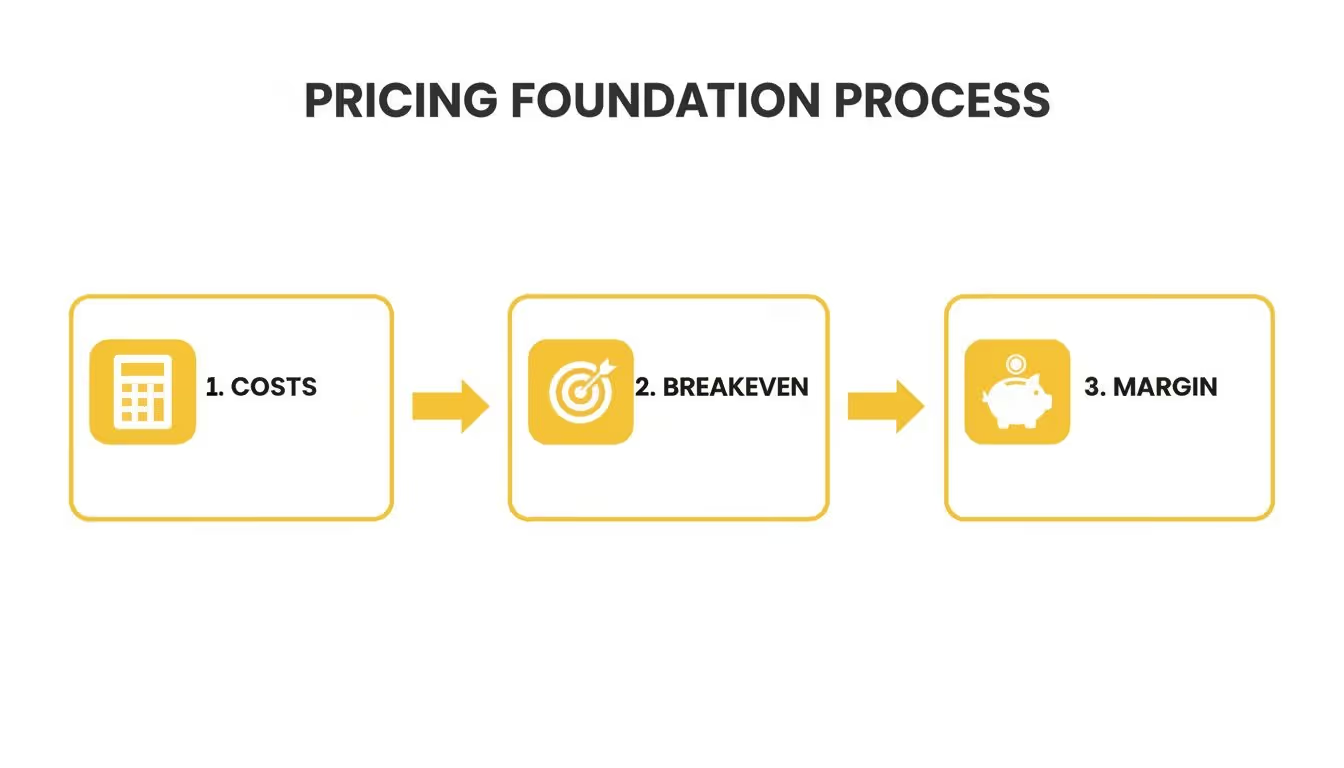
Your business expenses really fall into two buckets: the costs directly tied to a job and the overhead that’s always there, whether you’re cleaning one house or one hundred.
Forgetting small things like bank fees or the wear-and-tear on your equipment might seem minor, but those little costs add up and will quietly eat away at your profits. A detailed checklist is your best friend here.
The biggest mistake I see is owners focusing only on labor and supplies. Real, sustainable profit comes from accounting for every single penny it takes to operate—from the gas in your car to the software that runs your schedule. This isn't optional.
Once you've got a handle on every expense, you can figure out your real hourly operating rate. This powerful number tells you exactly what it costs for one of your cleaners to be working for one hour. You’re essentially bundling all your expenses—labor, supplies, and a slice of your monthly overhead—into a single, easy-to-use figure.
This clarity isn't just about profit; it's about safety, too. When you know your numbers, you can afford to invest in the right training and equipment, which is non-negotiable for managing on-the-job risks. For a deeper dive, check out our guide on how better intake systems can protect your team from unexpected hazards.
Industry data really drives this point home. For a typical small cleaning business, supplies might be 10% of your costs, but labor eats up 40-50%, and overhead can easily hit another 20%. That leaves you with a potential profit margin of 25-30%—but only if you've priced correctly from the start. It’s no surprise that underpricing is a major reason why nearly 30% of cleaning businesses don't make it past their first three years.
Let's walk through a quick example to see how this works in the real world. This cost-plus approach is the simplest way to ensure you're profitable on every job.
See? When you build your price this way, you're not just guessing. You're guaranteeing that your $52.65 hourly rate covers everything and leaves you with a healthy profit. This is the financial foundation you need to build a lasting, successful business.

Okay, you've crunched the numbers and know what it costs to run your business. Now comes the interesting part: deciding how you're going to charge your clients.
This isn't just about math; it's about psychology. The right model makes it easy for customers to say "yes," while the wrong one can create hesitation and kill a sale before you even get a chance to show them your work. Let's walk through the most common ways to price your services so you can pick the one that fits you best.
Charging by the hour is often the first stop for new cleaning businesses, and for good reason. It’s straightforward and feels safe, especially when you're dealing with jobs that are hard to predict—think post-construction chaos or a first-time deep clean on a neglected home. If the job takes an extra two hours, you’re covered. Simple.
But here’s the catch: customers get nervous about a running clock. That fear of an unknown final bill can be a real deal-breaker. Worse, it can subtly position you as inefficient; the slower you work, the more you earn. It’s a perception you absolutely want to avoid. While it has its place for unpredictable, one-off jobs, it can be a tough sell for the recurring residential clients who want budget certainty.
This is where you give one all-inclusive price for a specific list of tasks. Homeowners love this. Why? No surprises. They know exactly what they're paying upfront, which removes all the anxiety of hourly billing. Honestly, just offering a flat rate can be a powerful sales tool on its own.
The risk, of course, lands squarely on your shoulders. You have to get good at estimating your time, and fast. Underbid a job, and you're working for a fraction of your target rate. This model forces you to be incredibly efficient and to have a rock-solid cleaning checklist that defines exactly what's included. You'll make some mistakes at first—we all do—but once you dial it in, it’s a game-changer.
Offering a flat rate isn't just a pricing choice; it's a statement of confidence. It tells the client, "I know exactly what this job takes, and I stand behind my price." That confidence is often what closes the deal.
While hourly and flat-rate are the two big players, a few other methods work brilliantly in specific scenarios. Think of these as smart alternatives that can give you an edge.
Don't just take my word for it. The data shows that package pricing can lead to 35% more bookings for residential services compared to straight hourly rates. Customers are voting with their wallets for fixed-price options, a trend that’s helping fuel the global home cleaning market's growth from USD 8.7 billion to an expected USD 12.8 billion by 2030. You can dig into more of that data over at MarketResearch.com.
To help you decide, here’s a quick breakdown of how these models stack up against each other from a business owner's perspective.
Ultimately, choosing a single model isn't a lifetime commitment. Many of the most successful cleaning companies I know use a hybrid approach. They'll use flat rates for their bread-and-butter recurring clients but flip to an hourly model for that one-off, super-custom project.
The goal is to pick a primary model that makes your sales process feel effortless. Having tools that can handle this logic for you is a huge advantage. It's why we eventually learned how a cleaning team built a 24/7 AI sales agent—to solve this exact challenge and give customers instant, accurate quotes no matter the model.
Knowing your costs and picking a pricing model is like having a solid internal compass. But you still need to look at the external map: your local market. The final price you set is a delicate dance between what your numbers say you need to charge and what people in your area will actually pay. This is where we move from theory to real-world profitability.
Your goal is to find that sweet spot. You want rates competitive enough to get your foot in the door, but high enough to reflect your value and build a business that lasts. It's a common fear to price too high and scare people away, but I can tell you from experience that pricing too low is a guaranteed path to burnout and business failure.
First things first, you have to understand what your competitors are charging. Forget about awkwardly cold-calling your rivals to ask for their price list. You can gather a ton of intel discreetly just by being a savvy online detective.
Start by Googling "house cleaning services in [your city]" and see who pops up on the first page. These are your most visible competitors. Fire up a simple spreadsheet and start digging into their websites.
After checking out three to five local companies, you'll have a much clearer picture of the going rates. This isn't about copying them; it's about establishing a benchmark so you know where you fit in.
With your own costs calculated and market data in hand, it's time to apply a strategic profit margin. This isn't a random guess. It's a conscious business decision that defines your brand's position in the market. A higher markup signals a premium, detail-oriented service, while a lower one might position you as a budget-friendly option.
Your markup should reflect a few key things:
Don’t compete on being the cheapest. Compete on being the best value. Clients who hire based on price alone are rarely loyal and will leave you the second a cheaper option appears.
Knowing the typical pricing structures in your region is also a huge advantage. In North America, which holds a massive 37.65% share of the global cleaning market, a common approach is blending hourly and square footage rates. It's typical to see hourly rates averaging $25 to $50, often adjusted by property size, with standard services falling between $0.10 and $0.25 per square foot. You can discover more insights about global cleaning service market trends on fortunebusinessinsights.com.
Let's bring this all together with a quick example. Imagine your total hourly cost—your absolute break-even point—is $35 per hour.
Your market research shows that local competitors are charging anywhere from $45 to $60 per hour. You've decided to position yourself as a premium, reliable service with excellent reviews. Based on this, you land on a 40% markup for profit.
This rate puts you right in the sweet spot of the local market—not the cheapest, not the most expensive. Most importantly, it ensures you’re building a healthy profit on every single hour you work. This data-driven approach is how you price with confidence.
Of course, getting accurate property details like square footage is essential for this to work. Many owners find that automating this first step is a game-changer. As one Estimatty user told us, "[Estimatty] texts me the square footage & I lock it in, which cuts down on guesswork and streamlines their entire quoting workflow.
Getting your base price right lands you the job. But if you want to build a real business—one that grows and thrives—you have to think bigger. It's about shifting your mindset from just earning a paycheck on Friday to maximizing the lifetime value of every single client you bring on board.
This is where you go from being a cleaner to being a business owner. You start building multiple streams of income from the customers you already have, creating a service menu that doesn't just cover your bills but actively fuels your growth.
The single easiest way to boost your revenue on any given job is with high-margin add-on services. These are the little extras that clients are more than happy to pay for but often don't think to ask for themselves. Think of it as the à la carte menu that perfectly complements your main cleaning packages.
Your goal here is to offer simple solutions to common household headaches. These small additions can make a huge difference to your bottom line without adding much time or effort to your visit.
Here are a few no-brainers that always sell well:
The best add-ons solve a specific, nagging problem. When you frame it as, "Let us handle that greasy oven for you," the value is crystal clear. It makes the price an easy "yes."
Discounts are a powerful tool, but they can also be dangerous. Randomly slashing prices just to win a job devalues your work and attracts the wrong kind of clients—the bargain hunters. The trick is to use discounts to encourage the behavior you want: long-term commitment and predictable cash flow.
Hands down, the most effective strategy is offering a discount for recurring service. This is the bedrock of a stable cleaning business.
Let's Look at an Example:
Imagine your one-time deep clean for a particular home is $300. Instead of just offering a flimsy 10% off coupon, structure your pricing to reward frequency:
See what that does? It’s not just a discount; it’s a clear path showing the client how much they save by committing. They get a great deal, and you lock in predictable, recurring revenue. Of course, this all starts with knowing how to get residential cleaning clients in the first place.
Your happiest customers are your best salespeople, but they're not on your payroll... yet. A simple referral program can turn their praise into a steady stream of qualified leads who already trust you. You don't need fancy software; a straightforward "give-get" model works like a charm.
Here’s the simple structure:
This is a win-win-win. Your loyal client feels appreciated, the new customer gets a warm welcome, and you land a new client for a tiny acquisition cost.
Of course, none of this matters if your website isn't set up to convert lookers into bookers. That's why it's also crucial to use proven CRO tips to make your offers impossible to resist. When you combine smart upsells, recurring discounts, and a solid referral system, you're building a business that doesn't just survive—it thrives.
If you're still pricing jobs based on a "gut feeling" or scribbled notes on a napkin, you're not alone—but you're leaving a ton of money on the table. It might feel quick in the moment, but that approach is a slow leak that drains your profits and burns you out.
Think about it. Every minute you spend playing phone tag, punching numbers into a calculator, or typing up an estimate is a minute you aren't spending on the important stuff, like training your crew or finding new clients. More critically, it creates a delay. In the time it takes you to call back, your potential customer has already found a competitor who gave them the instant answer they wanted.
The trouble with manual estimating runs deeper than just wasted time. It introduces a level of inconsistency that can quietly kill your reputation and your bottom line. Did you remember to add the "pet fee" for this estimate? Did you charge the last client the same price for a house of the same size?
When you’re just winging it, a few serious problems creep in:
This is the administrative quicksand that keeps so many great cleaning business owners stuck. You become the bottleneck in your own sales process, making real growth feel next to impossible.
The biggest shift in my business was realizing that I shouldn't be the one sending estimates. By automating the process, I moved from being a quote-generator to a business-builder, focusing on strategy while my system handled sales 24/7.
This is where modern estimating tools completely change the game. An automated system is your dedicated sales agent, working around the clock to capture leads and deliver perfectly calculated, professional quotes. It’s like cloning yourself, but this version never sleeps, never makes a math error, and never, ever forgets to upsell.
Platforms like Estimatty are built for exactly this. A potential client lands on your website, answers a few simple questions about their home, and instantly gets an accurate estimate based on your specific pricing rules.
The benefits are immediate. You finally standardize your pricing, ensuring every quote is consistent and, most importantly, profitable. The system can even automatically suggest and add on services you've pre-selected, boosting your average job value without you lifting a finger.
And honestly, one of the most powerful parts is the professional image it creates. A customer who gets a detailed, branded quote sent to their phone seconds after visiting your site is instantly impressed. That builds a level of trust and credibility that a slow, manual process just can't compete with.
The impact here is profound. This isn't just about saving a few hours. It's about fundamentally changing how you land new customers. You get to step back and focus on the things that actually grow your business—like marketing, perfecting your service, and leading your team.
This is exactly what happened with one cleaning service owner who was tired of being chained to her phone. She put an automated estimator in place and was finally able to stop quoting every job herself. You can read the full story of how the tool now "sends estimates for me 24/7," letting her win jobs even while she’s on vacation.
That's the power of building a real system for your sales. You create a reliable engine that brings in new business consistently, giving you the freedom and financial stability to scale with confidence.
Even with the best strategy, you're going to run into some tricky pricing questions out in the wild. Let's tackle the most common ones I hear from other cleaning business owners.
Think of this as your playbook for handling those real-world situations that a simple spreadsheet can't solve. Nailing these moments is what separates the pros from the amateurs, protecting your profits and building a rock-solid reputation.
First things first: a deep clean is a totally different beast. It demands way more elbow grease, time, and attention to detail. So, it absolutely has to be priced higher than your regular maintenance clean.
A good rule of thumb I've always used is to charge anywhere from 1.5x to 3x your standard rate for the same house. So, if your standard clean on a three-bedroom home is $175, a deep clean estimate could land anywhere between $260 and $525. Where you fall in that range really depends on the initial condition of the home.
The secret is to be crystal clear on your estimate about what each service includes. Your deep clean checklist should spell out the heavy-hitting tasks:
When a client sees the sheer amount of work involved, that higher price tag suddenly makes perfect sense.
Ah, the age-old debate. Listing a flat price like "$150 for a standard clean" on your site is a huge gamble. You have no idea about the home's size or condition, and you can easily get locked into a job where you lose money.
But on the flip side, having no prices at all can scare off potential customers who just want a ballpark idea. Nobody likes a mystery.
The best solution I've found is a hybrid approach: use an instant online estimating tool. It gives potential clients the transparency they want, and it captures their info as a qualified lead for you. It’s the best of both worlds.
These tools let a visitor enter their details—square footage, number of bathrooms, pets, any add-ons—and get a personalized estimate right away. It gives them a realistic price without forcing you to commit to a number sight unseen.
I know it's tempting, but you have to fight the urge to slash your price just to land a job. The second you do, you've devalued your service and set a bad precedent. If they ask for a discount once, they will ask again.
Instead of cutting your price, focus on adding value.
If a potential customer is on the fence about your estimate, try offering something that keeps your rate intact. You could say something like: "My rates are firm to ensure we deliver top-notch quality, but for new clients who sign up for bi-weekly service today, I'd be happy to include a complimentary oven cleaning on our first visit."
This move holds your value, gives them a real incentive, and steers them toward the recurring business you want. You immediately position yourself as a premium service, not the cheapest option on the block.
You need to schedule a full-blown review of your pricing structure at least once a year. This is non-negotiable. It ensures you're keeping up with inflation and all those little costs that slowly creep up over time.
That said, some events should trigger an immediate price check:
When it's time to raise rates on your existing clients, always give them a heads-up—30 to 60 days' notice is standard. A short, professional email is all it takes. Just explain that the adjustment is necessary to cover rising operational costs and continue providing the excellent service they've come to expect.
Stop losing leads after hours and start closing jobs in your sleep. Estimatty is the 24/7 AI sales agent that gives your customers instant, accurate quotes online or over the phone, turning more inquiries into booked jobs. Learn how Estimatty can automate your sales process and grow your business today.