September 29, 2026
Commercial and Residential Cleaning in 2026
Compare commercial and residential cleaning markets in 2026. Explore pricing, staffing, compliance, and how AI estimators streamline operations.
Wednesday, January 28, 2026
Thinking about starting a cleaning business? Get a step-by-step plan for legal setup, client acquisition, and smart growth to start a cleaning business.
.avif)
So, you want to start a cleaning business? It’s a fantastic goal, and getting started is more straightforward than you might think. The real key is to get the fundamentals right from the beginning. Before you even think about pricing or finding clients, you need to define your service, sketch out a simple plan, and get your legal ducks in a row.
Doing this upfront work is what sets a real, profitable business apart from a side hustle that fizzles out.
Before you buy a single spray bottle or microfiber cloth, the most important work you’ll do is on paper—or a spreadsheet. The decisions you make right now build the foundation of your entire company. This isn't about writing some massive, 100-page business plan; it’s about making a few smart, strategic choices that will steer you toward success.
And it’s a great time to jump in. The global cleaning services market is absolutely booming. Projections show it’s on track to grow by a staggering USD 24.93 billion between 2026 and 2030, thanks to a healthy compound annual growth rate of 6.5%. That's a huge opportunity waiting for entrepreneurs who show up with a clear plan.
One of the best decisions you can make early on is to specialize. Seriously. Trying to be the cleaner for everyone is a recipe for getting lost in the noise. When you focus on a specific niche, you instantly become the go-to expert for a certain type of client. This makes your marketing easier, helps you command better prices, and attracts the right kind of customers.
Think about where you could really shine. Here are a few high-demand areas to consider:
Picking a niche shapes everything—the supplies you buy, the insurance you need, and the way you talk to customers. A commercial cleaner's toolkit is worlds away from what an eco-friendly home cleaner needs. A focused approach builds a strong brand right out of the gate. As you're figuring this out, it's also a great time to look into the best cleaning business software tools to manage things like scheduling and invoicing from day one.
Forget what you’ve seen in movies. You don’t need a dusty, leather-bound business plan. What you need is a simple, one-page guide to keep you focused. It just needs to answer a few core questions to be incredibly effective.
Your business plan is your compass, not a set of concrete rules. Think of it as a living document that gives you the confidence to make smart decisions about where to put your time and money. Every action should move you closer to your goals.
To get started, your plan just needs to cover three things:
This simple framework gives you clarity and a sense of direction. It also forces you to think about potential risks ahead of time, like the different safety protocols needed for various jobs. In fact, a solid client intake process is one of your best tools for protecting your team from unexpected dangers. You can learn more about that right here: https://www.estimatty.com/blog/when-a-cleaning-job-turns-dangerous-how-better-intake-systems-can-protect-your-team.
This foundational work ensures you launch with a purpose and are ready to build a business that clients will not only trust but rave about to their friends.
Here's a quick look at the essential actions to get your business officially off the ground.
PhaseKey TaskWhy It MattersFoundationChoose a Niche & Write a Lean Business PlanThis clarifies your target audience, services, and goals, preventing you from wasting time and money.LegalRegister Your Business Name & Structure (e.g., LLC)Protects your personal assets and establishes your business as a legitimate, professional entity.ComplianceGet Business Insurance (Liability is a must!)This covers you in case of accidents or property damage, which is non-negotiable for building client trust.FinancialsOpen a Separate Business Bank AccountKeeps your personal and business finances separate, which is critical for tracking profitability and simplifying taxes.OperationsPurchase Initial Supplies & EquipmentHaving the right professional-grade tools ensures you can deliver high-quality results from your very first job.
Tackling these steps methodically will put you on solid footing, ready to take on your first clients with confidence.
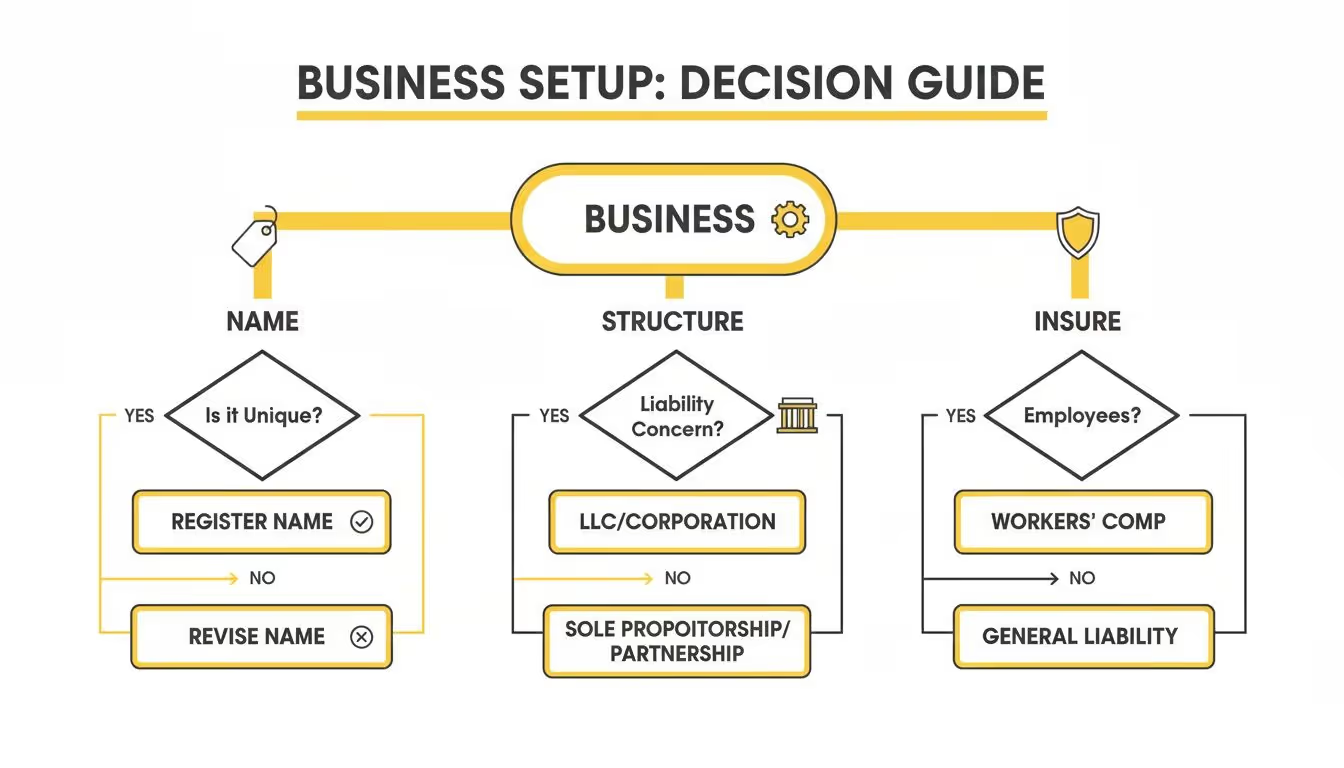
Let's talk about the "boring" stuff: paperwork. I know, it's not nearly as fun as landing your first big client, but getting your legal and financial house in order from day one is what separates a professional operation from a side hustle. This isn't about getting bogged down in legal complexities; it's about building a solid foundation so you can grow without worrying about preventable problems down the road.
First up, your business name. This is more than just a name—it's your brand. Pick something catchy, professional, and easy for people to remember and spell. Before you print those business cards, do a quick search to see if the name is available in your state and, just as importantly, if you can get the website domain. A little homework now can save you a massive rebranding headache later.
Once you’ve landed on the perfect name, you need to decide how to register your business. This decision has real-world consequences, affecting your taxes and, critically, how protected your personal assets are. For most new cleaning companies, it boils down to two main options.
Insurance is not optional. It's your safety net. One broken heirloom or an employee slipping on a freshly mopped floor could be enough to sink your entire business before it even gets off the ground. Don't take that risk.
Business insurance isn't just a protective measure; it's a powerful signal of your professionalism. It shows clients you're a serious, trustworthy company they can feel confident hiring.
Here's the bare minimum you should have:
This last tip is simple but incredibly important: open a dedicated business bank account from day one. Seriously. Do not mix your personal spending with your business income. It turns bookkeeping into a nightmare and makes it nearly impossible to know if your business is actually making money.
A separate account makes tax season a breeze and looks far more professional when you're cashing client checks or paying suppliers. This clean financial separation is crucial for tracking your cash flow and making smart decisions. Speaking of smart decisions, if you want to streamline sales and deliver instant estimates right out of the gate, check out a tool like Estimatty. It gives your new business a professional polish that clients will notice.
Let's be blunt: getting your pricing right is where a cleaning business either thrives or dies. It’s the single biggest factor that separates a profitable, growing company from a stressful, underpaid side hustle. If you're just guessing what to charge or trying to undercut every competitor, you're in a race to the bottom—and you'll burn out fast. The goal here isn't to guess. It's to price your services with a strategy that builds a real business.
And the opportunity is massive. North America's cleaning industry is a behemoth, accounting for a huge 36.8% of the global market. We're talking about a USD 154.1 billion industry right now, with the U.S. alone projected to grow at a 5.6% CAGR through 2030. This isn't just about mopping floors; it's about claiming your piece of a very valuable pie.
Before you can give an estimate, you need to decide how you're going to charge. Most cleaning businesses land on one of a few tried-and-true models. Each has its place, and knowing when to use which is key.
Ultimately, many successful businesses use a hybrid approach—maybe flat fees for recurring clients and hourly for one-off deep cleans. The trick is to match the model to the job for a win-win.
When you're just starting out, it's tempting to rely on instinct. You do a quick walkthrough, ask a few questions, and pull a number out of thin air that "feels right." I've seen it a hundred times, and it's a huge mistake.
Why? Because it’s wildly inconsistent. One day you undercharge for a tough job and lose money. The next, you might overcharge and lose the bid. It looks unprofessional, and it makes it impossible to know your profit margins.
Your ability to provide fast, accurate, and professional estimates is a direct reflection of your company's credibility. An inconsistent estimating process creates doubt, while a standardized system builds immediate trust and closes more deals.
Relying on manual estimates also means you're chained to your phone. Every potential customer needs your personal attention, which means you can’t generate new business while you're out on a job, with your family, or trying to sleep. This is the definition of a growth bottleneck.
This is where you can truly separate yourself from the competition. Moving away from manual guesswork and embracing automation is a total game-changer. Imagine this: a potential client lands on your website at 10 PM. Instead of filling out a "contact us" form and waiting, they answer a few simple questions and instantly get an accurate, professional-looking estimate sent right to their inbox.
This one shift accomplishes so much:
When you automate this crucial part of your sales process, you free yourself up to focus on what really matters: delivering fantastic service and managing your team. The results speak for themselves; we’ve seen how some cleaning companies have doubled their sales after implementing instant estimates.
Using an AI estimator like Estimatty isn't just about being more efficient. It’s about building a scalable, professional business that can grow and thrive without you having to personally handle every single inquiry. It’s about building a machine that works for you.
You’ve done the hard work of planning, getting licensed, and insuring your new cleaning business. That’s a huge step, but a pristine business plan doesn't pay the bills—clients do. Now it's time to shift gears and focus on the single most important thing: getting that phone to ring.
Let's be clear: your first clients are everything. They're more than just your first paychecks. They are your walking, talking advertisements, your first five-star reviews, and the source of your most powerful marketing tool—word-of-mouth referrals. Landing them requires a smart, modern approach that gets you in front of people who are right now looking for someone just like you.
Forget the Yellow Pages. In today's world, your website is your storefront, and for many potential customers, it's the only one they'll ever see. A clunky, unprofessional site will send them running to your competition. The good news? It doesn't need to be complicated.
Your website really only has three jobs:
Beyond your own site, your Google Business Profile is arguably the most powerful free marketing tool you have. Setting it up puts you on Google Maps and right at the top of local search results when someone types in "house cleaner near me." Once you land your first job, gently encourage that client to leave a review. Nothing builds trust faster than seeing a collection of glowing five-star ratings.
Most cleaning websites make a classic mistake. They have a "Contact Us" form and... that's it. A potential client fills it out, then waits. And while they're waiting, they're clicking over to three other competitors. You can't afford that delay.
This is where an automated, instant estimate tool on your website changes everything. Imagine a visitor landing on your site at 10 PM. Instead of just sending a message into the void, they can get a real, accurate price for cleaning their home in less than 60 seconds.
Shifting from a passive "contact us" form to an active, instant estimate tool is like turning your website from a simple brochure into a 24/7 sales agent. It engages visitors at their peak interest and captures qualified leads before they have a chance to look elsewhere.
This isn't just about speed; it's a powerful sales move. You’re giving potential clients exactly what they want, right when they want it. It instantly establishes your business as professional, transparent, and easy to work with—a huge advantage over competitors who are still playing phone tag.
Cleaning is a visual business, so use that to your advantage. Platforms like Instagram and Facebook are your best friends here. Start snapping high-quality before-and-after photos of your work. The transformation from a cluttered, dusty space to a sparkling clean home is incredibly satisfying to see and sells your service better than words ever could.
Get active in your local community online, too. Join neighborhood Facebook groups and be a helpful presence. When someone inevitably asks for a cleaning service recommendation, your happy clients can easily tag your business page. That kind of social proof is pure gold. For a deeper dive, we've laid out a ton of great strategies in our guide on how to get residential cleaning clients.
The cleaning industry is booming, projected to hit a staggering USD 616.98 billion by 2030. With 34% of cleaning contractors expecting their sales to jump, the competition is heating up. The businesses that thrive will be the ones that make it incredibly easy for customers to get a price and book a service. Those who stick with old, slow methods will simply be left behind. You can see more on these market trends and what they mean for your business.
By building a strong online presence and arming it with the power of instant estimates, you create a lead-generating machine that works for you around the clock. You won't just be finding clients; you'll be converting them on the spot and setting the stage for real, sustainable growth.
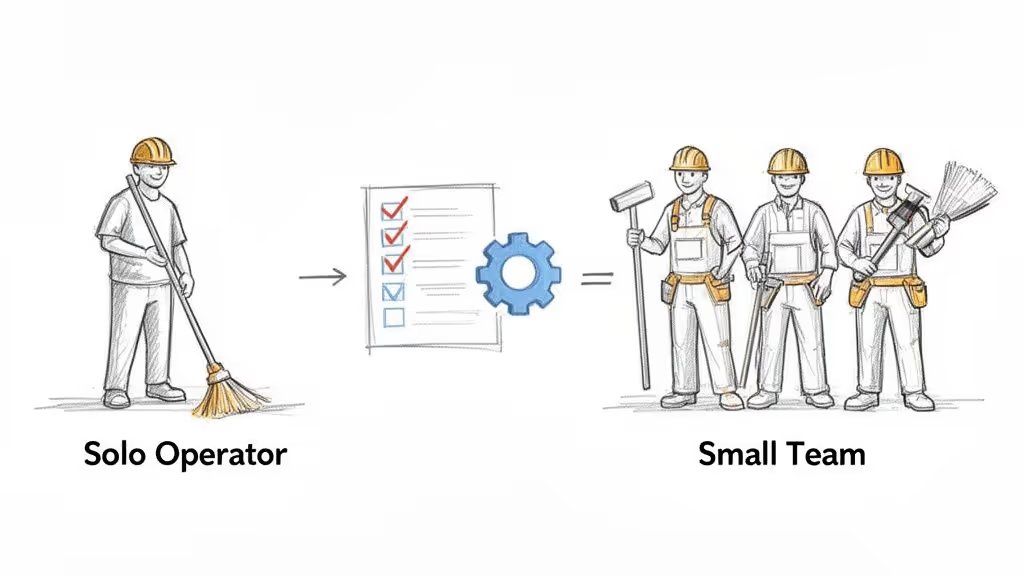
Making the leap from a one-person show to a business owner with a team is probably the most nerve-wracking—and rewarding—step you’ll take. All of a sudden, your job isn't just about getting the perfect shine on a countertop; it's about being a leader, a trainer, and a quality control expert.
This is where your business really starts to grow beyond what you alone can handle. How well you manage this transition all comes down to building a solid team and creating systems that guarantee every client gets the same fantastic service, whether you're on-site or not.
Hiring your first employee is a huge deal. They become the face of your company when you can't be there, so finding someone trustworthy and meticulous is non-negotiable.
Don't get too hung up on years of cleaning experience. Look for a great attitude and a rock-solid work ethic first. You can teach someone your specific cleaning methods, but you can't teach reliability.
When you're ready to post a job opening, look for platforms built for our industry. A specialized tool like pipehirehrm.com, for example, can connect you with people who are actually looking for cleaning jobs, not just any job. For additional reading on this topic, the blog at get.pipehirehrm.com/blog has some excellent articles.
In the interview, dig deeper than the usual questions. I like to use scenario-based questions to see how they think on their feet:
Their answers tell you so much more about their professionalism and problem-solving skills than a simple resume ever could.
Once you've found the right person, you can't just throw them the keys and a mop and hope for the best. Consistency is what turns a first-time customer into a loyal, bi-weekly client. The only way to achieve that is with standardized processes and really good training.
The biggest threat to a growing cleaning business isn't your competition—it's inconsistency. A detailed checklist is your best defense, ensuring every cleaner delivers the same exceptional result on every single job.
Create a ridiculously detailed cleaning checklist for every service you offer. I’m talking a step-by-step guide for each room, from top to bottom. This document does double duty: it’s a training manual for new hires and a quality control tool for your whole crew. It takes all the guesswork out of the equation and sets your team up for success.
As your team grows, so does the mountain of admin work. You'll quickly find yourself spending more time juggling schedules, answering phone calls for quotes, and creating manual estimates than on high-value tasks like training or landing that big commercial contract.
This is the point where automation becomes your secret weapon. It’s how you scale without burning out.
Technology is completely changing the game for businesses like ours. The global market for cleaning robots is expected to blast past USD 8.5 billion by 2026, all because of the push to work smarter, not harder. You can read more about these game-changing trends and how they address labor challenges.
Your sales process is the easiest place to start. By plugging in an AI-powered estimator like Estimatty, you can automate your entire lead qualification and estimating process. Your website suddenly becomes a 24/7 sales machine, capturing leads and giving out instant, accurate estimates while you sleep. I highly recommend reading about how a team built a 24/7 AI sales agent to tackle this very issue. You can find more helpful articles at estimatty.com/blog as well.
As you grow, you might even consider hiring virtual assistants for cleaning services to take even more admin tasks off your plate. This frees you up to focus on what actually moves the needle: leading your people and making sure your customers are thrilled after every single visit.
Jumping into the cleaning industry is exciting, but let's be real—it also brings up a ton of questions. Getting straight answers is the best way to build the confidence you need to go from just thinking about it to actually launching your business. Here are the questions I hear most often from new entrepreneurs.
Here's some great news: you can get a cleaning business off the ground for a lot less than you might think. If you’re starting out as a solo cleaner, you can realistically get everything you need for under $1,000.
What does that initial grand actually cover?
The trick is to start lean. It's tempting to finance a brand-new, logo-wrapped van right away, but hold off until the cash is flowing consistently. Your first investments should be in things that help you look professional and book jobs from day one.
I'm going to be blunt: skipping insurance is a gamble you can't afford to take. It’s the one thing that stands between you and a single accident that could wipe out your entire business.
At a bare minimum, you need three key policies in your back pocket:
Your first paying customer is probably closer than you realize. The name of the game is to get some momentum going and earn that first glowing review. That one review is the social proof you need to land the next client, and the one after that.
Start with the people you already know. Reach out to your friends, family, and former colleagues. Let them know what you’re doing and maybe offer a small "friends and family" discount to get your foot in the door. If they love your work, don't be shy about asking for a review on your Google Business Profile.
Another classic move that still works is designing a sharp, professional flyer and dropping it off in neighborhoods you want to work in. But honestly, the most powerful tool today is a simple website with an instant estimate calculator. It lets curious homeowners get a price right then and there, capturing their info before they click away to a competitor.
One hundred percent, yes. Specializing is the fastest way to cut through the noise in a crowded market and start charging what you're worth. It shifts you from being just another "cleaning service" to an expert solution for a specific problem.
When you focus on a niche, you stop competing on price and start competing on expertise. It makes your marketing laser-focused, your brand unforgettable, and your business far more profitable.
Think about becoming the go-to expert for a certain type of client:
Picking a lane makes it so much easier to find your ideal customer and talk directly to their needs. Once you've built a rock-solid reputation in your niche, you can always branch out.
Ready to stop chasing leads and start closing them automatically? Estimatty provides an AI-powered estimator that delivers instant, professional estimates to your clients 24/7, turning your website into a lead-generating machine.
Learn how Estimatty can help you grow your cleaning business today!