
October 22, 2026
How Do You Professionally Clean a House? a Room Guide
Learn how do you professionally clean a house with a room-by-room process, safety standards, quality checks, and team training tips.

Saturday, June 6, 2026
Master your cleaning business accounting with our 2026 guide. Learn step-by-step bookkeeping, job costing, payroll, and KPIs to boost your profitability.

Most cleaning owners don't start with a financial system. They start with a mop, a vacuum, a few clients, and a spreadsheet that gets uglier every month. Receipts pile up in the truck, bank transactions blur together, and invoicing happens whenever there's time left at night.
That works for a while. Then it doesn't.
The breaking point usually isn't tax season. It's when you can't answer basic questions fast. Which jobs make money. Which crew is efficient. Whether your pricing covers labor, supplies, drive time, and overhead. Whether that “great client” is profitable or just busy.
That's why cleaning business accounting matters. Not because accountants say it should. Because if your numbers are sloppy, your pricing gets sloppy, your hiring gets sloppy, and growth turns into stress.
A lot of owners move through the same stages.
First, it's the shoebox stage. Paper receipts, screenshots, handwritten notes, a checking account that mixes personal and business spending. Then comes the spreadsheet stage. It feels more organized, but now you're spending weekends fixing formulas and trying to remember what that hardware-store charge was for.
The sanity stage starts when you stop treating accounting like cleanup work and start treating it like operations.
Cleaning is no longer a tiny local side trade. One industry snapshot projects the global cleaning services market at about $90 billion by 2027, with a compound annual growth rate of about 7% (SBDCNet). If you want a bigger slice of that demand, especially in mature markets, your financials can't live in a glove box and a half-finished sheet.
That's the shift many owners miss. Organized books don't just help at tax time. They help you price faster, hire more carefully, and spot weak contracts before they drain cash.
If you're still leaning heavily on Excel, it helps to see how other owners streamline small business financial management before the spreadsheet becomes the bottleneck.
Messy books don't stay in the back office. They show up in underpriced jobs, late invoices, and payroll stress.
The first real improvement usually isn't hiring a controller or building a giant dashboard. It's simpler than that. You clean up the intake of financial information. Every sale gets recorded properly. Every expense has a home. Every bank transaction gets reviewed instead of guessed.
That mindset also changes how you choose software for the front end. If you're comparing systems that handle booking, estimating, and workflow, this guide to cleaning business software options is a useful starting point because accounting problems often begin long before the invoice goes out.
What doesn't work is waiting until month-end to “figure it out.” By then, the operational mistakes are already baked in. The profitable owners I've seen build simple systems early, then tighten them as the business grows from solo cleaner to multiple crews.
If your foundation is weak, every accounting fix becomes harder than it should be. Start with the essentials.
Use cloud accounting software. QuickBooks Online and Xero are common choices because they support bank-feed connections, reconciliation, and reporting without forcing you to key in every transaction manually. The exact brand matters less than the workflow.
Your software should let you:
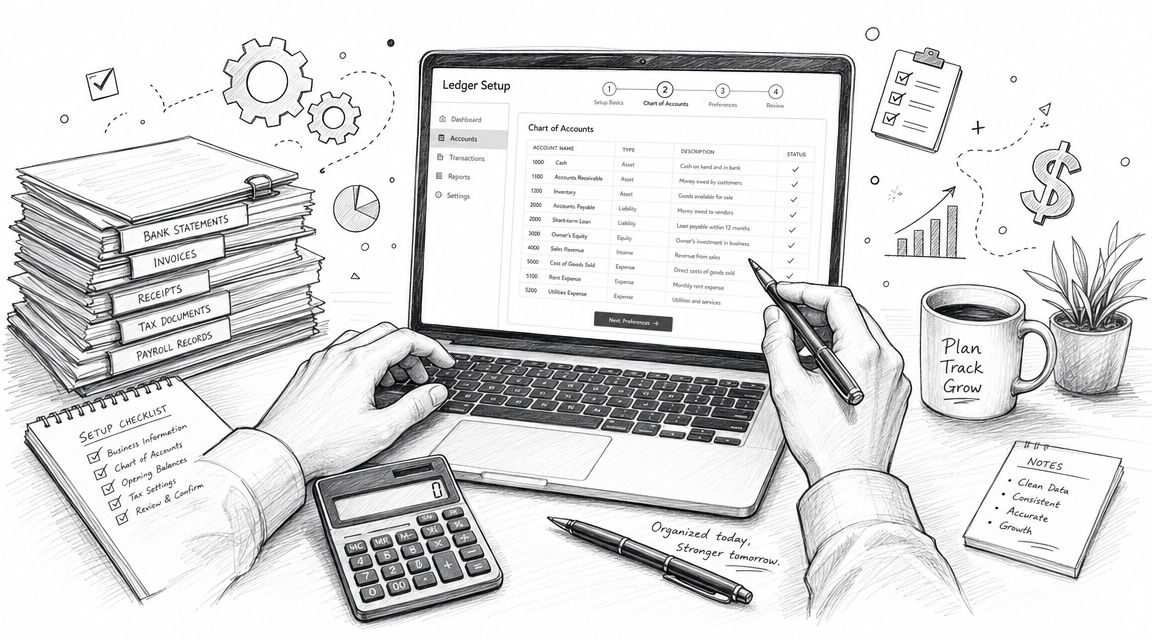
Many small operators often create their own mess. They buy supplies on a personal card, deposit customer payments into the wrong account, then try to untangle it later.
Open dedicated business checking and business credit card accounts. Route all revenue and business spending through them. That single move makes reconciliation easier, keeps your records cleaner, and gives you a usable view of cash flow.
Practical rule: If a transaction touches the business, it should land in a business account first.
Once you've got the software and accounts in place, connect your bank and card feeds. Don't stop there. Automation helps, but it doesn't replace review. Software can import transactions, but it can't always understand whether a purchase belongs under cleaning supplies, equipment, vehicle expense, or owner draw.
A simple weekly rhythm works better than a monthly scramble:
A lot of cleaning companies think they have a pricing problem when they have an overhead blind spot. Software subscriptions, insurance, fuel, phones, admin time, and equipment maintenance don't look dramatic one by one. Together, they change what a “profitable” job really means.
If you haven't mapped that yet, this breakdown of how to calculate overhead costs helps connect your bookkeeping categories to real pricing decisions.
What works is boring on purpose. Separate accounts. Connected feeds. Weekly review. Clean records. That's the foundation most owners try to skip, and it's why their numbers never feel trustworthy.
A generic chart of accounts is too broad for a cleaning company. It tells you how much you spent, but not where margin leaks start. That's a problem if you serve different client types, sell different service levels, or run multiple crews.
A stronger workflow starts with a segmented chart of accounts and bank-feed reconciliation, so you can separate income streams and cost centers for residential and commercial work and surface margin leakage faster (Ramp).
Most off-the-shelf setups lump income into one sales category and expenses into a few vague buckets. That hides useful information.
If residential recurring jobs, commercial contracts, and one-time deep cleans all sit in the same income line, you can't tell which service line carries the business. If payroll, subcontractors, supplies, and fuel all blur together, you can't diagnose why one route feels busy but never leaves cash behind.
Your chart of accounts is the backbone of financial reporting. For a cleaning company, it should mirror how the business earns and spends money.
| Account Type | Account Name | Example |
|---|---|---|
| Income | Residential Recurring Cleaning | Weekly or biweekly house cleaning |
| Income | Residential One-Time Cleaning | Move-out or first-time clean |
| Income | Commercial Recurring Contracts | Office or facility service agreement |
| Income | Deep Cleaning Services | Intensive reset cleaning |
| Income | Add-On Services | Inside fridge, oven, windows, extras |
| Cost of Sales | Direct Labor | Cleaner wages tied to jobs |
| Cost of Sales | Subcontractor Labor | Independent crews used on jobs |
| Cost of Sales | Cleaning Supplies | Chemicals, cloths, trash bags, gloves |
| Cost of Sales | Job Materials | Service-specific consumables |
| Cost of Sales | Fuel and Travel for Jobs | Crew travel tied to service delivery |
| Operating Expense | Vehicle Maintenance | Tires, repairs, oil changes |
| Operating Expense | Equipment Maintenance | Vacuum servicing, replacement parts |
| Operating Expense | Insurance | General liability, workers-related policies |
| Operating Expense | Payroll Processing | Payroll software or service fees |
| Operating Expense | Marketing and Advertising | Local ads, website spend, lead sources |
| Operating Expense | Software Subscriptions | Scheduling, CRM, accounting tools |
| Operating Expense | Office and Admin | Phones, printing, admin supplies |
| Equity | Owner Draw or Distribution | Money taken by the owner |
| Liability | Sales Tax Payable | Tax collected and held |
| Asset | Undeposited Funds | Payments received but not yet cleared bank |
The goal isn't to create endless account codes. The goal is to make decisions easier.
Use enough detail to answer practical questions:
A useful rule is this. If a category changes pricing, staffing, or service decisions, it deserves its own account. If it doesn't, combine it.
For owners comparing accounting platforms before they build this structure, this look at QuickBooks vs. FreshBooks can help clarify which environment fits a service business better.
Profit doesn't get decided when the payment hits your account. It gets decided much earlier, usually when the job is estimated.
Owners lose money when the estimate is built from memory, rushed over text, or adjusted on instinct just to close the lead. If your front-end process is inconsistent, your accounting will only confirm the damage later.
Use a standard estimating process. The point isn't to sound polished. The point is to price the same kind of job the same way every time.
That means capturing the details that affect cost:
For teams that want a more consistent front-end handoff, tools like Estimatty can generate cleaning service estimates, capture job details, and pass approved work into the next steps of invoicing and customer setup. Used properly, that makes the estimate the first record in your accounting chain instead of a disconnected sales artifact.
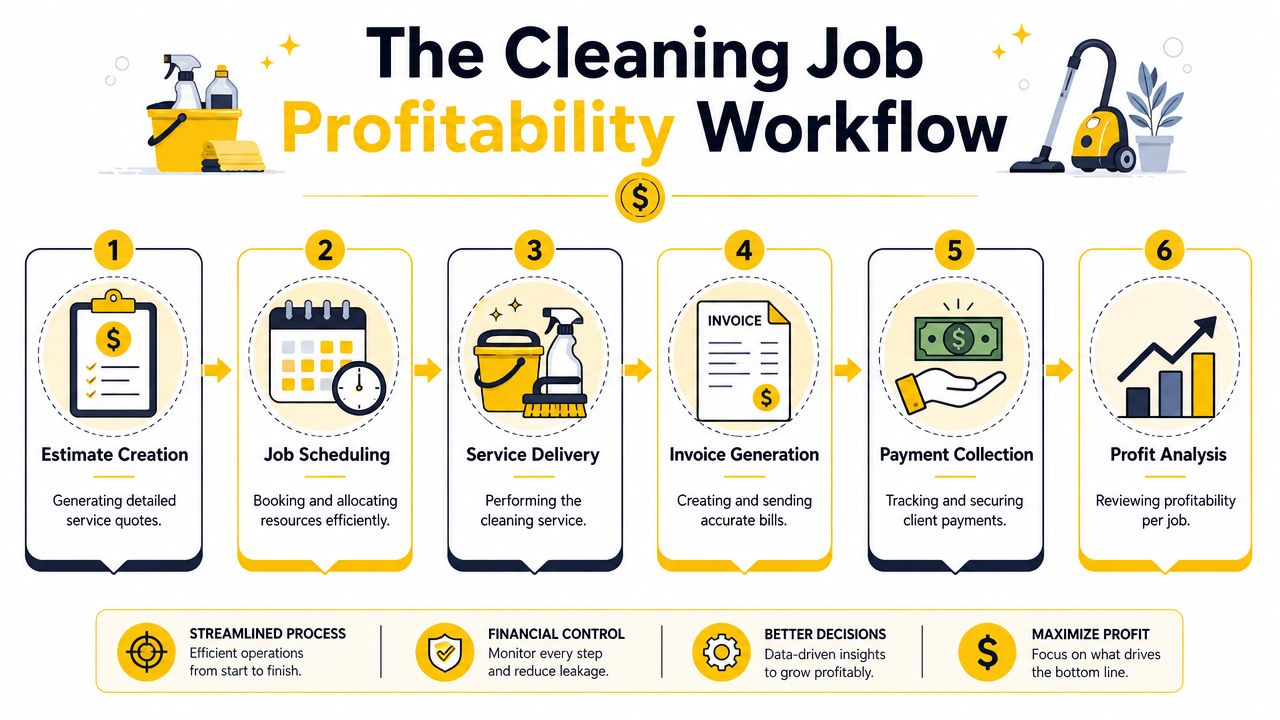
Once the work is scheduled, the next job is simple to describe and hard to do consistently. Track what happened.
You need the complete picture:
Many owners discover that a “profitable” service line isn't profitable at all. The estimate looked fine, but labor ran long, the crew doubled back, or the scope expanded without a price update.
If the estimate says one thing and the field does another, the invoice won't save your margin.
If you regularly bid larger or more variable jobs, it also helps to study how other operators avoid cleaning bid pitfalls, especially when scope creep and production assumptions can wreck a good-looking price.
After service delivery, turn the approved work into a professional invoice immediately. Don't leave billing sitting until the end of the week if the work is complete and documented.
A simple post-job review can tell you more than a monthly profit and loss statement:
| Checkpoint | What to Compare | Why it matters |
|---|---|---|
| Estimated revenue | Final invoiced amount | Confirms whether scope changed |
| Planned labor | Actual labor used | Exposes pricing or staffing misses |
| Expected margin | Actual margin | Shows which job types are worth repeating |
| Add-ons proposed | Add-ons billed | Finds missed revenue |
If your invoicing process still feels manual, this resource on invoices for cleaning businesses is worth reviewing because delayed or inconsistent billing often starts with a weak estimate-to-invoice handoff.
Owners who get this workflow right stop treating accounting like a rearview mirror. They use it to improve the next estimate before the same mistake repeats.
If there's one place where cleaning business accounting stops being theoretical, it's payroll.
For janitorial firms, payroll commonly represents 40% to 60% of total expenses, which is why accurate job costing and labor-ratio tracking matter so much for pricing and profitability (Westport Financial). In plain terms, if labor control is weak, the rest of your bookkeeping can still look neat while profit slips away.
A lot of owners think payroll means running direct deposit and filing forms. That's part of it, but it's not the useful part.
The useful part is knowing:
If those answers are fuzzy, pricing turns into guesswork. You'll keep raising rates generally when the underlying issue is one crew, one route, or one service type.
Small operators can start with payroll inside their accounting platform if the workflow is simple. Once schedules, crews, and job-level time tracking get more complex, many teams move to a dedicated payroll or workforce tool.
What matters is less about the logo and more about the fit:
For businesses trying to tighten labor data from the field, this guide to time and attendance software is a practical next step.
Good payroll records tell you whether your pricing model is honest.
Worker classification matters. If you treat people like employees operationally, but paperwork treats them like contractors, you're creating risk that can become expensive later. This is one area where “easy for now” can turn into a serious cleanup project.
Hiring also affects accounting more than owners expect. Bad hires create turnover, retraining, inconsistent production, and callback labor. Those costs don't always show up in one obvious line item, but they hit the numbers.
If you're building a stronger recruiting process, PipehireHRM is worth a look for cleaning employee hiring, and the advice on the PipehireHRM blog can help owners think more systematically about staffing quality before payroll problems start.
What works is tight connection between hiring, time tracking, payroll, and job costing. What doesn't work is running payroll in one system, schedules in another, and estimates somewhere else with no shared logic between them.
A monthly close shouldn't feel like punishment. It should feel like a management review. If the books are current, month-end gives you a clean look at what happened, what slipped, and what needs attention before the next month starts.

Keep it short enough that it gets done.
You don't need a giant dashboard. You need a handful of numbers that change decisions.
| KPI | How to think about it | What it tells you |
|---|---|---|
| Gross profit by job | Revenue minus direct job costs | Whether the work itself is priced correctly |
| Labor ratio by service line | Labor cost compared with revenue for that service | Which job types are operationally efficient |
| Average invoice value | Total billed divided by number of invoices | Whether upsells and service mix are improving |
| Accounts receivable aging | How long invoices stay unpaid | Whether collections are slowing cash flow |
| Repeat customer rate | Share of customers who book again | Whether retention is supporting stable revenue |
Gross profit by job helps with pricing. Labor ratio helps with staffing. Average invoice value helps with add-ons and service packaging. Receivables aging tells you whether a revenue problem is a collections problem.
For a visual walkthrough on tightening financial habits, this video is a good companion:
The monthly close is where accounting becomes useful.
If gross profit is weak on one-time jobs, revisit the estimate assumptions. If labor ratio keeps drifting on certain crews, inspect scheduling and production, not just pricing. If receivables are stretching, tighten invoicing speed and payment follow-up.
For more practical operating metrics and pricing guidance, the articles on the Estimatty blog are a solid place to keep building from.
If you want a cleaner handoff from lead to estimate to invoice, take a look at Estimatty. It helps cleaning businesses standardize estimates at the front end so the numbers feeding your accounting system start out more accurate.