October 22, 2026
How Do You Professionally Clean a House? a Room Guide
Learn how do you professionally clean a house with a room-by-room process, safety standards, quality checks, and team training tips.

Thursday, July 23, 2026
On identical cleaning jobs, the highest estimate is usually double the lowest. Here is why there is no going rate, and how to find your real number.
It's 9:40 on a Tuesday night and there's a half-written estimate on your screen.
2,200 square feet. Three bed, two bath. Biweekly. Two dogs.
You typed $185. Deleted it. Typed $210. Then you sat there wondering how much you should charge for house cleaning on a house you've never walked into, for a customer who will compare your number to two others by lunch tomorrow.
So you split the difference. You send $195. And you spend the week half-wondering whether you left money on the table or talked yourself out of the job.
You've been hunting for the right number. There isn't one.
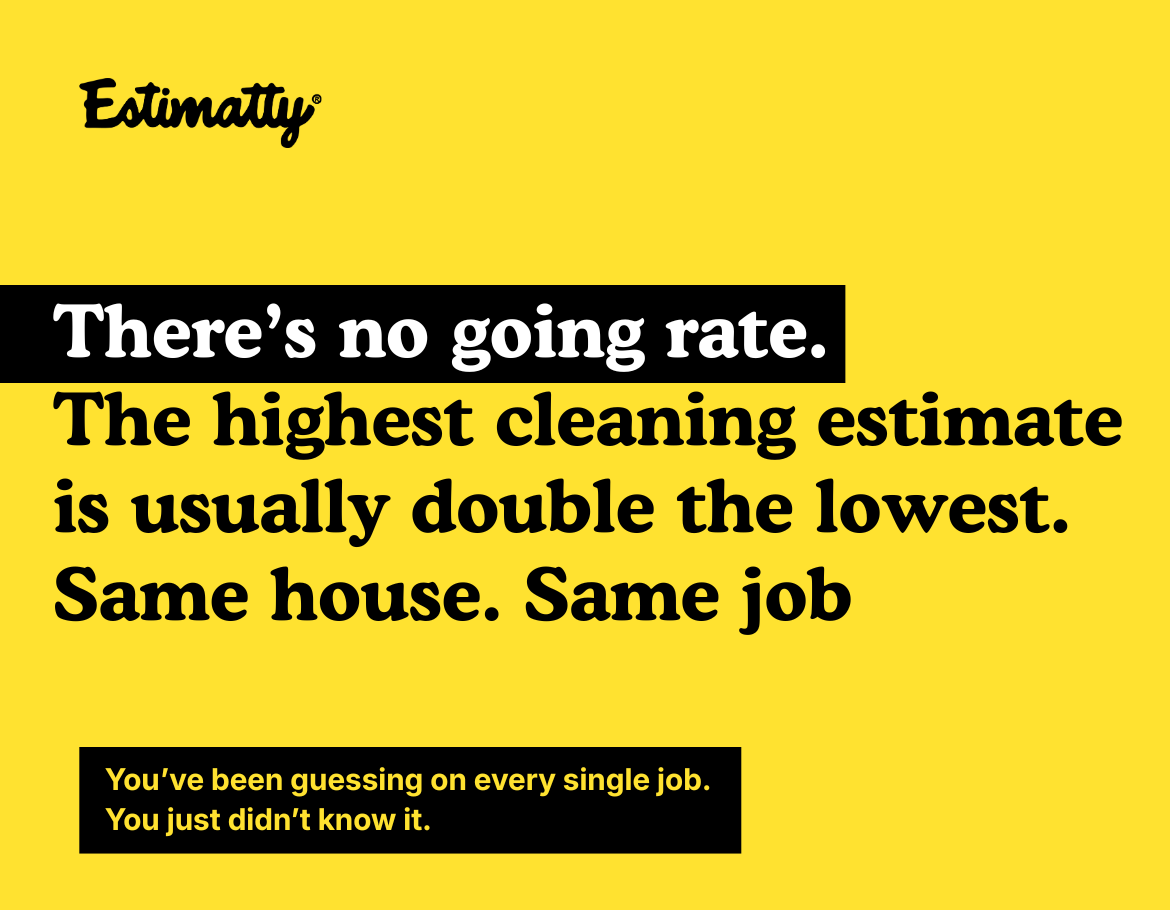
A marketplace called AllBetter looked at 1,722 cleaning jobs where homeowners collected multiple bids on the same scope of work. Same house, same job, competing estimates. The highest bid came in around double the lowest.
Not 10% apart. Not 20%. Double.
So when you send $195 tonight, somebody down the road is sending $260 for that exact house, and somebody else is sending $140. All three of you believe you're priced about right. All three of you are guessing.
That's the actual problem. Not that you don't know the going rate. There isn't one to know.
Gut-feel pricing is expensive in a way that never shows up on a statement.
Say you come in $30 under where you should be. Biweekly is 26 visits a year, so that's $780 gone from one client, on a decision you made in 40 seconds while tired.
Nobody calls to tell you. The customer who thinks your price is a steal is the happiest customer you have. She refers her neighbor. Now you're underpriced twice.
Guess high and it's quieter still. The estimate goes out, the reply never comes, and you file it under tire-kicker. You never learn that $260 was the number that scared her off and $235 would have booked her.
And then there's the raise you gave yourself in reverse. Nineteen states raised their minimum wage on January 1. Supplies are up 15 to 30% in recent years. The IRS mileage rate climbed to 76 cents. Insurance went up, because insurance always goes up.
If your prices haven't moved in twelve months, you didn't hold steady. You took a pay cut and called it loyalty to your customers.

Picture a week where you never do pricing math again.
A lead comes in Saturday morning while you're on a job. She gets a real number in seconds, built from your rates, and it's the same number the last person got for the same house. Not luck. The price already existed before she asked.
You stop being the calculator. The estimate stops being a thing you owe someone at 9:40pm.
1. Your real hourly rate. Not what sounds fair. What the business needs. Wages, payroll taxes, insurance, supplies, drive time, the vacuum that dies in March, then margin on top.
A floor experienced operators hold to: never price below 2x your fully loaded labor cost. That multiple isn't arbitrary. It keeps labor at or under half of revenue, roughly where a residential operation has to sit to clear real profit. If you can't state your loaded cost, fix that before you touch a single price.
2. How long the house honestly takes. Square footage is the starting point, not the answer. Bathrooms cost more time per foot than bedrooms. Pets, stairs, condition, and time since the last clean all move the clock. So does frequency: a weekly home takes less work on visit twelve than visit one.
Most pricing mistakes are time-estimate mistakes. The rate was fine. The three hours turned into five.

3. What they're actually buying. General, deep, and move-out are three different jobs wearing the same word. A deep clean typically runs 50 to 100% above a standard clean, and a move-out higher still. If your deep clean is a general clean with a small bump on top, you're funding somebody's oven out of your own margin.
4. Your market. Angi puts the typical visit between $118 and $238, averaging around $176, based on data from more than 90,000 customers. That's a national picture, and your city is not the nation.
The gap between cities is wider than most owners assume, and it isn't only about what customers will pay. Workers' compensation is rated per $100 of payroll, and the rate swings hard by state. Two companies can pay identical wages and still sit several dollars an hour apart on loaded labor cost, purely because of where they operate. Copying a price from a company three states away is importing somebody else's cost structure.
That last one is the hard one, because you can't see it.
You can see your own prices. You cannot see the fifteen other companies estimating your neighborhood, and given how far apart those estimates turn out to be, asking around doesn't help. You get one number, from one owner, who is also guessing.
That's the gap we built the Estimatty rate benchmark for. It covers 65+ cities across all 50 states and does one thing: shows what residential cleaning companies in your area actually charge, next to what you charge.
Some owners open it and confirm they're right where they should be, which is worth knowing too. A lot find out they've been leaving $20 to $50 per job on the table for years.
The invoice check. Pull your last three invoices. Divide each total by the hours your crew was actually on site, plus drive time. That's your real hourly rate. Not the one you tell people. Not the one on the pricing page you wrote in 2022.
The yes check. Think about your last ten estimates. If almost every one came back an easy yes with no hesitation, that isn't proof you're priced well. It's the most common sign of underpricing there is. A healthy close rate leaves room for people to say no.
.png)
Finding out is the easy part. Most owners stall here, because raising prices feels like asking permission.
Start with new estimates only. Move your rates today for everyone who hasn't hired you yet. No conversation required, no risk to existing revenue, and within two weeks you'll know whether the market blinked. Usually it doesn't.
Then move existing clients in one round. Pick a date, give 30 days notice, tell everyone at once. Doing it one client at a time as you work up the nerve is how it drags out for a year.
Raise 5 to 10%, not 3%. A 3% increase costs the same awkward conversation and fixes nothing. If you're 25% under, plan two increases six months apart instead of one shock.
Don't apologize. "Our rates are increasing to $X starting March 1. Everything else stays the same, including your team." That's the whole message. Long justifications signal you don't believe the number.
Expect to lose a couple of clients. That's not the increase failing, that's it working. The ones who leave over 8% cost you the most to keep.
.png)
Flat rate, in almost every case. Hourly punishes you for getting faster and makes the customer watch the clock instead of the result. Price the job, not the hour. Use your hourly rate to build the number internally, then give one figure.
Typically 50 to 100% more than your standard clean for the same house, depending on condition and how long since the last professional clean. If you're adding a flat $50 to a standard price, you're losing money on deep cleans and subsidizing them with your recurring work.
Higher than a deep clean. Empty homes hide nothing, cabinet and appliance interiors are expected, and a security deposit is riding on the result. Estimate it as its own service with its own scope, never as a discount off a recurring rate.
A weekly or biweekly rate reflecting the genuinely lighter workload makes sense. A discount offered just to lock someone in does not. Recurring clients are where underpricing compounds hardest: you repeat the mistake 26 or 52 times a year.
Yes, if you can do it accurately. Customers who can't get a number move on to a company that gives them one, and "contact us for an estimate" filters out serious buyers along with the tire-kickers. The catch is that a static price list misprices you constantly. What works is pricing built from your own rules that adjusts to the actual home.
Three tells: your close rate is near 100%, you're busy but your bank account disagrees, and you can't state your profit on a specific job without opening a spreadsheet. Any one is worth a hard look.
Residential operations commonly run 10 to 15% net, thinner than most owners expect. A well-run company sits closer to 15 to 25%. Under 10%, the problem is usually pricing, not expenses.
We spent 22 years in the cleaning industry before we built anything. Lost leads, mispriced jobs, three different prices for the same exact house depending on who picked up the phone and how tired they were.
Owners almost never find out they're underpriced from a customer. They find out from a competitor's estimate, a bookkeeper, or a year-end number that doesn't match how hard the year felt.
You don't have a pricing problem. You have a visibility problem. That one takes about two minutes to fix.