
October 10, 2026
How to Increase Qualified Leads for Cleaners
Learn how to increase qualified leads for your cleaning business. Discover AI estimators, speed-to-lead tactics, and scoring strategies that book more jobs.

Tuesday, August 25, 2026
Learn how to write a high-converting cleaning services proposal with proven pricing strategies, scope templates, and automation tips to win more residential
You've walked the property, taken notes, and promised to send an estimate before the day ends. Then the phone rings, the next job runs late, and the proposal sits in your inbox while another cleaner sends a polished document within hours. By the time you deliver a one-page PDF with a single lump-sum figure, the prospect has already moved on.
That loss usually isn't caused by an expensive rate. Cleaning businesses lose work because the estimate arrives too late, the scope leaves room for competing interpretations, or the document gives the buyer no reason to trust one provider over another. A strong cleaning services proposal turns operational knowledge into a clear buying decision. It tells the client what will happen, how often it will happen, what it will cost, and how problems will be handled.
The global market makes this discipline more important. One major industry estimate values cleaning services at USD 442.1 billion in 2025 and projects USD 770.8 billion by 2033, with a projected CAGR of 7.3% from 2026 to 2033 (Grand View Research's cleaning services market analysis). In a competitive professional-services market, your proposal is part of the service experience, not an administrative afterthought.
A commercial prospect once gave a cleaner access to an office building for a walkthrough. The owner measured the visible areas, asked when the building needed service, and promised an estimate by the end of the day. The walkthrough was useful, but the follow-up process depended on a spreadsheet, a remembered labor assumption, and time that never appeared.
Three days later, the owner sent a short PDF. It included a monthly price and a general sentence about “complete janitorial service.” It didn't identify the number of restrooms, distinguish carpet from hard flooring, explain day porter duties, or state whether interior glass was included. The buyer didn't have enough information to compare service levels, and another provider had already delivered a clearer proposal.
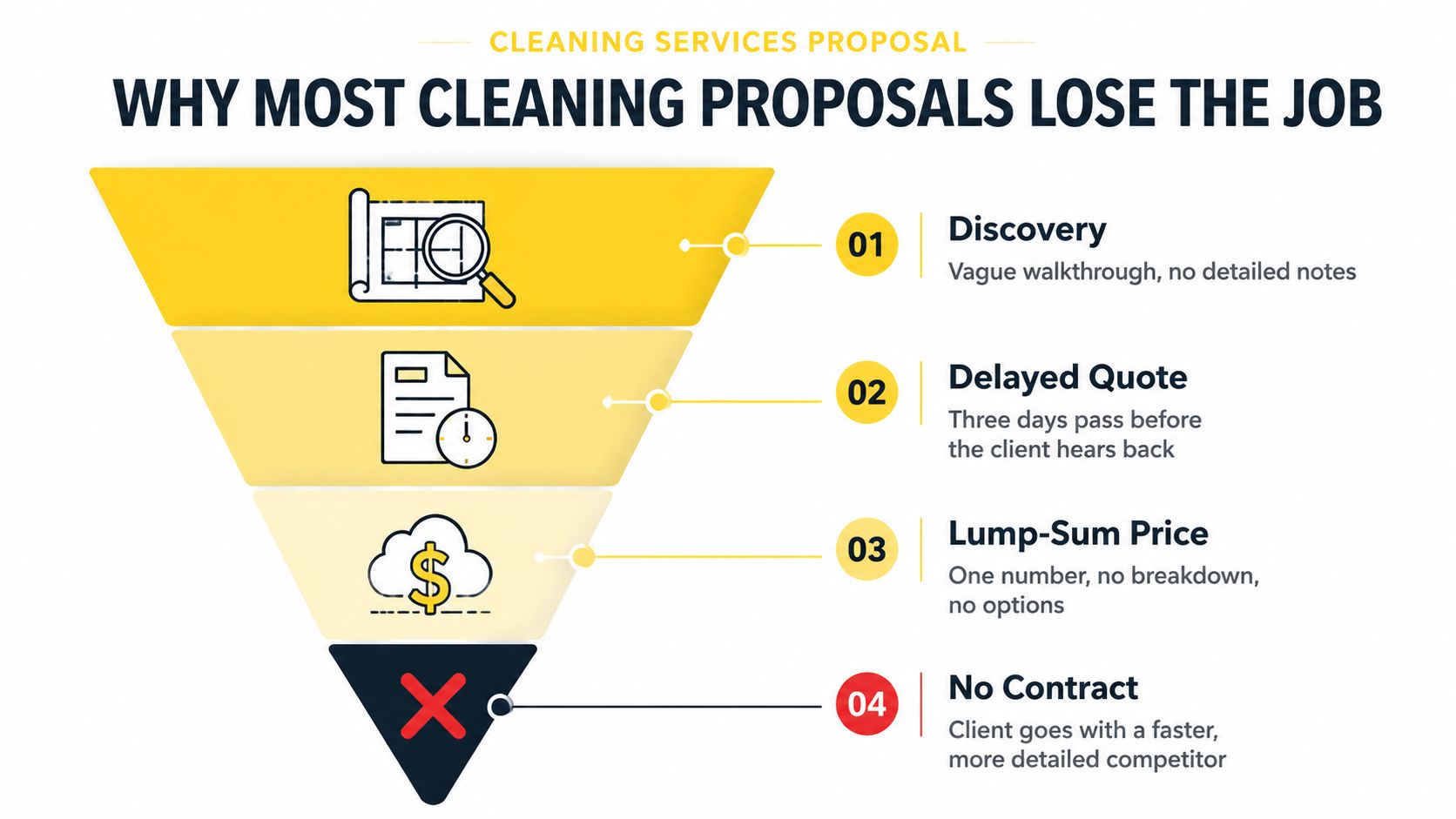
A delayed estimate makes the buyer wonder whether operations will be equally slow. Facility managers often need to coordinate budgets, vendors, access, and internal approvals. If they have to chase you for the document, you've already created friction before the contract begins.
The U.S. cleaning industry has a substantial base of competitors. A small-business industry snapshot reports about 60,000 janitorial establishments with combined annual revenue of roughly USD 50 billion, along with about 7,500 carpet and upholstery cleaning establishments producing about USD 3 billion annually (SBDCNet's cleaning services business research). Buyers in mature markets such as North America, Europe, and Australia are accustomed to comparing bids, service levels, and terms. Speed helps you stay in that comparison.
“Dust, vacuum, mop, sanitize, and remove trash” sounds complete until the client asks whether it includes high-touch disinfection, break rooms, partitions, supply replenishment, periodic floor work, or emergency response. A vague proposal forces the client to interpret your promise. That interpretation rarely favors the company that wrote it.
The proposal should answer objections before the client raises them:
Practical rule: A proposal should reduce the buyer's risk, not make the buyer calculate what your number might mean.
Treat the document as a conversion instrument. Discovery captures the facts, the estimate converts those facts into a sustainable price, and the proposal presents the service in a form the client can approve. If any stage fails, a lower price won't reliably rescue the opportunity.
A proposal can lose money before the first labor hour is scheduled. A leased area may include unused offices, locked rooms, storage, or spaces the client expects your crew to exclude. Price from the area your team will service, then account for layout, obstacles, traffic flow, and surface mix. Cleanable square footage is an operating input, not a figure to copy from a lease or listing.
Build a property record by zone. Mark offices, corridors, lobbies, restrooms, kitchens, storage areas, stairways, elevators, production spaces, and restricted rooms. Record the floor type in each zone. Carpet, sealed hard flooring, tile, concrete, and delicate surfaces require different methods, equipment, and production assumptions.
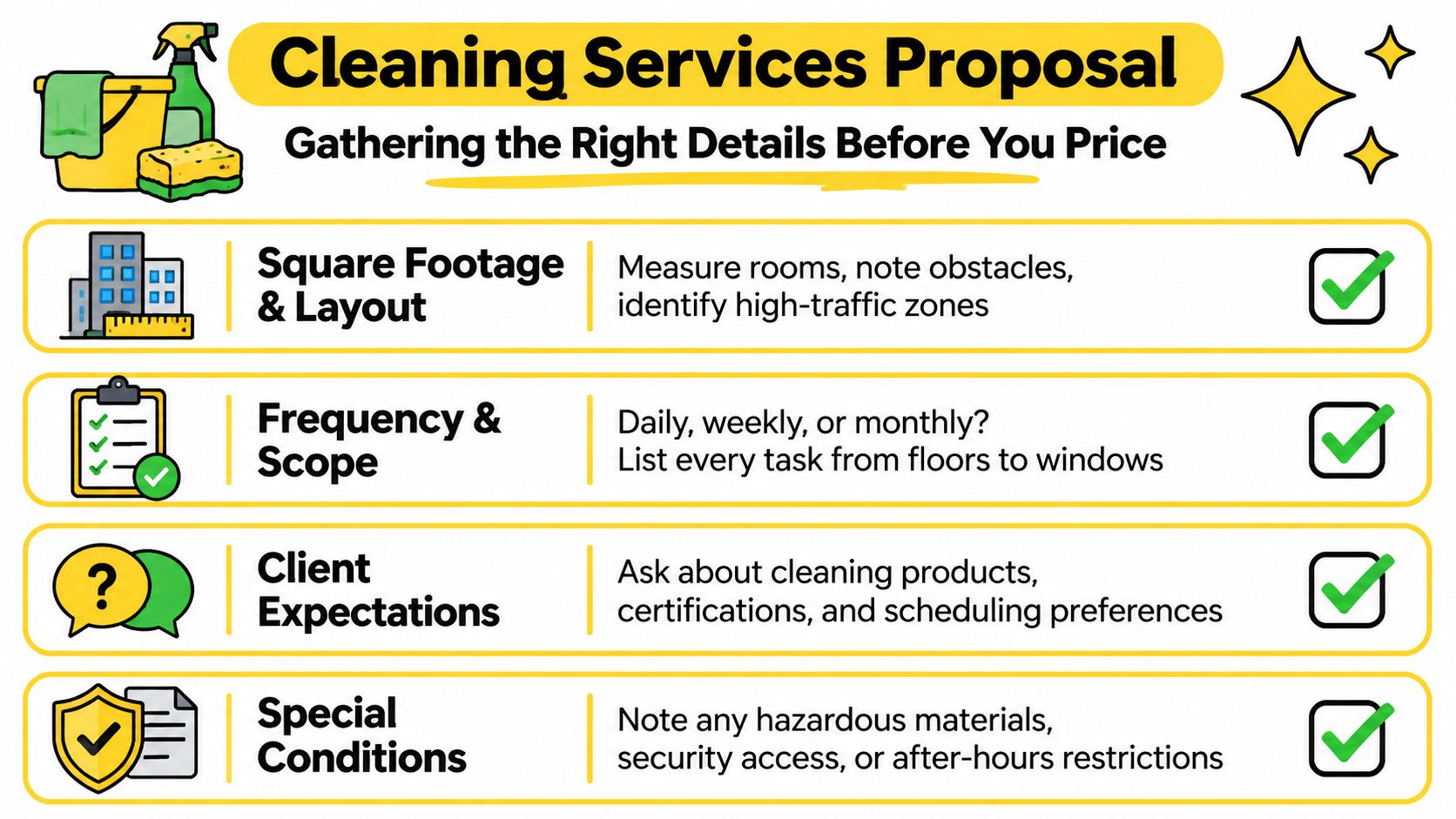
The current service frequency often reveals more than the budget discussion. A site cleaned five nights per week may request three nights because of a cost target, changed occupancy, or an expectation that the same condition will remain with fewer visits. Five nights per week differs materially from three nights per week, and non-billable time belongs in the estimate, as explained in Swept's commercial cleaning estimating guidance.
Use the same intake sequence for every prospect:
Schedule a site visit when the layout is complex, access is restricted, surfaces vary, or specialized work is expected. A virtual walkthrough can suit a straightforward residence or clearly documented space, provided the client shows every area and answers questions without guesswork.
Record discovery immediately. Use timestamped notes, labeled photos, an available floor plan, and a client-confirmed scope summary. A structured data collection software workflow can standardize intake before pricing begins and help Estimatty move from collected details to a faster estimate. That record protects margin and gives you evidence if the client later says a task was included even though the agreed scope excluded it.
A proposal becomes defensible when every price traces back to the work required. Matching a competitor's number or relying on instinct may win a contract, but neither approach shows whether the job can be staffed profitably. Start with cleanable areas, assign production assumptions to specific tasks, convert the workload into labor hours, then include supplies, job costs, overhead, and margin.
A commercial pricing model expresses burdened labor cost as:
Wage × (1 + burden percentage) + overhead per hour + job costs per hour
One model uses a labor burden of 22% to 32%, overhead of $8 to $15 per hour, and job costs of $2 to $5 per hour (Janister Pro's commercial cleaning pricing model). Burden can include payroll taxes, workers' compensation, paid time off accrual, and related employment costs. Supplies, equipment wear, travel, insurance, administration, and supervision also need defined cost categories.
The U.S. Bureau of Labor Statistics reports a median hourly wage of $16.08 and a mean hourly wage of $18.09 for maids and housekeeping cleaners. Its annual wage range runs from $24,520 at the 10th percentile to $45,680 at the 90th percentile (BLS occupational employment data for maids and housekeeping cleaners). These figures provide wage reference points, not customer rates. Your estimate must cover the full cost of employing and deploying each worker.
Build a rate card that shows how each component reaches the final service price. The example below uses the cited cost ranges as planning inputs. It does not assign percentages that have not been calculated from your own billable rate.
| Cost Component | Example $/Hour | % of Billable Rate | Notes |
|---|---|---|---|
| Direct wage | $16.08 to $18.09 | Calculate from your rate | Use your local wage plan, role, and staffing mix. |
| Labor burden | 22% to 32% of wage | Calculate from your rate | Include payroll taxes, workers' compensation, and PTO accrual. |
| Overhead | $8 to $15 | Calculate from your rate | Allocate supervision, insurance, administration, vehicles, and equipment. |
| Job costs | $2 to $5 | Calculate from your rate | Include supplies and other visit-specific costs. |
| Profit and contingency | Business-specific | Calculate from your rate | Protect against scope changes, churn, and operating risk. |
Non-billable time belongs in the calculation. Travel between sites, loading supplies, opening procedures, documentation, inspections, and waiting for access all consume capacity, even when no cleaning task is underway. Track actual hours after service starts and compare them with the estimate. If crews repeatedly exceed planned hours, review the scope, production assumptions, access conditions, and service frequency before asking workers to move faster.
A practical offer can include standard recurring service, deeper periodic service, and a premium package with added detail or accountability. Each tier should change the scope or service level. Renaming identical work at different prices creates confusion and invites disputes.
Commercial benchmarks place typical U.S. pricing around $0.10 to $0.25 per square foot or $30 to $60 per hour per cleaner, although local labor, building conditions, frequency, and inclusions determine whether those figures suit your operation. Use them as a comparison point, not as a substitute for site-specific labor planning.
A repeatable structure also matters in other trades. Compare your process with this pricing system for plumbers. The service differs, but the operating principle transfers: define the work, identify cost drivers, and make the pricing logic repeatable.
Residential estimates need the same discipline. Current market guidance places standard residential cleaning around $120 to $280 per visit and $0.06 to $0.14 per square foot (Housecall Pro's house cleaning prices guide). Another guide explains that square footage is only a starting point. It recommends selecting hourly, flat-rate, or per-room pricing according to scope and frequency, then adjusting for condition, bathrooms, and service type (Method's house cleaning estimate form guide).
Your cleaning services pricing process should expose those adjustments instead of hiding them inside an unexplained lump sum. Estimatty can turn recorded job details into a faster estimate, helping you respond before a slow quote loses the opportunity, while still leaving the assumptions visible for review.
A professional proposal lets a buyer approve a defined service without reconstructing your thinking. The document should read clearly on a phone, make the scope easy to scan, and place the price after enough context has been established to make it meaningful.
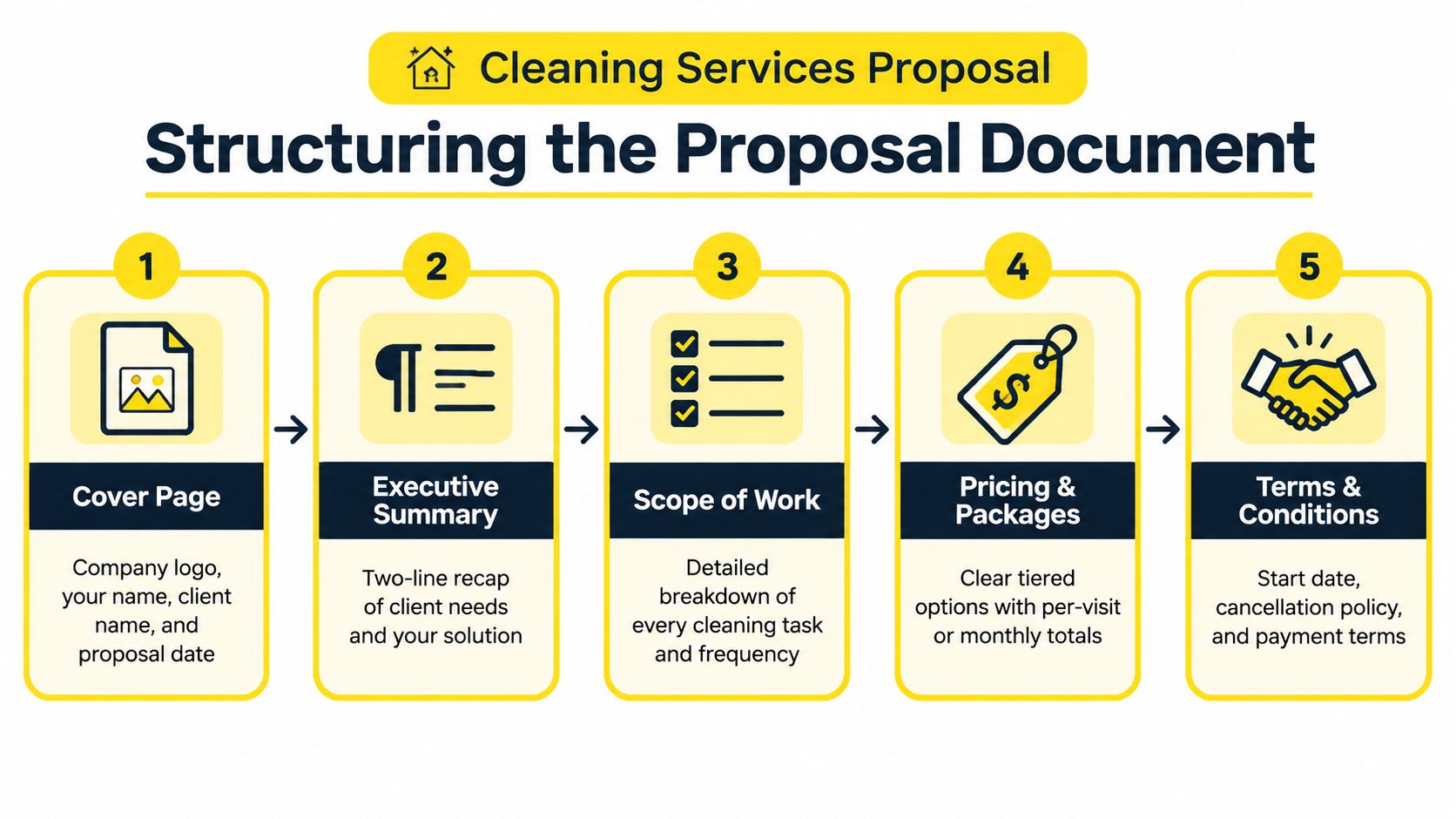
The cover page should include your company branding, client name, property address, proposal date, and contact details. Don't overload it with marketing copy. The buyer should know immediately whose proposal they're reading and which site it addresses.
The executive summary should restate the client's operating problem in plain language. If the facility needs consistent evening service across offices, restrooms, and common areas, say so. Then explain how your proposed schedule, staffing approach, inspection process, and communication method address that need.
Organize commercial work by room, zone, or service frequency. A recurring scope might separate daily tasks from weekly, monthly, and periodic add-ons. For residential work, list bedrooms, bathrooms, living spaces, kitchens, and requested add-ons. A cleaning estimate calculator from Jobber identifies bedrooms, bathrooms, living spaces, cleaning frequency, and special requests such as deep cleaning, appliance cleaning, and laundry as relevant inputs (Jobber's house cleaning cost calculator).
Use paired inclusions and exclusions:
A detailed scope doesn't make the proposal harder to buy. It makes the promised result easier to evaluate.
Good, better, and best packages give clients control while anchoring the value of your recommended option. Keep the differences operational:
Show per-visit and recurring totals when relevant, along with payment terms and any one-time charges. Don't use tiers to disguise exclusions. If a client needs a task, place it in the appropriate package and state what changes.
Finish with timeline, crew size, equipment expectations, insurance details, relevant certifications, testimonials you can substantiate, terms, signature fields, and a proposal expiration date. A practical proposal template for services can provide structure, but the content still has to reflect the actual building and the estimate behind it.
Manual estimating creates a predictable bottleneck. You're collecting information in calls, texts, spreadsheets, and site notes, then rebuilding the same calculations and proposal language for every lead. That process encourages inconsistent assumptions, delayed responses, and forgotten exclusions.
Automation works when it standardizes the repeatable parts without removing human review. A cleaning business can collect property details through a digital intake, apply its rate card, calculate labor requirements, select service tiers, and generate a branded document for approval. The owner still reviews unusual conditions, but the routine work no longer starts from a blank page.
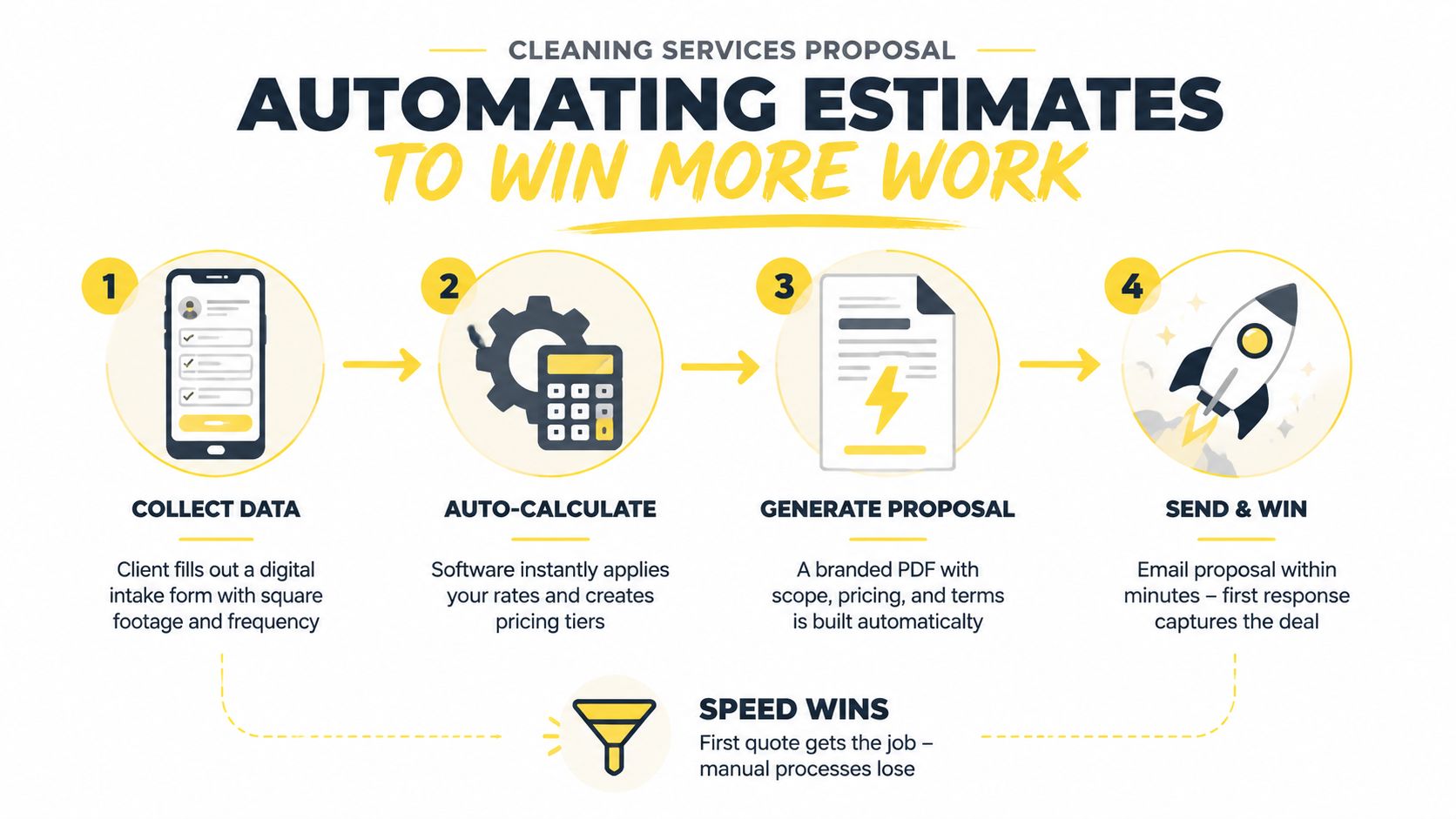
Your intake should collect square footage, room counts, floor and surface types, frequency, access conditions, urgency, special requests, and add-ons. A CRM or automation platform can trigger an estimate draft when a lead submits a form, then route exceptions to a manager for review.
Configure the system around your operating rules:
Estimatty is one example of a cleaning-focused AI web and voice estimator. It can capture details such as square footage, surfaces, and urgency, then send estimates by SMS and email, while connecting with tools such as Zapier or a CRM. Its role is to reduce slow forms, after-hours voicemail, and gut-feel estimates, not to replace judgment on a complex walkthrough. The workflow is described in more detail in this guide to AI estimate software for cleaning businesses.
A fast estimate still needs a clear scope. Automation only makes a bad assumption travel faster if you haven't built validation rules into the intake.
Watch the workflow in action before deciding how much of your process to automate:
Sending the proposal isn't the end of the sales process. It starts a period where the buyer compares your scope, asks internal questions, and tests how responsive you'll be after delivery. Your follow-up should create confidence without becoming pressure.
Use a simple sequence:
Each contact should add value. Explain a task, offer a second walkthrough when the scope is uncertain, or point to a relevant example of your inspection and corrective-action process. Don't send a string of messages that only asks whether the prospect has decided.
Your terms should define the relationship before the first service visit:
A proposal is not a substitute for legal advice, especially when liability, employment, hazardous materials, or recurring auto-renewal provisions are involved. Have an appropriate professional review the terms before using them broadly. Then remove signature friction with an e-signature option that works on a phone.
Your cleaning services contracts guide should align with the proposal, so the signed agreement doesn't introduce different scope, pricing, or cancellation language. When the estimate, proposal, follow-up, and contract all tell the same story, the client can approve the work with fewer questions and your team can deliver against a documented promise.
Estimatty helps residential and commercial cleaning businesses collect property details, apply consistent pricing, and send professional estimates by SMS or email without waiting for manual follow-up. Visit Estimatty to see how a faster, structured estimating process can turn more inquiries into clearly scoped, ready-to-sign cleaning services proposals.