October 8, 2026
10 Quotes on Jobs to Inspire Cleaning Business Growth
Explore 10 quotes on jobs for cleaning business motivation, social posts, marketing copy, and CTAs, with practical usage tips for owners.

Friday, October 9, 2026
Learn how to find commercial cleaning contracts that actually close. Expert strategies to land new clients and grow your cleaning business in 2026.
You drove to three buildings, left voicemails, handed out cards, and came home with no signed work. The next morning, you search for more leads and repeat the same routine, hoping one property manager finally calls back.
That cycle feels productive because you're busy. It isn't productive unless each activity moves a qualified opportunity toward a profitable agreement. Learning how to find commercial cleaning contracts starts with replacing random prospecting with a pipeline that tells you who can buy, what the work requires, when the current vendor may leave, and whether the account can support your operation.
The U.S. janitorial market is large and fragmented. The U.S. Small Business Development Center Network's market overview reports approximately 60,000 janitorial establishments generating about $50 billion in combined annual revenue, with commercial cleaning representing 73.3% of the market. That commercial category includes offices, hospitals, retail stores, and other commercial buildings.
Those figures matter because commercial cleaning is a recurring-revenue business. A tenant who needs a one-time service may not control the building's vendor relationship. A facility manager, property manager, general contractor, or procurement officer usually has a clearer path to awarding work. Stop treating every person who answers the phone as a buyer.

A useful pipeline records more than a company name. Track the decision-maker, facility type, approximate size, service frequency, current provider, access requirements, likely contract expiration, and next follow-up date. If you can't answer those questions, you don't have a qualified opportunity. You have a contact.
The best operators combine several routes. Direct outreach reaches privately managed properties. Referral relationships create introductions with borrowed trust. Government and nonprofit demand accounts for 12.4% of the market, and public buildings are generally sourced through contracting procedures, according to the same janitorial market data.
Owner's rule: A lead isn't valuable because it exists. It's valuable because you know who can sign, what must be delivered, and whether the agreement can produce acceptable profit.
Your weekly scoreboard should show new qualified accounts, conversations with decision-makers, walkthroughs completed, estimates sent, follow-ups due, and bids declined. That view exposes the problem quickly. If you have plenty of names but no walkthroughs, your targeting or message is weak. If you have walkthroughs but no signed work, your scope, estimate, proposal, or follow-up is failing.
Not every channel deserves equal time. Start where your crew, insurance, geography, and cash position give you a realistic chance to deliver.
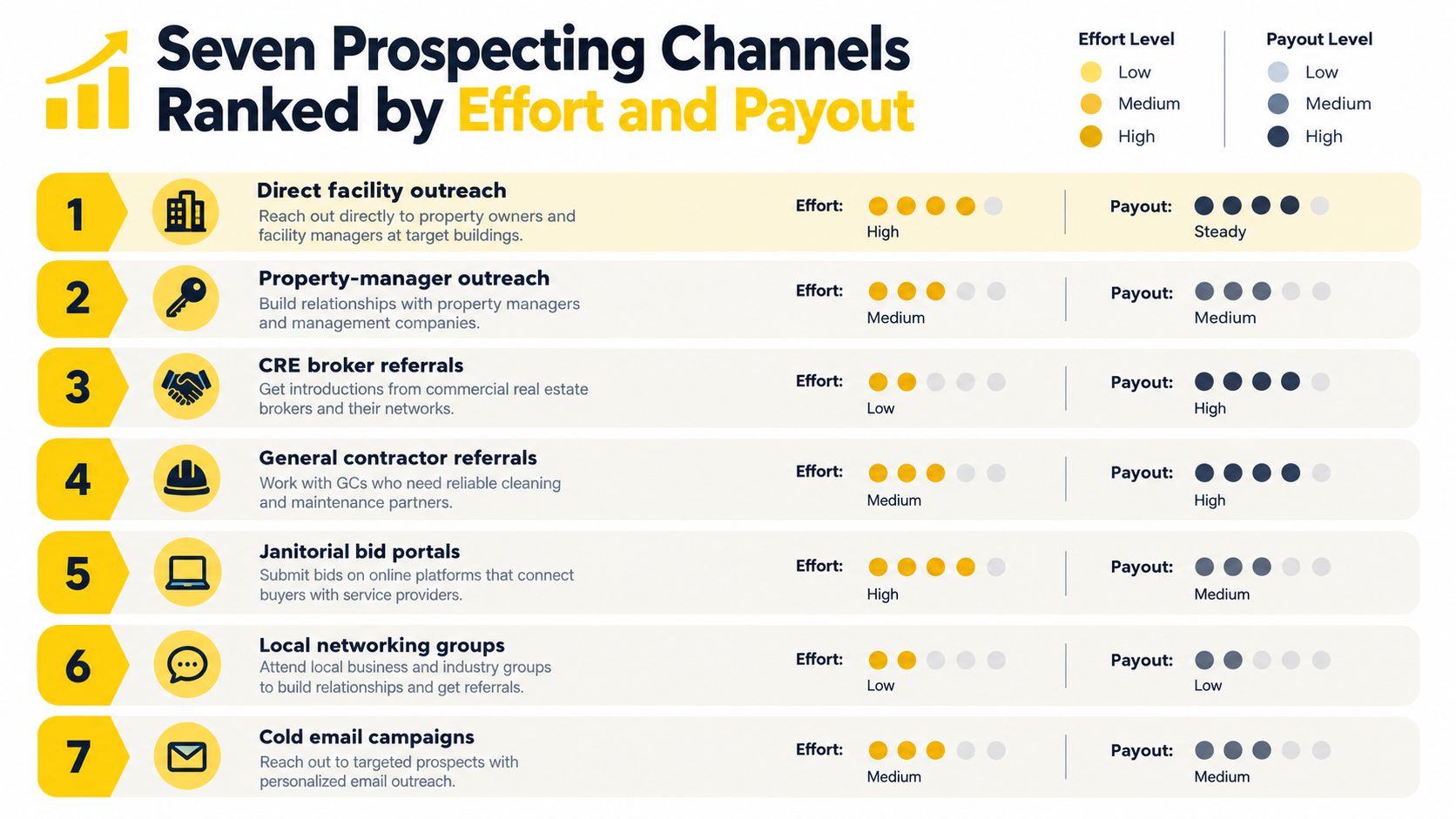
Payout: high. Effort: low once trusted. Brokers hear about building vacancies, tenant moves, and ownership changes early. Give them a narrow promise, such as fast walkthroughs and clearly documented estimates, then follow up reliably. One introduction can put you in front of a decision-maker instead of another receptionist.
Payout: high. Effort: medium. General contractors need dependable cleaning partners for turnover, post-construction work, and ongoing building services. Your responsiveness, insurance documents, and ability to work inside their schedule matter more than a polished slogan.
Payout: steady. Effort: high. Build a focused list of offices, clinics, retail properties, and managed buildings within a practical travel radius. Contact facility managers, property managers, and building owners with a specific observation about the site, not a generic “we offer cleaning services” message.
Payout: medium to high. Effort: medium. This route can fill capacity and create past performance, but read the scope, payment terms, supervision expectations, and insurance requirements carefully. A large account isn't automatically a good account if the prime contractor transfers every risk to you.
Payout: medium. Effort: high. Federal agencies advertise opportunities above $25,000 through SAM.gov guidance from the SBA. For janitorial work, search NAICS 561720, study incumbent vendors, inspect prior awards, and bid only where your geography and capacity match the solicitation.
For a broader stream of public opportunities, monitor cleaning tender alerts and compare each notice against your prequalification checklist. Portals don't replace selling. They make the opportunity visible.
Payout: low to medium. Effort: low. These groups rarely deliver instant contracts, but they can build familiarity with owners and managers in your target area. Attend with a clear vertical focus, such as medical offices or multi-tenant buildings, rather than presenting yourself as the cleaner for everyone.
Payout: medium. Effort: medium. Cold email works when the list is tight, the message is relevant, and follow-up is consistent. It wastes weeks when you send the same paragraph to every business and never identify the person responsible for vendor decisions.
Use this job lead generation framework to keep outreach organized. A solo cleaner should begin with the two channels that fit current capacity, then add another only after follow-up is under control. Small crews with limited insurance should prioritize local direct outreach, brokers, and property managers. Businesses with documented compliance and available supervision can add subcontracting and public bids. A cash-constrained operator should favor referral-led conversations before spending heavily on broad advertising or labor-intensive portals.
The fastest way to grow a cleaning company is often to decline more work. A contract that fills the schedule but fails to cover labor, travel, supplies, supervision, and risk doesn't build a business. It creates a payroll problem with a logo on it.
Calculate the fully loaded cost before preparing a proposal. Include labor and payroll taxes, paid travel between sites, supplies, equipment depreciation, supervision, insurance, replacement coverage for callouts, scheduling, invoicing, and the owner's administrative time. If the buyer wants emergency response, periodic floor care, consumables, or special access procedures, price those requirements rather than absorbing them.
A simple decision model needs four inputs:
| Input | Your Number | Threshold | Decision |
|---|---|---|---|
| Estimated monthly gross profit | ______ | Positive after fully loaded costs | Continue only if positive |
| Minimum acceptable margin | ______ | Your required floor | Reject below the floor |
| Mobilization cost | ______ | Recoverable from expected profit | Proceed only if recoverable |
| Payback months | ______ | Acceptable to your cash position | Shorter is safer |
Suppose a site looks attractive because the recurring monthly price is high. Then you account for a long drive, a second supervisor visit, heavy restroom demand, replacement coverage, and a client who pays slowly. The apparent opportunity may fail the test.
Bid discipline: If you can't explain where the profit comes from, you're not ready to submit an estimate.
Use a consistent job costing program for cleaning businesses to pull these inputs from every opportunity. The aim isn't to predict perfectly. It's to make the same decision with the same categories every time, so excitement doesn't override arithmetic.
Square footage is an input, not a labor plan. A 10,000-square-foot office can require very different production hours depending on occupancy, fixtures, glass partitions, floor types, restroom density, access restrictions, and the amount of periodic work.

Ask the facility contact when the building can be cleaned, how cleaners enter and secure the property, which areas require badges or escorts, and what happens when an employee calls out. Confirm the travel radius, shift windows, restroom and fixture counts, surface mix, consumables, waste handling, and any periodic floor care.
Photograph conditions with permission. Capture entrances, corridors, restrooms, kitchens, stairwells, elevators, glass, carpet transitions, storage areas, loading zones, and spaces with unusual access or safety requirements. Note what the buyer expects to be included and what they assume another vendor handles.
Your matrix should identify:
Separate recurring service from carpet cleaning, floor refinishing, window work, emergency response, and consumables. This prevents a buyer from reading a single low price as permission to request unlimited extras.
A defensible estimate gives the prospect a clear scope and gives your supervisor a usable operating document. A commercial cleaning estimate calculator can help standardize the intake, but the walkthrough still determines whether the assumptions reflect reality. Send the estimate only after the site information is complete enough to defend.
A proposal shouldn't force a facility manager to reconstruct your offer from scattered pages. Put the decision in front of them quickly, then support it with enough operational detail to make approval safe.
Start with a one-page executive summary. Name the property, state the service objective, identify your point of contact, and explain what makes your operating plan fit the site. Follow with a scope-by-area task list, a frequency and labor-assumption matrix, quality audits, service-level expectations, and a compliance summary.
The pricing page should separate recurring cleaning from optional add-ons. Show what is included, what triggers a change order, how urgent requests are handled, and which payment terms apply. A buyer can compare a transparent estimate more easily than a low number attached to an unclear promise.
A prospect who asks for pricing is trying to solve a scheduling or vendor problem. If you take days to respond, the prospect may accept another provider before your proposal arrives. Fast delivery also lets you clarify missing information while the walkthrough is still fresh.
Use a clear commercial cleaning services proposal structure that a human can review quickly. Include insurance documents, references relevant to the facility type, a sample inspection checklist, staffing coverage, and a short implementation plan. Don't bury the operational answer beneath branding.
The better experience: Replace slow forms and after-hours voicemail with a consistent intake that captures the property details, delivers a clear estimate by SMS or email, and alerts your team while the inquiry is still active.
The proposal should make the decision-maker feel that awarding the contract will reduce work, not create another management burden. That means naming who handles missed service, how inspections are documented, how replacements are covered, and when the first review occurs.
A cheap bid can lose before pricing is compared if the contractor can't produce required documentation. Commercial buyers want evidence that the cleaner can enter the site, protect the property, manage workers, and remain compliant after the start date.
Keep a reusable bid-ready pack with:
Some requirements are universal business basics. Others are buyer-specific, such as higher coverage limits, bonding, background checks, additional-insured wording, or site certifications. Never guess. Read the solicitation or client agreement, then confirm requirements with your broker and legal adviser.
Assign one person to track renewal dates, subcontractor disclosures, site-specific rules, and missing documents. A cleaning company liability insurance guide can help organize the coverage conversation, but a certificate submitted today doesn't protect you from an expired certificate later.
Compliance is an operating system, not a proposal attachment. If you need to add cleaners quickly after winning work, PipeHire HRM's cleaning-team hiring resources are a practical reference for building a staffing workflow.
A pipeline becomes useful when each week has a defined action and a measurable output. Don't start with every channel. Choose two based on your geography, current crew, insurance limits, and ability to respond.
Pick one direct channel and one relationship channel. Build a target list of 100 facilities within a 30-minute radius, recording the property type, decision-maker, phone, email, likely service needs, and follow-up date. At the same time, assemble the compliance pack and create one walkthrough checklist.
Your early milestone is not a signed contract. It's a clean operating base. You should know which properties fit your crew, which sites require additional documentation, and which conversations deserve a walkthrough.
Run 10 walkthroughs, issue estimates from documented scopes, and review every lost opportunity. Did you miss a facility contact? Underestimate fixtures? Ignore travel? Leave periodic work unclear? Correct the process immediately instead of repeating the same error in the next proposal.
Watch leading indicators weekly:
Aim to convert the first two contracts, then ask each new client for a relevant referral once service is stable. Build past performance before chasing larger, more complex work. After your operating routine is dependable, add government portals or subcontracting relationships.
Federal procurement deserves a structured approach. Federal janitorial obligations under NAICS 561720 were reported at $1.7152 billion in FY2024 and $1.7872 billion in FY2025, based on federal spending analysis published by Economic Market Research. The Department of Defense represented $1.1527 billion, or 67.2%, of FY2024 obligations, from the same analysis. These numbers don't mean every opportunity fits a small cleaner. They show that public contracting is a real channel with searchable data, incumbents, scopes, and qualification requirements.
Small-business set-asides also create a focused search path. The SBA states that contracts from $15,000 to $350,000 are generally reserved for small businesses when the applicable conditions are met, while larger acquisitions may still be set aside when qualified small-business competition exists, as explained in SBA contracting guidance. The relevant federal framework identifies $15,000 as the micro-purchase threshold and $350,000 as the simplified-acquisition threshold in Congressional Research Service guidance. Eligible firms can also investigate formal programs such as 8(a), Women-Owned Small Business, Service-Disabled Veteran-Owned Small Business, and HUBZone through SBA certification information.
This week, choose your two channels, list the facilities, finish your compliance pack, and schedule the first conversations. Contract acquisition is a volume-and-follow-up discipline, not a magic channel. When you need to discuss hiring cleaning employees for the new work, pipehirehrm.com is a useful staffing reference.
Estimatty helps cleaning businesses capture inquiries, collect the property details needed for a defensible estimate, and send consistent pricing by SMS and email around the clock. Visit Estimatty to see how a faster estimating workflow can help you qualify more commercial opportunities without sacrificing bid discipline.