September 21, 2026
Inside and Out Cleaning: A Practical Pricing Guide
Learn what inside and out cleaning really includes, how pricing works, and which add-ons actually pay off for residential and commercial estimates.

Tuesday, September 15, 2026
Discover 7 practical job lead generation strategies for cleaning businesses, from local SEO and ads to referrals, partnerships, automation, and offline tactics.

Stop treating every cleaning lead the same. More inquiries don't automatically produce more jobs. A low-intent marketplace contact, a homeowner searching “house cleaning near me,” and a returning website visitor ready for an estimate require different responses, budgets, and follow-up.
Strong job lead generation combines five things: clear intent, visible trust, fast engagement, accurate estimates, and disciplined follow-up. If your team spends money generating demand but takes hours to respond, the acquisition channel isn't the main problem. The leak is after capture.
The seven strategies below follow the full path from discovery to booked job. Use high-intent search to attract prospects, marketplaces to test demand, neighborhood promotion to build efficient routes, and referrals to strengthen trust. Don't spread a small budget across every channel at once. Test one acquisition play alongside one conversion improvement, then measure what happens.
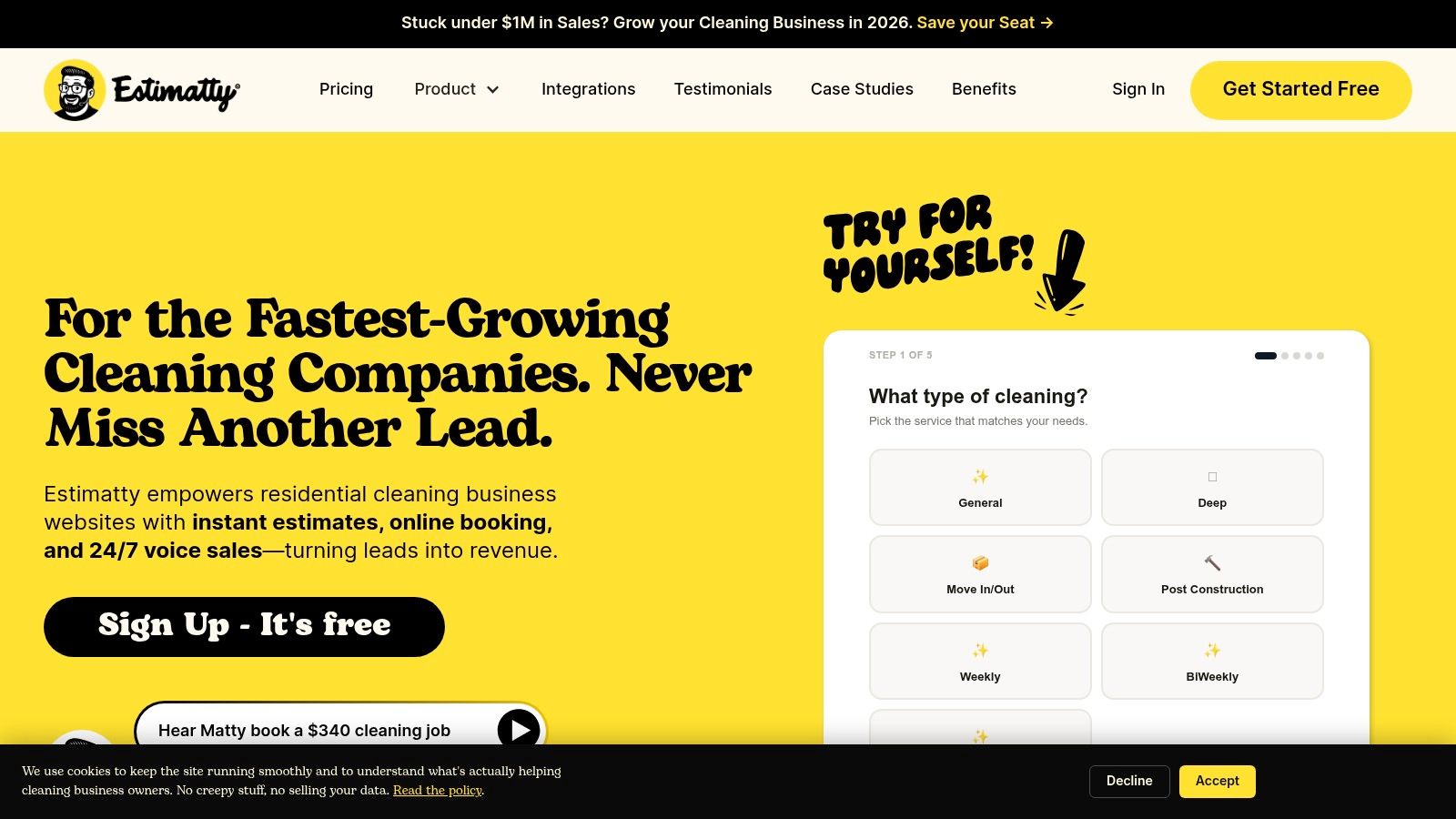
Estimatty addresses a different problem from the acquisition platforms below. It converts demand you have already paid for or earned through Google, referrals, marketplaces, and local promotion. For cleaning businesses, that makes it a conversion tool for the gap between a prospect's first inquiry and a booked job.
Its AI-powered web and voice sales estimator is designed for residential and commercial cleaning companies. The Matty agent collects details such as square footage, surfaces, and urgency, answers common questions, sends estimates by SMS and email, and alerts your team in real time.
A slow contact form makes a prospect wait. Estimatty responds to website visitors and callers 24/7/365, including nights, weekends, and holidays. Its no-code widget avoids a custom development project, while Zapier and CRM integrations can send captured leads into systems your team already uses. Configure pricebooks, recurring services, and add-ons such as oven, fridge, and deep-clean services so pricing follows your rules instead of an employee's guess.
Visit Estimatty to review the product, pricing workflow, and setup options.
A widely cited 2007 lead-response study found that contacting a lead within 5 minutes made a sales team about 21 times more likely to qualify it than waiting 30 minutes. Some summaries also report a 100x higher contact rate for the same comparison. Casey Response's lead-response statistics summarizes the study and later benchmark reporting.
Another benchmark found that the median B2B team takes 42 hours to respond, only about 7% reply within five minutes, and five-minute responders convert at roughly 21%, compared with 2.3% for teams waiting a day, according to Aloware's response benchmarks. Use these figures as a reason to test response speed, not as a forecast for your cleaning company.
Set the system to deliver the first useful response immediately. A human should take over when the prospect needs reassurance, requests an unusual service, or requires a more involved booking conversation. Estimatty supports optional U.S.-based receptionist handoff and bilingual voice agents, so automation can preserve human contact where it matters.
Practical rule: Configure the pricebook before promoting the estimator. Fast estimates only help when your service rules, minimums, add-ons, and service areas are accurate.
Estimatty also supports card capture at booking, standardized pricing, upsells, and fewer callbacks. Its website references coverage for less than approximately $0.54 per hour and offers a free trial with no credit card required. The site's testimonials and audio demonstrations are vendor marketing, not independent verification. Judge the tool by your own response time, estimate-to-booking rate, average job value, and cancellation rate.
Use Estimatty's lead-intent tools to connect acquisition activity with the questions prospects ask, the details they provide, and the point where they book. Configure the pricebook, add FAQs, install the widget, connect notifications, and test phone handoff before sending paid traffic. That setup turns faster replies into a measurable conversion test rather than another untracked software expense.
Google Local Services Ads suit cleaning businesses that need high-intent local demand. A homeowner searching for house cleaning services is already looking for a provider, and LSA can place an eligible business prominently across Google Search and Maps. Billing is based on leads rather than impressions, so lead quality deserves closer attention than visibility alone.
Set up the profile carefully. Select the correct service category and service area, complete verification, and prepare documentation supporting your business details. In the United States, house cleaning services are an eligible category. Verification and background checks can support a visible trust badge, giving prospects a quick reason to consider your listing over an unfamiliar advertiser.
Google's official Local Services Ads platform provides the account entry point and operating details.
An LSA lead is an opportunity, not a booked job. Your team still needs to answer, qualify the request, provide an estimate, and secure the appointment. Set an immediate response process before turning on the campaign. Review the lead log regularly, and use the platform's credit process to dispute invalid contacts.
Track four outcomes:
Lead costs vary by market and service, while onboarding and verification can take time. Treat LSA as a controlled acquisition test, not a budget you leave running without review. Pause weak service areas, tighten job types, and shift spend toward requests that fit your routes and margins.
Make the handoff to estimating fast. Guidance on Google Ads for cleaning businesses can help align search demand, landing-page messaging, and response handling. Use a clear intake form or estimator, then give a person the conversation when the prospect needs reassurance, requests unusual work, or has questions the form cannot answer. That combination connects discovery with a faster path to a booked cleaning job.
Thumbtack works best as a fast demand test. Use it to enter a new service area, fill open capacity, or learn which cleaning requests attract real buying intent before investing in a larger search presence. Homeowners post requests through the marketplace, and professionals may be charged when a customer messages or contacts them through Thumbtack's system.
Set up the operating rules before you pay for attention. Add specific service descriptions, recent cleaning photos, coverage areas, availability, and reviews. Select only the job types your team can deliver profitably. Configure budget controls and pause settings so the platform does not send requests that conflict with your schedule, routes, or margins.
Manage those settings through the Thumbtack for Pros platform.
Thumbtack gives you practical control over budget, availability, service categories, and job preferences. Reviews, verification features, and badges can strengthen trust for a newer cleaning company that is still building its independent reputation.
Competition remains the main constraint. Several professionals may be charged for one inquiry, while the prospect may contact multiple cleaners. Expect masked phone numbers, ghosting, and uneven outcomes when requesting refunds for poor-quality leads. Do not confuse a fast reply with a qualified opportunity. A response such as “Are you still looking?” keeps the conversation open but does little to move it toward a booking.
Use the first message to collect details and create a clear next action:
Review results by service category, location, and route value. Keep requests that produce completed jobs or efficient recurring routes. Reduce exposure to inquiries that consume staff time without producing bookings. Use this information alongside a broader comparison of sites like TaskRabbit for cleaning businesses to decide whether Thumbtack belongs in your lead mix.
A quick win is to review the lead log weekly and pause one weak category or area at a time. That keeps the test controlled and shows whether better targeting, faster estimating, or stronger qualification improves booked-job volume.
Angi Leads, formerly associated with the HomeAdvisor marketplace, matches homeowners with professionals by task type and ZIP code. It can bring steady home-services demand in active metros, but the platform does not close jobs. Your profile, response process, estimate speed, and follow-up decide whether that demand becomes revenue.
Set the account around work that fits your operation. Choose ZIP codes where your crews already work, list cleaning tasks you can deliver consistently, and remove services that cause scheduling problems. Add badges, ratings, service descriptions, and photos that answer common questions before a homeowner contacts you. If budget controls or account settings limit lead volume, use them to keep inquiries within crew capacity.
Review the Angi Leads process for professionals before committing to a larger spend.
Angi can help a new location or a team with unused capacity. Its consumer reach and agent-support resources may help move homeowners toward a booking, while profile settings can let you adjust activity to match operating needs. Lead pricing and quality vary, and some professionals find contracts or terms rigid.
The same homeowner may compare several pros. Respond quickly with a specific estimate path: confirm the requested service, show why your team is reliable, and offer a clear way to choose a time. A generic reply leaves the decision anchored to price.
A lead source only opens the door. Your estimate process decides who walks through it.
Measure Angi separately from other marketplaces. Record the source, task type, ZIP code, contact status, estimate sent, booking result, first-job value, and repeat potential. Judge the channel by completed work after lead costs, labor, travel, and follow-up time, not by the number of contacts delivered.
Use lead services for contractors as a reference when comparing marketplace economics. If a service area produces better bookings through your website or referrals, shift budget toward that owned channel and strengthen the estimate and follow-up process there. Run the test by location and service type so you can cut weak demand without abandoning a market that performs well for another crew or route.
Yelp Ads performs best after your business profile has earned trust. Cleaning prospects compare ratings, photos, service descriptions, and contact options before they inquire, so paid visibility cannot repair weak proof. Build the profile first, then promote it to people searching for relevant cleaning categories.
Yelp charges on a cost-per-click basis. Campaigns can generate calls, messages, or Request a Quote inquiries, with reporting such as average CPC. You can set daily or monthly spend, pause campaigns, and change activity without treating the budget as permanent.
Review the Yelp Ads advertising options before launching.
Show the work you want to book. A residential cleaner should clearly present recurring, deep-clean, move-in, and move-out services. Keep service areas accurate, explain what affects an estimate, and answer reviews professionally. Prospects need evidence that your team arrives prepared and delivers consistent results.
Use a simple inquiry test before increasing spend. A prospect clicks an ad for a move-out cleaning, reaches a profile that describes the same service, provides property details, and receives a clear estimate path. If the request stalls at any point, paid traffic will expose the weakness rather than solve it.
Set up the conversion path in this order:
Yelp combines demand with trust signals. Reviews reduce perceived risk, while paid placement increases exposure to active searchers. Track the path from click to estimate to booked job, then compare revenue with lead cost, labor, travel, and follow-up time. If you only watch CPC, you can mistake traffic for performance.
Nextdoor works best when the goal is denser routes, not maximum reach. It puts your cleaning business in front of people within specific neighborhoods and ZIP codes, which can support recurring customers near jobs you already serve. Recommendations within a community often carry more weight than broad ads when residents are comparing local providers, so use the platform to strengthen local trust rather than treat it as a citywide discount channel.
Complete your Business Page before buying promotion. List the neighborhoods, cleaning services, booking method, and evidence of dependable work. Add real project photos and make the service area accurate. Then test ads or Local Deals where your crews already travel. A focused offer for a defined property type or service is easier to measure and less likely to fill your schedule with low-margin requests.
The Nextdoor platform for businesses provides neighborhood advertising and business promotion tools.
Start with a neighborhood that already produces recurring work or sits along an established crew route. Make the message specific: name the area, identify the service, and state when appointments are available. Grouping jobs geographically can protect margin by reducing unpaid travel time.
Local Deals can create attention in an active neighborhood feed, but discounting every service is a poor default. Use an offer to generate a first booking, then present recurring cleaning or a clearly defined follow-up option. Communities vary in activity, so set a limited test budget and judge performance by qualified inquiries and booked work, not impressions alone.
Test these angles:
Speed determines whether local attention becomes a job. Let prospects submit property details, service type, size, and timing through a clear estimate path. Deliver pricing or the next required step promptly. A delayed callback gives nearby competitors time to respond and makes the original recommendation less useful. Track each inquiry through estimate and booking, then compare the result with promotion cost, labor, and travel.
Bark.com works best as a selective marketplace, not a hands-off lead stream. Cleaners browse posted jobs, check the requested service and location, then spend credits to contact a customer. Because each opportunity shows its credit cost before contact, you can screen potential jobs before paying for access.
Set up the free profile with only the cleaning categories and service areas you can serve profitably. Turn on app notifications so relevant requests do not sit unanswered. Use starter credit packs for a controlled test, apply the service and location filters, and check whether your activity qualifies for an Elite Pro badge.
Bark fits schedule gaps, new-area testing, and specific service experiments. If a crew has an open day, focus on requests near its existing route. If you want to test a neighboring area, set a separate budget and track whether those inquiries become estimates and booked work. Selecting individual opportunities gives you more control than accepting every contact.
Set a hard credit budget before you start. Bark charges for contact before you win the job, multiple professionals may approach the same customer, and lead quality can vary. Stop the test when booked revenue no longer supports the credit cost.
Use this screening check before spending:
Your first message should request missing details and point the customer toward an estimate. Avoid a long generic pitch. Ask for property size, service type, preferred timing, and any access requirements, then provide the next step promptly. On a contact marketplace, selection and response speed determine whether a paid opportunity becomes a job. Track credits, inquiries, estimates, bookings, labor, and travel so you can keep the profitable request types and cut the rest.
| Solution | Implementation complexity | Resource requirements | Expected outcomes | Ideal use cases | Key advantages |
|---|---|---|---|---|---|
| Estimatty | Low–Moderate: no-code widget but requires pricebook setup | Minimal dev; time to configure pricing/rules; optional receptionist/payments fees | Instant, standardized estimates and 24/7 bookings; reported lead uplift (vendor claims 15–35%) | Residential & commercial cleaners wanting automated quoting and booking | AI web+voice, CRM/Zapier integration, bilingual + human fallback, customizable add‑ons |
| Google Local Services Ads (LSA) | Moderate: verification/background checks and Ads setup | Pay‑per‑lead budget; onboarding & compliance time | Very high‑intent leads and prime Search/Maps placement | Businesses seeking top local search visibility and immediate leads | Trust badge, pay‑per‑lead model, dispute/credit process |
| Thumbtack for Pros | Low: simple profile setup | Pay‑per‑contact credits/budget; active profile management | Fast lead volume and rapid ramp‑up for new pros | New or local cleaners wanting quick exposure and flexible budgeting | Strong consumer usage, adjustable budget and job filters |
| Angi Leads (HomeAdvisor) | Low–Moderate: profile and settings configuration | Per‑lead or subscription spend; ongoing profile optimization | Steady national lead flow in many metros; scalable volume | Pros seeking broad reach and predictable lead supply | Large consumer base, badges/ratings, agent support options |
| Yelp Ads for Local Services | Low–Moderate: CPC campaign setup and creative | CPC budget; good reviews/photos; campaign management | Targeted traffic and inquiry leads (calls/messages/quotes) | Businesses with established reviews aiming to control spend | Review-driven intent, flexible budgets, pause/adjust anytime |
| Nextdoor Ads & Local Deals | Low: self‑serve hyperlocal targeting | Local ad/deal budget; neighborhood creative/promotions | Improved local awareness and neighbor referrals; variable ROI by area | Recurring residential cleaners focused on neighborhood routes | Hyperlocal targeting, community trust, fine-grained geographic control |
| Bark.com (Leads Marketplace) | Low: profile creation and credit purchases | Purchase credits per lead; time to screen/respond | Opportunistic/selective leads to fill schedule gaps | Pros who want control over which leads to pursue | Transparent per‑lead credit pricing, selective lead selection |
Seven channels won't create a reliable business if you measure only inquiries. Group them by the job path they support. Google Local Services Ads and Yelp Ads capture people already searching. Thumbtack, Angi Leads, and Bark.com provide marketplace experiments, but each charges for access to shared demand. Nextdoor supports neighborhood trust and route density. Estimatty converts the demand you already paid for, earned through search, or received through referrals into estimates and bookings around the clock.
Start with one acquisition channel and one conversion improvement. For example, launch Google LSA in a tightly defined service area while replacing a slow contact form with an instant web and voice estimator. Or test Nextdoor in a neighborhood where your crews already work while adding recurring-service messaging and a faster booking response. Don't launch all seven at once. You won't know which spend worked, and you won't know whether poor results came from weak demand or slow follow-up.
Track every source using the same fields:
Response speed deserves its own operating standard. One follow-up guide recommends spacing early touches by 24 to 48 hours, then moving to about 72 hours later in the sequence when there's still no response, with email, calls, and LinkedIn touches used together, as outlined in Skaled's inbound follow-up guide. Another guide recommends 5 to 7 touches for new leads over 2 to 3 weeks, and 3 to 4 touches for estimate follow-ups over about 10 days, summarized by Whitespace Solutions' lead follow-up guidance. Use those as process references, then adapt the cadence to the prospect and service.
AI-assisted lead generation is becoming standard infrastructure rather than a novelty. One 2026 benchmark reports that 61% of B2B teams use AI for lead scoring, up from 23% in 2024, while another aggregate reports that 84% of sales professionals use AI in their workflow. Those figures come from Digital Applied's 2026 lead-generation data. For a cleaning company, the useful application isn't chasing technology for its own sake. It's capturing details, routing inquiries, sending estimates, and keeping every promising prospect from disappearing into voicemail.
The quality problem matters as much as the volume problem. Median MQL-to-SQL conversion fell from 13% in 2024 to 9.8% in 2026, while top-quartile programs achieved 4.7 times lower cost per lead than bottom-quartile programs, according to Digital Applied's lead-generation marketing data. That supports a direct operating principle: generate fewer poor-fit inquiries and improve what happens after capture.
Your quick-win sequence is straightforward. Improve the booking response first. Select one acquisition channel. Add a trust signal, such as current reviews, real cleaning photos, or a clear service guarantee. Then review results after enough leads have passed through the same process. If you want to reduce wasted spend, start with this guide on stopping wasted money on bad contractor leads, then connect every campaign to a measurable estimate and booking workflow.
Estimatty gives cleaning businesses a 24/7 web and voice estimator that captures job details, sends consistent estimates by SMS and email, alerts your team, and supports booking without forcing prospects to wait. Visit Estimatty to replace slow forms and missed calls with a faster job lead generation system.