
November 5, 2026
AI Voice Sales Agent for Cleaning Companies in 2026
Learn how an AI voice sales agent answers calls, qualifies leads and sends estimates 24/7, with ROI math, use cases and setup steps for cleaners.

Friday, November 6, 2026
Compare residential deep cleaning services by scope, price and provider, with a room-by-room checklist and tips for getting fair, instant estimates.
6.79% of U.S. households, approximately 9.4 million households, paid for housekeeping services during a typical three-month period in 2025, according to the Bureau of Labor Statistics Consumer Expenditure Survey analysis published by RapidEye Research. That scale explains why price shopping feels chaotic. Two companies can sell you "a deep clean" and deliver two completely different jobs.
Scope is the main price driver with residential deep cleaning services, not the headline number. Don't compare totals until you've matched rooms, tasks, add-ons, condition, and crew time. If a provider won't put scope in writing, you don't have a comparable estimate. You have marketing.
A deep clean is a reset. It's a detailed pass through the edges, fixtures, grout, tracks, baseboards, and appliance areas that weekly cleaning skips because there isn't time to do them properly every visit.
That doesn't mean everything is included. The most expensive misunderstandings come from items homeowners assume are standard while providers price them separately, especially inside the oven, inside the fridge, interior cabinets, and blinds.
Use the table as your baseline, then force every provider to place each task in one column or the other. If you're preparing your own walkthrough before booking, follow a thorough home cleaning checklist and mark the rooms where buildup is worst.
| Area | Typically included | Often an add-on or excluded |
|---|---|---|
| Kitchen | Counters, sink, exterior appliances, cabinet fronts, backsplash wipe-down | Inside oven, inside fridge, interior cabinets |
| Bathrooms | Tub and shower scrubbing, toilet inside and out, grout and tile, mirrors and fixtures | Caulk replacement, mold removal |
| Bedrooms | Dusting, baseboards, doors and frames, vacuuming under furniture | Upholstery shampoo, mattress cleaning |
| Living areas | Dusting, baseboards, light fixtures, floors, wiped cushions | Sofa or upholstery steam cleaning |
| Floors | Vacuuming and mopping hard floors, edges and corners | Carpet extraction, stripping and waxing |
| Windows and blinds | Interior sills, tracks and accessible glass | Exterior windows, blinds (add-on in many booking flows) |
| Walls and ceilings | Spot cleaning of scuffs and marks, cobweb removal | Full wall washing |
| Vents and ducts | Dusting accessible supply vents | Duct cleaning, unless mold, pests or heavy debris are visible |
Pay close attention to the bathroom row. Scrubbing grout and tile is cleaning work. Replacing failed caulk or removing established mold is repair or remediation work, and a good provider separates those jobs instead of doing a cosmetic wipe and calling it done.
The vents row needs the same discipline. The U.S. Environmental Protection Agency guidance on air duct cleaning reports that duct cleaning has not been shown to prevent health problems. Dust accessible vents during a deep clean. Pay for duct service only when there's visible mold growth, pest infestation, substantial debris, or a system-specific maintenance problem.
Ask these before you discuss price:
Booking flows often list those extras automatically because they change labor. That's useful, not upselling, when the price moves with the task. For a practical view of task order and detail work, see how professionals clean a house step by step.
Don't buy the label "deep clean." Buy the room list, the task list, and the exclusions written beside them.
If two providers give you different totals, compare the right-hand column first. That's usually where the cheaper job got cheaper.
Cleaning and disinfection aren't the same job. Clean first with soap, water, or detergent to remove dirt and organic matter. Then disinfect only where that extra step is justified, using the right product for the surface.
The CDC guidance on cleaning and disinfecting your home recommends cleaning surfaces with soap and water before disinfecting them, then applying an EPA-registered disinfectant according to its label. A disinfectant must remain visibly wet for the full listed contact time, and wiping it dry early can reduce effectiveness.
Not every surface needs disinfectant. Spending chemical and dwell time everywhere doesn't make a home cleaner. It makes the job slower and can increase odor and exposure for no practical gain.
| Surface | Clean with soap and water | Disinfect after cleaning |
|---|---|---|
| Door handles and knobs | Yes | Yes, high-touch |
| Light switches | Yes | Yes, high-touch |
| Faucets and sink handles | Yes | Yes, high-touch |
| Toilet flush handles and seats | Yes | Yes, high-touch |
| Food-area countertops | Yes | Yes, per product label, then rinse food-contact surfaces |
| Phones and electronics | Wipe per manufacturer guidance | Only products approved for electronics |
| Walls, baseboards and floors | Yes | No, unless visibly soiled |
| Upholstery and carpets | Vacuum and spot clean | No routine disinfection; follow fabric care rules |
Dwell time is where sloppy disinfection fails. If a product specifies a 10-minute contact time, the surface must stay wet for at least 10 minutes, potentially requiring reapplication. A spray and immediate wipe is cleaning theater, not disinfection.
That timing affects scheduling and estimates. A crew disinfecting kitchen and bathroom touchpoints properly has to sequence rooms so surfaces stay wet while other work continues. Ask the provider to name the product, the surfaces it's used on, and the required contact time. Our breakdown of professional cleaning chemicals and label use covers what those product details should look like on a job checklist.
Tell the provider before booking if your home includes infants, asthma, pets, or chemical sensitivities. Ask directly about low-VOC and fragrance-free options, ventilation during the job, and when people and pets can re-enter treated rooms.
Demand for those options is commercially significant. The Mordor Intelligence North America household cleaners market report notes that approximately 61% of surveyed consumers aged 25 to 44 preferred providers offering eco-certified products, and 44% reported willingness to pay up to 15% more for sustainable cleaning. Preference still doesn't prove performance. "Natural" isn't automatically safer or more effective, and a strong fragrance doesn't prove sanitation.
For ingredient-aware households comparing gentler products, home cleaning advice from Evo Dyne Products is useful background before you question a provider. Then ask for specifics, not adjectives.
Practical rule: Get the product list in writing, matched surface by surface. If a provider can't tell you what's being sprayed in a nursery or kitchen, don't book them.
Never allow a crew to mix disinfectants unless the label specifically permits it. Require handwashing after disinfectant use, proper ventilation, and rinsing where the label requires it for food-contact surfaces.
Regular cleaning and deep cleaning are different scopes. Scope, not the headline rate, is what you are buying. Homeowners often feel unsure whether they clean enough, and that uncertainty leads to the wrong booking: a maintenance visit on a home that needs a reset.
Regular cleaning maintains a home already under control. A deep clean restores detail areas that routine visits keep postponing. The distinction matters most when you compare quotes, because a low deep-clean estimate usually means the provider priced a regular visit and renamed it.
| Factor | Regular cleaning | Deep cleaning |
|---|---|---|
| Purpose | Maintain a clean home | Reset neglected areas and heavy buildup |
| Typical frequency | Weekly or biweekly | One-off, or before a recurring plan starts |
| Focus | Visible dust, floors, kitchens and bathrooms | Edges, fixtures, inside appliances, detailed bathrooms and kitchens |
| Typical labor | Shorter maintenance visit sized to the established baseline | 4 to 8 labor-hours for 1,200 to 1,800 sq ft, crews of two to four |
| Disinfection | Optional | Targeted to high-touch surfaces, with label dwell times |
The labor row explains the price gap better than any sales pitch. A reset visit needs scrubbing, edge work, fixture detail, appliance work, and moving through areas a maintenance crew normally touches lightly. It cannot be priced like a recurring visit without cutting tasks.
Many providers require one deep clean before accepting a recurring customer. That is sound practice when the home has not had detailed work for months. The first visit sets the baseline. Weekly or biweekly service then defends it.
Book regular cleaning when kitchens and bathrooms are current, floors need routine care, and there is no heavy grease, soap scum, or neglected detail work. Book a deep clean after a move, a renovation, a long gap in service, or when baseboards, grout, tracks, and appliance interiors show visible buildup.
Use condition as your test, not habit. A home cleaned weekly but never detailed still has grout, tracks, and appliance interiors that need attention. A home with light use and current detail work does not need a reset every month.
Ask one question before you book: which rooms and surfaces change between the two services? If the answer is vague, you are comparing a real scope with a guess. Get the deep-clean task list in writing, then compare that list with the regular visit list. The gap between them is the work you are paying for.
A written quote should name the rooms, surfaces, add-ons, and condition limits. An estimate is a range based on home size and assumptions. Treat a phone number as an estimate and a task list as a quote.
Don't pay deep-clean money every visit. Don't expect maintenance money to fix months of buildup either.
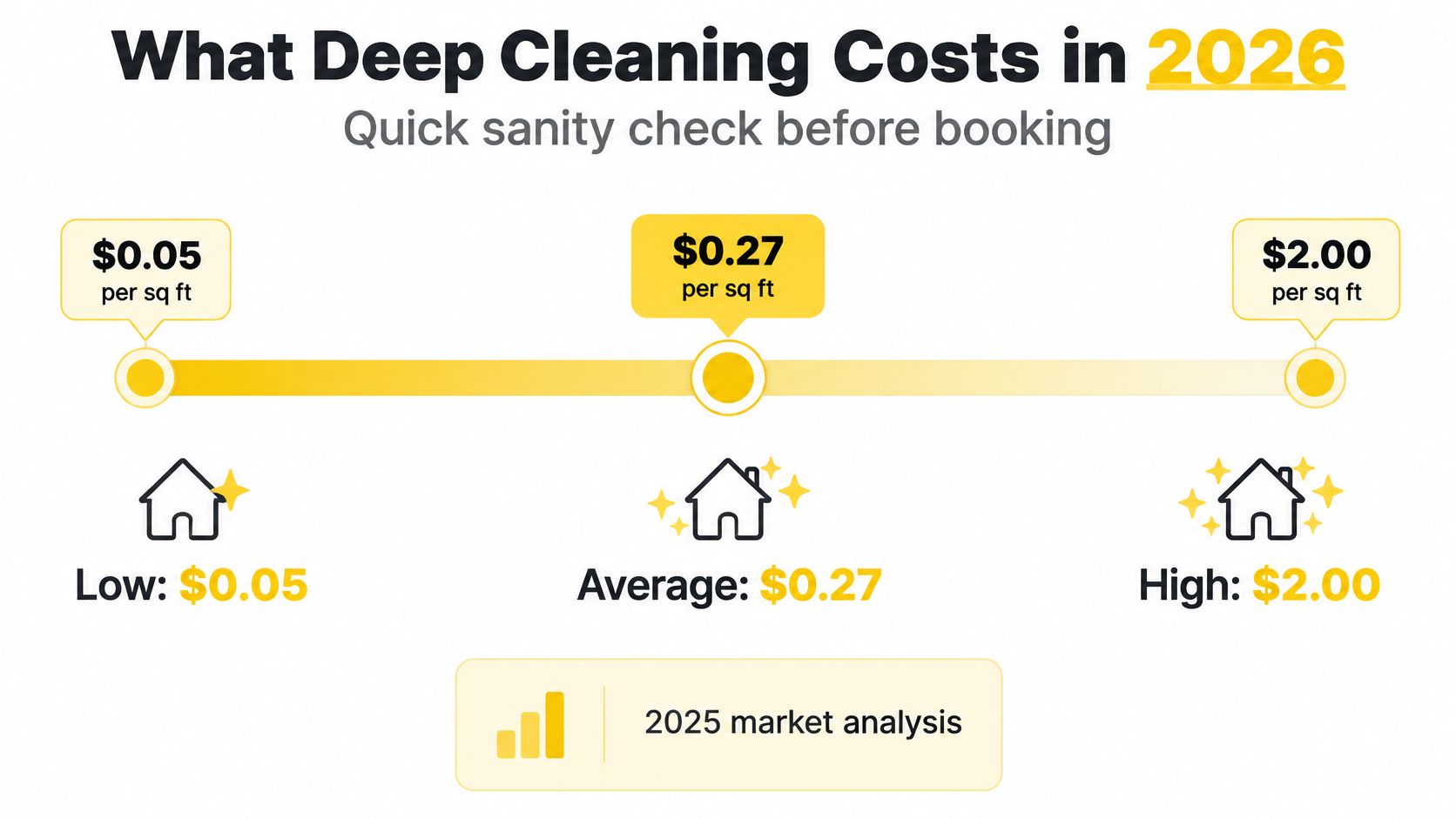
The per-square-foot number is a screening tool, not a price. The 2025 Market.us janitorial services market analysis puts deep-cleaning services between $0.05 and $2.00 per square foot, with an average of $0.27 per square foot. That spread is wide because "deep clean" has no standard scope. Use the range to test whether an estimate is plausible, then read the scope before you call it expensive or cheap.
| Benchmark | Reported value | How to use it |
|---|---|---|
| Per-square-foot range | $0.05 to $2.00 | Sanity-check the low and high ends of a quote |
| Average per square foot | $0.27 | Multiply by home size for a rough baseline |
| One-off metro average | About $185 | Compare only against similar square footage and scope |
| Typical residential range | $150 to $450, or $200 to $400 | Wide spread, so ask what is included |
A 1,500-square-foot home at that average lands near $405. If another provider quotes far less for the same address, do not assume you found a deal. Ask whether they assumed lighter condition, fewer bathrooms, a smaller crew, or a scope that leaves out ovens, cabinets, blinds, and detailed grout work. The lower number usually describes a smaller job.
The guide to how much a deep house cleaning costs helps after you have that baseline. The next step is matching the number to your rooms, your condition, and the tasks you need done.
Home size sets the floor and dusting time. Bathrooms set the scrubbing time, and each extra bathroom adds a separate room of detail work. Kitchen condition is the second big lever. Grease on cabinet fronts, backsplashes, stovetops, and appliance exteriors slows every crew, and baked-on residue can consume more time than open floor does.
Buildup and clutter add labor before cleaning starts. Pet hair, soap scum, hard-water deposits, and surfaces buried under belongings all consume hours. Add-ons should carry their own prices: inside oven, inside fridge, interior cabinets, blinds, carpet extraction, and upholstery. Product and safety steps also take time, including pre-cleaning, dwell-time monitoring, ventilation, and careful handling around sensitive occupants.
A low estimate that excludes the oven, cabinets, and blinds is not cheaper for the same job. It is a smaller job with the same label.
Treat every published average as a screening tool. An estimate is a planning range. A quote is a fixed number tied to a written scope, a date, and a named list of included tasks. Your usable price is the one attached to your square footage, your room count, your condition, and that written scope.
Most providers list tasks and prices, but few publish a standardized room-by-room scope. That's why two prices for the same home can differ sharply without either company necessarily lying. They're often not selling the same work.
The Dataintelo one-off cleaning services market report describes one-off residential deep cleans averaging about $185 in major metropolitan markets, commonly covering 1,200 to 1,800 square feet and taking 4 to 8 labor-hours with teams of two to four cleaners, while other coverage places residential pricing around $150 to $450 or $200 to $400. Those ranges don't tell you whether ovens, refrigerators, cabinets, blinds, baseboards, walls, and windows are included.
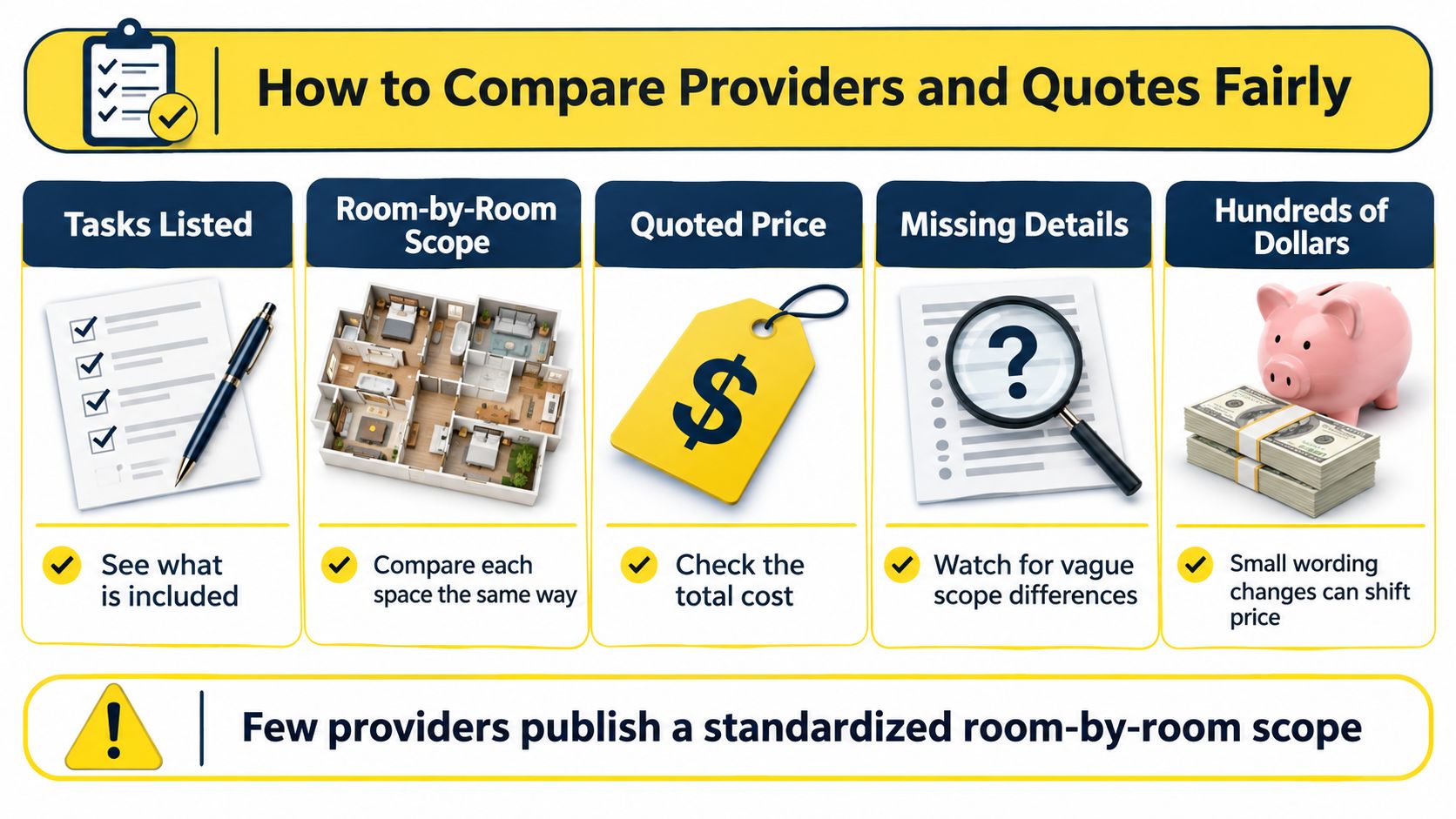
Ask all seven, in the same order, and record the answers beside each estimate:
For Estimatty, keep the language straight. We separate estimates from quotes. An estimate is a planning figure based on the details entered. A quote is the confirmed price after scope and condition have been checked. Providers using our system can itemize add-ons during booking so the estimate reflects the tasks selected, and our guide to cleaning service cost factors explains the pricing inputs behind that figure.
A baseline package plus condition-based surcharges is fairer than one lump number. You can see what the standard job costs, what your home adds, and what you chose to include.
Comparison test: If you can't line up three providers row by row on rooms, add-ons, crew time, and change rules, you aren't comparing prices yet.
Compare at least three providers with identical inputs. Drop any company that refuses to separate included work from add-ons, won't explain surcharges, or pressures you to book before scope is written down.
A fast estimate earns its place only when it survives scope review. The number should give you a shortlist. The written quote should lock the job the crew will clean.
Online booking starts shaping the estimate the moment a customer enters home details.
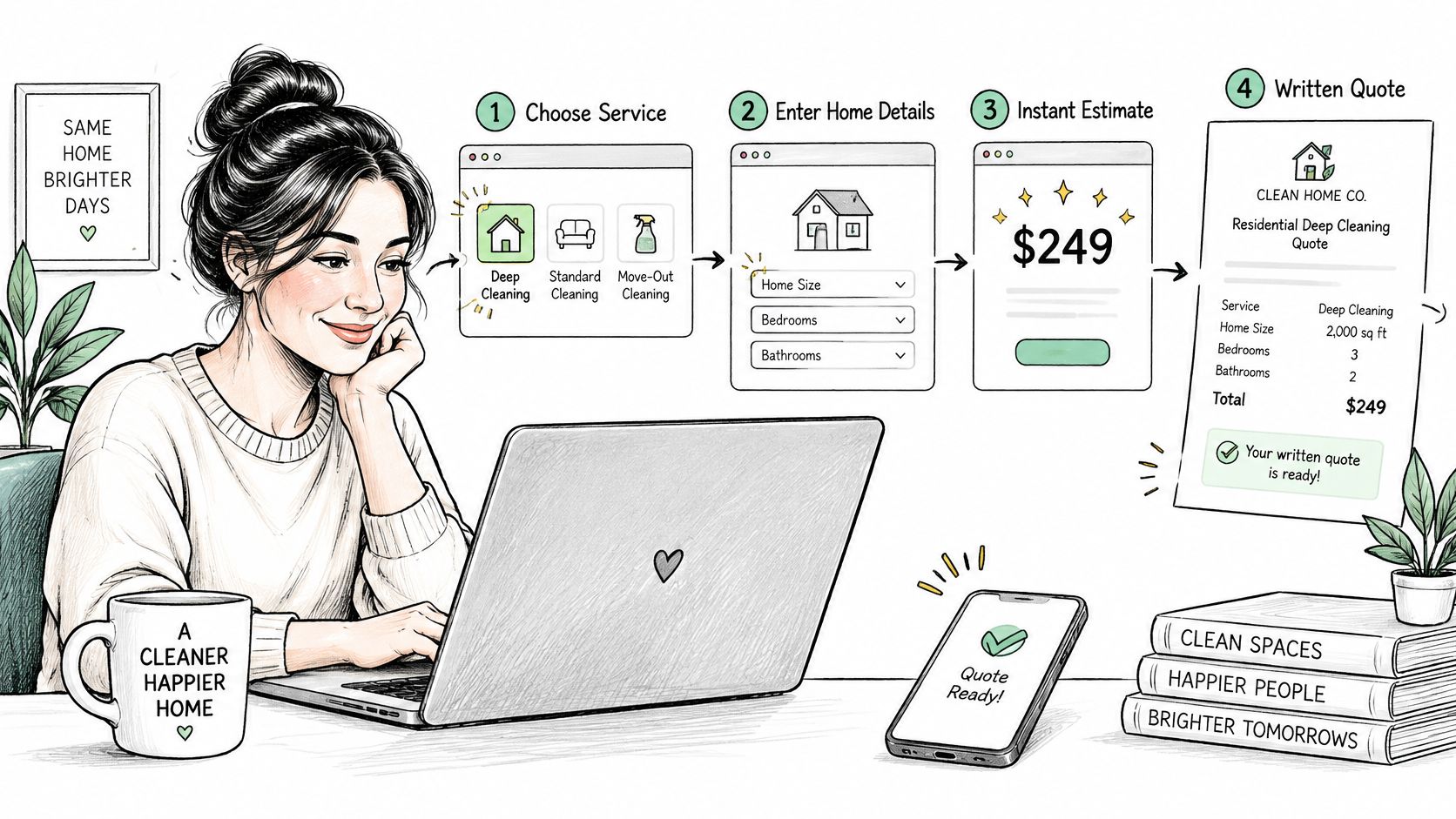
Estimatty's instant price tool asks for service type, when the last clean was done, home size in square feet, beds, baths, pets, and add-ons. Online booking lets customers pick a service, enter home size, select bedrooms and bathrooms, and add options such as oven cleaning. Add-ons such as inside oven, steam cleaning, AC vents, and blinds appear automatically during the booking flow.
Use the flow in this order:
That flow replaces slow forms and callback delays, with one limit: the estimate reflects only what you entered. Heavy grease, mold concerns, severe pet hair, hoarding-level clutter, renovation dust, or damaged surfaces still need photo review or an onsite check before a firm quote.
The walkthrough below shows how a structured proposal turns those inputs into a booking decision.
Put the leading estimate through photo review or an onsite check, then ask for a written quote. Confirm what could change the price, who approves changes, how many cleaners will attend, which products they bring, and what cancellation terms apply. A polished number with vague scope loses to a plain number with exact tasks. Our walkthrough of a cleaning services proposal shows the details that should survive from estimate to booking.
For cleaning businesses, standardized estimates reduce callbacks, keep crews from absorbing unpriced add-ons, and make scheduling honest. Owners can find more pricing and estimating guidance on estimatty.com/blog.
Decision rule: Use an estimate to shortlist. Book only from a quote that names scope, condition assumptions, product practices, crew time, and change rules.
Book once those points are in writing. If the provider resists, choose the competitor who will document the job before taking your payment details.
If slow forms and inconsistent pricing are costing your cleaning business deep-clean leads, Estimatty gives you instant estimates, online booking, and 24/7 voice sales that capture home size, rooms, condition, and add-ons before your team follows up. Standardize your deep-clean estimates, separate them clearly from confirmed quotes, and convert more inquiries into booked jobs.