October 12, 2026
Cleaning Office Prices: A Practical Pricing Guide for 2026
Learn how cleaning office prices really work in 2026. Compare per square foot, hourly, and monthly models, plus tips to estimate and present winning quotes.
Monday, April 13, 2026
Master professional cleaning chemicals. Learn types, safety, green options, and cost-saving tips to accurately estimate for your business.
.png)
A crew finishes a job, the space looks clean, and then the callback lands. A stone vanity is dulled. A floor has sticky residue. An employee says the degreaser made their hands burn through thin gloves. None of those problems start at the mop bucket. They start with chemical choices made earlier, often in a rush.
That’s why professional cleaning chemicals can’t be treated like a supply closet detail. They shape job quality, rework risk, team safety, and margin. The businesses that get this right don’t just clean better. They train faster, standardize better, and create more defensible estimates because labor time and product use stop swinging wildly from job to job.
A lot of owners buy chemicals the same way they buy trash liners. Find a familiar label, compare price, move on. That works until one wrong product touches the wrong surface, or a “stronger” cleaner slows the crew because it needs extra rinsing, extra PPE, or extra explanation to the client.
Professional cleaning chemicals sit inside a very large market. The global industrial cleaning chemicals market was valued at $57.56 billion in 2023, with the commercial segment accounting for over 69% of revenue, and North America holding a 32% market share according to Benchmark International’s industrial cleaning chemicals global industry report. That tells you something important. Chemical selection isn’t a side issue in cleaning operations. It’s one of the core levers in the industry.
The cheapest gallon is rarely the cheapest outcome.
A product can look affordable and still cost you money if it:
Practical rule: Buy chemicals for repeatable results, not shelf appeal.
A strong chemical program does three things at once. It protects surfaces, protects people, and protects your gross margin. If one of those is missing, the program is incomplete.
When you know why one product works and another fails, you stop guessing. You can build service packages around surface type, train new hires faster, and write estimates with more confidence because your production method is stable.
That marks a significant shift. Professional cleaning chemicals aren’t just cleaning agents. They’re operating controls.
Most cleaning failures come from one bad assumption. People think “stronger” means “better.” It usually means “more reactive,” and that can help or hurt depending on the soil and surface.
Cleaning works when you match the chemistry to the mess.
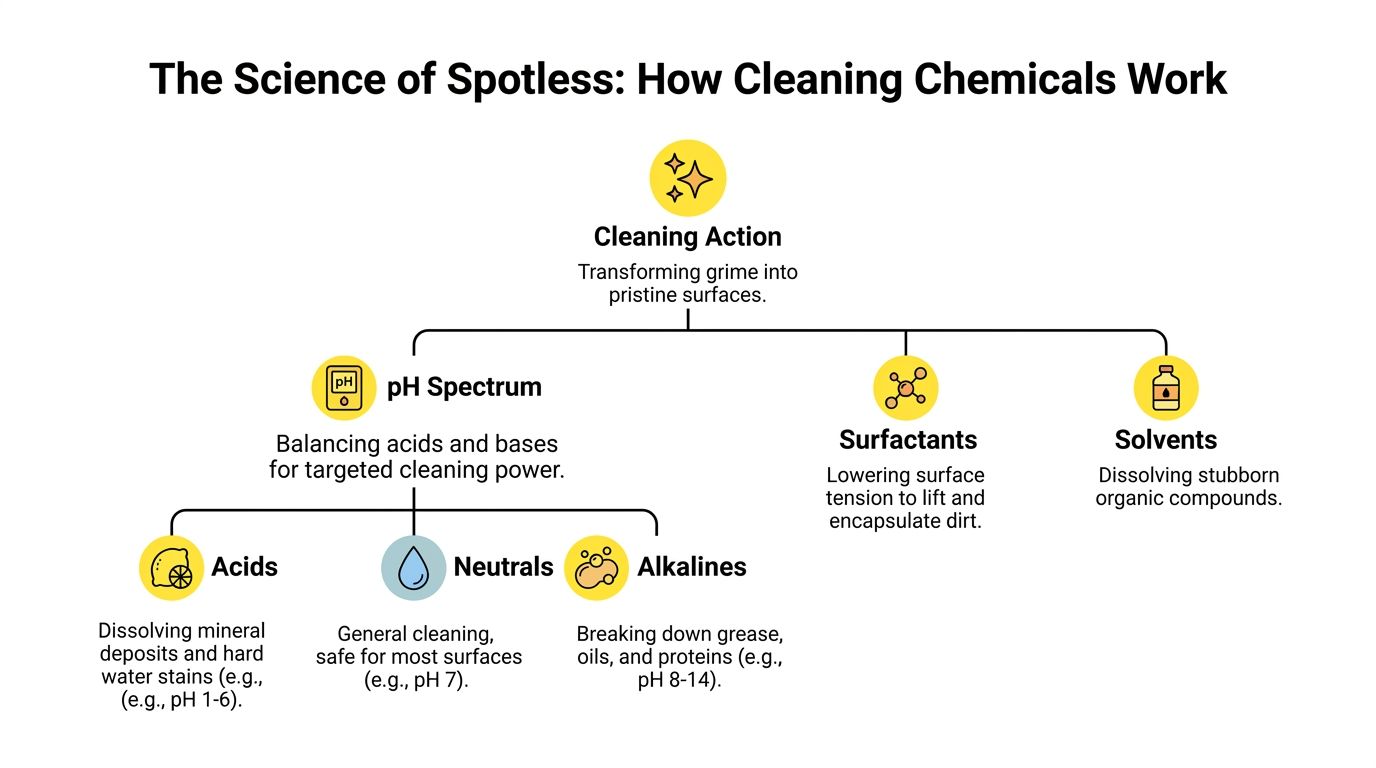
Think of the pH scale as a tool rack.
Acidic cleaners help dissolve mineral buildup, soap scum, and hard water deposits. They belong in restrooms, around fixtures, and on scale-heavy surfaces that can tolerate them.
Neutral cleaners are your everyday workhorses. They clean light to moderate soil with less risk to finished floors, sealed stone, and delicate materials.
Alkaline cleaners attack grease, oils, food residue, and protein soils. That’s why they show up in kitchens, break rooms, and heavy-duty floor work.
The mistake is using the right pH on the wrong material. An acid might win against scale and still lose the job if it etches natural stone. A high-alkaline degreaser might crush kitchen film and still leave a tacky floor if it isn’t diluted and rinsed correctly.
Surfactants are the part of the formula that help water spread and grab soil. Without them, water tends to bead up and skate past greasy residue.
A simple way to explain surfactants to staff is this: one end likes water, the other likes oil and dirt. That lets the chemical surround grime so you can wipe, scrub, or extract it away.
According to Kaivac’s guide to cleaning chemicals, surfactants reduce water’s surface tension, but in hard water up to 70% of surfactant molecules can be deactivated by minerals. Modern chelating agents can counteract that, improving cleaning efficiency by 2 to 3 times in water over 150 ppm hardness.
That matters in the field. If a crew says, “This product doesn’t work at this account,” the formula may not be the problem. The water may be.
Hard water is like static in the system. Minerals interfere with detergency and leave film behind. Chelating agents tie up those minerals so the cleaner can work as intended.
If you’ve ever seen these symptoms, suspect hard water interference:
In those environments, a cleaner with decent surfactant chemistry but poor mineral control often disappoints. A better-balanced formula usually beats a harsher one.
Solvents are useful when the soil is oily, sticky, adhesive, or otherwise resistant to water-based cleaning alone. They don’t replace surfactants. They support them.
Enzymes are different. They help break down organic soils like food residue. They’re often useful where odor control and organic buildup matter, but they’re not universal answers. If the issue is mineral scale, enzymes won’t save you.
A cleaner should match the soil first, then the surface, then the workflow.
This gets missed all the time. Cleaning removes soil. Disinfection targets microorganisms, and dirty surfaces can interfere with that process. Crews need to understand both the pre-clean step and contact time.
If you want a simple explanation to support training, this article on how bleach kills germs gives useful context on why bleach works differently from a standard cleaner.
The best operators don’t memorize chemistry textbooks. They remember a few field truths:
That’s enough science to make better choices without turning every shift into a lab exercise.
A useful chemical lineup is smaller than most owners think. You don’t need a shelf full of near-duplicates. You need a controlled set of products that cover your common soils, your common surfaces, and your service mix.
All-purpose cleaners handle day-to-day soil. On residential jobs, that means counters, touchpoints, exterior surfaces of appliances, and light bathroom maintenance. In commercial work, they carry a lot of lobby, office, and general common-area cleaning.
Degreasers belong where cooking oils, body oils, and heavy buildup collect. They’re right for range hoods, backsplashes, break rooms, ovens, and certain floor zones. They’re wrong for any crew member who thinks “degreaser” means “universal cleaner.”
Disinfectants are for high-touch and high-concern environments where the service scope requires microbial control, not just appearance. They need surface compatibility checks, proper dwell time, and clear training. Used carelessly, they increase labor and liability without improving the result.
Sanitizers fit workflows where reducing contamination is part of the service standard but the environment doesn’t call for broad disinfection on every pass.
Glass cleaners should leave no haze, no drag, and no residue trail on mirrors, partitions, and glass doors. The best teams treat glass chemistry as its own category, not an afterthought. If your crews do a lot of glass work, this overview of The Ultimate Guide to Window Washing Fluid is a useful reference for understanding what separates a good formula from one that smears.
Owners usually overspend in two places. First, they buy specialty chemicals for one-off situations that rarely recur. Second, they rely on one aggressive product for too many tasks.
A smaller, disciplined arsenal usually wins:
That mix gives crews clarity. It also makes training and restocking simpler.
Use this as a field decision aid. Manufacturer labels and finish-specific guidance still come first, but this chart helps crews avoid common mistakes.
| Surface Type | Acidic Cleaners (e.g., Toilet Bowl Cleaner) | Alkaline Cleaners (e.g., Degreasers, Oven Cleaners) | Neutral pH Cleaners | Disinfectants (Quat-based) | Abrasive Cleaners |
|---|---|---|---|---|---|
| Granite | Use caution. Avoid on unsealed or sensitive finishes. | Use caution. Test first. | Generally preferred. | Often acceptable if label allows and residue is removed. | Avoid. Can dull finish. |
| Marble | Avoid. Can etch surface. | Use caution. Can dull finish. | Preferred. | Use caution. Test first and avoid residue. | Avoid. High damage risk. |
| Stainless Steel | Use caution. Rinse well. | Often effective for grease, but watch concentration and grain direction. | Good for routine cleaning. | Often acceptable with proper wipe-down. | Use caution. Can scratch. |
| Vinyl | Use caution. Strong acids can damage finish. | Use caution. Strong alkalines may affect wear layer. | Preferred for routine care. | Often acceptable if label permits. | Avoid. Can scuff or dull. |
| Ceramic Tile | Often suitable for mineral deposits and soap scum. | Often suitable for soil and grease. | Good for daily maintenance. | Often acceptable. | Use caution, especially on polished tile. |
| Sealed Quartz | Usually avoid strong acids. | Use caution with heavy-duty degreasers. | Preferred. | Often acceptable if non-residue and label approved. | Avoid. |
| Painted Surfaces | Avoid. | Use caution. Can strip or dull paint. | Preferred. | Use caution. Spot test first. | Avoid. |
| Glass and Mirrors | Avoid except for specific mineral stain situations. | Usually avoid. | Suitable when glass-safe. | Use caution. Some leave haze. | Avoid. |
Experienced operators separate themselves from “grab whatever’s under the sink” cleaning.
For example:
Selling deep cleaning without matching the chemistry is how you create callbacks with extra steps.
If you’re tightening your production standards for first-time or recurring services, this professional deep cleaning checklist is a practical way to make sure chemical selection lines up with task sequencing.
What works is a limited chemical arsenal tied to written use cases.
What doesn’t work is asking technicians to improvise between “blue spray,” “green spray,” and “the strong one.” Color coding without training is decoration. Product names without surface rules are a liability.
A good arsenal makes the right choice easy under time pressure. That’s the standard.
A chemical program isn’t professional because the labels look organized. It’s professional when a new hire can pull the right product, read the hazard signals, wear the right PPE, and use it without improvising.
The stakes are real. According to the Responsible Purchasing Network facts on cleaners, experts estimate that six out of every 100 janitors are injured by the chemicals they handle each year. The same source notes that the average janitor uses 23 gallons of chemicals annually, with hazardous ingredients comprising 25% of that volume.

A Safety Data Sheet only looks intimidating until you know what you need from it. Train crews to pull practical answers fast.
Focus on these points first:
If your team can’t find those sections quickly, they don’t really have SDS access. They have paperwork.
One of the worst habits in the field is treating gloves as a universal answer. Gloves matter, but thin disposable gloves won’t solve every exposure issue. Some tasks also call for eye protection, aprons, or stronger hand protection depending on the product and splash risk.
Build PPE rules around categories, not around personal preference:
If a product requires special handling, that instruction belongs in training, labeling, and route sheets. Not just in a binder at the office.
Safe storage isn’t glamorous, but it stops leaks, cross-contamination, and accidental mixing.
Keep these habits simple and essential:
Many owners also need better intake controls before a crew ever arrives on site. If your business handles unknown conditions, prior damage, or strong customer preferences around products, this article on when a cleaning job turns dangerous and how better intake systems can protect your team is worth reading.
Don’t let crews wing disposal decisions. Follow label instructions and local requirements, and make sure they know that “pour it somewhere out back” is never a system.
Documentation matters too. If a customer asks what was used in their home, your team should be able to answer clearly. If an incident happens, you should know the product, the dilution, the technician, and the task.
A short training visual can help reinforce the basics during onboarding or refreshers:
Clients may never ask to see your chemical handling system. Their confidence still depends on it. They notice whether bottles are labeled, whether technicians work carefully, and whether your team can explain what’s safe on their surfaces.
The best safety cultures don’t sound dramatic. They sound calm, clear, and routine. That’s the point.
Greener cleaning gets dismissed in some circles as marketing language. That’s a mistake. For a lot of businesses, safer chemistry is a practical way to reduce friction with clients, appeal to health-conscious households, and stand out in crowded markets.
It also connects to a deeper issue. According to ECOS, low-income and BIPOC communities often face disproportionate exposure to toxic cleaning chemicals, and businesses that offer and clearly communicate safer, certified product lines have a differentiator that many competitors ignore. That point is discussed in ECOS’s article on why access to safer cleaning products is a human right.
Most homeowners don’t ask for “green cleaning” in technical language. They ask for things like:
That’s a sales conversation, not just an operations choice. If you can explain what you use and why, you remove uncertainty. That builds trust faster than vague promises about being eco-friendly.
Poorly chosen green products can underperform. So can poorly chosen conventional products. The issue isn’t the label category. It’s whether the formula fits the soil, the water, and the surface.
A smart greener cleaning program usually includes:
Clients don’t need a lecture on formulation. They need confidence that your team has thought through safety, performance, and fit.
Businesses that speak clearly about safer options often earn trust in neighborhoods where chemical exposure concerns are personal, not theoretical. That can matter for families managing asthma, scent sensitivity, or general indoor air concerns.
If you want that positioning to feel credible, your messaging has to match your operations. Don’t advertise safer chemistry if crews can’t explain the products in the field. Don’t claim premium care if your bottles are unmarked and your process changes from house to house.
A lot of owners sharpen this message through better visual identity and clearer service framing. This guide to branding for cleaning services is useful if you’re trying to align your service promise with how clients perceive your company.
Greener chemistry can require more discipline. Sometimes that means better dwell control, better microfiber use, or better task sequencing. That’s not a drawback. It’s a filter. Businesses willing to standardize those habits usually deliver a more consistent service anyway.
The win isn’t just environmental. It’s commercial. Safer options give you a reason to compete on trust instead of racing to the lowest price.
Most owners know chemicals cost money. Fewer track how chemical decisions affect labor time, rework, customer confidence, and estimate accuracy. That’s where the bigger profit story sits.
Small cleaning businesses also miss a major sales opportunity. Baron Chemical notes that many operators fail to use chemical safety communication as a differentiator, even though explaining the use of EPA-approved or surface-safe products in estimates can help justify premium pricing, support upsells, and separate the business from competitors in the customer’s mind. That point appears in Baron Chemical’s piece on the best cleaning chemicals for businesses and restaurants.

If every technician mixes differently, every job costs differently. If every team chooses products based on habit, your production times drift. Then your estimates drift with them.
Chemical management becomes a profit center when you standardize:
That gives you a cleaner operation and a cleaner pricing model.
Visible waste is easy to spot. Leaking jugs, duplicate orders, forgotten inventory. Hidden waste is more expensive.
Hidden waste includes:
Owners usually blame labor for these issues first. Often the chemical system is driving them.
A good tech doesn’t need to recite every active ingredient. They need to know what product fits the task, what can damage a surface, and when to stop and ask.
That means your training should cover:
If you’re growing and need more reliable hiring support around these standards, pipehirehrm.com is relevant for cleaning employee hiring workflows. Consistent operations start with who you bring in, not just what you hand them on day one.
When you explain your chemical choices in estimates, you’re not adding fluff. You’re showing the customer that your process is intentional.
A strong estimate might clarify that you use:
That does two things. It makes your price easier to defend, and it reduces surprises on service day.
If you’re serious about margin, connect chemical planning to overhead analysis too. This guide on how to calculate overhead costs helps frame supplies, training, callbacks, and labor variability as financial inputs, not random operating noise.
The businesses with the healthiest margins usually aren’t using magic products. They’re using fewer products, more consistently, with clearer rules. They buy less junk, waste less time, and explain their process better.
That last piece matters. Clients often can’t judge your chemistry directly. They judge whether your team sounds informed, careful, and trustworthy. When your chemical program is disciplined, that confidence comes through.
Use the product label and manufacturer guidance as your first rule. If your team can’t confirm a safe window, don’t leave diluted product sitting indefinitely. Mixed solution can lose effectiveness, create confusion, or end up in an unlabeled bottle that nobody trusts.
A safe field policy is simple:
Separate towels by function. Glass towels, disinfectant towels, greasy kitchen towels, and stone-safe detailing towels shouldn’t live in the same wash cycle by default.
Good practice looks like this:
Cross-contamination doesn’t always show up as a health problem. Sometimes it shows up as haze on mirrors and streaks on counters.
Allow it only with a clear policy. Customer-provided chemicals create uncertainty around performance, safety, and surface compatibility.
Set expectations before the job:
If your estimates and pricing framework need to reflect exceptions like this, this guide on how to price cleaning services is a useful reference.
No. Use them when the scope, environment, or customer request calls for them. Many surfaces need effective cleaning more than routine disinfection.
Overusing disinfectants can create extra steps, residue issues, and unnecessary complexity. Build the service around what was sold and what the environment needs.
Fewer than most carry now. Start with a disciplined core lineup and add specialty products only when a recurring service need justifies them. Every extra bottle adds training load, storage complexity, and room for mistakes.
Standardize three things first:
Callbacks often happen because the product was wrong for the material, mixed too strong, or poorly explained after use.
Estimates get easier when your cleaning process is consistent. If you want a faster way to turn inbound leads into accurate, standardized estimates without relying on back-and-forth calls, Estimatty helps cleaning businesses capture job details, respond instantly, and send polished estimates around the clock.