October 8, 2026
10 Quotes on Jobs to Inspire Cleaning Business Growth
Explore 10 quotes on jobs for cleaning business motivation, social posts, marketing copy, and CTAs, with practical usage tips for owners.

Wednesday, May 20, 2026
Craft investor-ready cleaning business plans with our step-by-step guide. Get templates, financial projection tips, and learn how to secure funding.
.png)
You're probably staring at a blank document, a lender checklist, or a business plan template that feels like it was written for a software startup instead of a cleaning company. That's normal. Most cleaning business plans fail before they're finished because they read like school assignments, not operating manuals.
A lender doesn't want a pretty document. They want proof that you understand how this business works: how you'll win clients, price jobs, schedule labor, control quality, and keep cash moving. If your plan can't explain those basics in plain language, it won't inspire confidence.
The strongest cleaning business plans do two jobs at once. They help outsiders evaluate risk, and they help you run the business on a hard Tuesday when a cleaner calls out, a prospect wants same-day service, and your pricing has to hold up under pressure. That's the standard worth building to.
Most owners start here. That's a mistake. Write the executive summary last, after your market, operations, and financials are already clear.
Lenders read it first because they're screening for judgment. They want to know whether you can explain the business quickly, whether the opportunity is defined, and whether the numbers later in the plan are likely to be grounded in reality. If the first page is vague, they assume the rest is vague too.
Your executive summary should answer five questions in one page:
That's it. Not a brand manifesto. Not a long personal story.
A clean version usually includes:
Practical rule: If your executive summary says “we offer high-quality cleaning at affordable prices,” it says nothing. Every cleaning company says that.
Keep your mission short. One sentence is enough if it explains the job your company does for a specific market.
Then define the customer problem in operational terms. Busy homeowners need reliable recurring service. Property managers need turnover cleans with consistent turnaround. Small offices need dependable after-hours service without frequent rework. Specific problems sound credible.
Your solution is not “exceptional service.” Your solution is a service package, a coverage area, a pricing approach, and a delivery system.
A simple structure works well:
| Element | What to write |
|---|---|
| Mission | Why the company exists in one sentence |
| Customer problem | The pain you solve in the local market |
| Service solution | The exact services you'll provide |
| Target market | The customer type and geography |
| Business model | How you price, book, staff, and retain clients |
| Funding ask | What capital is needed and how it will be used |
Here's the kind of wording that works better than template fluff:
We provide recurring residential cleaning and move-out cleaning for busy households and property turnover clients within a defined local service area. The business is built around standardized estimates, structured scheduling, documented cleaning procedures, and repeat service plans designed to improve retention and labor efficiency.
That tells a lender you're thinking like an operator.
If you're still early, it helps to review a practical startup walkthrough before finalizing this page. Estimatty's guide on how to start a cleaning business is useful for pressure-testing whether your summary matches the business you're building.
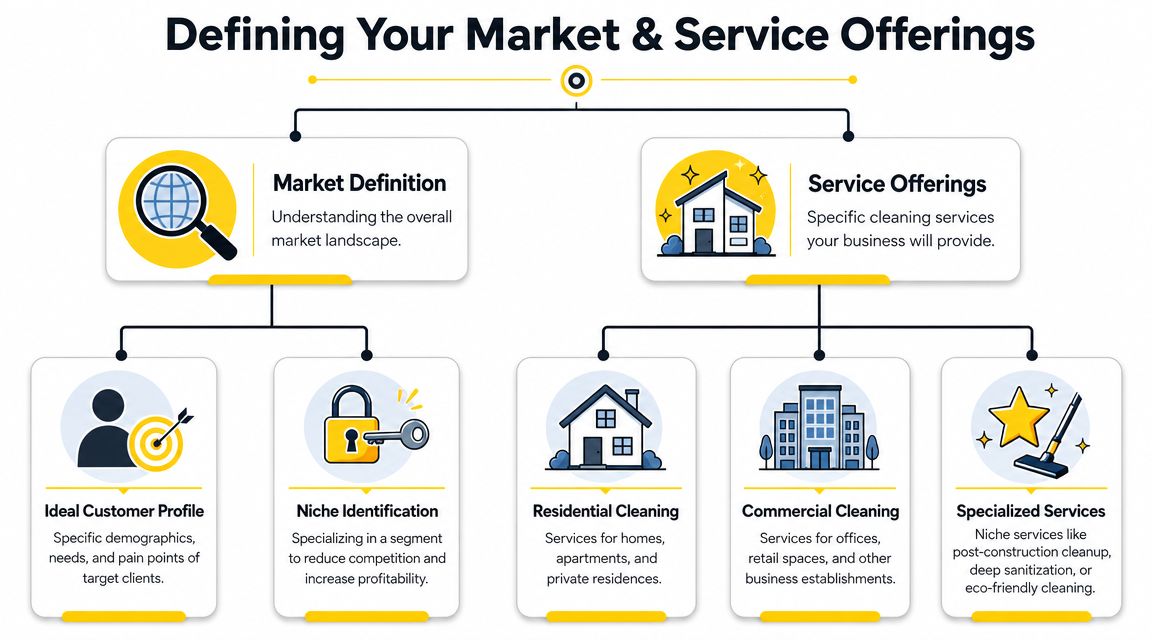
A cleaning company gets stronger when it narrows its target before it expands its menu. Owners who say they serve “everyone” usually end up with scattered routes, mismatched pricing, and jobs they shouldn't have taken.
One reason cleaning business plans deserve real market analysis is that the category is large and still growing. One source projects the global cleaning services market will reach about $90 billion by 2027, growing at roughly 7% CAGR in a market where North America, Europe, and Australia are identified as mature regions, which supports including focused local analysis, competitor benchmarking, and pricing discipline in the plan (cleaning services market overview from SBDCNet).
Local service businesses don't compete in an abstract market. They compete in a drive radius.
Start with three filters:
Each segment buys differently. A recurring residential client usually cares about trust, consistency, and schedule fit. A property manager often cares about responsiveness and completion reliability. A small office may care more about access procedures and after-hours dependability.
You don't need a giant market study. You need a sharp local reading.
Review competitors by asking:
The goal isn't to clone their service menu. It's to spot white space. Maybe everyone chases one-time deep cleans, but few have a clean recurring program. Maybe many companies advertise residential cleaning, but very few clearly serve small offices or move-out clients.
A useful next step is reviewing advice on getting more cleaning clients because client acquisition gets easier when your offer matches a specific buyer instead of a generic audience.
Once the market is clear, the service offering should feel obvious. Good plans usually separate services into three layers:
| Service layer | Purpose |
|---|---|
| Core services | The repeatable work you want most often |
| Add-ons | Higher-value extras that raise ticket size |
| Specialized work | Niche jobs you take only if capacity and skill fit |
For example, a residential-first company might center recurring home cleaning, offer deep cleaning as an entry service, and add fridge, oven, interior windows, or move-in/move-out as add-ons. A commercial-first company might center scheduled office cleaning and limit one-off requests that disrupt the route.
The service menu should protect margins, not just attract inquiries.
A common planning error is listing every possible cleaning task because it sounds ambitious. In practice, too many disconnected services create training problems, inconsistent estimates, and scheduling headaches. A lender sees that as operational risk.
Your market section should end with a direct statement of fit: who you serve, where you serve them, what you sell most often, and which jobs you'll decline. That last part matters. A business plan gets stronger when it shows restraint.
Cleaning businesses don't become scalable because demand exists. They become scalable because the owner turns repeatable work into repeatable systems.
That's why I push owners to treat operations as the center of the plan, not the appendix. If estimating changes depending on who answers the phone, if onboarding depends on memory, or if quality checks happen only when a client complains, the business is still improvising.
A practical planning approach is to define service mix, pricing model, and workflow as separate operating modules, then measure whether they work. One industry guide notes that residential profit margins can range from 10% to 28% depending on operational efficiency and customer retention, which is why process discipline belongs in the core of the plan, not as a side note (operational planning guidance for cleaning companies).

You don't need a giant operations manual on day one. You need a handful of systems that remove inconsistency.
Focus on these first:
If you want a broader management framework outside the cleaning niche, this playbook for service business founders is worth reading because it connects staffing, admin, and delivery discipline in a way most owners only learn after a few painful months.
Many cleaning business plans collapse in real life. The numbers in the financial section assume a certain average job value and a certain close rate, but the actual estimates are being made from memory, mood, or whatever the owner says after a rushed phone call.
That gap kills predictability.
When pricing is inconsistent, three bad things happen:
For a tech-enabled plan, that's where a tool like Estimatty can fit logically. It standardizes cleaning estimates by collecting job details, applying your pricing rules, and sending estimates without relying on gut-feel responses. In a business plan, that matters because a lender can see how revenue assumptions connect to a defined sales process instead of guesswork.
If you're reviewing software options, Estimatty's article on cleaning business software is a practical place to compare what needs to be automated first.
Growth usually breaks at the staffing layer. The owner sells work faster than the team can absorb it, then quality slips.
A better plan explains:
| Area | What lenders want to know |
|---|---|
| Hiring | How you'll find reliable cleaners |
| Screening | What standards you use before sending someone into a client's property |
| Training | How new hires learn your service method |
| Accountability | How performance is reviewed and corrected |
When you need support on the recruiting side, platforms like pipehirehrm.com can help structure hiring and applicant flow. That belongs in the plan because labor quality isn't a background issue in cleaning. It directly affects retention, referrals, and rework.
Good operations reduce surprises. Lenders don't expect perfection, but they do expect a method.
Most weak financial sections fail in one of two ways. They're either too vague to mean anything, or they're packed with aggressive assumptions that no operator could defend in a real conversation.
Believable projections come from the ground up. Start with actual service assumptions, tie them to labor capacity, and only then build revenue and profit forecasts. A lender can spot top-down fantasy fast.
This section deserves a visual summary before you build the spreadsheets.
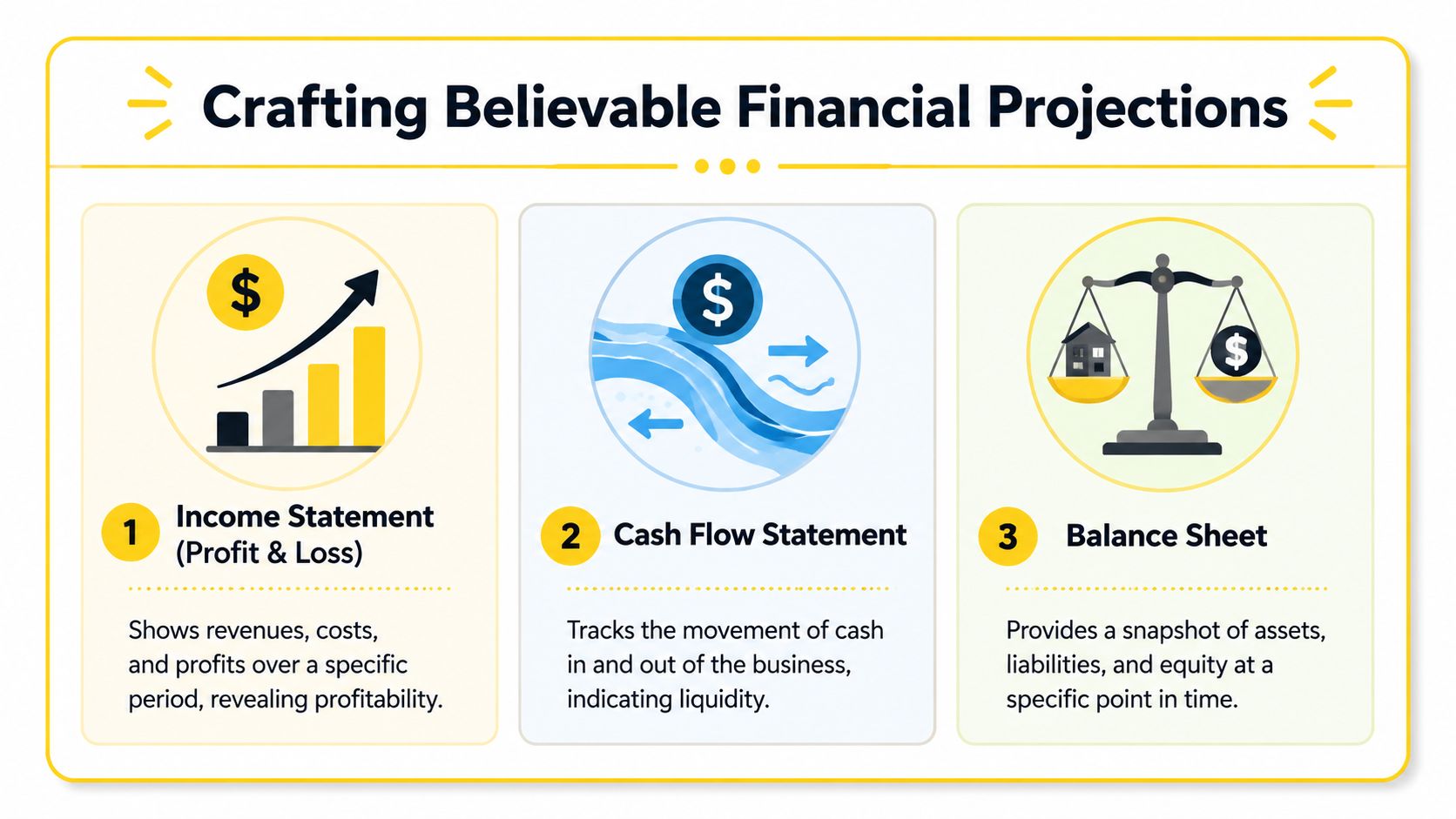
Every serious plan should include these:
| Statement | What it tells a lender |
|---|---|
| Income statement or P&L | Whether the business can become profitable |
| Cash flow statement | Whether cash arrives in time to cover obligations |
| Balance sheet | What the business owns, owes, and has built |
Owners often understand the P&L first because it feels intuitive. Revenue comes in, expenses go out, and what's left is profit or loss. But lenders care just as much about timing. A profitable month on paper can still create stress if payroll, supplies, insurance, or vehicle costs hit before client payments clear.
Here's a useful video explainer to keep the three statements straight while you build them:
The cleanest method is bottom-up forecasting. Don't begin with “how much do I want to make.” Begin with the mechanics of service delivery.
Use assumptions like:
Then stress-test the result. If your forecast requires nonstop booking, no cancellations, and perfect staffing, it isn't conservative enough for a lender.
One of the most common planning failures is optimism without execution detail. Industry guidance warns against overestimating revenue and underestimating expenses, and notes that the global cleaning services market is projected to grow from $481.75 billion in 2026 to $859.20 billion by 2034 at a 7.5% CAGR, which reinforces a simple point: growth in the industry doesn't rescue weak operations (cleaning business plan execution risks from Tailor Brands).
The danger isn't usually the obvious costs. Owners remember supplies. They remember payroll. They often miss the drain created by overhead and delivery friction.
Make room for:
If overhead is still fuzzy, this guide on how to calculate overhead costs is worth using before you finalize projections.
Break-even analysis doesn't need to be fancy. It needs to answer one practical question: how much booked work do you need to cover fixed obligations and direct operating costs?
That means your plan should connect:
A lender isn't impressed by a big revenue target. They're reassured by a forecast that shows exactly how many booked jobs or recurring accounts are needed to keep the business stable.
For owners who need a simpler framework before they build the final spreadsheets, MyOfficeOps has a helpful guide to simplify business financial planning. It's useful because it turns projections into manageable assumptions instead of accountant jargon.
A believable projection doesn't try to look ambitious. It tries to survive scrutiny.
A business plan starts earning its keep when it becomes a calendar, not just a document. The roadmap is where strategy turns into assignments, deadlines, and review points.
Most cleaning business plans improve immediately when the owner stops writing “grow client base” and starts writing actions tied to milestones. Register the business. Finalize insurance. Set pricing rules. Launch estimate intake. Hire and train. Review retention. Adjust service area. Those are operating moves lenders can trust.

A workable roadmap often looks like this:
The best plans are living documents. Review them on a set schedule, compare assumptions to actual performance, and update decisions when the field tells you something different.
Track a short list of KPIs such as retention, service efficiency, employee productivity, and revenue growth. Those are the measures that tell you whether the plan is working operationally, not just whether the document looked good at the bank.
If you're thinking beyond survival and into structured growth, Bare Digital's article on proven strategies for small business growth is a useful outside perspective on expanding without losing control.
A roadmap also needs a scaling trigger. Don't add territory, services, or headcount just because demand appears. Add them when your numbers, quality checks, and scheduling discipline say the business can absorb more. For a more operations-focused view, Estimatty's guide on how to scale a service business is useful when you're turning the first-year plan into a growth plan.
The right answer is a checklist, not a guess. Your startup needs depend on your service mix, whether you're solo or hiring early, and whether you're serving residential or commercial clients first.
Build your estimate around items like:
Use estimates, not fake precision. Lenders prefer honest assumptions they can follow.
That's a business, tax, and legal decision, so confirm details with a qualified advisor in your state. From a planning standpoint, what matters is that your structure matches your risk, admin needs, and growth goals.
Many owners like the simplicity of starting small, but lenders usually want to see clean separation between personal and business finances no matter which structure you choose. Separate accounts, separate records, and organized documentation matter more than trying to appear impressive on paper.
The biggest mistake is writing a static plan filled with optimistic revenue and thin expense assumptions.
A close second is failing to connect pricing, staffing, and capacity. If your plan says you'll grow quickly but doesn't explain how estimates are standardized, how cleaners are hired, or how route density is maintained, it reads like hope instead of management.
Keep the plan simple enough to update, and detailed enough to run the business from it.
Yes, but not because they want polished marketing copy. They care because sloppy writing often signals sloppy thinking.
A good cleaning business plan is clear, restrained, and specific. It states what you do, who you serve, how the work gets delivered, and how the numbers were built. That's what makes it lender-ready.
If you want your plan to function like a real operating system instead of a one-time document, Estimatty can help by standardizing how cleaning estimates are collected and priced. That gives you a cleaner link between your sales process, your capacity planning, and the financial projections inside the plan.