October 8, 2026
10 Quotes on Jobs to Inspire Cleaning Business Growth
Explore 10 quotes on jobs for cleaning business motivation, social posts, marketing copy, and CTAs, with practical usage tips for owners.

Thursday, May 21, 2026
Uncover the true contractor license cost. Our guide breaks down all fees, bonds, and insurance for cleaning businesses, with state-by-state estimates.

You start asking about contractor license cost when the business stops feeling small.
One month you're handling routine house cleans. The next, a property manager asks whether you're licensed and bonded for a larger turnover project, a post-construction cleanup, or a job that includes work sitting close to repair, finish, or light trade scope. That's usually the moment owners realize the number on the state form isn't the true number they need.
What matters is the full first-year compliance picture. Government fees matter, but they're only one line item. Bonds, insurance, fingerprinting, business structure, renewals, and the time you lose fixing mistakes can turn a “simple application” into a real budget decision.
For cleaning businesses, there's another wrinkle. You might not even need a contractor license yet, depending on your state, project size, and the exact work you perform. That's why smart owners don't ask only, “What does the license cost?” They ask, “Do I need it now, and if I do, what's the all-in cost to stay compliant?”
A lot of cleaning businesses hit the same wall the same way. You build a solid client base, your referrals improve, bigger jobs start showing up, and then a commercial client asks a simple question you can't dodge: Are you licensed?
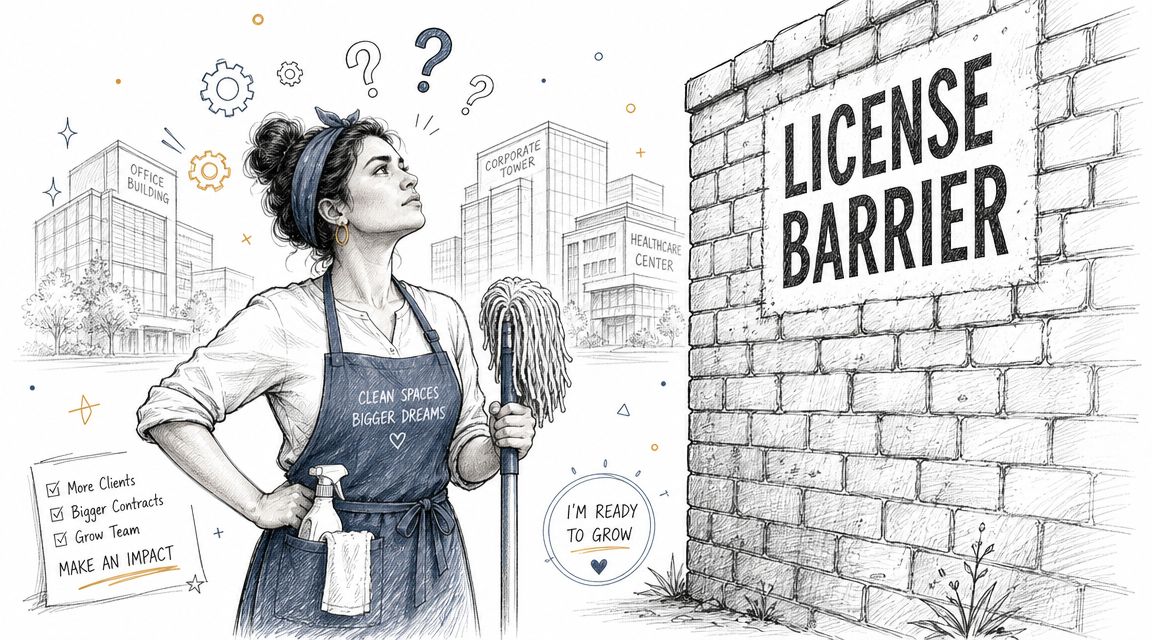
That question usually isn't really about paperwork. It's about risk. The client wants to know whether you can legally take the job, whether you understand compliance, and whether your business is set up to handle larger work without creating a problem for them.
Owners often freeze because they see licensing as a bureaucratic expense. I think that's the wrong frame. The better way to look at it is this: what is the cost of staying unlicensed when the work you want is moving upmarket?
If you're turning down property managers, post-construction work, or bundled service contracts because your credentials don't line up, that has a cost too. So does bidding on work you shouldn't legally touch.
Practical rule: If clients are starting to ask for proof of licensing, bonding, or insurance before awarding work, your business has already reached the point where compliance affects sales.
Owners frequently stumble at this point. Basic janitorial service may fall under one set of rules, while related services can trigger another. State rules differ. Local rules can matter too. A project's total value can matter just as much as the task itself.
That's why I tell owners to stop chasing one magic number. Start with the business model you're building. If you're staying narrow, your path may be simpler. If you're adding maintenance-adjacent work or larger site jobs, you need a different plan.
If you're still sorting out your basic setup, this guide on a cleaning business license is a useful starting point before you move into contractor-level compliance.
A lot of cleaning business owners budget for the filing fee, then get blindsided by everything attached to it. The application charge is only one line item in a bigger compliance bill.
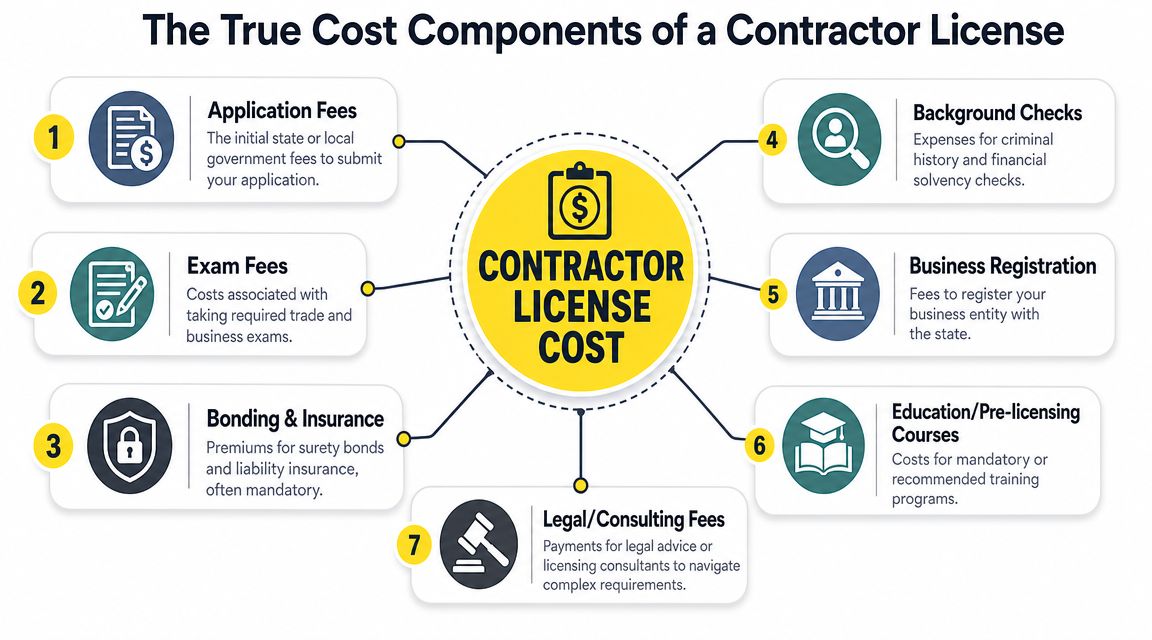
The number depends on how your business is set up, what kind of work you take on, whether you have employees, and how your state handles bonds, insurance, and renewals. That is why the posted state fee rarely matches what leaves your bank account in year one.
These are the cost buckets that usually matter:
This is the part many owners miss. A contractor license is not just a permission slip. It is an operating cost that has to be carried in your pricing, just like labor burden, insurance, and admin time. If you want a cleaner way to fold these recurring items into your pricing, use this guide on how to calculate overhead costs.
A quick walkthrough helps make that stack easier to visualize:
Public fee schedules make licensing look cheaper than it feels in real life because they only show the government charge. They do not show the bond premium, the insurance upgrade a commercial client asks for, the cost of fixing an application error, or the renewal calendar you now have to keep up with.
California is a good example. The state publishes the application and licensing fees clearly, but the first-year spend is higher once fingerprinting, bond costs, and related compliance items are added. That gap is where owners get caught.
I have seen the same mistake more than once. An owner sets aside money for the filing fee, gets approved, then realizes they still need the bond, the insurance certificate, and a clean way to track renewals. At that point, the question is no longer "what does the license cost?" It is "what does it cost to stay eligible for the work I want?"
What works is a simple worksheet with three columns: startup, recurring, and conditional.
Startup covers application fees, fingerprinting, and setup costs. Recurring covers bond premiums, insurance, and renewals. Conditional covers employee-related costs, entity changes, late fees, and outside help if the paperwork gets messy.
What does not work is pulling one number from a state website and calling it your budget. For a cleaning business, the smarter move is to price the full compliance stack before you apply. That gives you a clearer answer on whether getting licensed makes financial sense now, or whether you should wait until your mix of jobs supports the added overhead.
A cleaning owner in California, Virginia, and Minnesota can be chasing the same type of work and face very different compliance bills to get there. That is why a national average does not help much. The useful question is narrower: what does your state require, and do your current jobs justify the full cost of staying licensed?
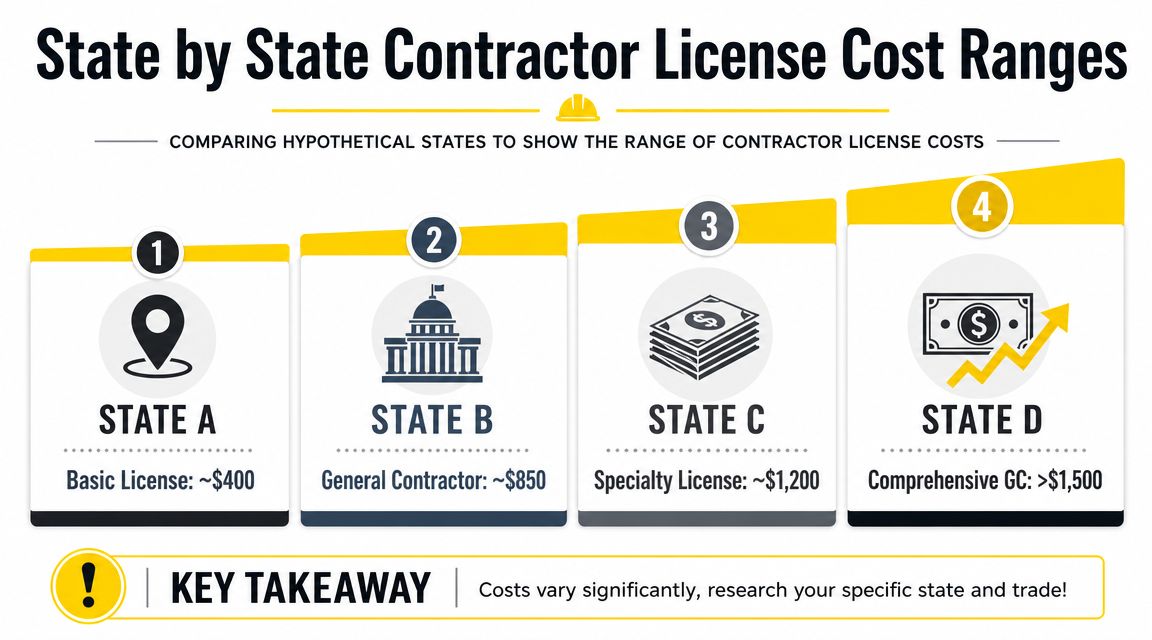
A review from the U.S. Chamber of Commerce shows how widely initial costs can vary by state. California applicants can expect roughly $700 to $1,500 in total initial costs, while Virginia applicants may budget about $345 to $360 for the initial license plus $20 to $60 for exams and a $25 recovery fund assessment. Arizona runs about $780 to $1,050 excluding exam fees, according to the U.S. Chamber of Commerce contractor licensing review.
Those ranges matter, but the spread is only part of the story. States build the bill differently. One state charges more up front. Another keeps the filing cost lower but adds exams, recovery fund payments, bond requirements, or higher renewal costs later.
For cleaning businesses, that difference affects the threshold decision. If you only take standard residential cleaning jobs, the license math may not work yet. If you are bidding post-construction cleanup, larger commercial work, or jobs that push you into contractor territory, the all-in cost starts to make more sense. A good starting point is understanding the requirements for a contractor's license before you price the license itself.
California illustrates how structure changes the bill. The state charges different initial license fees for sole owners and non-sole owners, so two cleaning companies doing similar work can start with different government costs because one is operating alone and the other uses an entity. Renewal fees also add up fast if the license stays active year after year.
Virginia and Arizona show a different pattern. Their totals are shaped by separate exam charges, assessments, and state-specific licensing layers rather than one simple application number. Owners who budget from a single headline fee usually come up short.
That is the practical lesson here. Do not compare states by application fee alone. Compare the full stack, including filing charges, exam costs, bond premiums, insurance upgrades, recovery fund payments, and renewals.
Minnesota is a good example of a state where growth can raise the compliance bill. Residential contractor licensing starts with a base license fee of $180, and the required recovery fund contribution increases by revenue tier: $320 for businesses under $1 million in gross annual receipts, $420 for $1 million to $5 million, and $520 for over $5 million, based on the Minnesota residential contractor licensing rules.
For a small cleaning company, that matters more than it looks on paper.
A solo operator may see one number in year one and assume the cost will stay flat. It often does not. As revenue rises, crews expand, and the business shifts toward bigger jobs, the licensing bill can increase along with insurance needs and admin work. That is why the right budget is not just "what do I pay to apply?" It is "what will this state cost me to maintain once the business grows?"
Abstract fee discussions only go so far. It helps to look at the decision through the lens of two businesses that feel familiar.
One is a solo cleaner taking on bigger work and trying to stay lean. The other is a small commercial cleaning firm stepping into a more regulated environment with employees, payroll, and a more formal structure.
Maria runs a small residential cleaning business. She's starting to pick up larger move-out and post-construction cleanup jobs. She operates alone, wants to keep the business simple, and is trying to estimate what licensing could do to her first-year overhead.
Her real cost profile isn't just the filing. It's the filing, exam-related expenses, background processing if required, bond premium estimates, and time away from paid work while she handles the process. For a solo operator, that time cost matters more than most owners admit.
CleanCorp has a few employees and wants to compete for larger commercial accounts in a more tightly regulated state. The business is not a sole proprietorship. That changes things immediately. Entity structure can increase the base issuance cost, and employees can trigger additional insurance obligations.
This is also the stage where staffing process matters. A growing operator who's formalizing crews, documentation, and hiring flow will usually need tighter systems around onboarding and compliance. That's where tools and hiring resources such as pipehirehrm.com start becoming useful operationally, even though they don't reduce the state fee itself.
| Cost Component | Scenario 1: Solo Cleaner (Mid-Cost State) | Scenario 2: Small Firm (High-Cost State) |
|---|---|---|
| Application fees | Present | Present |
| Exam fees | Likely | Likely |
| Background check or fingerprinting | Possible | More likely to be part of the process |
| Surety bond premium | Usually part of the estimate | Usually part of the estimate |
| Liability insurance | Often needed for contracts or local compliance | Commonly needed |
| Workers' compensation | Usually not needed without employees, depending on state rules | Often part of the compliance stack once employees are involved |
| Entity-related cost impact | Lower if staying sole proprietor | Higher if applying as a non-sole owner |
| Renewal exposure | Easier to miss if owner is doing everything alone | More administrative, but easier to systematize |
The lesson from both scenarios is simple. Small firms rarely lose money on licensing because the state charged too much. They lose money because they under-budget the side costs and fail to update pricing after taking on new compliance burdens. That's why any licensing plan should sit beside your insurance review, especially if you're evaluating liability insurance for a cleaning company.
Money is only half the contractor license cost story. Time is the other half.
Owners often assume they can decide to get licensed and start licensed work right away. That's not how it usually plays out. The process has multiple checkpoints, and a delay at any one of them can stall the whole file.
In practical terms, the licensing path tends to move through these stages:
The biggest delays are usually self-inflicted.
A delayed license can cost more than an expensive one if it forces you to postpone the jobs you were counting on.
Don't promise start dates for regulated work until you have the license number in hand or you've confirmed exactly what your state allows during processing. Keep your pipeline moving with work you can legally perform now. Use the waiting period to tighten scope descriptions, client onboarding, and documentation.
That part matters for cleaning businesses because your service mix can shift quickly. If a property manager asks for bundled work that edges into regulated territory, you need to know whether to accept, defer, or partner it out.
You can't negotiate away state fees. You can reduce waste.
That's the practical approach. Good operators don't look for shortcuts that create compliance risk. They look for the parts of the process where shopping carefully, preparing better, and renewing on time keep the contractor license cost under control.
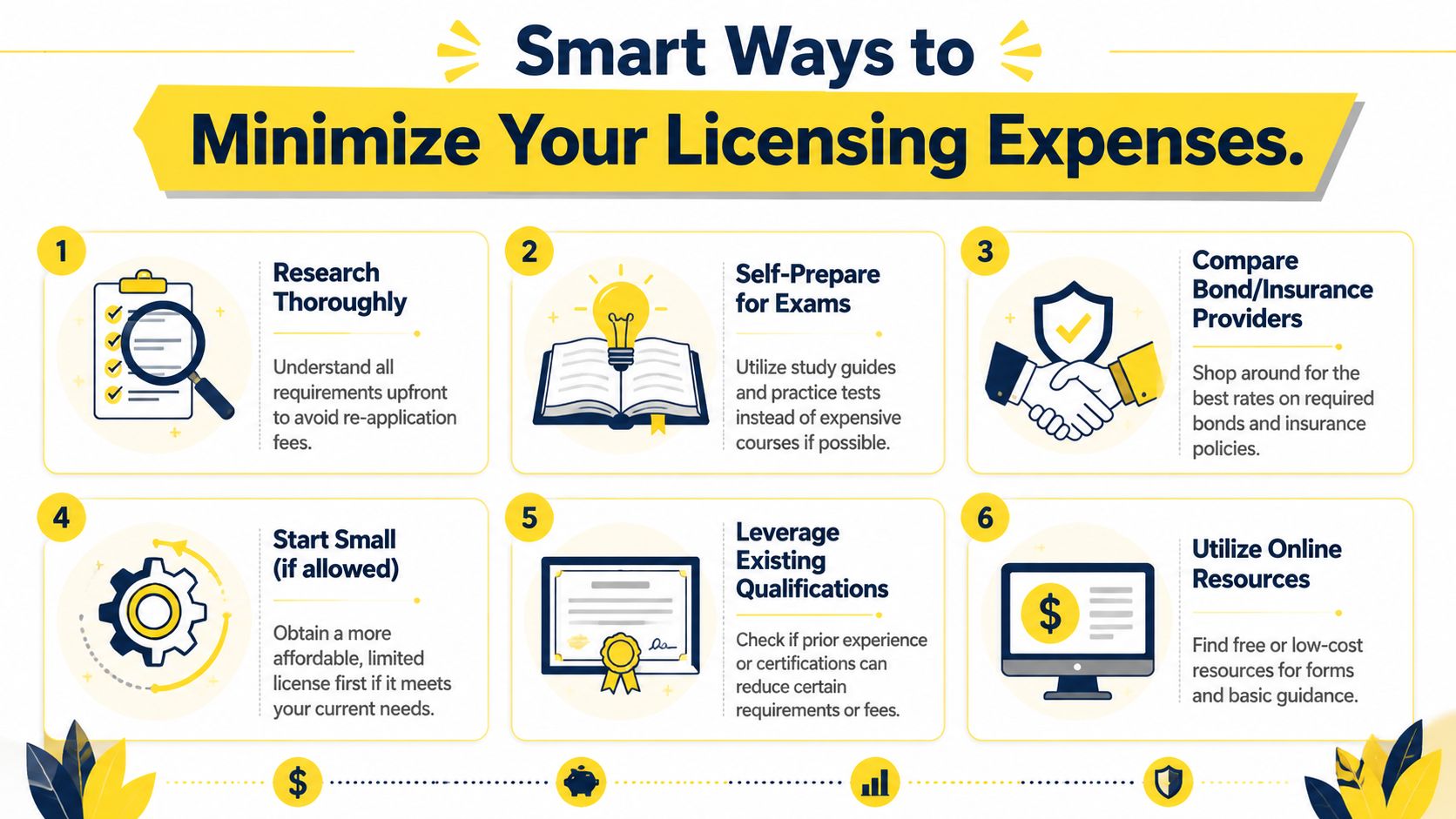
Here's what tends to work best in practice:
A common mistake is trying to save money by buying the cheapest thing available without checking whether it satisfies the licensing requirement. Cheap insurance that doesn't match the state or client requirement isn't savings. It's rework.
Another mistake is spending heavily on outside help before reading the state instructions carefully. Sometimes you need a consultant or attorney. Sometimes you just need a clean checklist and a disciplined owner.
“Spend carefully on what removes real risk. Don't spend impulsively on confusion.”
The best long-term savings come from turning licensing into a system instead of a crisis.
Use a simple recurring checklist for renewal dates, bond expiration, insurance certificates, and business updates. Store everything in one place. Make one person responsible, even if that person is you for now.
For cleaning companies that are tightening pricing and job intake at the same time, practical operations guidance from the best estimating software for contractors conversation can help you think more systematically about cost control overall.
Most cleaning business owners don't need more theory here. They need straight answers.
Sometimes yes. Sometimes no.
The answer depends on your state, your local jurisdiction, the total project value, and the exact work you're performing. A plain janitorial scope may not trigger contractor licensing where you operate. A larger project, bundled service package, or work that crosses into regulated trade activity may change that answer fast.
One threshold example matters because it shows how quickly rules can shift. In California, the project threshold long cited as $500 changed to $1,000 as of Jan. 1, 2025 under AB 2622, while Idaho uses a $2,000 threshold for contractor registration, according to this summary of state contractor license requirements and thresholds.
Start with these questions:
The risk is bigger than a missed form.
You can lose jobs, damage credibility with commercial buyers, create problems with payment collection, and expose the business to enforcement trouble. Even when the legal penalty is what gets people's attention, the business damage often starts earlier. Clients stop trusting a company that can't clearly explain its compliance position.
Sometimes there is.
A local business registration, a narrow specialty credential, stronger insurance documentation, or a tighter service scope may be enough while you decide whether full licensure makes sense. But that only works if you stay inside the legal boundary. Wishful thinking is not a compliance strategy.
Pull your current service list and mark each item by risk level. Separate standard cleaning from anything that could be viewed as repair, build-out, installation, or contractor-style project work. Then check the current state rule and local rule before advertising or estimating those services.
That exercise alone clears up most of the confusion.
If you want to grow without losing money to bad pricing and slow follow-up, Estimatty helps cleaning businesses send fast, consistent estimates around the clock. It's built for owners who want cleaner intake, quicker responses, and a tighter grip on the actual cost of the jobs they take.