November 3, 2026
Lead Qualification Criteria for Cleaning Jobs
Lead qualification criteria that separate bookable cleaning jobs from empty inquiries, with a scorecard for size, surfaces, urgency, budget and location.

Wednesday, November 4, 2026
Learn how to calculate booking conversion rate for cleaning businesses, compare it with real benchmarks, and fix the drop-off points that cost you jobs.
Only 52% of inbound calls reach a person in the Invoca home services lead conversion benchmarks report, and once you multiply the stages that follow, only about 8.9% of all inbound calls become same-call bookings. That's the Booking Conversion Rate problem for most cleaning firms. You're probably not losing jobs at the final sales script. You're losing them earlier, in missed calls, slow estimates, and a booking page that asks for too much before it gives a price.
Fix the leak in order. Split the rate into stages, measure each one, and repair the stage with the largest measured loss first. Everything else is guessing with your ad budget.
Your Booking Conversion Rate is completed bookings divided by total visitors or sessions, multiplied by 100. That's the whole-site version, and it's useful for one thing only. It tells you whether the overall system is improving.
The math shows why small moves matter. If 10,000 qualified visitors convert at 1%, you get 100 bookings. At 2%, you get 200 bookings from the same traffic, with no extra ads, no new referral partners, and no discounting. A single percentage point sounds trivial in a meeting. On your schedule, it's another crew's worth of work.
A single rate hides the cause. An estimate request, a started booking, and a completed cleaning are different events with different denominators. If you lump them together, you can't tell whether your problem is traffic quality, qualification, pricing, availability, or cancellations.
Track three linked rates instead. Session-to-inquiry shows whether the page and traffic work. Inquiry-to-qualified-estimate shows whether you're attracting the right homes in the right service area. Qualified-estimate-to-booking shows whether price, follow-up speed, trust, and open slots close the deal.
Available benchmark data puts visitor-to-lead conversion around 2.9% across 14 industries, while qualified-to-booked meeting conversion has a median near 62% and top performers reach approximately 78% or more, according to RankHaus conversion rate benchmarks. Those aren't cleaning targets. They're reference points that prove the stages behave differently and need separate owners.
| Stage | Formula | Reference Value | What It Diagnoses |
|---|---|---|---|
| Visitor to inquiry | Inquiries ÷ sessions × 100 | About 2.9% across 14 industries | Traffic quality and page messaging |
| Inquiry to qualified estimate | Qualified inquiries ÷ inquiries × 100 | 38% of digitally generated answered calls are genuine leads | Targeting and qualification questions |
| Estimate to booking | Booked jobs ÷ estimates delivered × 100 | Median near 62%; top performers near 78% | Pricing friction, follow-up speed and availability |
| Booked to completed | Completed jobs ÷ booked jobs × 100 | Set from your first 30 days; any gap is lost revenue | Cancellations and no-shows |
| Overall booking conversion | Booked jobs ÷ sessions × 100 | Travel sites roughly 0.2% to 4%; e-commerce about 1.6% in 2022 | Overall performance, comparable only with matching definitions |
Use the table as a diagnostic, not a report card. A low visitor-to-inquiry rate means your ads, service pages, or offer are pulling the wrong people or failing to give them a reason to act. A low inquiry-to-qualified rate means your qualification questions, service area rules, or minimums are out of sync with who's contacting you.
A low estimate-to-booking rate is different. That one points at price presentation, delayed follow-up, thin availability, or weak trust signals like missing reviews, unclear guarantees, and no named team. Don't rewrite your homepage when the leak is a two-day callback delay.
Run the call chain on your own numbers. Start with every inbound call, then count how many reached a person, how many were genuine leads in your service area with a home you can clean, and how many of those booked during the call. Home-services benchmark data puts those stages at 52% answered, 38% genuine leads, and 45% of leads booking during the call.
Multiply them and you land near 8.9%. An owner quoting the 45% figure thinks the phones are fine. An owner looking at 8.9% sees the truth, which is that most demand never reached a conversation where a booking was even possible.
Practical rule: Fix the earliest stage with the largest measured loss first. Adding traffic to a funnel that misses half its calls just buys more missed calls.
That ordering matters for cleaning in particular. Your crews are in homes during the day, so the person answering is often you, between jobs, or nobody. After-hours inquiries pile up because people shop for a cleaner at night after looking at their kitchen. Weak qualification then wastes the few conversations you do have on out-of-area homes, one-off deep cleans you don't want, or jobs below your minimum.
Blaming price is the easy diagnosis, and it's often wrong. If prospects never got an estimate, price didn't lose the job. Access did.
Count booked, completed, and paid as separate outcomes. A firm can post a strong booking rate while steadily losing money on cancellations, reschedules that never land, and first cleans that never convert to recurring service. Those losses belong to operations and confirmation process, not marketing.
Use one fixed attribution window and count one unique inquiry per prospect. A homeowner who calls twice, fills a form, and texts you is one opportunity, not three. Duplicate counting inflates your denominator, flatters some channels, and makes your real rate impossible to improve on purpose.
Segment the final rate before you act on it:
If you're still learning the mechanics, this plain-English guide on how to improve conversion rates is a good primer on defining the conversion event before you try to lift it. Apply that discipline here. Decide what counts, write it down, and don't change the definition mid-month to make a report look better.
External benchmarks set context, nothing more. Travel sites reporting roughly 0.2% to 4%, with a rate above 2% placing a site among stronger performers and 3% to 4% among the top 10% in some datasets, come from Xola's average conversion rate for travel websites. Broader e-commerce sat around 1.6% in August 2022 in that same reporting.
Those numbers compare fairly only when the denominator, attribution window, traffic source, device mix, and definition of booking all match. Yours won't match a travel site's. There's no solid published cleaning-specific benchmark to chase, so stop looking for one.
Take your first 30 days of clean stage data and call that your baseline. Then beat your own number, stage by stage. That's the only comparison that pays crews.
Cleaning prospects shop in parallel. A homeowner with guests coming Friday or a move-out deadline contacts three firms in ten minutes and books the first one that gives a usable price and a real slot. Speed isn't politeness here. It's the deciding factor.
| Response Benchmark | Reported Result | Implication for Cleaning |
|---|---|---|
| Contact within 5 minutes vs after 30 minutes | 100 times more likely to be reached; 21 times more likely to enter the sales process | An instant estimate beats a later callback |
| First response within 5 minutes vs later | Conversion eight times higher | Measure first response on every inquiry |
| Call within 5 minutes vs 10 minutes | 900% more interest generated | Speed outweighs polish |
| Average organization response time | 44 hours; only 4.7% reach five minutes | Night and holiday inquiries can wait nearly two days |
| Local Services Ads calls answered within 1 hour vs 24 hours or more | About 31% book vs about 15% | Response window changes booking odds |
The scale behind one row is hard to argue with. A 2021 analysis of more than 55 million sales activities involving 5.7 million inbound leads across more than 400 companies found conversion rates were eight times higher when the first response was attempted within five minutes, yet only 0.1% of leads were engaged in that window and 57.1% of first attempts came after more than one week, per InsideSales research on response time. The opportunity isn't theoretical. Almost nobody responds fast, so responding fast is cheap differentiation.
Other findings point the same way. Leads contacted within five minutes were 100 times more likely to be reached and 21 times more likely to enter the sales process than leads contacted after 30 minutes, with an approximately 391% conversion lift reported for a first call within one minute in IntentSignal's speed to lead analysis. A separate lead-response study found calling within five minutes generated 900% more interest than waiting ten minutes, while the average response took 44 hours and only 4.7% of organizations hit the five-minute window, according to the InsideSales lead response management infographic. Recent benchmark data also reports Local Services Ads calls booking at about 31% when answered within an hour versus roughly 15% after 24 hours or more, per NowBooked home service lead generation benchmarks.
None of those studies is cleaning-specific, so don't budget against them as guaranteed uplifts. Treat them as a strong hypothesis you can test in your own funnel within a month.
Chatbot reply speed is the wrong metric. Measure time from inquiry to a complete, usable estimate that includes scope, price, assumptions, and a booking path. A fast hello followed by a two-day wait for pricing doesn't count, and the prospect knows it.
Bucket every inquiry by latency:
Track inquiry-to-booking rate and revenue per inquiry in each bucket, and control for lead source, job size, urgency, and service area so you're comparing like with like. Our guide on response time improvement walks through setting those service levels up. Once you see the gap between buckets in dollars, the value of 24/7 coverage for nights, weekends, and holidays stops being a debate and becomes arithmetic.
Most prospects who abandon your booking page aren't rejecting your price. They're rejecting the effort. The visual summary below frames the size of that problem before you work through the fixes.
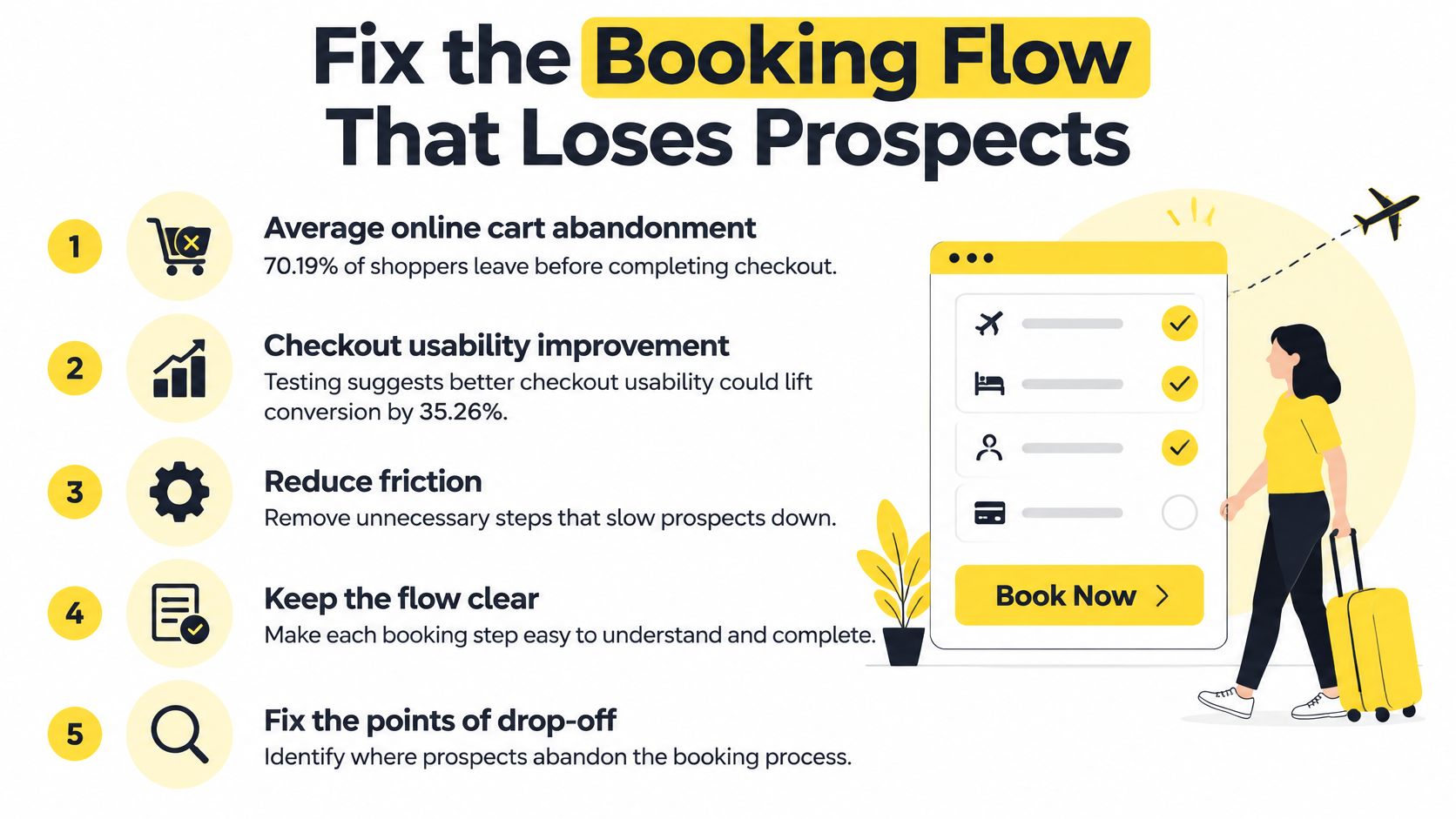
Baymard Institute places the average online cart abandonment rate at 70.19% and estimates the average large-scale site could lift conversion by 35.26% through checkout usability improvements alone, based on Baymard's checkout usability research. In its survey work, 17% of U.S. online shoppers had abandoned an order in the previous quarter because the process was too long or complicated, 48% cited unexpected extra costs, and 24% cited forced account creation, per Baymard's UX statistics summary.
Those figures come from general online checkout research, not cleaning. Use them as direction for your booking page audit, then confirm every fix against your own drop-off data.
The short walkthrough below shows what a low-friction booking path looks like in practice, step by step.
Mark each item pass or fail on your own page today. Fix failures in the order your drop-off data dictates, not in the order that looks best in a redesign mockup. If you're evaluating platforms while you do this, our breakdown of online booking software for cleaning businesses covers what to require. Retest the whole flow on your own phone, on a normal connection, before you publish a single change.
Homeowners are letting strangers into their bedrooms and bathrooms. That takes trust, and trust is why many prospects still want a human voice before they commit. But wanting reassurance doesn't mean they'll wait until Monday for it.
The answer isn't online booking versus phone. It's immediate, consistent service on both channels, so the prospect gets speed first and a person when they're ready to finalize.
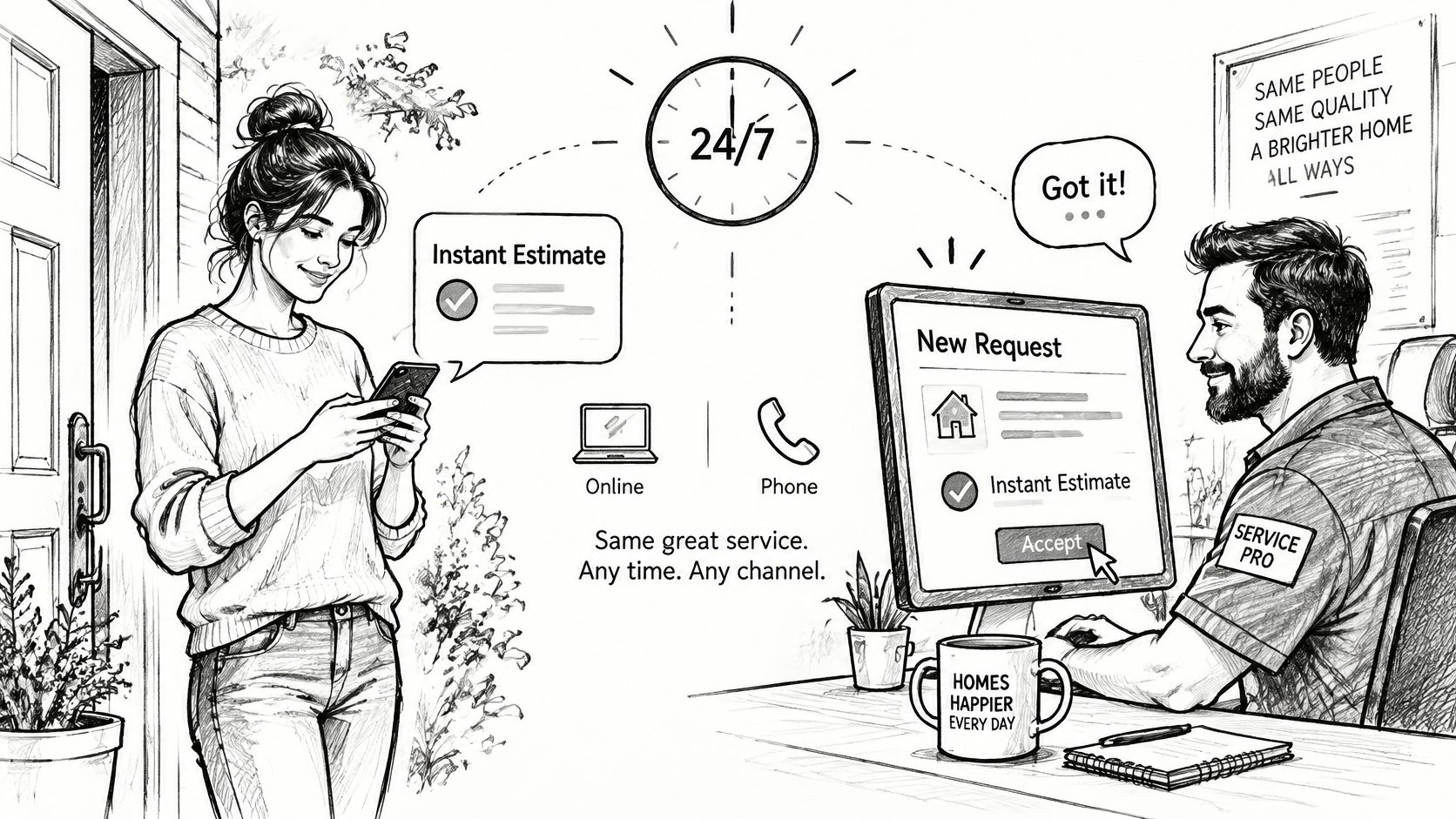
The first minute should look like this. The estimator asks for square footage, rooms, surfaces, add-ons, and urgency. It builds the price from one shared price book, so the same home gets the same estimate at 2 p.m. and 2 a.m. It sends that estimate by text and email, then alerts your team with the lead's stage so a person can step in with context instead of cold-calling a stranger.
That handoff is the whole design. The automated estimator engages first, answers the routine questions, and captures the details. A human closes when the prospect asks something specific or wants to talk through access, pets, or a tricky move-out timeline.
Compare that with the manual path. The prospect calls, waits on hold, and a large share of callers hang up when the hold drags on. If they do get through, the price depends on who answered and what that person remembers about your rate for a four-bedroom deep clean. Gut-feel pricing trains prospects to negotiate and trains your team to discount.
An always-on estimator isn't a replacement for your crew or your sales lead. It's a front desk that never sleeps, never guesses a price, and never lets a Sunday-night inquiry sit until Tuesday.
Traffic only helps if the page those visitors land on can convert them, which is why the fundamentals in this guide to SEO for service ecommerce websites matter alongside your estimator. Ranking brings the visitor. The instant estimate turns that visit into a priced opportunity while intent is still warm.
If you want to see the mechanics, our cleaning estimate calculator shows how home details become a consistent price in under a minute. Set yours up once, from your real price book, and every after-hours prospect after that gets the same answer you'd give yourself. That's what capturing demand around the clock means. It's not a chatbot saying hello. It's a priced, bookable estimate in the prospect's hand before a competitor's office opens.
An unanswered estimate isn't a dead lead. Buying decisions stretch out, and cleaning is rarely the only thing competing for a homeowner's attention that week.
The scale of that drift shows up in travel research. Expedia Group and Luth Research reported in 2023 that travelers viewed an average of 141 pages of travel content during the 45 days before booking, with an average path to purchase of 71 days, in Pathmonk's summary of travel booking conversion research. Your prospect won't view 141 pages about house cleaning, but she will get distracted, compare two other firms, and come back when the bathrooms finally annoy her enough. Follow-up is how you're the firm she returns to.
Be honest about the evidence, though. That same research context cites a controlled 30-day test where a better booking experience produced a 5.05% booking rate versus 4.06% for control, or 24% more trips booked. That test measured improving the experience at the moment of intent. It does not prove any particular follow-up cadence works.
So treat the sequence below as a disciplined starting point, not a proven universal schedule. Run it for 30 days, log which touch produced each booking, and keep what your own data supports.
| Touch | Timing | Purpose |
|---|---|---|
| Instant estimate | Within 1 minute of request | Deliver price, scope and booking path |
| Text check-in | 1 hour after estimate | Answer questions about add-ons or timing |
| Human call | Same business day | Close the booking when the prospect is ready |
| Recap email | 24 hours | Restate what the estimate includes |
| Second text | Day 3 | Offer a specific open slot |
| Final touch | Day 7 | Ask whether the home still needs cleaning, then close the file |
| Nurture message | Day 30 | Re-engage seasonal or move-in prospects |
Two rules keep this sequence from becoming noise. Stop the moment a booking is made, because nothing erodes trust faster than chasing someone who already hired you. And tune the gaps by urgency and source, since a move-out clean with a Friday deadline needs same-day touches while a recurring biweekly prospect can breathe between messages.
Make each touch carry new information. The hour-one text answers questions. The day-three text names a specific open slot, because "Thursday at 9" converts better than "we have availability." The day-seven message gives the prospect an easy no, which paradoxically produces yeses from people who just needed a nudge. Our guide to following up on estimates covers the wording for each of these touches.
You don't need a dashboard with forty charts. You need a thirty-minute weekly routine that ends with one change and one owner.
First, instrument the funnel. Estimatty fires tracking events at widget loaded, service picked, home details submitted, price shown, and booking completed, so every drop-off has a timestamp and a stage. If you can't see where a prospect stopped, you're back to guessing which stage leaks.
Second, work the leads closest to revenue first. Estimatty tags every lead by how far they got: Schedule, Property, Payment, or Booked. A prospect who reached Payment and stalled is worth a personal call today. A prospect who only loaded the widget gets the automated sequence. Because Estimatty lets you see which leads converted and which did not, your weekly list sorts itself by money at stake.
Third, compare the same three views every week. Look at your linked stage rates, your response-time buckets, and which follow-up touches produced bookings. Then name the single weakest stage out loud in the meeting. Not three priorities. One.
Fourth, change one thing in that stage and leave it alone for 30 days. Shorten first response, cut two form fields, show the estimate before contact details, add a day-three text with a named slot. One variable, one month, one verdict. Stacking five changes at once feels productive and teaches you nothing.
Weekly discipline: One weakest stage, one change, thirty days. Firms that test this way know exactly what each improvement is worth.
Tag where every lead came from while you're at it, so a channel that sends cheap traffic and no bookings gets exposed quickly. Our walkthrough on lead source tracking shows how to set that up without a spreadsheet habit you'll abandon by March.
For more working guides like this, keep the Estimatty blog bookmarked, and when the constraint shifts from too few bookings to too few cleaners to cover them, pipehirehrm.com covers the hiring side of a growing cleaning team. Review the full funnel with your team monthly, crews included, because the people answering doors hear objections your reports never capture. Start this week with the simplest test available. Measure your current time to a usable estimate, then beat it.
Your Booking Conversion Rate won't move until prospects get an accurate estimate the moment they ask, on your site or by phone, at any hour. Estimatty gives your cleaning business instant estimates, online booking, and 24/7 voice sales built on your own price book, with a human handoff when a prospect is ready to finalize. Visit Estimatty, see how the estimator handles a real inquiry, and put a price in front of tonight's prospects before your competitors open tomorrow.