November 2, 2026
Cleaning Day Quotes: 8 Sayings That Motivate Crews
Cleaning day quotes that motivate crews and win clients: 8 proven sayings, where to use them, and wording tips for SMS, email, and voice channels.

Tuesday, November 3, 2026
Lead qualification criteria that separate bookable cleaning jobs from empty inquiries, with a scorecard for size, surfaces, urgency, budget and location.

The popular advice is to collect more information, assign a score, and hand the lead to sales. That's not enough for a cleaning business. A prospect can answer every question, accept your price, and still request a job your crew can't service profitably. Lead qualification criteria should protect the booking calendar, not decorate the marketing dashboard.
A filled form is an inquiry, not a qualified lead. When someone requests a price without square footage, a ZIP code, or a service date, your coordinator has to reconstruct the job before preparing an estimate. Calling that inquiry qualified hides the work still required.
Research summarized from Forrester and Gleanster by SHNO's lead-quality statistics compilation puts the initially sales-ready share of marketing-generated leads at about 25%, while other analyses cited there put the immediately ready share near 5%. The same compilation reports that only about 39–40% of organizations apply qualification criteria consistently, leaving roughly 55% of leads inadequately assessed, neglected, or mishandled.
Those are broader marketing benchmarks, not cleaning-industry booking rates. The operational lesson is straightforward: interest alone doesn't establish readiness.
Booking rule: A qualified cleaning lead is a prospect likely to become a profitable, serviceable job.
Judge the opportunity on location, property type, square footage, requested services, urgency, budget fit, and willingness to schedule. Then confirm that the crew can perform the work under the requested conditions.
For owners aligning marketing with the booking desk, Digital Skyrocket's qualified lead definition for service businesses provides a useful starting point. Your own definition still needs to include the operating limits of your business.
Adopt a shared standard that everyone can apply:
Use a compact criteria card as the reference, then evaluate fit, intent, feasibility, buying readiness, and response handling. Nobody should have to guess what another employee meant by a good lead.
| Criterion | What to capture | Strong signal | Disqualify or park when |
|---|---|---|---|
| Square footage | Living or office area plus room or bathroom count | Size and room count fit the published price book and crew capability | Below the minimum job size unless the prospect accepts minimum pricing, or beyond supported capacity |
| Surface types | Flooring, counters, bathrooms, and any specialty surfaces | Hard floors, carpet, tile, and kitchens that match services you sell | Unsupported work such as heavy construction dust, hoarding, or biohazard if those services aren't offered |
| Urgency | Desired start date and the reason | Move-out, inspection, event, or start inside seven days | No date and no callback window, only a vague someday request |
| Budget | Acceptable range or a yes to the estimate | Accepts the estimate or states a range inside the price book | Rejects the minimum or asks for a price far below the published floor |
| Frequency | One-time, weekly, biweekly, or monthly | Weekly or biweekly recurring work that fits a route | A cadence you don't sell or can't staff on that day |
| Location | Service ZIP code or address | Inside the defined service-area ZIPs | Outside the zone, even if the property details look ideal |
| Access | Entry method, parking, pets, stairs, and allowed hours | Keys, code, or a person on site plus a bookable window | No entry plan, a site you can't enter, or hours that break the route |
Pin this cleaning lead qualification criteria card beside the phone and use the same fields in the website widget. The seven-day urgency window is a proposed operating rule, not an industry benchmark. Adjust it to your scheduling model without letting individual coordinators invent their own definition.
Take square footage. Asking how large the property is isn't enough; intake needs the area you'll clean and the room or bathroom count that affects labor.
Say your hypothetical price book supports homes around 1,000 to 3,500 square feet. A home inside that range can proceed through standard estimating, while a larger property needs review. A sub-600-square-foot studio might still be serviceable, but if your hypothetical minimum is two hours, the prospect must accept that minimum rather than expect an area-only price.
That's how to read every row: capture the fact, compare it with a rule, then decide what happens next. Don't turn the table into a questionnaire that collects answers nobody uses.
For teams translating these decisions into automated intake, CapyScout's AI lead qualification guide is a useful companion for thinking through qualification logic. Define your rules before asking an automated system to apply them.
A completed field isn't necessarily a usable answer. Flexible, normal size, and whatever it costs don't establish an appointment window, a property size, or acceptance of your minimum.
Give coordinators an explicit unknown option. That prevents them from entering a guess merely to advance the record.
A lead isn't qualified until every required row has evidence. The job examples below show how to turn those answers into a handoff another employee can act on without restarting intake.
A BANT-style checklist can identify a willing buyer and still miss a bad cleaning job. Someone may have money, approval authority, a clear need, and a deadline, yet live outside your route or require work you don't perform.
The incentive problem is real: Marketing Week reports that 37.7% of surveyed B2B marketers face pressure to deliver marketing-qualified leads regardless of quality, while 26.7% are judged only on lead delivery. Don't import that volume-first behavior into your cleaning operation.
The distinction is easier to see when apparent readiness is separated from bookability.
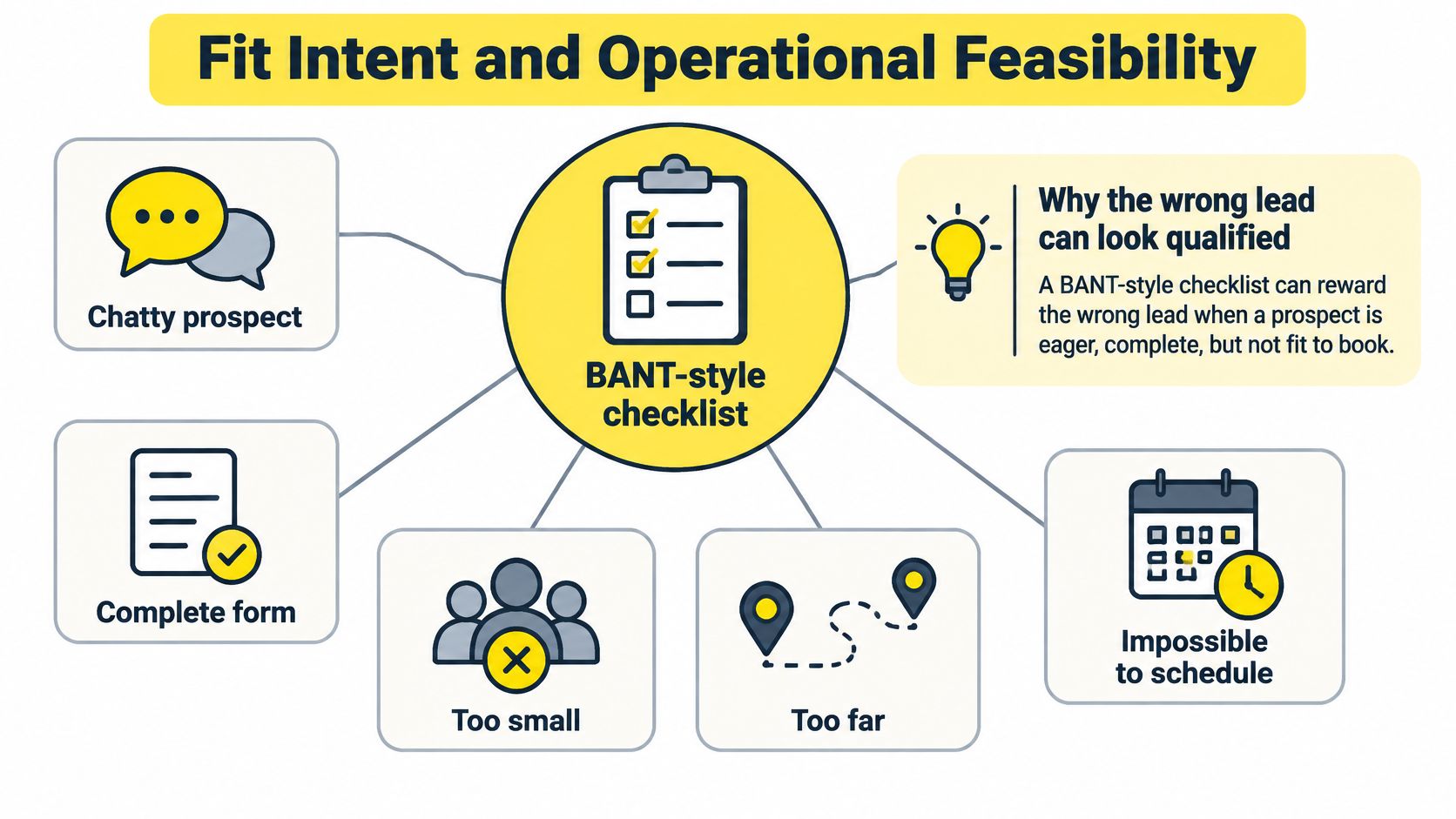
Fit includes property type, square footage, location, frequency, and required surfaces. In a hypothetical case, a 2,200-square-foot biweekly home inside your ZIP zone with standard tile and carpet could fit perfectly. A 400-square-foot one-time tidy across town may not.
Draw the territory before you advertise. Our guidance on defining a cleaning service area helps make location a firm boundary rather than a negotiation during intake.
Other appointment businesses face a similar targeting decision. Transactional LLC's guidance on how to attract high-value patients through dental SEO offers an adjacent example of targeting valuable demand rather than pursuing every inquiry. For cleaning owners, the practical equivalent is marketing the jobs your operation is built to serve.
Intent includes urgency, preferred start date, and willingness to receive and accept an estimate. A Friday move-out with acceptance of the price shows buying intent. Browsing without a date calls for a different response.
Operational feasibility includes access, add-ons, travel time, and staffing availability. A hypothetical third-floor walk-up with no parking and a same-day-only window may fail this test even when the prospect wants to buy.
Use this video as a discussion prompt when aligning intake and booking staff.
Qualified means likely to become a profitable, serviceable booking, not merely ready for a salesperson to call.
Don't award points for form completion alone. Route an out-of-area request to Outside Area, uncertain buying intent to nurture, and unsupported work to do-not-service. Those outcomes require different follow-up, not a generic rejected label.
Say a homeowner requests biweekly cleaning for a 1,850-square-foot, three-bedroom, two-bathroom house. The hypothetical property has hardwood floors and tiled bathrooms, sits inside your service zone, and needs service starting next Tuesday.
The homeowner accepts an estimate within your published band. A lockbox code will be available, and both dogs will be crated before arrival.
The coordinator should store an evidence note like this:
Residential handoff: Homeowner approves biweekly cleaning for a 1,850-square-foot, three-bedroom, two-bathroom home. Hardwood and tiled baths; service ZIP confirmed inside zone; requested start next Tuesday; published estimate band accepted; lockbox entry arranged; two dogs crated.
That note supports a scheduling conversation. It also identifies recurring revenue potential, which deserves attention when comparing this request with isolated work that requires a separate trip.
The coordinator must still check the actual calendar. Accepted pricing and good access don't reserve labor.
Now change the request. The same homeowner needs a one-time clean before a showing tomorrow at 7 a.m., but the first available crew is Thursday.
Keep the property evidence, but change the disposition. Offer the available appointment or record that the required window can't be met. Don't book an impossible arrival time because the rest of the record looks attractive.
Consider a hypothetical office manager requesting a 6,000-square-foot nightly clean under a monthly contract. The floors are tile and carpet, work must happen after 7 p.m., and the manager can provide a loading-dock key.
The important authority question is whether that manager can approve the contract. A tenant gathering prices for a landlord isn't the same buying contact, even if both provide identical property details.
Store the distinction:
Don't treat a larger property as automatically better. A commercial request can require a walkthrough, a different labor plan, and clearer scope documentation before the estimate is reliable.
Post-construction dust is a different service from recurring maid cleaning. Route it to the correct service process rather than assuming a standard home-cleaning checklist will cover it.
Oven, fridge, and interior-window cleaning are add-ons that change scope and price. They don't, by themselves, establish buying readiness. Pets, alarms, and gated parking belong in access fields, not personality notes about whether the customer seems easy.
The person writing the estimate should paste the evidence sentence into the handoff. A note such as needs a move-out clean before June 30 tells the next employee what must happen; seems interested tells them almost nothing.
Use Budget, Authority, Need, and Timeline, the BANT framework described by Avoma, as a transparent buying-readiness score: grade each dimension from 1 to 5, then use 16–20 for sales-ready, 10–15 for nurture or follow-up, and below 10 for low priority.
| Dimension | A score of 1 | A score of 5 |
|---|---|---|
| Budget | Unknown or below the minimum | Accepts the estimate or states a range inside the price book |
| Authority | Approval authority is unknown | Homeowner, office manager, or property manager confirms they can approve |
| Need | Vague request for cleaning | Names a supported service such as recurring home, move-out, office, or post-construction cleaning |
| Timeline | No service date | Defines a service date or urgency trigger |
Use intermediate scores for partial evidence. A contact who knows the budget but still needs approval shouldn't receive the same authority score as the person who can authorize payment.
The chart gives coordinators a consistent reference for the endpoints.
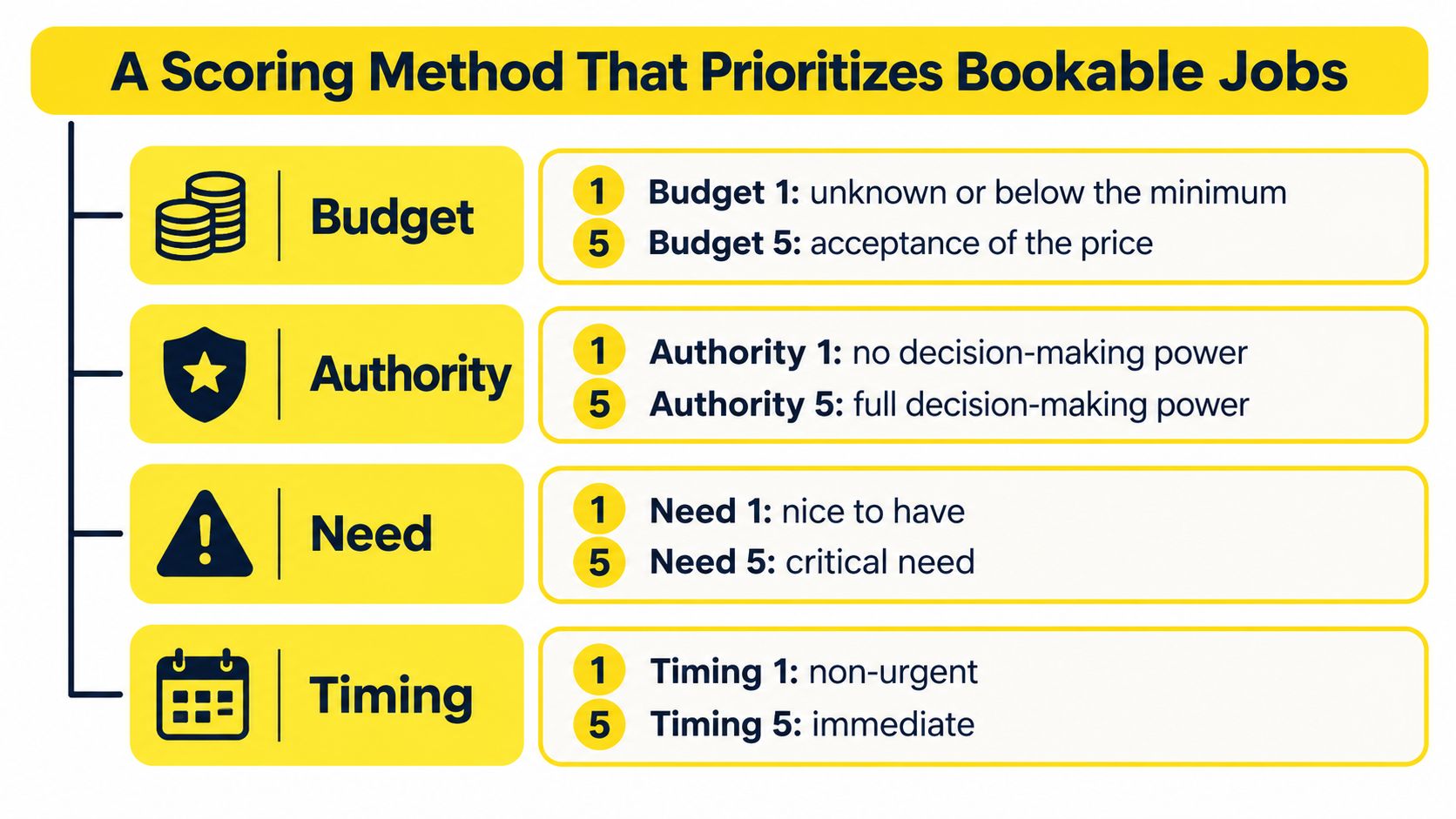
A strong BANT total earns attention, not an exemption from service rules. Record ZIP code, property type, square footage, room count, surfaces, frequency, access, and add-ons before promoting the lead.
For leads that clear that gate:
Tie budget evaluation to your cleaning business pricing strategy. A prospect accepting an improvised discount isn't proof that the job meets your financial requirements.
Calibrate residential and commercial thresholds separately. Approval processes, job values, and decision cycles differ, so a shared form doesn't justify identical scoring weights.
A peer-reviewed lead-scoring study reports average lead-to-customer conversion of approximately 15% for predictive approaches, compared with approximately 5% for traditional scoring. Those study-level averages aren't a promise for your business; they support validating the model rather than treating a score as permanent truth.
Review booking rate, estimate-to-job conversion, cancellations, average job value, and gross margin monthly. Include won, lost, no-response, and unserviceable outcomes so the model doesn't mistake plentiful inquiries for good opportunities.
Re-score when material evidence changes. A newly supplied address or confirmed service date can change the decision; another email open usually shouldn't.
Use the same intake order whether a visitor types into a website flow or speaks on the phone. Start with the facts that can stop the process, then gather the information needed for an estimate.
This shared path keeps the information consistent without forcing a phone conversation to sound like a form.
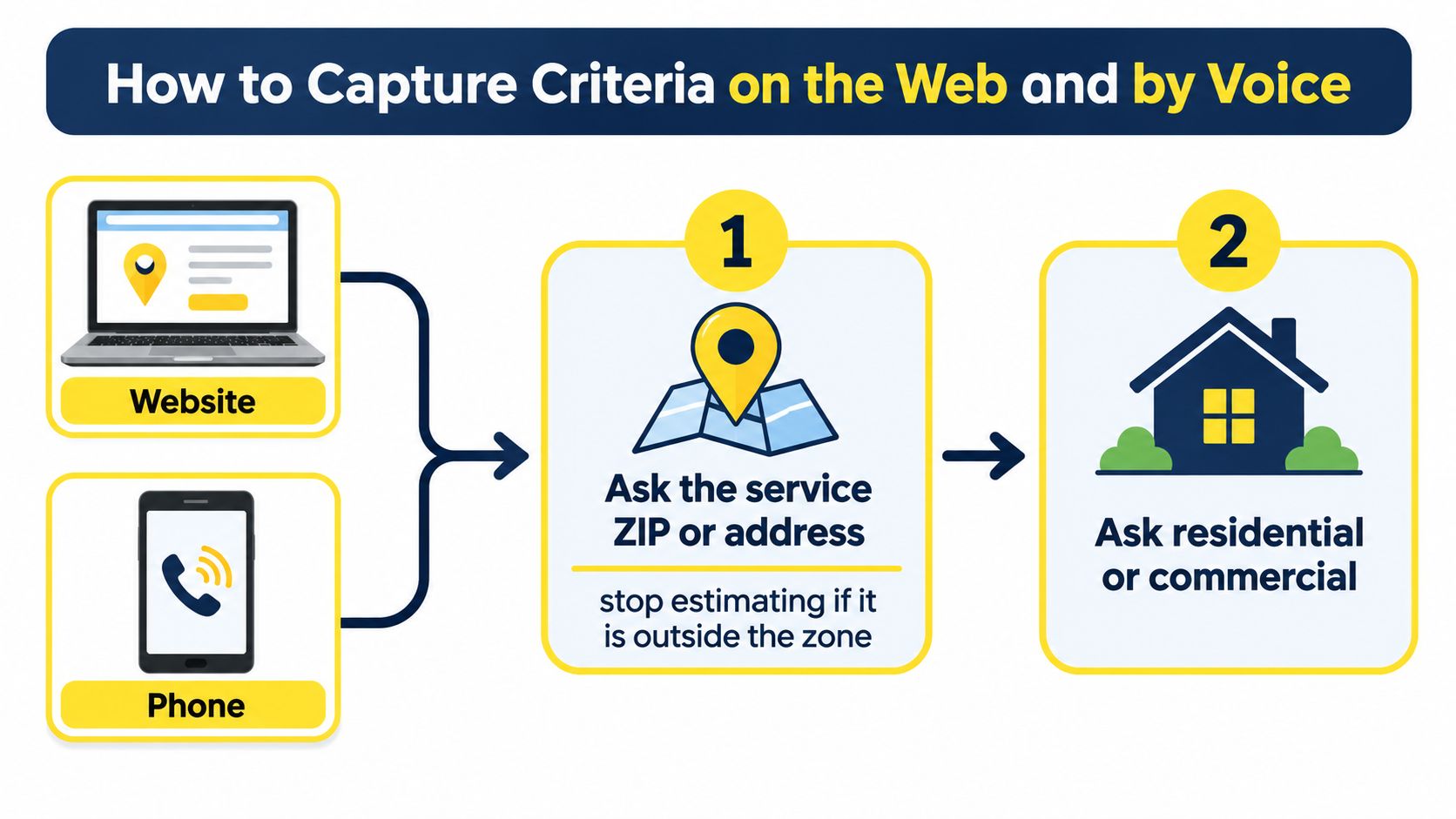
On the web, use short fields, conditional questions, and an interactive calculator so the visitor can see the estimate before leaving. Don't show commercial-only questions to a homeowner or require unrelated details before establishing service-area eligibility.
Use the cleaning estimate form templates to turn the intake into clear fields. Give each field an internal definition so the website and phone team record the same thing.
On a call, ask conversationally and confirm ambiguous answers aloud. Send the estimate by SMS and email before ending the conversation when those channels are authorized.
A Tuesday website inquiry and a Sunday-night call should land in one record when they concern the same job. More worked intake examples are available in the cleaning-operations writing on Estimatty's blog.
Missing permission to contact is a capture failure even when every property field is filled. Record the permitted channel and don't treat possession of a phone number as permission for every kind of follow-up.
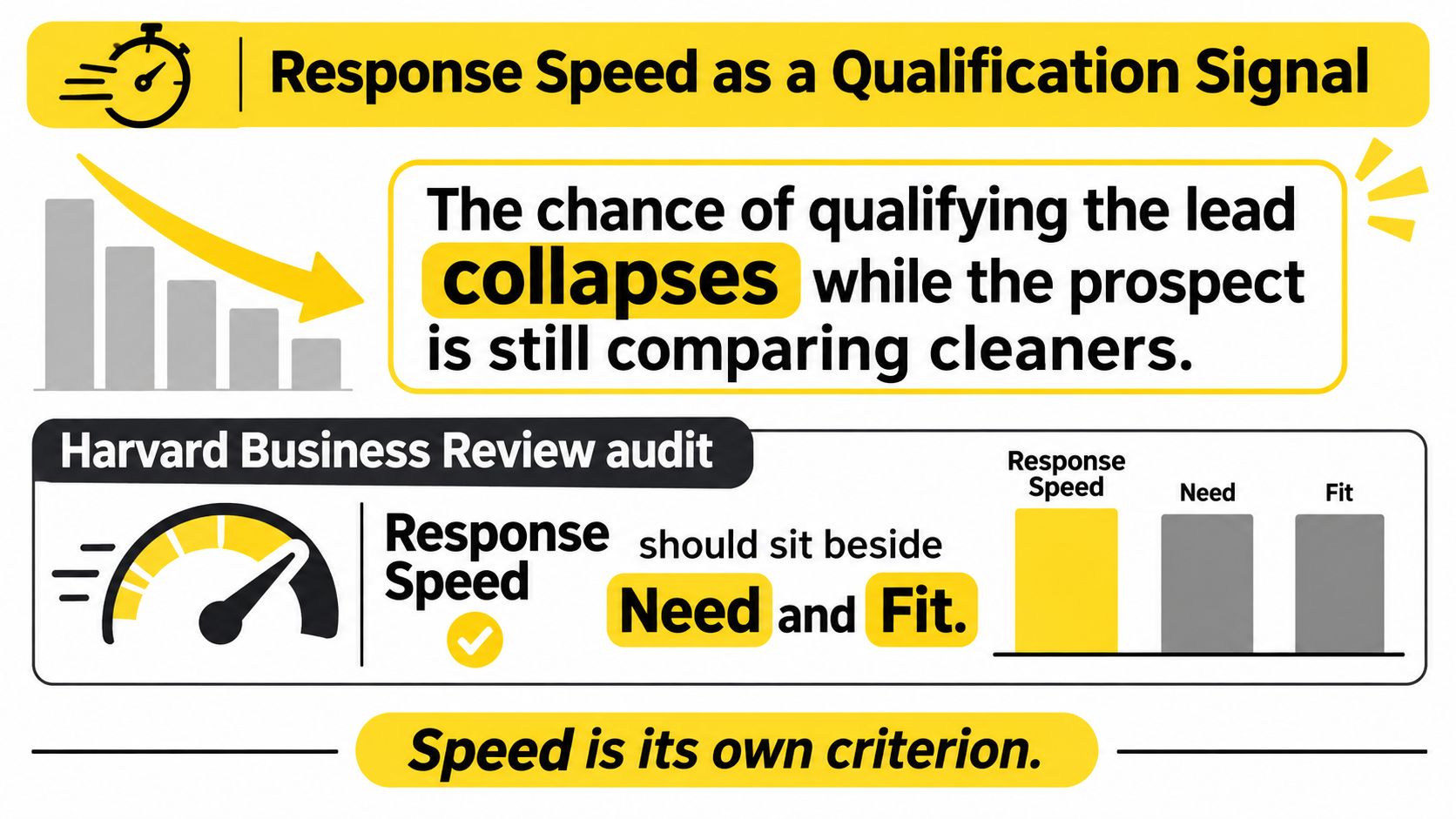
Speed belongs beside need and fit because you can't qualify a prospect you never reach. The opportunity to ask useful questions is strongest while the person is actively comparing providers.
As summarized in Vida's speed-to-lead analysis, MIT and InsideSales research involving more than 15,000 web leads found that contact within five minutes rather than 30 minutes made teams approximately 21 times more likely to qualify a lead and about 100 times more likely to make contact; a separate Harvard Business Review audit found contact within one hour was nearly seven times more likely to qualify a lead than waiting an additional hour.
The Harvard Business Review audit covered 2,241 U.S. companies and found an average response time of 42 hours among companies that replied, with 37% responding within an hour and 23% never responding. It also found that companies contacting a lead within the hour were more than 60 times more likely to qualify it than those waiting at least 24 hours.
These are cross-industry findings, not a forecast of cleaning bookings. They give owners a clear operating direction: measure response in minutes, not eventual callbacks.
Use the visual as a reminder that response handling affects whether the team can establish qualification at all.
An inquiry still inside the immediate response window deserves an attempt to capture property size, surfaces, frequency, and appointment timing. A receipt-only email doesn't do that work.
After-hours requests need the same distinction. A move-out, inspection, spill, or newly listed property may explain urgency, but the team must still verify scope and capacity.
Someone or an intake system must own the first meaningful response, including nights when the office is closed. Our guidance on improving cleaning lead response time addresses that operating handoff.
A next-day callback queue fails this standard even if the eventual conversation is polite. Don't penalize the prospect's quality score because your team answered late; record response delay separately so you can fix the process responsible.
Set these as auditable routing rules, not assumptions that every workflow already has the required connections. Our cleaning sales automation guide provides context for designing the handoffs.
Keep a reason attached to every stage change. If a coordinator can't explain why a record moved, the automation is too opaque.
Separate a new-lead notification from an approval to schedule. Owners need visibility into incoming demand without interpreting every alert as confirmation that a crew can be dispatched.
A complete record can reveal a clear no. That's a useful result, not a failure of intake.
An out-of-area prospect may accept your minimum, describe a supported property, and request recurring service. The location gate still wins. Park the record as Outside Area rather than making a territory exception the dispatcher must absorb later.
A high-urgency request with no entry arrangement needs a different response. Keep it in nurture and ask who will provide access; don't invent an estimate that assumes the crew can enter.
Recurring work can be attractive and still be impossible to schedule. If the route is full, offer a genuine alternative or a permission-based waitlist instead of squeezing another appointment onto an overloaded crew.
For staffing work, use Pipehire and the hiring guidance on the Pipehire blog. Lowering the cleaning price won't create labor capacity.
A channel with many completed forms but few bookings also needs scrutiny. Inspect whether the losses came from territory mismatch, unsupported services, unavailable times, or weak buying intent before changing the channel's score.
A busy intake desk isn't evidence of a healthy booking pipeline. Count serviceable jobs and the margin they leave.
Don't leave failed qualification records in an undifferentiated pending queue. Give each record an outcome and, where appropriate, a named next action.
| Outcome | When to use it | What happens next |
|---|---|---|
| Book | Buying evidence and operating requirements clear | Offer a real appointment and confirm the scope |
| Nurture | A missing fact or temporary constraint can be resolved | Ask a specific question or agree on a follow-up time |
| Do-not-service | The work conflicts with a firm capability or safety boundary | Explain the limitation and close the request |
Outside Area should remain separately identifiable so it doesn't distort your assessment of sales performance.
An after-hours move-out is the important speed exception: the office being closed doesn't make the inquiry weak. Keep immediate engagement active while retaining the same scheduling restrictions.
Before anyone confirms the job, answer the decision test: Will it clear your minimum gross margin after travel and labor, and can a crew reach it on the requested day? If either answer is no, a complete form doesn't justify a booking.
Roll this out during the same week. Don't postpone implementation while debating a scoring model your coordinators can't explain.
Have the owner, estimator, and booking coordinator approve the criteria card together. Freeze the scoring bands already defined, document the service boundaries, and name who can approve an exception.
Then apply the rules to sample inquiries. Include an easy recurring booking, an incomplete request, unsupported work, and a willing buyer whose requested time is unavailable.
Don't require employees to memorize a policy document. Put the card where they estimate and schedule.
Add the agreed fields to the website flow and voice intake. Test whether size, surfaces, and urgency remain attached when the conversation changes channels.
Our service-area process uses ZIP codes: eligible leads receive estimates and routing, while out-of-zone leads enter Outside Area. Test both paths rather than assuming the territory settings are correct.
Our lead handling also uses Schedule, Property, Payment, and Booked tags, with the furthest-along prospects listed first. The owner's phone receives lead details including square footage, surfaces, and urgency; use the automation rules to distinguish visibility from readiness to schedule.
At the end of the rollout, inspect whether staff followed the rules and whether the handoffs retained the evidence. Fix missing fields and conflicting definitions before adding more scoring complexity.
Set a monthly review of converted leads and channels that produced only volume. Keep changes tied to actual booking outcomes, cancellations, and margin rather than whichever campaign generated the most notifications.
Use the setup stories on our blog to support implementation, but make the immediate decision operational: turn on the shared intake before the next after-hours call. The criteria do nothing if the first answer is still a contact form.
Estimatty offers AI-powered web and voice estimating for residential and commercial cleaning businesses, capturing job details and buying intent before a human closer takes over a ready-to-buy conversation. Visit Estimatty to put your service-area rules, pricing, and qualification questions into an intake that can answer the next inquiry while the prospect is still there.