
October 23, 2026
How to Start Commercial Cleaning in 2026
Learn how to start commercial cleaning in 2026 with proven steps for pricing, staffing, licensing, and automation that win recurring contracts.

Saturday, October 24, 2026
Learn how to define and map your area of service for a cleaning business using drive time, travel fees and job minimums that protect profit.

You've accepted a home clean because the customer's city appears on your website. Then you check the actual route, look at the crew's next appointment, and realize you've sold a cleaning job without pricing the trip. The booking looks good on the calendar, but the afternoon won't.
A useful area of service prevents that mistake before you send an estimate. It defines where your team can work reliably, what travel costs, and which jobs are worth accepting. A smaller, well-priced territory can leave you with more profit than a sprawling map full of isolated appointments.
Two cleaning companies can run the same number of crews, charge the same hourly rates, and end the year with very different profits. The difference is often one decision: where each owner agreed to drive. Company A takes any job inside the county line. Company B draws the boundary at a 25-minute drive from its base and prices anything beyond it separately. Company B loses some bookings. It keeps more money per crew-day.

The terms owners use loosely do different jobs:
The distinction matters because customers read coverage while you pay for service area. A city name on your listings page costs nothing to display. The job behind it costs crew wages, vehicle wear, fuel, and the unbilled minutes between addresses. Once you account for the full cost of that gap, the boundary stops being a marketing question and becomes a profit line.
Your boundary should describe where you can arrive on time, complete the agreed work, and charge enough to make the visit worthwhile. It should hold without the owner donating travel time or rescuing an overloaded schedule.
Run the test on a real booking. Take a standard clean 40 minutes from your base. Between loading, driving both directions, and the slower arrival that follows lunch traffic, your crew loses well over an hour of paid time that the invoice never sees. Multiply that across a week of scattered jobs and the distant work eats into the margin the close jobs earned.
National labor statistics and industry benchmarks will not fix that leak. Only your own route times, job costs, and margins can tell you where the line belongs.
Your area of service is the distance you can serve on time, at a price you can keep.
Use this as a proposed operating framework, not an industry benchmark. The bands are starting rules to test against your own travel records and margins.
Drive-time zones with pricing and acceptance rules
| Zone | One-way drive time | Pricing rule | Job types to accept | Action |
|---|---|---|---|---|
| Core | 0-20 min | Standard estimate, no travel fee | All recurring and one-time jobs | Market actively and fill gaps |
| Standard | 20-40 min | Standard rate plus small travel fee | Recurring and deep cleans | Accept, prefer recurring schedules |
| Extended | 40-60 min | Travel fee plus higher job minimum | Recurring routes and large jobs | Book only on days already routed nearby |
| Outer edge | 60-120 min | Travel fee and premium minimum, or decline | Contracted recurring only | Review each quarter against profit per visit |
| Beyond | More than 120 min | Decline or refer | None | Refer to a partner, do not list as covered |
Core is where you should have the most booking flexibility. Offer your standard estimate without a separate travel fee, accept recurring and one-time work, and use nearby appointments to fill calendar gaps. Keep normal service exclusions in place, though. A close address doesn't make unsafe or unsuitable work acceptable.
Standard needs a modest travel adjustment. Recurring appointments and deep cleans are sensible candidates because you can evaluate either a repeatable schedule or a larger scope of work.
Extended requires more discipline. Apply a higher job minimum and accept only work that supports an existing route or justifies the journey on its own. Don't send a crew across the boundary merely because there's an empty slot.
Outer edge should be an exception supported by contracted recurring work, not an open invitation. Review the actual contribution from those visits quarterly. If the arrangement no longer works, change the terms or leave the area.
Beyond belongs with a referral partner. A polite referral is better than an appointment you already expect to regret.
For a hypothetical example, a Standard-zone home 35 minutes away may fit a Tuesday route with three other homes. The same address, booked alone on Friday evening, may deserve Extended-zone pricing and acceptance rules. The physical address hasn't moved, but your cost to serve it has.
Watch the exceptions:
The zone should control both price and acceptance. If it changes only the fee while your office still accepts every appointment, it isn't doing enough.
Start with completed jobs, not the territory you hope to dominate. You need to see where crews went, what customers purchased, and what remained after delivery costs.
Use this visual as the starting point for assembling that record.
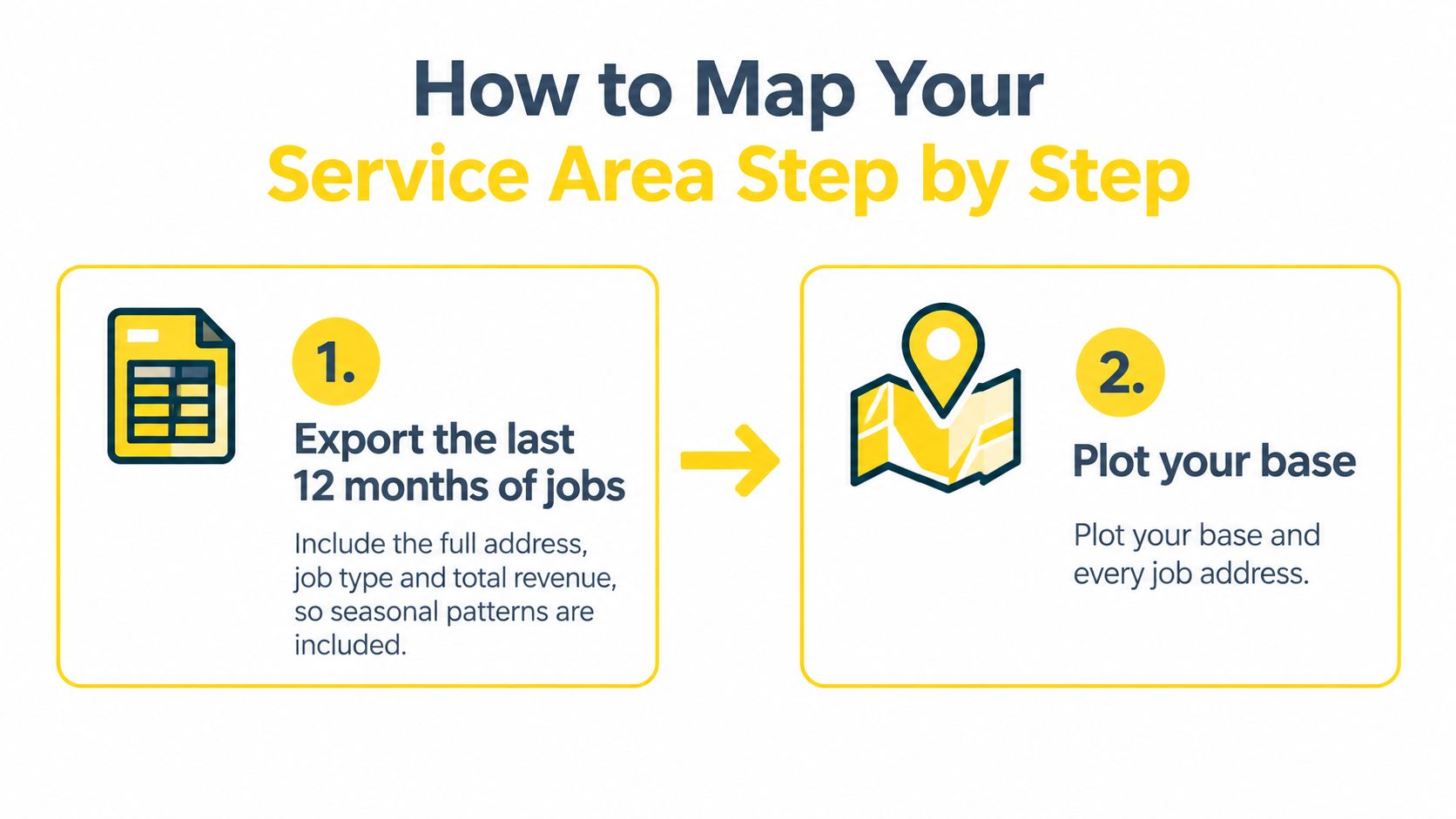
Export the last 12 months of jobs. This is a recommended review period, not a market statistic. Include full addresses, job types, and total revenue so you don't build the boundary around an unusually busy or quiet season.
Plot your base and every job. Use different colors for recurring and one-time appointments. Separate the location where supplies are stored from a crew's actual starting point when those differ.
Measure drive time rather than distance. In a routing tool such as Google Maps, check typical morning and evening conditions around each proposed boundary. Save the assumptions so another dispatcher can reproduce your decision.
Calculate contribution per visit. Subtract paid cleaning and travel labor, fuel or mileage cost, tolls, and parking from revenue. Then account for supplies and allocated overhead before calling the remainder profit.
Compare jobs by zone and route type. Review average visit results, but also separate isolated appointments from clustered work. Otherwise, a strong recurring route can hide losses on scattered one-time bookings.
Set travel fees and minimum job sizes. Base them on the cost gap you measured rather than what sounds easy to sell. If the necessary fee makes a small job unattractive, decline that job type instead of absorbing the gap yourself.
Draw boundaries around workable clusters. Follow accessible streets and practical routes rather than perfect circles. For a non-cleaning example of location data, StumpSniper.com's stump grinding service locations offers a geographic resource to examine alongside your own address records, not a cleaning boundary to copy.
Schedule a quarterly review. Compare actual results with your assumptions and adjust when wages, traffic, fuel, or customer concentration change. Record why you changed the boundary so staff aren't left interpreting an unexplained map.
Keep your working map separate from the customer-facing version. The working version can contain costs, rejected inquiries, crew starting points, and route exceptions; the public version should explain eligibility clearly.
Use the accompanying video alongside your mapping work.
Once you know which clusters deserve more work, align your local marketing techniques with those streets rather than buying attention across the entire metro.
The common mistake is mapping only jobs you won. Keep a record of addresses you declined or never estimated. Without them, you can't distinguish an unprofitable area from an untested one.
Consider a hypothetical $120 job. A two-person crew paid $20 an hour each spends an extra 75 minutes round trip traveling, creating $50 in additional wage cost. Add an assumed $15 for fuel and parking, and only $55 remains before cleaning labor, supplies, payroll-related costs, and overhead.
Fifty-five dollars is all that remains before the cleaning itself is paid for. Run that same job inside your Core zone and the $65 stays in the ticket.
Distance converts directly into labor cost, which makes your service area a profit boundary rather than a line on a marketing map. Owners who advertise the widest radius they can defend often subsidize its outer ring with every job. A smaller area priced on real drive time can earn more than a larger one priced on optimism.
Travel carries several separate costs:
A travel fee covering gasoline alone can still leave the visit unprofitable. Your minimum job size has to absorb cleaning labor and overhead too, or the outer zone becomes charity work with a route sheet.
Wages change the math. A senior crew on a higher hourly rate turns the same 75 minutes into a bigger cost than a new team does, so rerun the travel numbers whenever pay rates shift instead of treating last year's fee as permanent.
For a small home beyond your usual boundary, quote a minimum service value instead of compressing the work into a ticket that loses money. If nearby customers can share a route, apply a route-based adjustment only after confirming the scheduling savings are real.
Show travel as a separate estimate line when it makes the charge easier to understand. Explain what it covers plainly. Paying your staff for their time on the road needs no apology.
Pricing rule: Reduce the fee when the delivery cost falls. A request for a discount changes nothing about what the trip costs you.
Write the zone, minimum, and approved exceptions into your cleaning business pricing strategy. Staff should produce the same estimate from the same inputs instead of negotiating the boundary away on every call.
A nearby cleaner with no suitable appointment isn't necessarily the best choice. A customer who needs dependable weekly service may prefer a farther-away business with a reliable recurring opening.
In a hypothetical comparison, a cleaner 45 minutes away with an available Tuesday slot could suit that customer better than a nearby company with no opening until next month. Proximity matters, but it doesn't replace availability.
The Tinuiti home-services research reports that more than 60% of seasonal home-service customers prefer booking more than a week ahead, including 28% who prefer at least a month ahead. That research concerns seasonal home services, not cleaning customers alone. It supports offering a clear future appointment rather than assuming everyone wants immediate service.
Keep your intake short, but collect enough information to assess the actual request:
The estimate response should distinguish geographic eligibility from appointment availability. Being inside the Core zone doesn't promise same-day, evening, or holiday service.
Use your cleaning-business scheduling software to maintain capacity by zone and weekday. A broad calendar opening isn't useful if the available crew would have to cross the territory between appointments.
Check who can reliably reach each proposed area and who can cover absences there. A zone dependent on a single employee's willingness to make an awkward journey isn't ready for aggressive promotion.
When expansion requires additional cleaning employees, Pipehire is an option to consider for recruitment. Confirm staffing and workable appointment windows before advertising the new boundary.
Set capacity by zone and weekday. Promote bookable coverage, and clearly label waitlisted or temporarily unavailable areas.
Google's service-area guidance recommends keeping the overall boundary within roughly two hours of the business location and avoiding areas you can't reasonably serve. Treat that as listing guidance, not evidence that a journey near the limit is profitable.
Your boundary must also be one you can legally and safely serve. A listing is a promise to customers, not permission to operate wherever you can draw a polygon.
Use this checklist before adding another location.
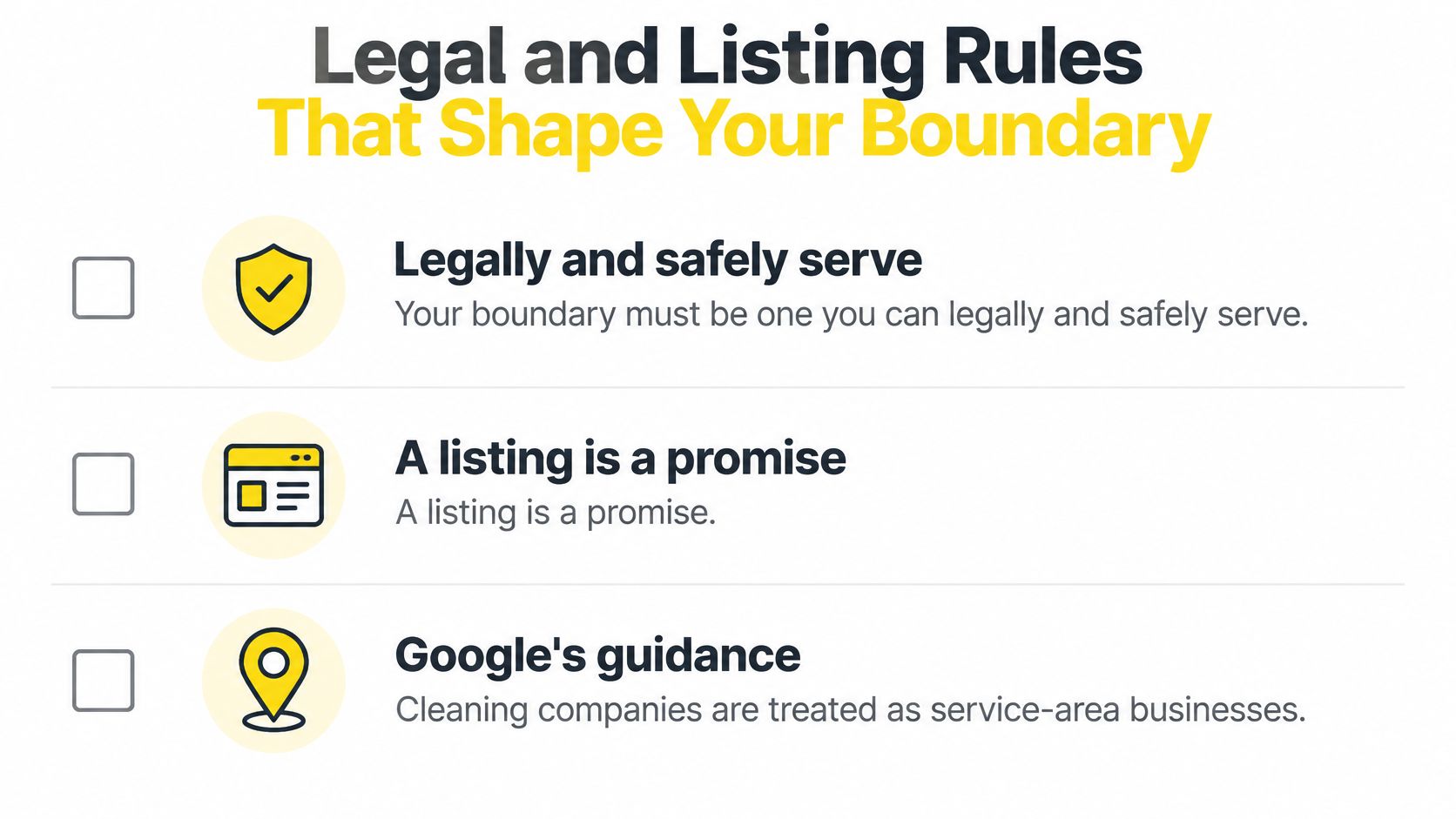
Requirements depend on your jurisdiction, policies, and employment arrangements. Treat these as questions to resolve with the relevant office, insurer, or adviser:
For U.S. operations, don't assume travel between customer jobs is treated like an ordinary home-to-work commute. Confirm the applicable wage-hour rules with your state labor office and payroll adviser before deciding what time to pay or how to recover that cost.
A customer travel fee and an employee pay obligation are separate matters. Waiving the fee doesn't settle what you owe the worker.
List only locations where you're currently permitted and able to work. If customers don't visit your operating address, check the applicable profile rules and use the address-hiding settings intended for service-area operations.
Keep a record of who approved each new zone and when its requirements were checked. That makes later reviews easier than trying to reconstruct decisions from messages and old estimates.
Your SEO for cleaning services should reflect this operating reality. Don't publish location pages that imply an established local service when you have neither the staff nor the permissions to fulfill the promise.
Open your website as a prospective customer would. Can you find out whether your address qualifies, whether restrictions apply, and what happens next? If the only answer is a long alphabetical list of cities, the page needs work.
Group covered places by zone and explain the booking conditions beside them. A statement such as “Northside appointments are available on designated route days” is more useful than “Entire metro covered” when your team can't support unrestricted bookings.
The website should make those conditions visible before someone commits.
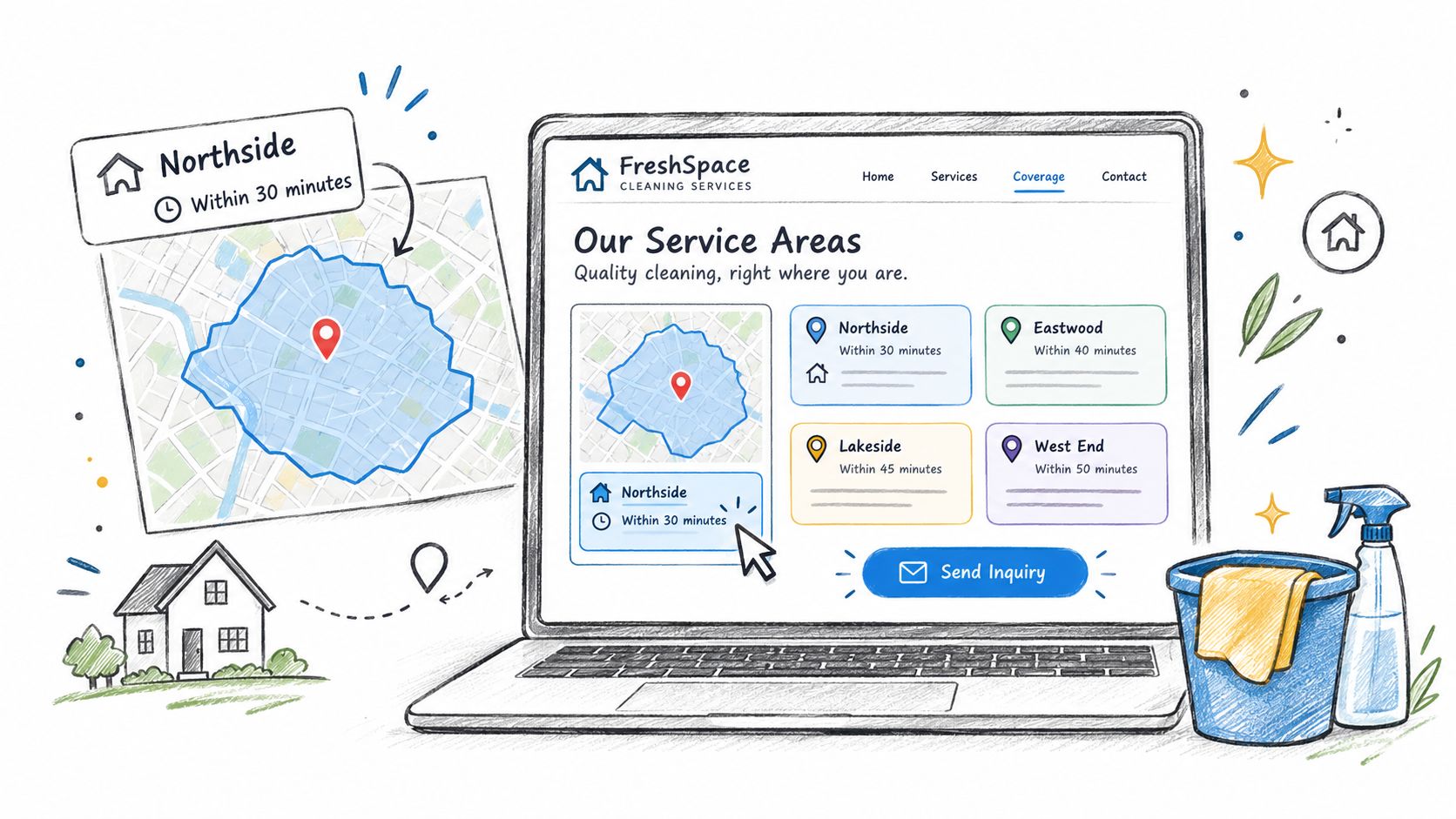
Add an address, ZIP, or postcode check early in the inquiry process. Let eligible customers continue, explain conditional coverage, and give out-of-area visitors a clear answer instead of collecting details for a job you won't accept.
When reviewing the structure of an area page, you can also check local removalist coverage from Get n Go Removals Melbourne. Use it as a cross-trade reference for presenting locations, not as a pricing or territory model for cleaning.
Your cleaning-business website should connect coverage information to the estimate request without making visitors hunt through separate pages. Ask about exact addresses where postal boundaries don't match practical routes.
Match the covered locations in your Google Business Profile and other directories to the website. When a boundary changes, update the public pages, intake rules, staff reference sheet, and listings together.
Keep useful exceptions internal. Customers need clear eligibility, not a dispatcher's entire decision tree, and staff need written authority for handling edge cases.
For further operating guidance, use the cleaning-business guides at Estimatty. If expansion depends on recruiting first, consult the cleaning hiring guidance at Pipehire before promoting the new area.
Make these your actions for this week:
Estimatty offers a no-code website widget and the Matty agent to capture customer details, answer coverage questions, and deliver instant estimates by SMS and email, including after hours. Visit Estimatty to build an address-first inquiry process around your service zones and consistent pricing rules.