October 22, 2026
How Do You Professionally Clean a House? a Room Guide
Learn how do you professionally clean a house with a room-by-room process, safety standards, quality checks, and team training tips.

Friday, October 23, 2026
Learn how to start commercial cleaning in 2026 with proven steps for pricing, staffing, licensing, and automation that win recurring contracts.
Buying a vacuum, stocking chemicals, and finding a customer isn't a plan to start commercial cleaning. It's a shopping list with a sales target attached. The harder job is agreeing to a service price you can deliver, then paying employees while you wait for the customer's money.
Start with the contract economics, not the equipment catalog. A building that looks profitable on a square-foot spreadsheet can become an account you subsidize once you include access delays, replacement workers, supervision, and unpaid invoices.
Commercial cleaning isn't a tiny market waiting for someone with a mop. The U.S. janitorial-services industry includes approximately 63,000 companies, employs more than 1 million workers, and generates about $73 billion in annual revenue, according to Vertical IQ's janitorial-services industry profile. You're entering a fragmented service business, not competing only against national brands.
The important distinction is what you're selling. Customers aren't buying your vacuum. They're buying dependable service at an agreed frequency, usually with expectations about access, appearance, communication, and accountability.
The operating model looks like this:
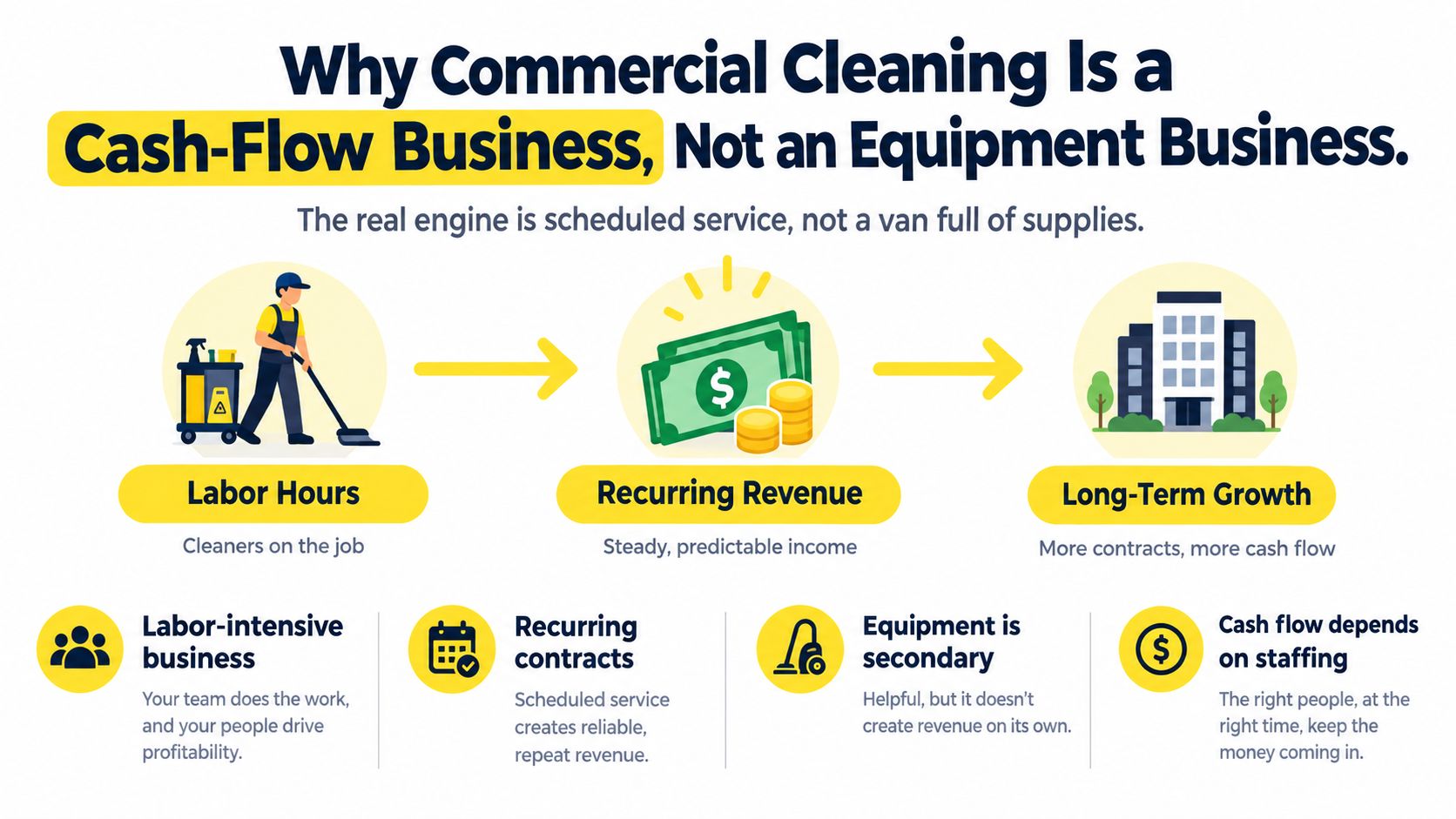
In the 2022 Census business dataset, janitorial services reported approximately $74.03 billion in receipts and $30.78 billion in annual payroll. Payroll alone represented roughly 41.6% of receipts, before other operating expenses, as detailed in Building Services Management's analysis of the Census figures.
That's why an equipment-only startup budget misses the main exposure. Employees need paying even when a customer hasn't approved an invoice. Supplies, transport, and insurance don't stop costing money while you chase accounts payable.
Build a 60–90-day cash-flow survival plan, rather than assuming your opening equipment purchase represents your funding requirement. LivePlan's cleaning-business startup guidance provides context for startup budgeting; the practical question is how much cash you'll need before commercial receivables become usable money.
Your forecast should separate:
For help organizing payment timing and cash visibility, use HireAccountants cash flow management advice alongside your operating forecast.
Practical rule: Don't accept an account merely because its monthly revenue looks attractive. Accept it when you can fund delivery and still earn an acceptable return.
The cheapest launch isn't necessarily the safest. Buying less equipment can be sensible. Leaving no money for payroll isn't.
Choose a building type before you choose equipment. General offices, medical offices, warehouses, retail, and schools create different operating demands. If you already clean homes, use this comparison of commercial and residential cleaning to identify which parts of your current operation transfer and which need redesigning.
Keep your initial service area compact enough that you can supervise it. A distant account must justify its travel and coverage burden, not merely add revenue to your sales report.
Use this checklist to frame the inspection:
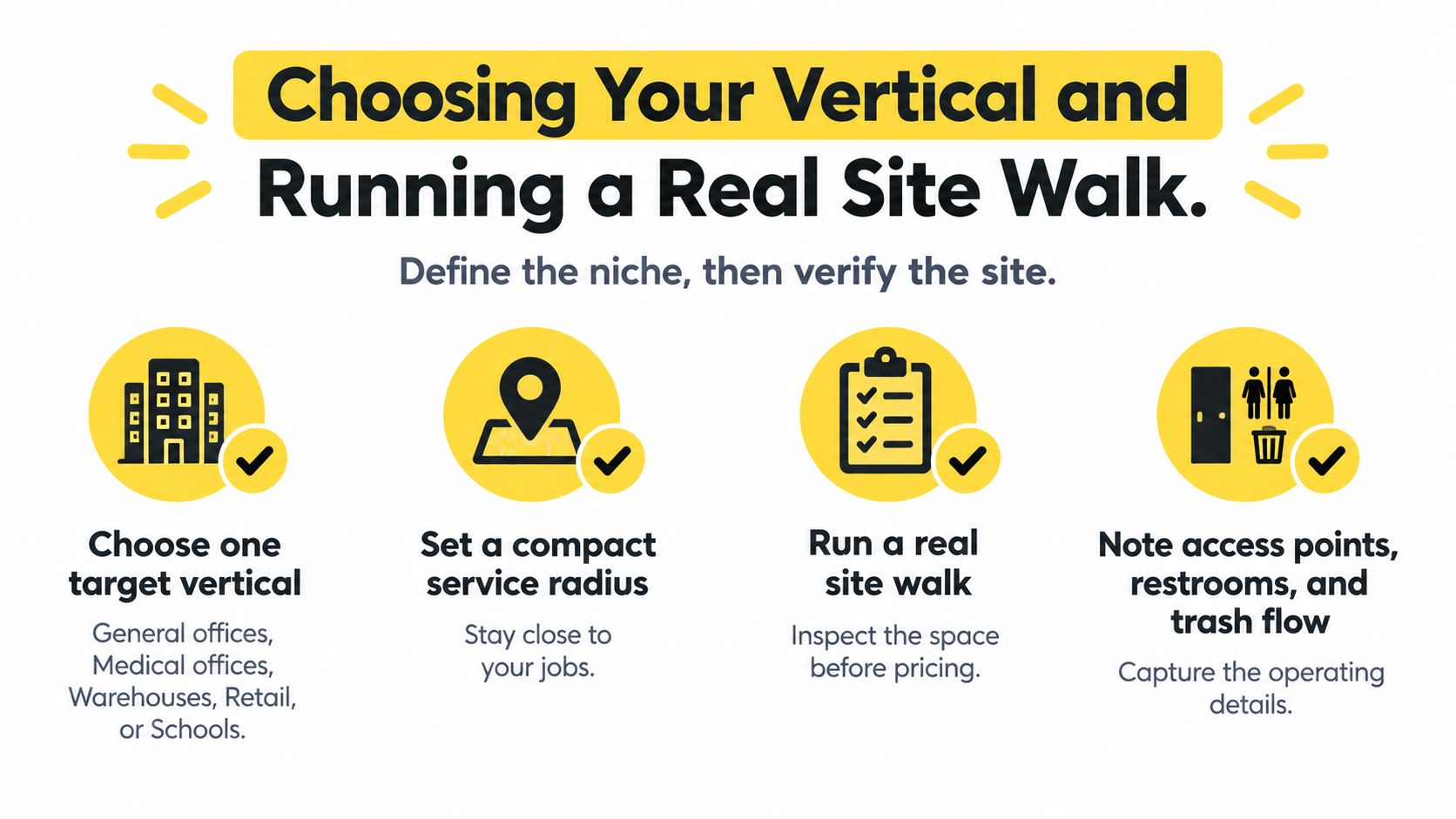
Walk the property with someone who understands its daily operation. The person requesting an estimate may not know where cleaners lose time or which rooms remain occupied after closing.
Record cleanable square footage, restroom and fixture counts, floor surfaces, occupancy, access constraints, frequency, consumables, travel time, and specialty tasks. The ISSA-referenced cleaning-time estimating approach supports this bottom-up inspection method and provides a typical-office benchmark of approximately 3,289 square feet per worker-hour. Treat that benchmark as a starting assumption, not a promised production rate.
Ask the customer to demonstrate the arrival and lockup process. An access procedure described as simple can look different when someone performs it in person.
For another walkthrough perspective, watch this commercial-cleaning video:
Write a scope that lets a supervisor determine whether the work is complete. “Clean restrooms” is vague; specifying fixtures, floors, waste removal, replenishment, and agreed surface treatment gives both parties something observable.
Separate recurring tasks from periodic work and exclusions. Record who authorizes additions and how you'll price them before an employee starts doing extra work as a favor.
A walkthrough isn't a courtesy before the sale. It's where you decide whether you understand the job well enough to accept responsibility for it.
A square-foot rate is a comparison tool, not a complete cost model. Start with the labor required to perform the written scope, then decide whether the resulting price makes commercial sense.
Use the office production benchmark established during your site walk cautiously. Reduce assumed production for dense furniture, restrooms, kitchens, hard-floor maintenance, heavy soil, security procedures, and fragmented work areas. Otherwise, you're assuming the cleaner can move through every part of the building as efficiently as open office space.
Your estimating worksheet should make each cost visible:
Use a commercial cleaning bid template to preserve those assumptions instead of leaving them in the estimator's head. Show the expected service frequency, labor allowance, inclusions, and exclusions alongside the customer-facing estimate.
Revenue isn't margin, and adding a markup isn't the same as achieving your intended margin. Check the calculation against the final selling price, not just against costs.
The following Recurring Monthly Square-Foot Pricing by Facility Type ranges come from the CleanQuote commercial-cleaning cost guide, which commonly assumes three to five weekly visits for standard offices and five to seven for medical facilities.
| Facility Type | Monthly Rate per Sq Ft | Typical Visits per Week |
|---|---|---|
| General offices | $0.07–$0.18 | Three to five |
| Medical offices | $0.14–$0.32 | Five to seven |
| Warehouses | $0.04–$0.12 | Confirm for the specific scope |
| Retail or showrooms | $0.08–$0.20 | Confirm for the specific scope |
These are monthly recurring ranges, not per-visit prices. Don't multiply them by the visit count again, and don't assume the warehouse or retail ranges establish a service frequency.
If your bottom-up estimate differs substantially, investigate the reason. The building may have an unusual scope, your production assumption may be wrong, or the customer's requested service may cost more than expected.
An employee exceeding the estimated hours isn't automatically a slow employee. The estimate may be wrong.
Compare actual labor with estimated labor after every visit. Investigate repeated overruns by task and cause before demanding faster work. Correct the production assumption, service scope, or frequency rather than asking employees to make an impossible estimate work.
A customer handing over building access should ask how you protect people, property, and confidential spaces. Prepare answers before the sales meeting, not after the customer requests documents.
Confirm business registration, applicable licensing, insurance, and bonding requirements with the relevant local authorities, insurance adviser, and prospective customer. Don't assume another cleaning company's paperwork satisfies your location or your intended scope.
Keep the documentation organized and ready for review:

OSHA's Hazard Communication Standard requires covered employers using hazardous cleaning chemicals to maintain accessible Safety Data Sheets and provide hazard information and training. The operational requirements include a chemical inventory, appropriate container labels, employee training before assignment, and SDS access during every shift and at each work location, as explained in this commercial-cleaning startup compliance guidance.
An SDS folder locked in the owner's office doesn't help a worker who needs it at a customer's building. Test access under actual working conditions, including after-hours shifts.
Build written procedures around the tasks employees perform:
Use the cleaning industry standards guide to help organize your operating expectations. Then verify competence through demonstrations rather than assuming a signature proves understanding.
Prepare a customer-facing qualification file containing the documents relevant to the account: insurance evidence, bonding information where required, scope, inspection process, and escalation contacts. Keep employee-specific records appropriately controlled rather than sharing personnel files as sales material.
Medical, school, food-service, and post-construction work deserve additional scrutiny before you promise service. Confirm the required training, equipment, coverage, and procedures for the particular facility.
Be equally precise in the agreement. Document response expectations, inspection rights, exclusions, damage reporting, payment terms, and authorization for changed work.
Compliance capacity is a sales qualification. Explain how your team will work safely and document completion. Don't advertise capabilities you haven't verified, and don't sign an agreement assuming you'll figure out the requirements afterward.
Winning a contract before establishing a realistic staffing cost is a gamble. You've committed to the customer's price, but you haven't established what dependable delivery will cost.
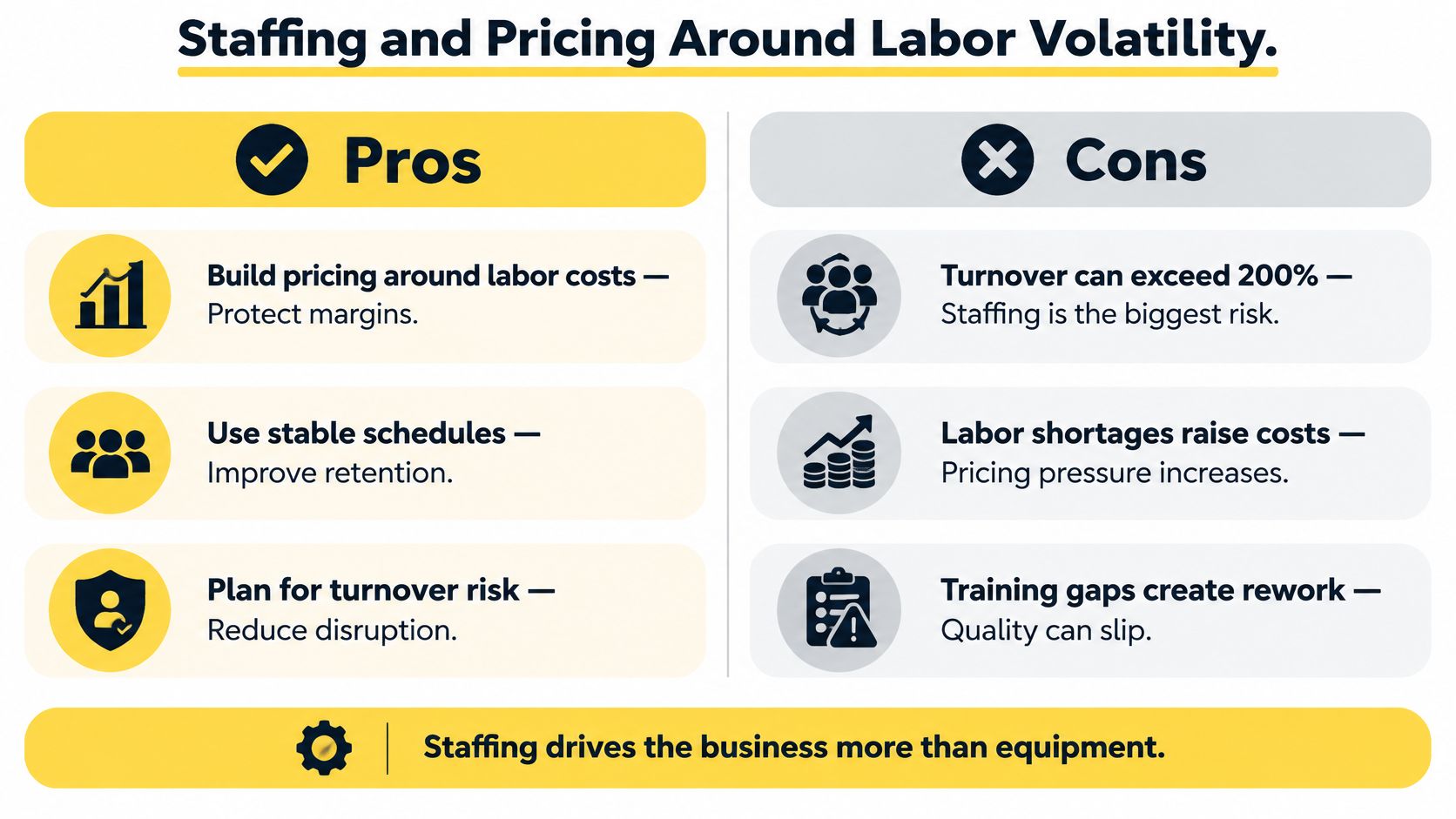
Staffing was identified as the biggest risk by 63% of commercial-cleaning contractors entering 2025. Some market analyses reported turnover exceeding 200%, while janitorial wages reportedly rose 6.1% in 2024 after reaching $31,860 in 2023, according to Mordor Intelligence's contract-cleaning market analysis. These are industry signals, not predictions of your own turnover or payroll.
The operating trade-offs are straightforward:
Build your staffing plan around the wage needed to attract suitable workers for the actual location and shift. Don't use the lowest advertised wage you can find and assume applicants will accept it.
Use this labor-cost-per-hour calculation guide to distinguish base pay from the cost of having a trained employee available. Include replacement coverage, onboarding time, and supervision in the appropriate estimate allowances.
For absence planning, use LeaveWizard's guidance to plan employee coverage around absences. Apply it to specific sites and access windows rather than maintaining a list of people who might answer the phone.
Document task demonstrations and site orientation for new hires. Use the chemical-safety system already established rather than improvising onboarding when someone calls out.
Walk away when the service window doesn't match available coverage, the customer rejects necessary staffing costs, or replacement labor would consistently erase the return. Negotiate a different schedule or scope before treating refusal as the only option.
Don't make the owner the permanent unpaid backup cleaner in the estimate. Owner coverage is still work with an economic cost.
A busy schedule isn't proof of a healthy business. A schedule you can staff, supervise, and deliver at the agreed price is a much better test.
The right tool should preserve your operating judgment, not replace it with a faster guess. Choose software only after you've defined the information required to price an ordinary account and the exceptions that require review.
A spreadsheet can support disciplined estimating. A polished form can still collect the wrong information. Evaluate the process behind the interface.
| Approach | Useful when | Main trade-off |
|---|---|---|
| Manual spreadsheet and personal follow-up | The owner handles a manageable inquiry volume and inspects each opportunity | Flexible, but responses and calculations depend on someone being available |
| Generic forms and estimating tools | Standard fields capture most requirements | Structured intake, but unusual details may require additional calls |
| Cleaning-specific AI web and voice estimator | Prospects arrive through calls and the website outside staffed hours | Can standardize intake and responses, but needs sound pricing rules and escalation boundaries |
Estimatty is one option in the cleaning-specific category. Its AI web and voice agent engages website visitors and callers, captures details such as square footage, surfaces, and urgency, sends estimates by SMS and email, and notifies the team in real time, with no-code setup and optional U.S. human receptionists for booking assistance.
For commercial work, distinguish an initial estimate from final acceptance of an inspected scope. Automation shouldn't commit your company to unfamiliar hazards, unsupported specialty services, or an access arrangement nobody has reviewed.
Evaluate each option against real inquiries, including an incomplete request and an unsuitable account.
Outbound prospecting needs the same discipline. If you use cold callers through LatHire, give them your service boundaries and qualification questions rather than asking them to book every interested property manager.
A useful intake system leaves the estimator with usable facts. A weak one leaves a name, a phone number, and another discovery call to make.
Treat this launch schedule as an operating sequence, not a promise that every business will be ready on the same date. Move forward when the underlying work is complete. Don't accept an account early just to keep a calendar milestone.
The strongest starting position is a defined service, a defensible estimate, a funded delivery plan, and people capable of performing the work. Advertising before those pieces fit together can leave you selling something you haven't learned to deliver.
Choose your vertical and service radius. Investigate registration and licensing requirements, speak with an insurance adviser, and identify the customers you're equipped to serve.
Build your cash forecast before buying specialized equipment. Decide which expenses must be funded even if the first customer pays later than expected.
Arrange site walks with qualified prospects and build bottom-up estimates from observed conditions. Verify insurance and bonding requirements before committing to a start date.
Prepare the scope, agreement, inspection checklist, and change-authorization process. Test whether someone other than you can understand what the customer is buying.
Complete staffing, site orientation, and compliance documentation before service begins. Test the lead-capture process from the customer's first inquiry through the internal handoff.
Use this commercial cleaning lead-generation guide to organize prospecting around accounts that fit your operating capacity. Track qualified opportunities rather than celebrating every inquiry.
Your next step today is to arrange a walkthrough of a target building and open an estimating worksheet beside the site notes. If you can't explain a cost allowance, investigate it before sending the estimate.
The appeal of commercial cleaning is recurring work. The discipline is ensuring that each recurrence earns money rather than repeating the same underpriced obligation.
Estimatty offers AI-powered web and voice intake that captures cleaning requirements and sends estimates by SMS and email. Visit Estimatty to explore how automated intake could support your commercial launch while keeping site-specific risks subject to your review.