September 29, 2026
Commercial and Residential Cleaning in 2026
Compare commercial and residential cleaning markets in 2026. Explore pricing, staffing, compliance, and how AI estimators streamline operations.

Friday, August 14, 2026
Use this commercial cleaning bid template to create accurate estimates that win contracts. Includes pricing formulas, scope tips, and scripts.
You're standing in a hallway with a clipboard, a laser measurer, and a manager who wants a price by tomorrow morning. The space looks straightforward at first glance, then the details start piling up, the restroom count is higher than expected, the floors aren't all the same, access is tighter after hours, and the client wants the proposal to look polished enough for procurement. That's where a commercial cleaning bid template earns its keep, not as a form, but as a cost model that keeps you from guessing wrong.
The bids that win usually don't feel flashy. They feel complete, easy to audit, and fast to approve. The bids that lose are often the ones that hide assumptions, blur scope, or take too long to land in the buyer's inbox.
The first mistake most owners make is pricing from the parking lot. They see the square footage, throw out a number, and hope the building behaves like the last one. It usually doesn't, because labor time changes the moment floor type, restroom count, trash volume, condition, and traffic patterns shift.
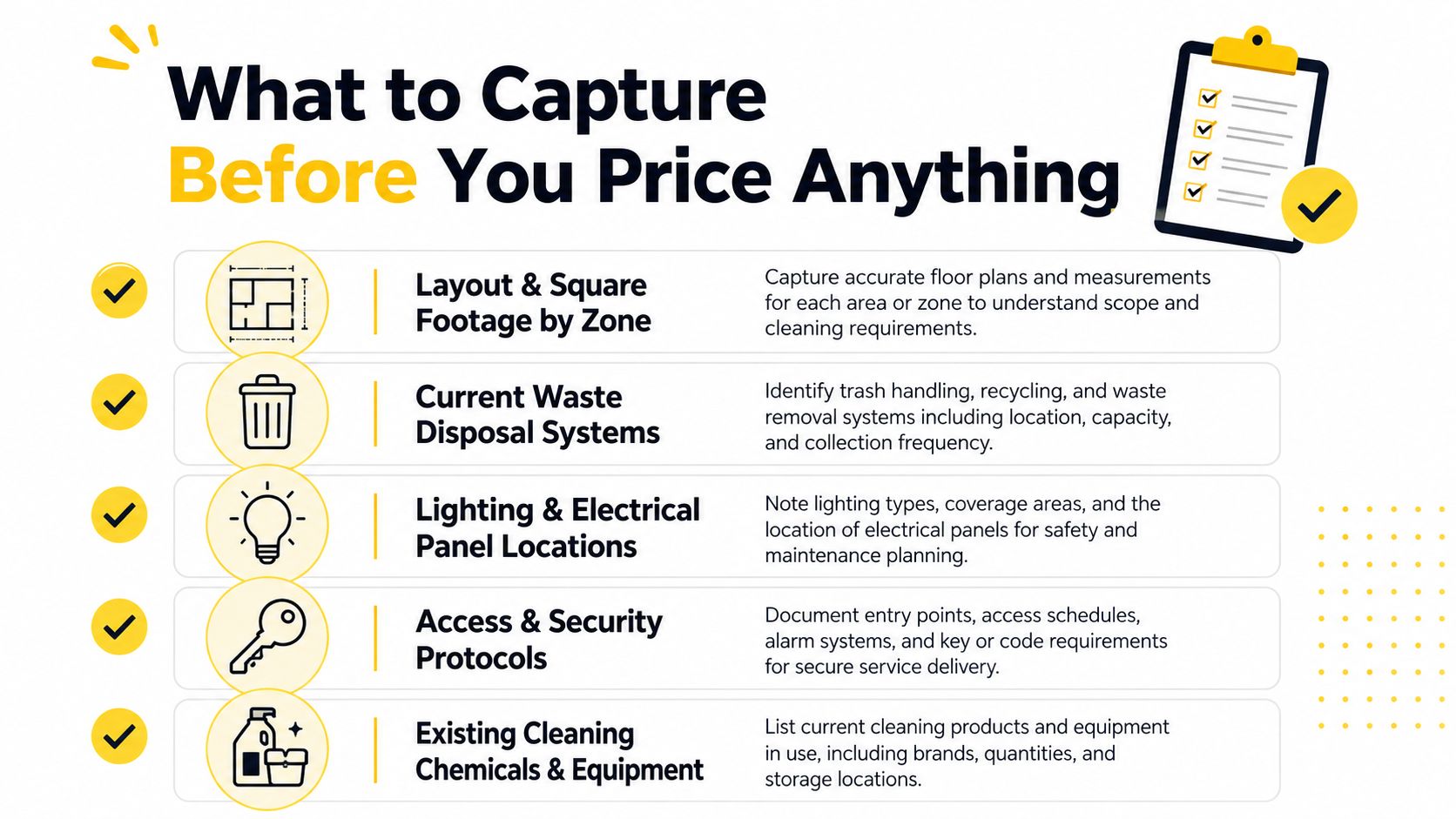
A credible bid starts with a walkthrough that captures the physical building data the pricing model needs. Neutral industry guides consistently point to facility type, total square footage, floor type, restroom count, trash-container count, building condition, and occupant density as the inputs that drive labor hours before you ever assign a dollar value. That's why a commercial cleaning bid template isn't just a document, it's a cost engine that turns what's in the building into a repeatable monthly or annual price. Estimatty's data collection software guide fits that workflow well, because the core task is collecting clean inputs before anyone starts talking about price.
If you skip even one of those inputs, the bid can look fine on paper and still bleed cash in month one. A warehouse with light trash pickup is not a medical office with strict sanitation expectations. A lobby with polished stone doesn't behave like carpeted corridors, and a building with heavy occupant density creates more restroom and trash work than the square footage alone suggests.
Practical rule: if you can't explain why one building needs more labor than another, you probably don't have enough site data yet.
The best walkthroughs are part inspection, part discovery call. Ask how access works, when doors open, which areas are sensitive, and what the client considers a must. Take notes on building condition, because a tired facility usually costs more to maintain than a newer one that's already organized for service.
You'll also want to capture what's already on site, including existing equipment and chemicals, because that tells you whether you're supplying a full service program or stepping into a partially equipped operation. That distinction changes how you think about labor coverage, supplies, and startup effort. A template that ignores those realities gets tossed aside fast in larger markets, because buyers expect a real operating plan, not a generic rate sheet.
Once the site data is solid, the pricing formula stops feeling like a guess. Clean math is easier to defend later, especially when a procurement manager asks why your number is higher than the competitor's. A professional bid should show how the building becomes hours, how hours become cost, and how cost becomes a monthly or annual price.
The base formula is straightforward: convert the scope into labor hours using task-specific production rates, apply a burdened labor rate that includes wages plus payroll taxes and benefits, then add supplies, equipment, overhead, and margin. That structure belongs in a serious commercial cleaning bid template, because it tracks how the work is delivered instead of pretending every building behaves the same. This pricing calculator guide is useful if you want a cleaner way to plug in the math without rebuilding every estimate from scratch.
A bidding guide from Leadduo's proposal template guidance recommends adding a 10% to 15% buffer for setup, pack-up, and restocking time when you convert production rates into monthly labor hours. That is the kind of detail many new bidders miss, and it matters because small task overruns turn into real margin loss. The same guide notes that supply costs commonly run 5% to 8% of revenue, overhead usually sits at 15% to 25%, and target profit margins often fall between 10% and 28%. Those figures are benchmarks, not a substitute for your own job costing, but they are useful for checking whether your pricing is drifting away from reality.
A pricing reference can also help you sanity-check the final figure. The same commercial cleaning pricing calculator approach gives you a faster way to compare your labor build against what similar facilities usually support, instead of trusting a gut feel when the proposal is already late.
A 2026 pricing guide reports per-visit rates of $0.07 to $0.25 per square foot, with small offices under 1,000 square feet at $0.15 to $0.25, medium offices from 2,000 to 10,000 square feet at $0.10 to $0.18, and large facilities above 10,000 square feet at $0.07 to $0.12. Medical and dental facilities typically add 25%. The benchmark set is a useful check when your estimate feels too lean or too padded.
| Facility Type | Square Footage Range | Price Per Sq Ft | Notes |
|---|---|---|---|
| Small office | Under 1,000 sq ft | $0.15 to $0.25 | Higher unit cost because fixed time still exists |
| Medium office | 2,000 to 10,000 sq ft | $0.10 to $0.18 | Common range for recurring service |
| Large facility | Above 10,000 sq ft | $0.07 to $0.12 | Lower unit cost as scale improves |
| Medical or dental | Varies | Add 25% | Higher sanitation burden and oversight |
If your number lands well outside those ranges, do not panic. Check the walkthrough notes first. The building might be unusual, and that is exactly why the template has to be built from site facts instead of optimism.
A vague scope is where bids go to die. Procurement teams don't just want to know that you'll clean the building, they want to see how the work is divided, what happens on each visit, and what's excluded. If they can't audit the math line by line, they'll discount the proposal, even if the headline price looks attractive.
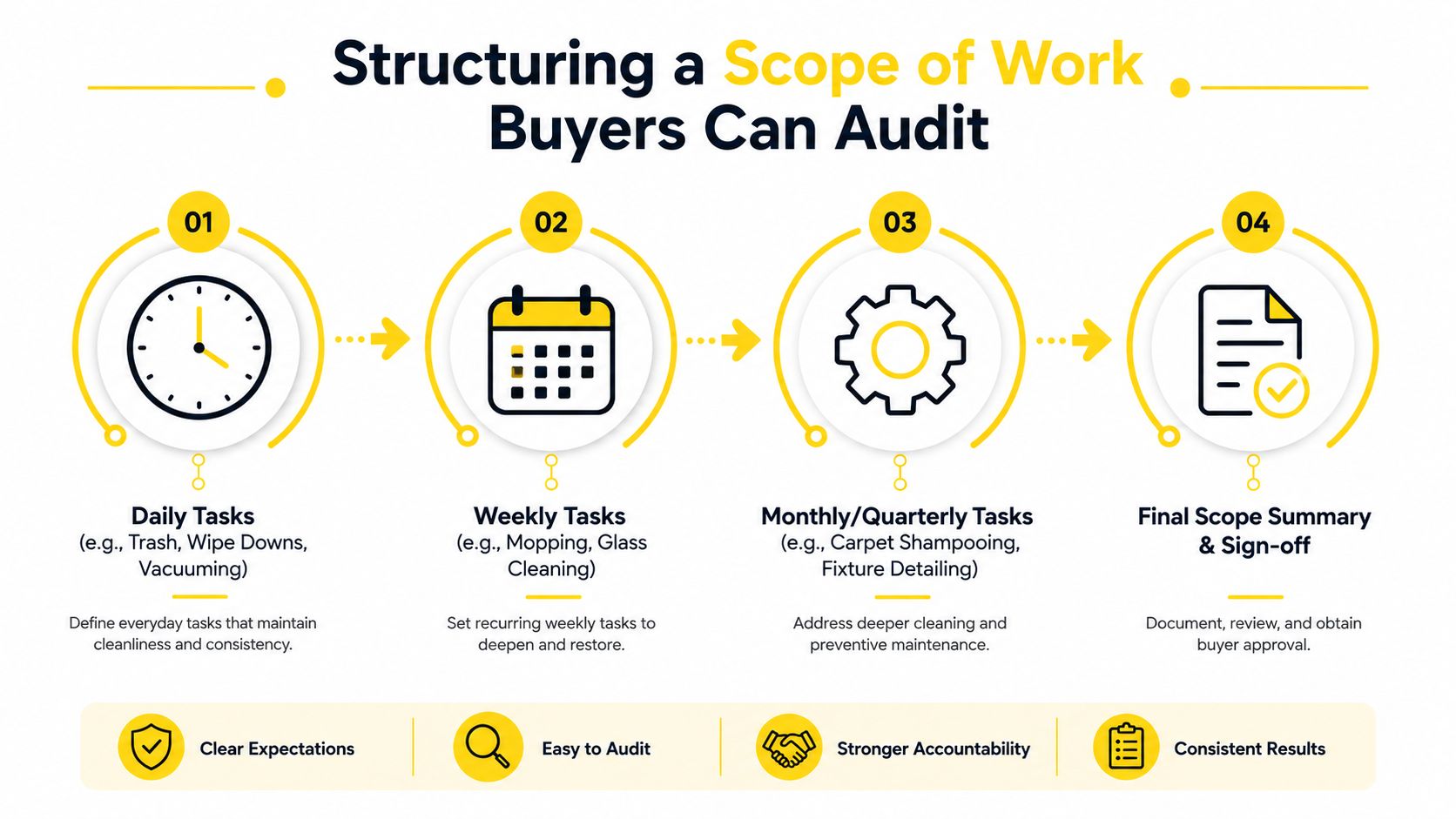
The cleanest structure is simple. List daily, weekly, monthly, and quarterly tasks, then assign each task to a specific area and service frequency. That gives the buyer a line-by-line view of what gets done, when it gets done, and how the monthly total was built. A serious commercial cleaning bid template should mirror the scope exactly in the pricing table so the math never feels disconnected from the work.
That means daily tasks might include trash removal, restroom sanitation, and vacuuming. Weekly work may cover mopping, glass cleaning, or surface detailing. Monthly and quarterly items usually belong to maintenance tasks like deeper floor care or detailed fixture cleaning. If you keep those buckets clear, the buyer can spot the difference between recurring labor and occasional maintenance at a glance.
A good scope doesn't stop at the task list. Commercial buyers often look for a compliance matrix, staffing and coverage plan, equipment list, and proof of insurance or certifications because they're evaluating readiness, not just price. Bidwell's cleaning services procurement page is a useful example of how formal buying processes tend to surface those expectations.
For contract language and structure, this cleaning services contracts guide pairs well with a well-built scope. It helps keep the scope aligned with the contract instead of leaving key terms floating outside the proposal.
A scope that's specific enough to audit is also specific enough to protect your margin.
A short video walkthrough can help train your team on the same structure.
The payoff is fewer clarifying emails. When the buyer can trace every area, frequency, and task back to the price, the proposal feels credible, and scope gaps are much harder for either side to ignore later.
The hardest part of bidding isn't the core scope, it's everything that sits outside the neat checklist. Access restrictions, after-hours work, specialty surfaces, and client requests that weren't visible during the walkthrough can change your labor time fast. If you don't price uncertainty on purpose, you end up absorbing it by accident.
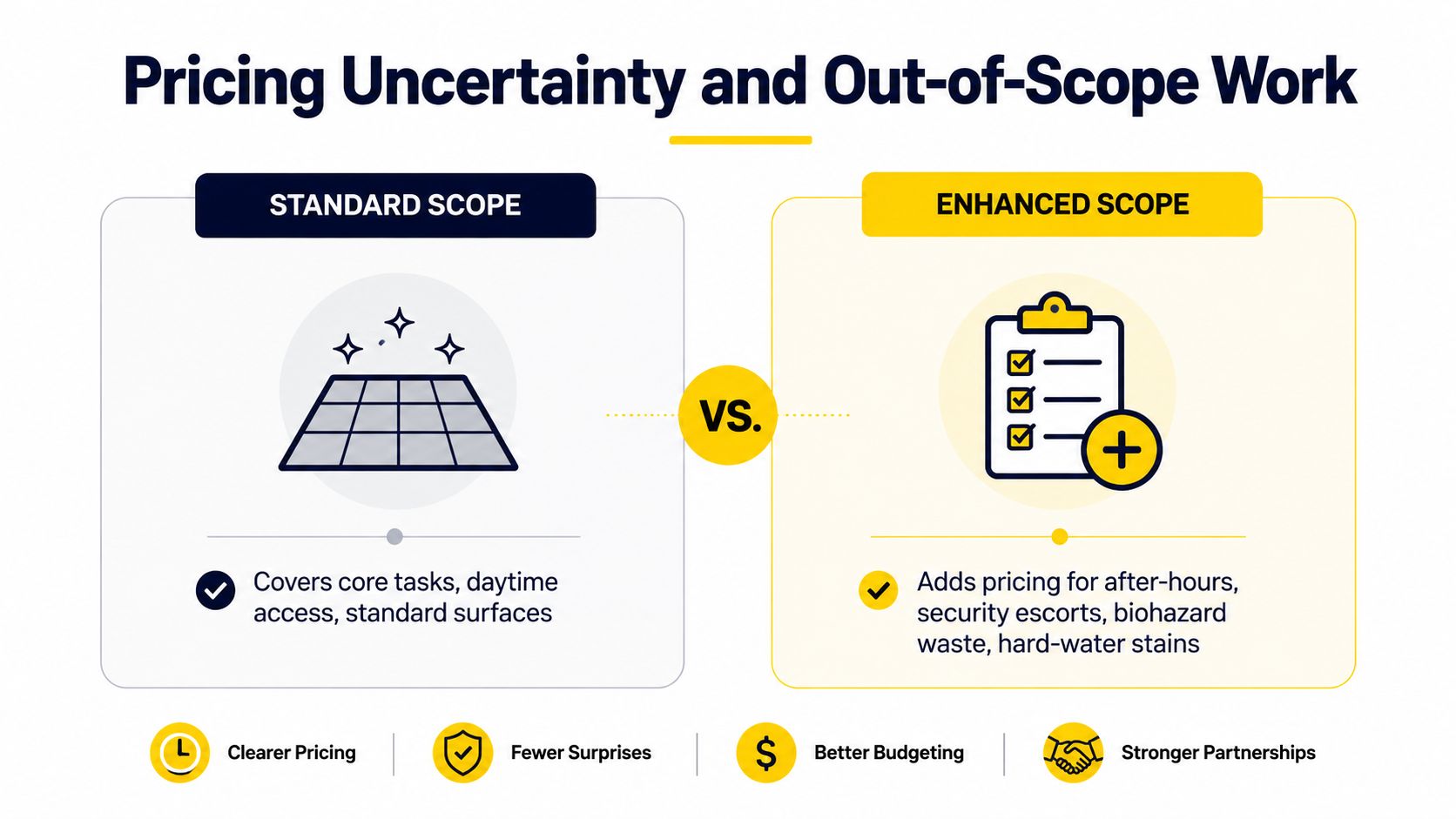
Independent guidance explicitly calls out access rules and security procedures as bid inputs, and it warns against pretending every site works like a normal daytime office. That's the right instinct. If you need escorts, key management, restricted entry windows, or specialty handling, those are real production constraints, not minor notes in the margin. A bid template that doesn't price those conditions is too thin to survive a tough procurement review.
The cleanest fix is an Additional Services or Out-of-Scope Work clause. If extra work falls outside the agreed scope, it gets a separate quote. That keeps you from carrying extra labor forever because one manager casually added a floor or a set of hard-water stains after approval.
A strong proposal can use Good-Better-Best tiers or a transparent monthly rate with clear scope-change pricing. That gives the client choices without forcing you into one oversized lump sum. It also makes it easier to explain why a standard scope covers core tasks, while an enhanced scope includes things like after-hours access, security escorts, biohazard waste, or specialty stain work.
Practical rule: if a condition changes labor time, it deserves a line item or a clause, not a shrug.
This approach works because it reduces future disputes. The client knows what's included, what isn't, and how added work gets handled. If a prospect pushes back on price, you can adjust the scope or the tier instead of gutting the whole contract and hoping the margin somehow survives.
The old static PDF still shows up everywhere, cover page, scope, pricing, signature block, and a hope that somebody opens it before the next vendor's follow-up lands. That approach is losing ground because buyers compare faster now, and the first clear, credible estimate often gets the advantage when several vendors are in the mix. A slow quote doesn't just feel outdated, it creates room for a faster competitor to frame the conversation first.
Recent guides now recommend e-signature delivery, and one notes that it can reduce approval time by up to 60%. That same 2026 delivery guidance also points to SMS follow-up scripts and real-time notifications as part of the modern sales flow. That matters because the bid is no longer just a document, it's a booking path.
The lowest-friction setup asks for the minimum needed to price accurately, then sends the estimate by SMS and email the moment the prospect engages. Estimatty is one option in that category, since it captures details like square footage, surfaces, and urgency, then sends instant estimates through SMS and email without making the client wait for a manual callback.
The more steps you add, the more chances a prospect has to stall. A shorter booking flow is better when it captures the right fields upfront and gets the estimate in front of the client quickly. If the buyer can review, approve, and ask one clarifying question without starting over, you've already removed a major source of drop-off.
Document workflow software guidance fits into this part of the process because it helps standardize delivery, routing, and follow-through. The point isn't just to send a file. The point is to turn a bid into a response loop that moves while the client is still paying attention.
Most lost bids don't fail because of one dramatic mistake. They fail because three small ones stack together, vague scope, hidden assumptions, and slow follow-up. Procurement managers notice those gaps quickly, and once they do, the proposal starts to look risky instead of professional.
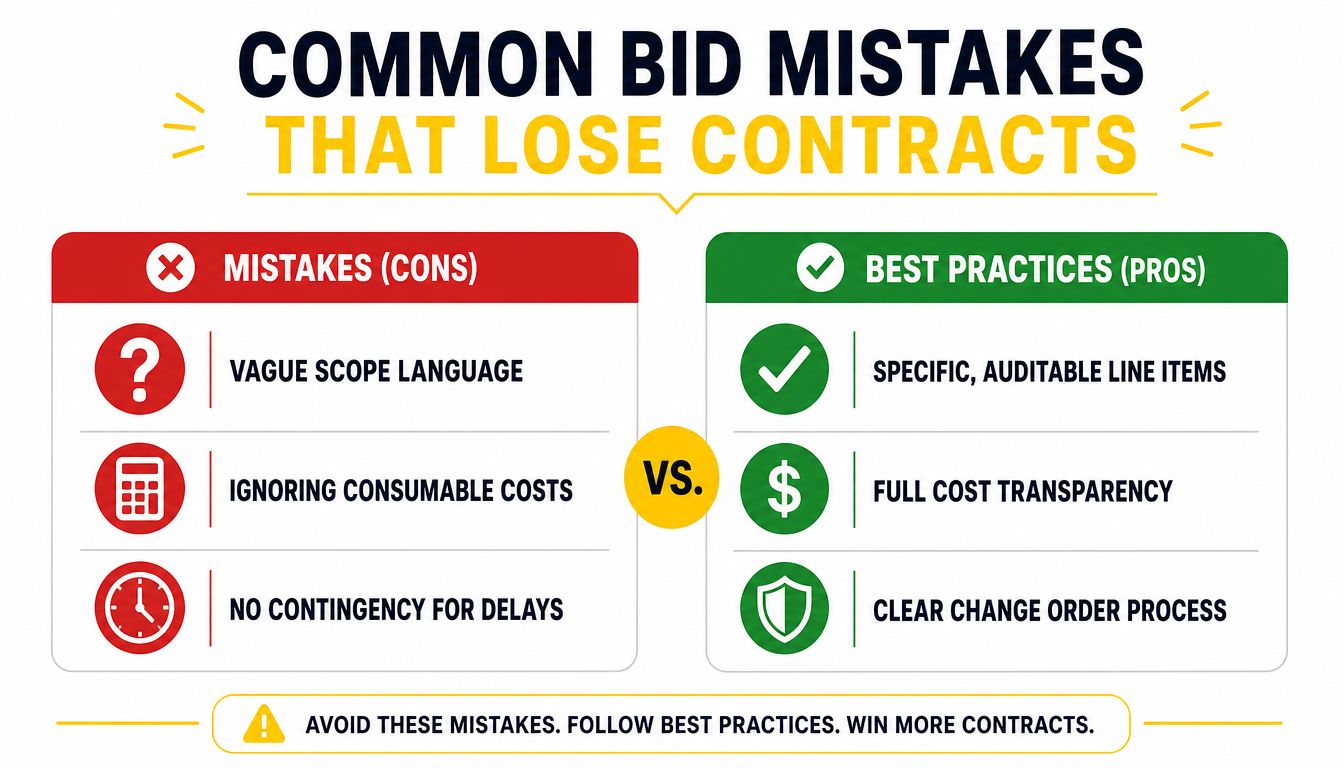
I've seen strong cleaning operators lose work because the scope and price didn't match. The buyer saw a low number, then noticed the proposal had vague assumptions about supplies or labor coverage. That's when the bid stops looking competitive and starts looking incomplete.
A cluttered proposal creates the same problem. Multiple industry templates recommend staying concise, often in the 4 to 6 page range, with some practitioners accepting 5 to 10 pages, because buyers want to compare bids quickly and reject clutter before they reach the pricing table. That guidance appears in several commercial proposal templates, and it lines up with how procurement teams read. If they can't find the numbers quickly, they move on.
Formal tenders deserve more discipline. One template advises setting evaluation weighting before responses arrive, issuing the bid to 4 to 6 operators, and allowing at least 3 weeks for replies so the process favors real comparison instead of incumbent advantage. That's useful context when you're bidding into a structured procurement environment rather than a casual one.
This bid-for-cleaning-contracts guide reinforces the same point with a cleaner contract structure. When the evaluation process is serious, the proposal has to look serious too.
Don't try to win by being the cheapest line on the page. Win by being the easiest bid to trust.
Sending the estimate launches the sales conversation, and what you do next decides whether it keeps moving. Buyers may be comparing vendors, waiting for internal approval, or sorting out one scope detail before they sign off. If you go quiet, that momentum usually shifts to the cleaner who answers first and makes the next step easy.
A simple follow-up rhythm works. Call or text after the bid lands, then check back a few days later if there's no response. The practical side of that work lines up with proven closing techniques for sales, because the goal is to keep the thread alive without sounding pushy.
Start with a text or email like this, then adjust it to fit your voice and the account:
Those lines work because they make it easy to reply without pressure. They also give the buyer a clean way to raise a scope issue, which matters more than dropping price too early. If the objection is about cost, go back to the labor assumptions, access hours, or supply coverage before you reach for a discount. In commercial cleaning, the cheapest number rarely wins if the buyer can see the logic behind a stronger one.
Before you hit send, verify proof of insurance, contract terms, exclusions, and digital signature setup. A proposal can still stall in review if any of those pieces are missing, even when the pricing is solid. That is why the delivery side matters as much as the math. A bid that opens cleanly on a phone, routes to approval fast, and gives the buyer one obvious next step gets handled sooner than a PDF that sits in someone's inbox.
For teams hiring and scaling the workforce behind the bids, pipehirehrm.com is worth a look alongside the Estimatty blog.
A sharp commercial cleaning estimate wins when it is accurate, easy to audit, and quick to approve. If you want a system that turns walkthrough data into a cleaner estimate flow, Estimatty gives cleaning businesses a way to capture site details, send instant estimates, and keep approvals moving without the manual bottlenecks that slow closings.