September 8, 2026
How Much Should a House Cleaning Cost in 2026
How Much Should a House Cleaning Cost. Learn how much a house cleaning should cost in 2026, with real pricing ranges by home size, service type, and tips

Saturday, August 1, 2026
Learn how to bid for cleaning contracts with a proven playbook. Covers scope, pricing, proposals, negotiation, and automation to win more cleaning jobs.

You're probably staring at a messy RFP right now, trying to decide whether the job is worth the trouble. The buyer wants a price, the scope is vague, and somebody on your team is tempted to guess low just to stay in the game. That's how good cleaning companies end up winning work that eats profit.
Treat a bid for cleaning contracts as a pricing discipline, not a sales document. The point isn't to sound impressive, it's to prove you can deliver the work, stay compliant, and still make money after labor, supervision, travel, supplies, and rework. The global contract cleaning services market was estimated at USD 383.99 billion in 2024 and is projected to reach USD 406.56 billion in 2025, with 6.4% CAGR from 2025 to 2030, which is why small mistakes in pricing can turn into real dollars lost or gained when the work scales (Grand View Research).
If you want more leads to feed the pipeline while you build stronger bids, a practical lead-gen framework like the Silva Marketing lead generation guide is worth a look. And if your current estimating process is still too manual, tie it to a job-costing workflow like https://www.estimatty.com/blog/job-costing-program so every number in the bid has a cost behind it, not a guess.
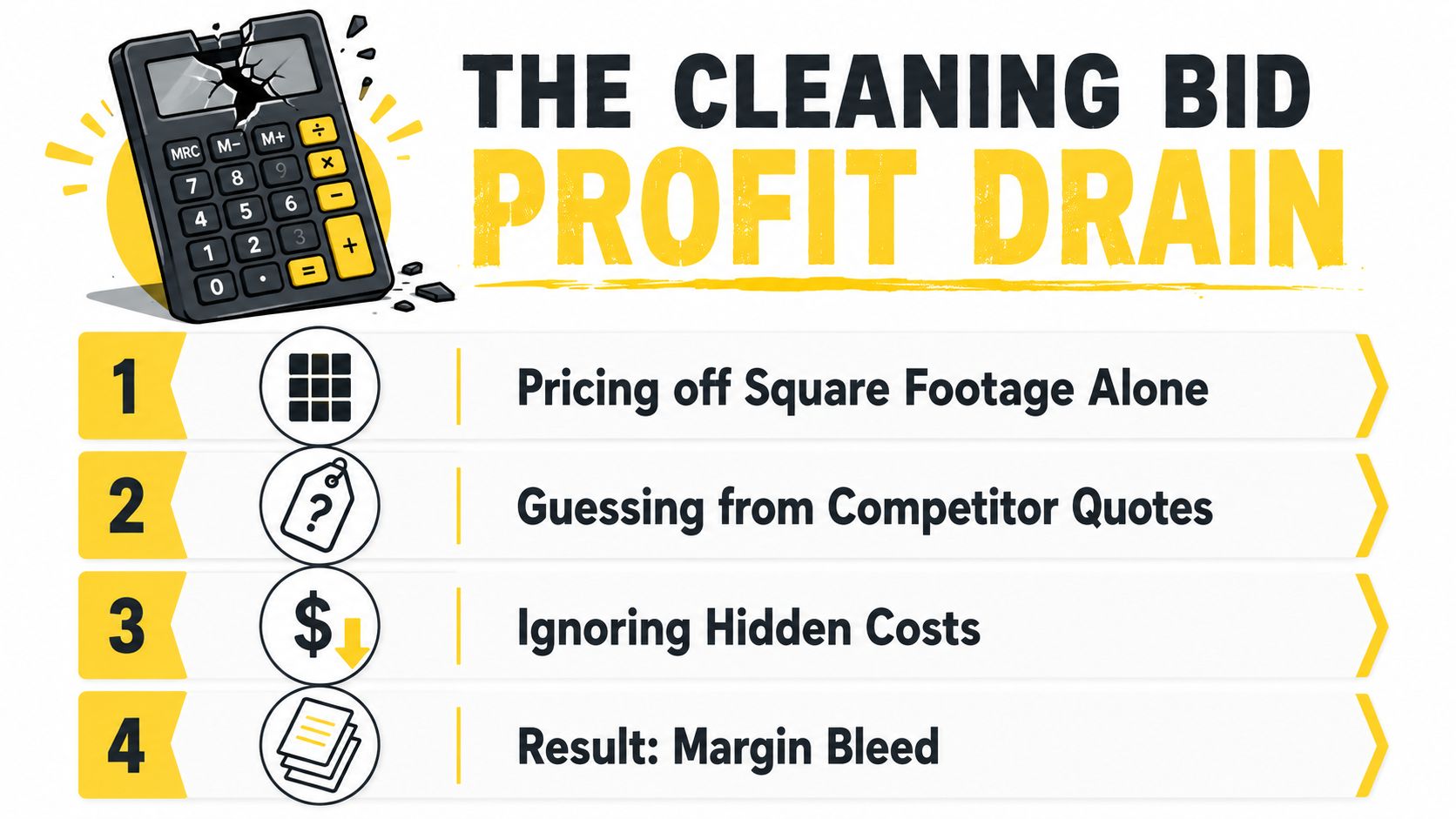
The biggest trap is simple, pricing off square footage alone. That shortcut feels fast, but it skips the part that makes or breaks the job, labor hours. Restrooms, kitchens, corridors, high-touch surfaces, and specialty flooring can blow up your time even when the building looks modest on paper.
A real walkthrough is not a polite stroll with the prospect. It's a fact-finding job. You photograph every restroom, check floor types, note whether surfaces are sealed or unsealed, and ask who uses each area, when they use it, and how often the space gets hit.
For commercial sites, ask blunt questions. How many occupants use each restroom daily? Are there kitchens, break rooms, or medical-style touchpoints? What does after-hours access look like, and who opens the doors? For residential bids, the same discipline applies, just on a smaller scale. You still need to know how many bathrooms, what surfaces need special products, and where the fragile finishes are.
Practical rule: If you don't know where the time is going, you don't know what the job costs.
Most scope fights start because the bidder kept assumptions in their head. Don't do that. Put every assumption in writing, especially when the brief is thin or the buyer's narrative doesn't match the pricing sheet. If the buyer forgot to mention certain rooms or response expectations, flag it before you submit.
That's also where a simple scope sheet helps. Keep it one page and make it repeatable: site name, square footage, occupancy pattern, restroom count, kitchen count, floor types, after-hours access, storage access, special surfaces, exclusions, and open questions. If a buyer gives you an incomplete brief, that sheet becomes your protection.
A useful example of a broader pricing and business-development angle is the commercial lead and follow-up workflow in Estimatty's commercial quoting article, because fast follow-up only matters if the underlying scope is accurate.
If you build this into every walkthrough, you stop winging bids and start building a repeatable pricing habit.
A profitable cleaning bid starts with fully loaded labor hours. That means you estimate the work task by task, then price the labor at a rate that includes wages, payroll burden, supervision, travel, supplies, equipment depreciation, overhead, and profit. The square footage matters only after you know what the labor burden really is.
Don't lump everything into one nightly guess. Separate routine nightly work, weekly or monthly detail work, and periodic tasks like floor care or deep cleans. That keeps you from hiding expensive labor inside a flat number and calling it a quote.
Take a 12,000 square foot office cleaned five nights a week. Routine nightly cleaning might take one amount of time, periodic floor work another, and a monthly detail clean another. You don't need a magic formula. You need a clean breakdown of each task, the hours it takes, and the cost you're carrying for each hour.
Hard truth: If you can't explain where the hours go, you're not bidding. You're gambling.
Your hourly rate should not stop at payroll. Add the cost of supervision, travel, consumables, equipment wear, and the overhead that keeps the company alive when one client pays late or a shift gets covered twice. Then add profit last, not first.
That's why a shortcut can look fine on paper and still fail in the field. Square-foot pricing breaks down fast in places with heavy restroom demand, medical-style spaces, post-construction work, or sites that look small but are brutal on labor. A lean office with simple access is not the same thing as a facility full of touchpoints and special finishes.
If you want a clean overhead structure to support that loaded rate, keep your accounting discipline tight and tie it to a system like how to calculate overhead costs. The cleaner your overhead math, the less likely you are to underprice the work.
That order protects margin. Anything else is just a prettier way to guess.
The pricing model changes who carries the risk. Pick the wrong one and you either scare off the buyer or absorb every scope change for free. Pick the right one and the contract stays predictable for both sides.
A flat monthly rate works best when the scope is steady, the site is well understood, and the buyer wants budget certainty. It rewards efficient operators, but only if the scope stays disciplined. If the client starts adding tasks informally, you need a change-order habit or you'll donate labor.
Hourly pricing is safer when the scope is unstable, the site is unfamiliar, or the buyer keeps changing the rules. It protects you from hidden labor spikes, but some buyers hate the uncertainty. That's fine. You're not trying to please every prospect, you're trying to avoid bad contracts.
Per-visit pricing is cleaner for post-construction cleans, deep cleans, and seasonal work. It gives both sides a fixed event-based price, which is easier to understand than a recurring retainer when the work is episodic. It also keeps you from pretending a one-time clean behaves like a stable monthly route.
| Model | Monthly Revenue Example | Risk Carrier | Best Fit |
|---|---|---|---|
| Flat rate | Same recurring amount each month | Mostly the contractor if scope creeps | Stable recurring commercial work |
| Hourly | Depends on hours used | Mostly the buyer, if hours are managed well | Unclear or changing scopes |
| Per-visit | Charged per clean or event | Shared, based on defined visit scope | Deep cleans, move-outs, seasonal jobs |
If the same 12,000 square foot office from the prior section is stable and well defined, flat rate is usually the cleanest structure. If the buyer keeps adding work, hourly gives you room to survive. If it's a one-off, per-visit is the least messy option.
A cheap bid with a sloppy proposal still loses. Buyers don't just buy labor, they buy clarity. If your document looks like you built it between jobs, the lowest bidder with a cleaner package often gets the nod.
Use a tight structure. Start with an executive summary, then a site understanding section, then scope inclusions and exclusions, assumptions, pricing schedule, transition plan, quality controls, insurance and compliance, references, and terms. That order matters because it helps the buyer find the answer fast.
For residential work, keep it lean. One page can be enough if the scope is simple. For commercial and public-sector work, they usually want more structure and more proof. Government-style bid documents often require both technical and financial components, including a qualification form, bid submission form, price activity schedule, and bid-securing declaration, plus a wage-compliance undertaking.
The strongest line in any proposal is the one that stops scope creep. Write your assumptions plainly. Write your exclusions plainly. If the buyer wants special areas, after-hours response, or unusual supplies, list them separately so nobody can pretend they were included by accident.
Use plain language. Don't hide behind jargon. A solo owner should be able to read the proposal back and explain it to a client without translating it.
Useful rule: If the customer can't tell what's included and what isn't, the contract is already too risky.
Your pricing schedule should show what is covered, how often it happens, and what it costs. Don't turn it into a creative writing exercise. Buyers want a clean financial picture, not a novel.
For service business proposals, a clean template like proposal template for services is useful because it forces you to spell out the basics without padding the document. That discipline helps you win on professionalism, not just on price.
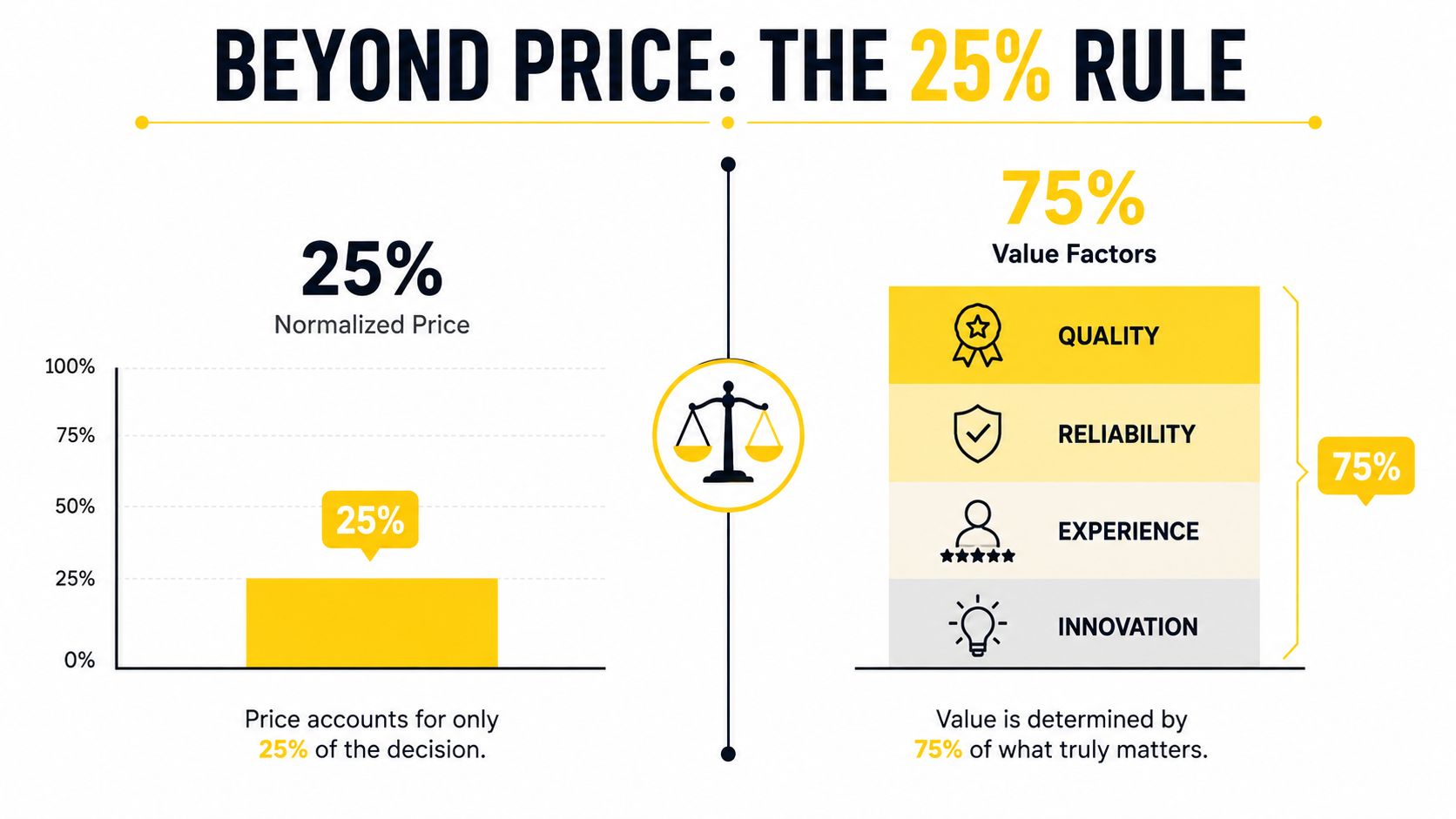
Most cleaners lose money because they try to beat the lowest number in the room. That's bad strategy. In structured bidding, price is only part of the decision, not the whole thing. One commercial bid-scoring model weights normalized price at 25%, while the other 75% is tied to scope specificity, operational capacity, quality systems, insurance, compliance, and references (Millfac).
Your bid should start with what the job costs you, not what the other guy might charge. That's the only stable anchor. If your labor model says the job needs a certain number of hours, the bid has to cover that reality or you're just buying revenue at a loss.
The useful move is to stay close enough to the market to be considered, while refusing to chase the floor. Independent bid guidance suggests pricing within 5% to 10% of the buyer's historical median bid while competing on quality and social-value answers (Millfac). That doesn't mean every contract behaves the same way, but it does tell you something important. The buyer is often comparing you against a familiar price band, not just the cheapest line on the page.
Every buyer wants three things, even if they don't state them clearly. They want to know if you'll show up. They want to know if someone competent is supervising. They want to know what happens when something goes wrong. Put those answers in your value summary before the price table.
A one-page value summary should cover operational capacity, supervisor coverage, quality checks, insurance, compliance, and references. Keep it concrete. The buyer does not need a mission statement. The buyer needs confidence that the site will stay clean without constant chasing.
The ugliest bids are the ones built on incomplete information. The RFP leaves out restrooms. The pricing sheet says one frequency, the narrative says another. No one defines occupancy patterns. Response times are never stated. That's where many bidders panic and either refuse to bid or guess.
Do neither. Write every gap down, make your assumptions page visible, mark unclear items as optional or excluded, and send one round of clarification questions before the deadline. That's cleaner than pretending the brief is complete. Recent guidance also puts a sharp focus on scope consistency, commercial clarity, and visible assumptions and exclusions, because those gaps are where bids fall apart (Facility Management Insights).
If the scope is messy and the buyer wants clarity, your job is to be the most organized bidder in the pile, not the cheapest guesser.
Winning the bid doesn't matter if the final contract gets negotiated down into a bad deal. The last mile is where owners give away margin because they're afraid to lose the work. That's the wrong fear. Losing unprofitable work is cheaper than keeping it.
If the buyer pushes your number, don't start chopping percentages off the top. Offer scope reductions, service frequency changes, or a narrower service window instead. That keeps the economics honest. If the buyer still wants the full scope at a lower price, the job probably doesn't fit your business.
A second line of defense is indexation. If labor and compliance costs rise, your contract should not trap you in a stale rate forever. Build language that lets the price move when the underlying cost structure moves. That's basic survival, not sophistication.
Government-style cleaning bid documents are unforgiving. Late submissions get rejected, not reconsidered. Missing forms, missing declarations, or missing wage-compliance undertakings can kill a bid instantly. If the RFP asks for a specific attachment, attach it.
The same logic applies to site visits and mandatory forms. If attendance is required, show up. If a document is listed in the package, answer it. Don't assume the buyer will chase you for missing information.
A government-style cleaning bid document commonly requires both technical and financial components, and the procurement package from Mauritius shows how formal that can get, with a qualification form, bid submission form, price activity schedule, and bid-securing declaration (Mauritius Procurement Office%200825%20e-SBD.doc)). That's not busywork. That's proof the buyer wants discipline.
For a broader contract reminder, keep your service agreement discipline tight with cleaning services contracts. If your paperwork is weak, the contract will be weak too.
Fast response wins work because the buyer is still engaged when the answer lands. A slow estimate often dies in the inbox. A small cleaning company can beat a larger competitor on speed if it captures the right details instantly and turns them into a usable estimate without bouncing the prospect around.
A web or voice estimator should ask for square footage, surfaces, urgency, and the other basics that shape price. The point is not to replace judgment, it's to remove the delay between interest and estimate. When the inputs are structured, the result is more consistent than a back-and-forth phone game.
That matters even more after hours. A 24/7 system that handles evening and holiday inquiries can keep prospects from drifting to the next vendor. If a human needs to step in, the handoff should be instant and clean, not a voicemail maze.
The right tool doesn't just spit out numbers. It sends the estimate by SMS and email, notifies the team in real time, and gives you a warm lead to follow up on while the prospect is still paying attention. That saves time on smaller work and frees your team to spend more energy on bigger commercial opportunities.
One option in this space is Estimatty, which is an AI-powered web and voice estimator for cleaning businesses that captures inputs, sends instant estimates by SMS and email, and alerts the team when a lead comes in. If your operation is scaling, staffing support through pipehirehrm.com can also help with hiring cleaning employees without turning recruiting into a full-time distraction.
Instant estimates are only useful if the cost model underneath them is solid. A fast number that ignores labor, supervision, or compliance is just a faster way to lose money. Tie automation to the same cost discipline you use for bids, and the speed becomes an advantage instead of a liability.
For a deeper look at software support for this workflow, see AI estimates software for cleaning. The goal is simple, less time on manual quoting and more time on profitable contract work.
If you're serious about winning cleaner, more profitable contracts, use a system that helps you estimate faster without guessing. Visit Estimatty to see how instant estimates, 24/7 lead capture, and consistent pricing can tighten your bid process and keep you focused on the jobs worth winning.