
October 23, 2026
How to Start Commercial Cleaning in 2026
Learn how to start commercial cleaning in 2026 with proven steps for pricing, staffing, licensing, and automation that win recurring contracts.

Sunday, September 6, 2026
Build a home cleaning price list that wins more jobs. See pricing models, sample templates, and how to automate instant estimates for your cleaning business.
You've got three new inquiries waiting, a full schedule, and no consistent answer when someone asks, “What will it cost?” You check the last invoice, remember the home was fairly large, and send a number that feels safe. Sometimes it wins the job. Sometimes it leaves you scrubbing for an hour longer than planned with nothing left for supplies, travel, or profit.
A strong home cleaning price list fixes that problem. It turns your service scope into a repeatable sales tool, gives customers a clear path to the right service, and creates the foundation for fast estimates through your website or phone line. The market already supports several pricing methods, including flat visit pricing, hourly rates, and square-foot estimates, so your job isn't to find one magical number. Your job is to build a system that explains why the number changes.
A homeowner calls about a neglected kitchen, three bathrooms, and floors that need extra attention. Another wants only the floors and bathrooms. If you price both jobs from memory, the result depends on your last appointment, your available time, and how badly you want to fill the opening. That is how a solo cleaner loses margin before the first room is vacuumed.
Guessing creates three operational problems:
Build the price list as a sales tool. It should show the service scope, separate routine work from deeper work, and make add-ons visible. Home size, cleaning intensity, frequency, access, and extras should explain every adjustment instead of remaining hidden decisions made during a rushed call.
Practical rule: If you cannot explain why two homes receive different prices, your price list is unfinished.
Start with three service levels, a minimum charge, and an add-on menu. Before quoting, collect the details that affect labor: square footage, bedrooms, bathrooms, home condition, pets, desired frequency, and access. Put those fields into your estimate form so the customer and your team work from the same information.
Published market ranges reinforce the need for tiers. Standard residential visits in the U.S. commonly fall around $120–$280, while Canadian visits average about $230 and most range from $160 to $320, according to 2026 house cleaning pricing ranges. Treat those figures as reference points, not a universal tariff. Your list still needs clear service definitions and adjustments for actual scope.
Use the same comparison logic found in other service menus. Viral.new pricing plans separate options so buyers can compare without opening a sales conversation. Your cleaning menu should identify the standard service first, place deep work in its own tier, and show which extras change the estimate. An instant estimate widget such as Estimatty can apply those rules consistently and send a qualified request to your booking process.
Owners discount when they fear losing the lead. Keep the conversation tied to scope instead. Explain the standard scope, point to the frequency discount, and offer the weekly tier instead of discounting the deep clean.
That response protects your labor and gives every inquiry the same standard. Your price list is not a restriction. It is the operating rule that keeps estimates clear, tiers easy to compare, and more inquiries moving toward booked jobs.
A price list should give customers one clear starting point, then provide controlled alternatives. Use flat pricing for predictable visits, hourly pricing for uncertain scope, and square-foot pricing when size drives the workload. That combination turns a menu into a sales tool instead of a list of disconnected numbers.
Flat visit pricing offers the easiest buying decision. List a standard two-bedroom clean at one amount, define the included tasks, and price extras separately. Customers see an expected total, while your crew works toward a production target. The risk is margin loss when a home takes longer than its category suggests, so define the service boundary carefully.
Hourly pricing fits partial-home assignments and jobs with unclear scope. Professional cleaning commonly falls around $25–$50 per cleaner per hour, with some higher-cost U.S. listings reaching $45–$75 per cleaner per hour, according to Housecall Pro's home cleaning pricing guide. Set a minimum booking and explain what the crew can reasonably complete within that time. Customers accept hourly work more readily when the time limit and task priorities are visible.
Square-foot pricing gives larger homes and specialty services a scalable starting point. Published guides place standard cleaning around $0.05–$0.16 per square foot, while another industry range places it around $0.08–$0.20, with higher rates for deep and move-out services. Review the home's condition and requested tasks before treating the rate as a final estimate.
| Model | How It Works | Typical Range | Best For | Weakness |
|---|---|---|---|---|
| Flat visit | One fixed amount for a defined service and home category | $120–$280 per standard U.S. visit | Recurring maintenance and easy-to-classify homes | Long or unusually difficult jobs can erode margin |
| Hourly | Charge per cleaner for time worked | $25–$50 commonly, with some listings at $45–$75 | Partial-home jobs and uncertain scope | The customer does not know the final total |
| Square foot | Apply a rate to finished floor area | $0.05–$0.16 for standard work | Large homes, deep cleans, and move-outs | Condition and task density still require review |
Put the flat visit rate first as the customer-facing anchor. Keep hourly pricing for limited assignments, and reserve square-foot pricing for tiers where home size strongly affects labor. You can study how software companies separate their pricing plans, then apply that same clarity to your own menu.
Use an instant estimate widget such as Estimatty to apply tier rules, add-ons, and size inputs consistently before a request reaches your booking process. For a broader framework on choosing and testing a model, review these business pricing strategies. Your goal is a simple buying decision backed by disciplined internal math.
Square footage sets a starting point, not a final price. A lightly used condo and a crowded family home can occupy the same footprint while demanding very different labor. Build your price list around the variables that change production time.

A common pricing mistake, according to industry guides, is treating condition as a minor detail. A first-time reset may require deep-clean labor even when the customer selects “standard.” Ask when the home was last professionally cleaned, whether appliances need interior work, and whether clutter blocks surfaces. Put those answers into your intake form and estimate widget, then attach the right tier or add-on before booking.
Frequency should appear clearly on the price list because it gives customers a reason to continue service. Industry pricing overviews commonly describe recurring discounts compared with one-time bookings, so show the discount structure instead of making customers request a private concession. Pair the frequency option with an instant estimate from Estimatty, allowing customers to see how the service tier and add-ons affect the quote.
Set your internal rate from labor first. Use how to calculate labor cost per hour to separate crew cost from the customer-facing price. Add operating costs, travel, supplies, and your target margin before publishing the base rate. Your list should sell a clear choice while your internal worksheet protects the margin.
A weekly maintenance visit, an abandoned kitchen, an empty rental, and a property covered in construction dust cannot share one rate. The scope, risk, and labor density change. Your price list should make that difference obvious and help customers choose the right service before they request an estimate.
Use four clear tiers:
Published market ranges show why these services need separate lines. Standard cleaning for a two- or three-bedroom U.S. home commonly falls around $120–$180 per visit, deep cleaning around $250–$400, move-in or move-out work around $300–$450, and post-construction cleaning around $300–$800. Use these figures as market context, then set your own prices from production records and scope.
| Tier | What's Included | Labor Hours per 1,000 sq ft | Average Price Range | Best Fit Customer |
|---|---|---|---|---|
| Standard | Dusting, floors, kitchen and bathroom wipe-downs, trash | Estimate from your production records | $120–$180 for a 2–3 bedroom home | Weekly or recurring maintenance |
| Deep | Standard scope plus baseboards, buildup, detailed surfaces, selected appliance interiors | Estimate separately from standard production | $250–$400 | Seasonal reset or first visit |
| Move-out | Empty-home detail, cabinets, closets, appliances, and handoff surfaces | Higher labor density than standard | $300–$450 | Tenants, landlords, and sellers |
| Post-construction | Fine dust, residue, debris, windows, and floors | Highest variation and inspection risk | $300–$800 | Contractors and property owners |
Keep labor-hour fields internal unless your records support a reliable promise. Use your crew's tier and size-band completion records to set production targets, then adjust for access, condition, and included add-ons. Square-foot pricing also rises with service complexity: standard work commonly runs around $0.10–$0.17, deep cleaning around $0.13–$0.30, move-out around $0.20–$0.35, and post-construction around $0.25–$0.50 per square foot, according to MyQuoteIQ's pricing guide.
Place post-construction at the top of the menu. That placement tells prospects you price for residue, inspection risk, and labor, rather than room count alone. Add clear checkboxes for upgrades, then connect the tier and selected extras to an instant estimate widget like Estimatty. A customer who can see the price change while choosing the scope has a stronger reason to book.
For a useful starting framework, review this deep cleaning price list, then adapt each task to your crew, equipment, and local market.
Build the first version on one page. Customers should understand the service level, frequency, minimum, and available extras without opening a second document or calling for basic information.
Start with a base table organized by home size. Use your own production history to fill the amounts, then show the frequency options beside each category:
| Home Category | One-Time Standard | Monthly | Bi-Weekly | Weekly |
|---|---|---|---|---|
| Studio or 1 bedroom | Set your base | Apply your recurring rate | Apply your recurring rate | Apply your recurring rate |
| 2 bedrooms | Set your base | Apply your recurring rate | Apply your recurring rate | Apply your recurring rate |
| 3 bedrooms | Set your base | Apply your recurring rate | Apply your recurring rate | Apply your recurring rate |
| 4 bedrooms or more | Set your base | Apply your recurring rate | Apply your recurring rate | Apply your recurring rate |
Don't copy a competitor's numbers blindly. Your price must cover labor, supplies, insurance, travel, payment processing, administration, and the time spent selling and scheduling the job. Use a $120–$150 minimum for short visits if that matches your market and cost structure, as suggested in the supplied template guidance.
Place extras below the main table as a checklist. The following menu gives you a practical starting framework, but you should validate each item against your actual labor:
These add-ons should describe a specific task, not a vague promise. “Appliance interior” is harder to understand than “inside oven,” and “pet treatment” is less useful than “pet hair surcharge.”
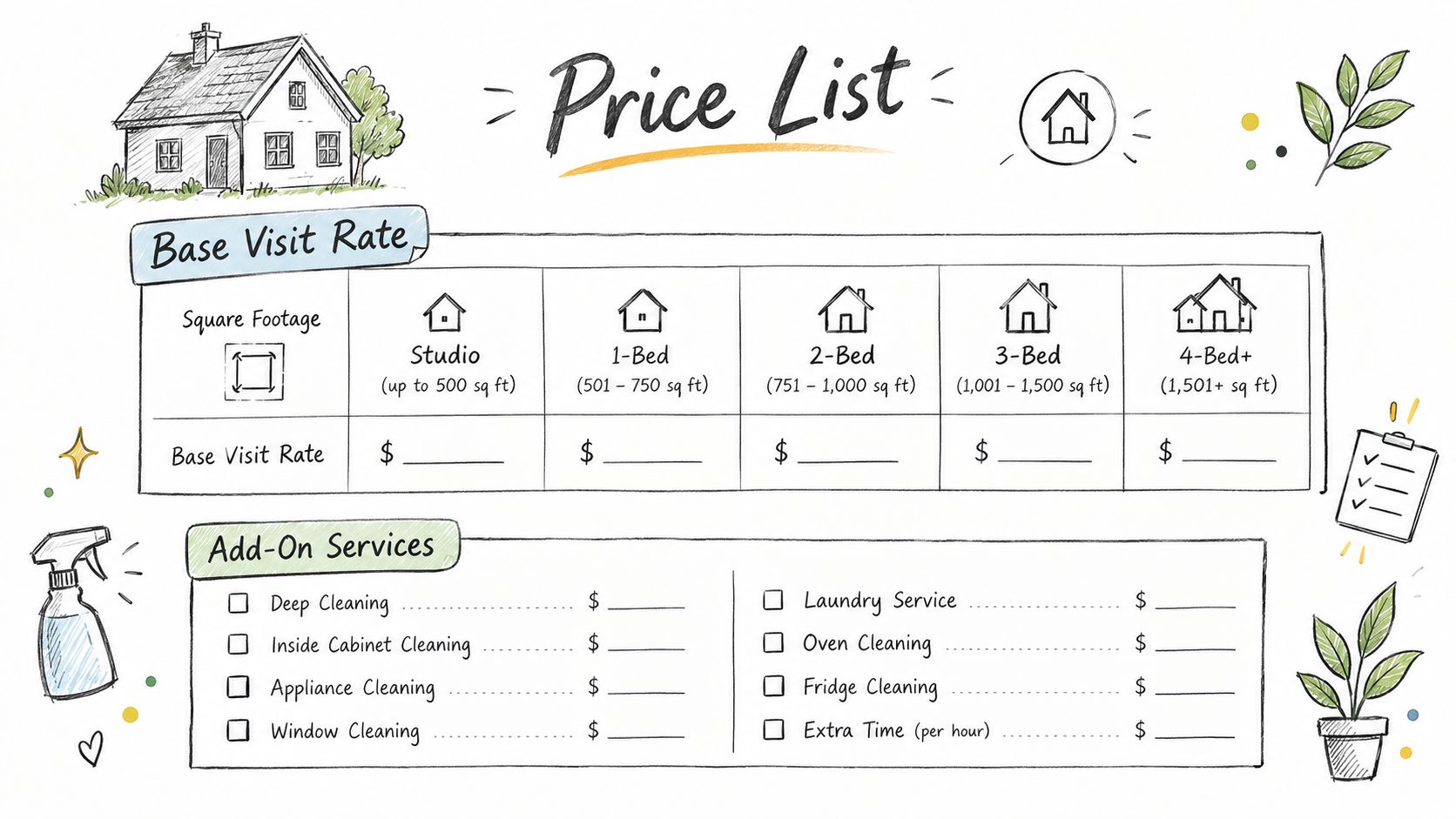
Add a travel rule in plain language. For example, state that addresses beyond your standard service radius receive a travel fee after reviewing drive time, parking, or access requirements. Don't hide that adjustment until checkout.
Use estimate form templates to organize the questions your intake form should ask. Keep the finished page visually simple: bold the four main tiers, use checkboxes for add-ons, show the minimum near the top, and include a short note that final estimates depend on condition and confirmed scope.
A price list buried in an email cannot sell a cleaning service. Publish the core version on your services page, then repeat the same tiers and scope on your Google Business Profile. Prospects should see whether the service fits their budget before calling.
Use the page to set expectations. A customer booking routine maintenance should not mistake it for a move-out reset. Clear tiers also give staff one approved explanation for each inquiry and filter out leads who do not match your minimum or scope.
An instant-estimate widget can collect square footage, bedrooms, bathrooms, condition, frequency, and add-ons, then return a range from rules you control. Estimatty offers a cleaning-focused option with web and voice estimators that capture job details, send estimates by SMS and email, and alert your team when a prospect needs follow-up. Review AI estimates software for cleaning before choosing the workflow.
Configure it in this order:
Position the estimate button above the fold on your services page so prospects can request a quote without navigating away from your pricing tiers. Route every submission to a monitored inbox or CRM. Set a follow-up rule that contacts each serious lead within 10 minutes, as required by the operating plan.
Pair the widget with the price list, not a separate generic form. Customers can choose a tier, add a specific task, and receive an estimate that reflects the scope they just reviewed. If you are comparing field-service software more broadly, check JobsiteStack's lawn care software review for examples of how service businesses assess scheduling and operational tools.
A working price list should produce booked jobs, not sit unchanged on a services page. Publish a usable version, test it against real homes, and adjust the rules from completed-job data.
Day 1: Set your base hourly cost and choose three customer-facing tiers. Keep post-construction separate from deep cleaning because the scope, labor, and risk differ.
Day 2: Complete the add-on matrix and square-foot multipliers. Mark which jobs require photos or manual review before an estimate becomes final.
Day 3: Build the public price list page. Show each tier's scope, frequency options, minimum charge, and clear path to an estimate.
Day 4: Update your Google Business Profile with the same service categories and pricing explanation. Consistent wording builds more trust than decorative design.
Day 5: Load the rules into an instant-estimate tool such as Estimatty. Test the form with five real homes: a standard recurring home, a neglected home, a move-out, a large property, and a home with add-ons.
Day 6: Train anyone answering calls. Use one script: identify the tier, confirm the major variables, explain the estimate range, and record exceptions instead of improvising discounts.
Day 7: Launch the page, promote it, and review conversions weekly. Track customer questions, selected add-ons, and jobs requiring manual correction.
Pair the price list with the estimate tool so customers can review a tier, add specific tasks, and request a scope-based quote. A price list becomes a sales tool when every lead follows the same path. If bookings outgrow your solo capacity, hiring and vetting additional cleaners can help you keep booked work billable instead of sending customers to a competitor.
Estimatty provides cleaning businesses with a web and voice estimator that uses service tiers, home details, and add-ons to deliver consistent estimates in under a minute. Visit Estimatty to turn your home cleaning price list into a 24/7 estimate and booking workflow.