
September 29, 2026
Commercial and Residential Cleaning in 2026
Compare commercial and residential cleaning markets in 2026. Explore pricing, staffing, compliance, and how AI estimators streamline operations.

Tuesday, August 18, 2026
Master business pricing strategies for residential and commercial cleaning. Learn proven models, avoid common mistakes, and automate estimates to win more jobs.
Raising prices across the board isn't the only way to improve margins. In many cleaning businesses, profit leaks begin earlier, when one employee gives a different estimate from another, a prospect waits hours for a response, or a rushed team member forgets to include a difficult surface, extra bathroom, or urgent scheduling request.
The number on an estimate affects more than revenue per job. It shapes trust, conversion, scheduling, labor planning, and the customer's expectation of service. Business pricing strategies work best when they make profitable decisions repeatable, not when they depend on whoever happens to answer the phone.
A cleaning owner can lose money without ever setting an obviously low price. The damage often comes from inconsistency. One prospect receives a careful estimate based on square footage and condition, while another gets a number based on memory. A returning customer may receive a different rate because a team member wants to close the job quickly. Neither situation creates a reliable pricing system.
McKinsey's pricing guidance, summarized by PwC's pricing reference, reports that well-designed pricing strategies and tactics can deliver a 2% to 7% increase in return on sales. The important point for a cleaning company isn't the promise of a universal result. It's that pricing can improve profit without requiring proportional volume growth or a major cost reduction.
A profitable estimate must account for the service itself and the way the buyer experiences the process. If a prospect calls after business hours and gets voicemail, the eventual price may arrive too late. If two team members describe the same deep clean differently, the customer may question the fairness of both estimates. Slow response and unclear scope can cost the booking before price becomes the deciding factor.
Practical rule: A price that arrives late behaves like a higher price, because the customer has already started comparing alternatives.
Job costing helps expose these leaks. Reviewing job costing for cleaning businesses can help you connect labor, supplies, travel, and job time to the amount you charge, rather than treating every estimate as a fresh guess. That turns pricing into a revenue-management discipline. The price influences perceived value, the chance of booking, and the margin left after the crew finishes.
The better question isn't “Should I raise prices?” Ask instead: Where does my current process create avoidable variation? Fixing estimate speed, scope accuracy, and price consistency may protect more profit than a blanket increase that makes every lead more price-sensitive.
No single model fits every cleaning service. A recurring office contract has different cost and scope risks from a one-time move-out clean, so forcing both into one formula creates predictable problems.
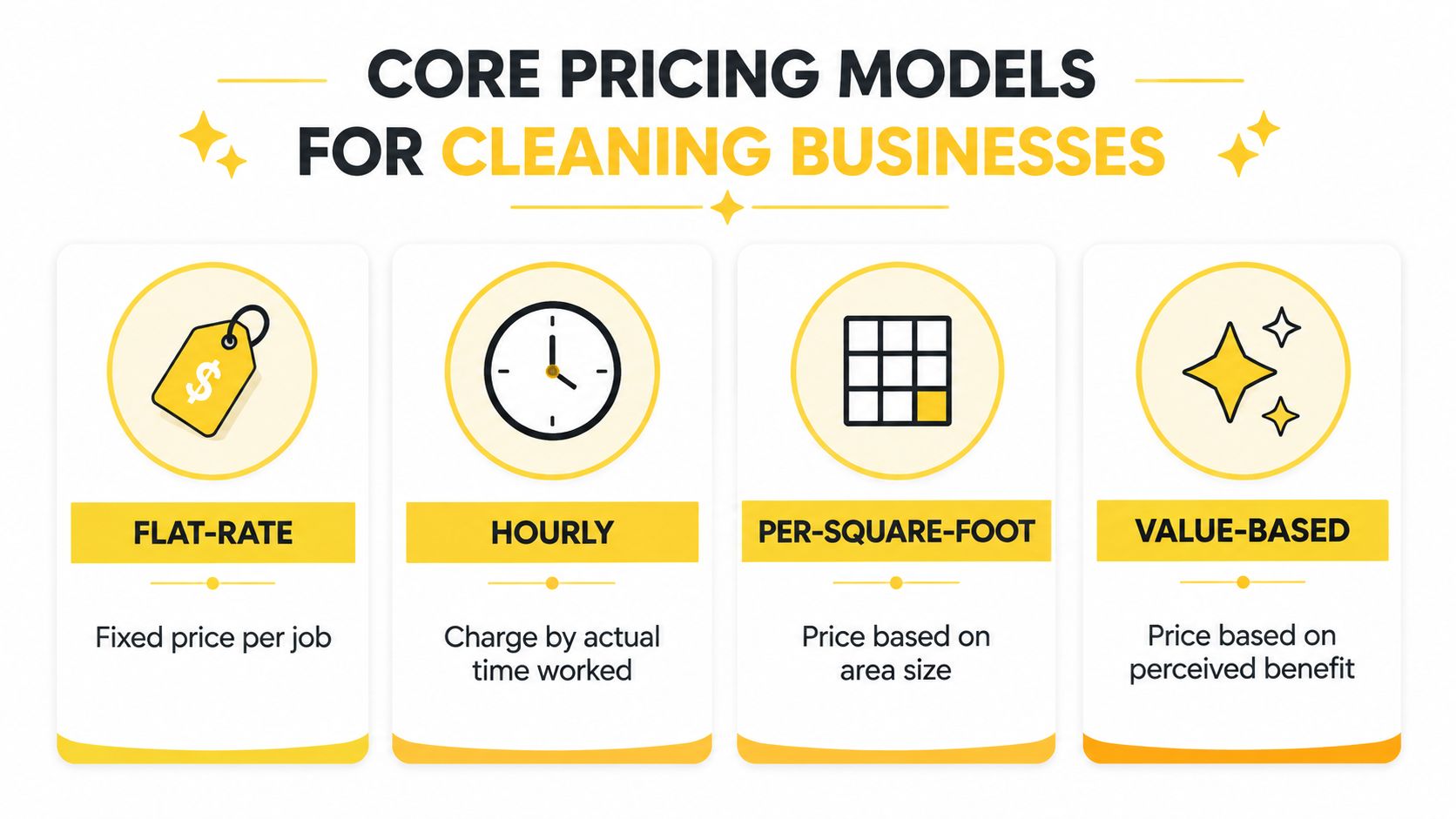
For a 2,000-square-foot home deep clean, a flat rate gives the customer a clear total before work begins. It's easy to present, easy to schedule, and attractive to buyers who don't want the final bill to depend on how quickly a crew works.
The risk is scope creep. If “deep clean” doesn't define appliances, interior windows, baseboards, blinds, and heavy buildup, the crew may perform far more work than the price supports. Flat-rate pricing protects margins only when the scope checklist is specific and the estimate rules are consistent.
Hourly pricing can suit a recurring office contract where the work pattern is still being measured. Charging for actual time worked gives the business protection when conditions vary, and it can be useful during an initial service period.
Customers may perceive it as less predictable, though. A slow crew, an unexpected delay, or unclear productivity standard can create tension. If you use hourly pricing, explain what the hourly charge includes and how the team records time.
A move-out clean often benefits from a per-square-foot starting point because the property size gives both sides a common reference. It creates a quick way to compare larger and smaller homes, especially when the service has a relatively repeatable scope.
Area alone doesn't describe condition. Pet hair, neglected kitchens, clutter, and renovation residue can change labor requirements sharply. Use square footage as a base, then apply clear condition and add-on rules. A detailed cleaning service price list can help your staff present those differences consistently.
A post-construction job may justify value-based pricing because the customer isn't buying labor. They're buying a property that can be occupied, inspected, marketed, or handed over without visible construction residue. The outcome carries more weight than the time spent wiping surfaces.
Value-based pricing requires stronger discovery. You need to understand urgency, risk, finish expectations, and the consequences of incomplete work. For broader pricing and marketing comparisons, owners can view ViralRef pricing as a reference point when evaluating how service businesses package and position offers.
| Pricing Model | Best For | Customer Perception | Margin Risk |
|---|---|---|---|
| Flat-rate | Defined residential jobs | Predictable and simple | High if scope is vague |
| Hourly | Variable or trial-period work | Flexible but less certain | High if productivity varies |
| Per-square-foot | Size-driven services | Easy to compare | High if condition is ignored |
| Value-based | Complex, urgent, outcome-focused work | Tied to results | High if value isn't explained |
The strongest operators often combine models. They may use a base formula, add condition adjustments, and reserve value-based pricing for urgent or specialized work. Familiarity matters less than matching the model to the job's uncertainty.
Start with the cost of delivering the work, not with a competitor's number. Competitor matching can make you look aligned with the market while leaving out travel, paid preparation, equipment replacement, insurance, taxes, and administrative time.
List the hours the business pays for, not only the time spent inside the customer's property. Include loading, travel, arrival preparation, supply restocking, communication, and cleanup after the job. Employee wages are only one part of the labor burden, so hiring and workforce planning resources such as pipehirehrm.com can be useful when reviewing staffing costs.
For a three-person crew serving a 1,800-square-foot recurring residential clean, begin by estimating total crew time from arrival through departure. Multiply paid hours by the fully loaded labor cost, then add travel and preparation time. Don't treat the home's size as a substitute for a time estimate. A large but maintained home may require less work than a smaller property with heavy buildup.
Create a monthly overhead list and assign a reasonable share to each service hour or job. Include vehicles, fuel, software, phones, uniforms, equipment depreciation, supplies, insurance, taxes, office work, and payment processing. If a cost supports the business but doesn't appear on the work order, it still needs a place in the pricing structure.
Then build service-specific rate cards. Standard cleans, deep cleans, move-out jobs, post-construction work, and recurring commercial contracts should have different assumptions for labor, supplies, inspection, and risk.
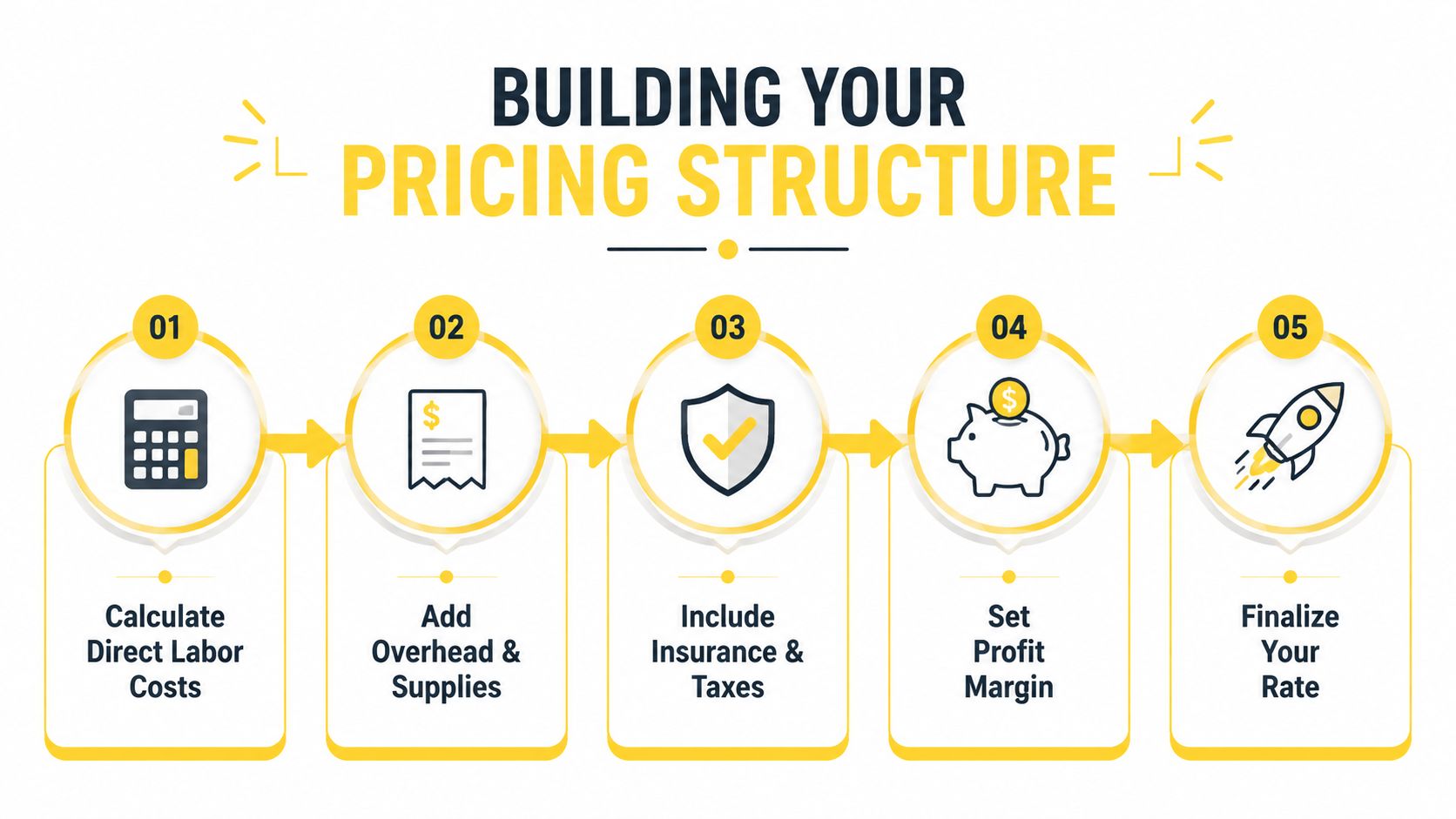
Profit shouldn't be whatever remains after a busy month. Choose a target that sits above direct costs and overhead, then check whether each service reaches it. A rate card that sells well but produces weak contribution per job can keep a team busy while limiting growth.
For example, if a recurring clean requires substantial driving, the travel allocation may make the job unprofitable even when the labor estimate looks acceptable. Put travel into the formula rather than hoping route density will solve it later.
Review completed jobs and compare estimated time with actual time, planned supplies with actual usage, and expected scope with customer requests. Adjust the formula when a pattern appears, but don't change prices after every unusual job.
Speed matters as much as accuracy. A carefully built rate card loses value if staff need to call an owner for every estimate or if prospects wait until the next day. When comparing external service costs, you might compare packaged marketing packages, but keep marketing decisions separate from the operating formula that determines whether each clean is profitable. A labor cost calculator for cleaning businesses can support the labor portion of that review.
Charm pricing can help, but it can't rescue a confusing offer. A clean, well-defined estimate ending in a non-round number may feel more accessible than the same estimate rounded upward. A vague service with an odd ending can feel like a trick.
Research summarized by Business.com's analysis of prices ending in 9 reports sales increases of at least 24% and, in some cases, up to 60% for prices ending in 9, 99, or 95. The same source reports that 60.7% of retail prices end in 9, while 7.5% end in a whole number such as 0. Those findings come from retail contexts, so cleaning owners should treat them as directional rather than automatic proof for service estimates.
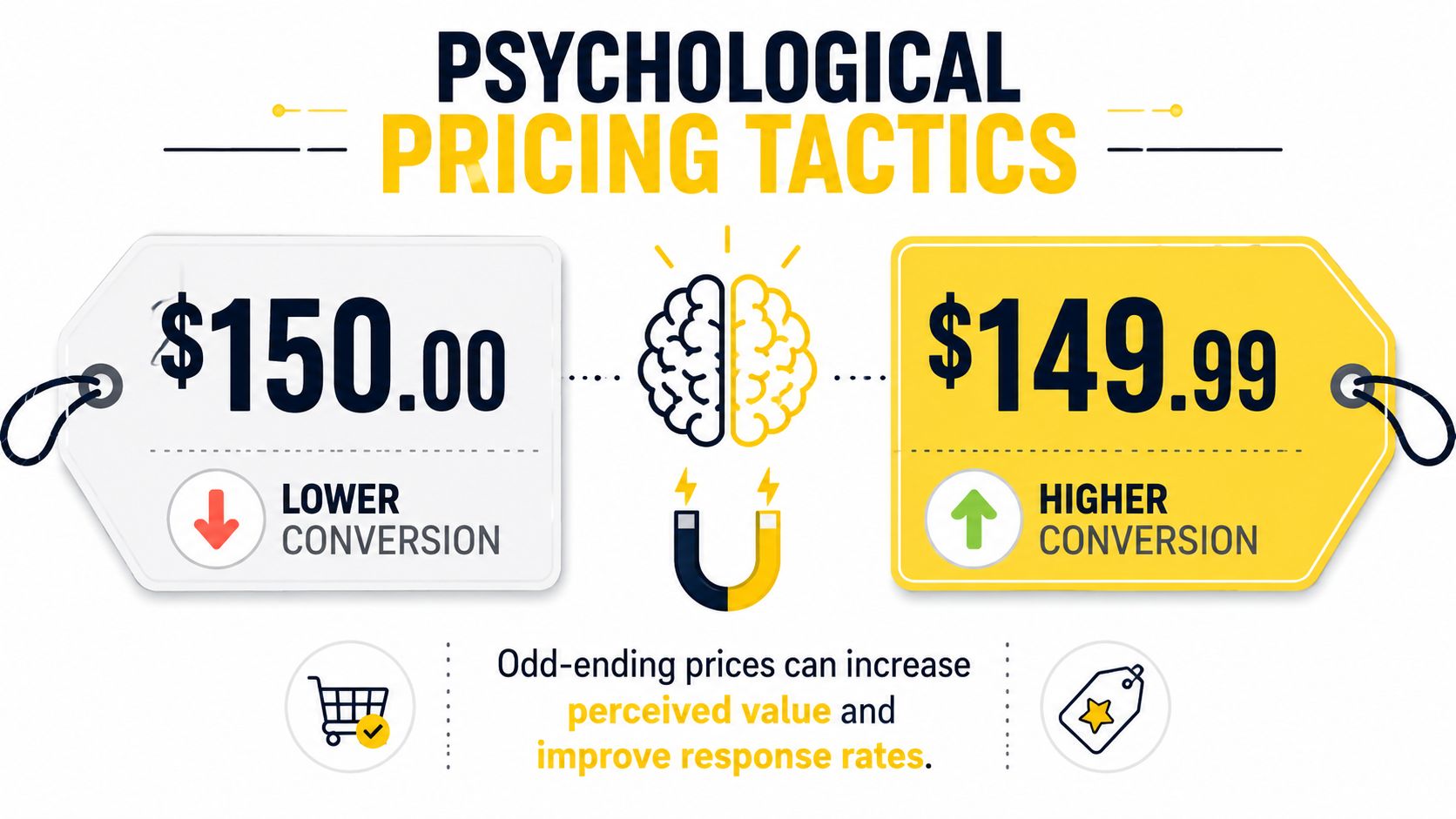
An add-on such as interior refrigerator cleaning, inside-cabinet cleaning, or an odor treatment may suit charm pricing when the scope is clearly stated. The customer can understand what the add-on does and evaluate it without feeling that the base estimate hides the cost.
The field study indexed by RePEc on 9-ending prices found that 9 endings increased demand in all three experiments. It also found a stronger effect for new items than for products already sold by the retailer, and some evidence that the effect weakened when explicit “Sale” cues were used.
Service buyers process trust differently from shoppers scanning a shelf. A commercial client reviewing a recurring contract may prefer a clean, rounded figure that makes budgeting easier. A household comparing estimates may also react poorly if the strange ending looks designed to distract from unclear scope.
Customer numeracy matters too. A University of Missouri summary of 99-ending price research explains that highly numerate consumers may round 99-ending prices upward, while preferences can differ according to the left-hand digits and number fluency.
Use odd endings selectively, not mechanically. Keep the service name, inclusions, exclusions, and total easy to read. If a round price communicates confidence and simplicity better, use it. The objective is not to make the customer notice the ending. It's to make the complete offer feel credible.
For broader conversion testing ideas, review conversion rate optimization tools for service websites, then test one change at a time against your own estimate-to-book behavior.
A pricing formula only creates value when your team applies it quickly and accurately. If one employee calculates a price manually, another relies on an old spreadsheet, and a third discounts to close the conversation, your published pricing strategy isn't the price customers receive.
The hidden cost appears in several places:
An AI-powered estimator can apply configured rules to information such as square footage, surface types, service condition, and urgency. Estimatty is one example built for residential and commercial cleaning businesses. It engages website and phone prospects, captures job details, sends estimates by SMS and email in under a minute, and notifies the team when a prospect is ready for follow-up.
The value isn't that automation makes every estimate perfect. The value is that it gives every prospect the same starting logic, including when the owner is driving, the office is closed, or the team is handling a large job. You can set pricing parameters and minimum or maximum limits, then review the estimates that lead to bookings, cancellations, or follow-up questions.
Operational standard: Automate the first accurate response, then give a person control over exceptions and final booking decisions.
Setup doesn't need to become another software project. A no-code workflow can involve customizing the pricing rules, placing a widget on the website, adding FAQs, choosing a voice experience, and connecting the estimator to Zapier or a CRM. The system should support the process rather than force your staff to rebuild it.
The practical details of AI estimate software for cleaning businesses matter most here. Look for control over scope, pricing boundaries, customer messages, and the handoff to a human receptionist. Automation should remove voicemail tag and inconsistent arithmetic, not remove judgment from complicated jobs.
A flat rate for every neighborhood, lead source, and customer type assumes that every buyer values the service in the same way. Cleaning demand rarely behaves that neatly. A recurring customer comparing several providers may respond differently from a property manager facing an urgent turnover, even when the physical work appears similar.
Price elasticity should be estimated by segment, location, and customer type, because buyers don't respond uniformly to price changes. Guidance from True Margin North on price elasticity recommends using historical volume, churn, and revenue data, or comparing cohorts that faced different rates, to understand response without relying entirely on a live experiment.
Start with small pricing bands. Keep the service scope constant, then compare results across neighborhoods, lead sources, customer types, or urgency levels. Don't change the price, the landing page, the service description, and the follow-up process at the same time. You won't know which factor influenced the result.
Track a compact scorecard:
A benchmark shouldn't stop at competitor matching. A structured price benchmarking framework compares market references using a common unit, maps packaging differences, and combines customer interviews with win/loss information. For cleaning companies, that might mean comparing the price of a defined recurring clean rather than comparing two vague “standard cleaning” labels.
Transparency adds another trade-off. Research in the Simon-Kucher Global Pricing Study brochure describes consumers trading down toward lower-priced tiers globally, including a 0.8% global shift that the source connects to billions in sales. The same verified guidance notes that greater transparency from dynamic pricing can reduce perceived value and willingness to pay in some situations.
That doesn't justify hiding prices. It argues for explaining differences through outcomes. Show what the customer receives, why an urgent service costs more, and which conditions change the estimate. Segment the offer carefully, document the rule, and review complaints alongside revenue.
Most margin problems come from ordinary process failures, not exotic pricing theory. Use this checklist to find the gaps that affect your estimates today.
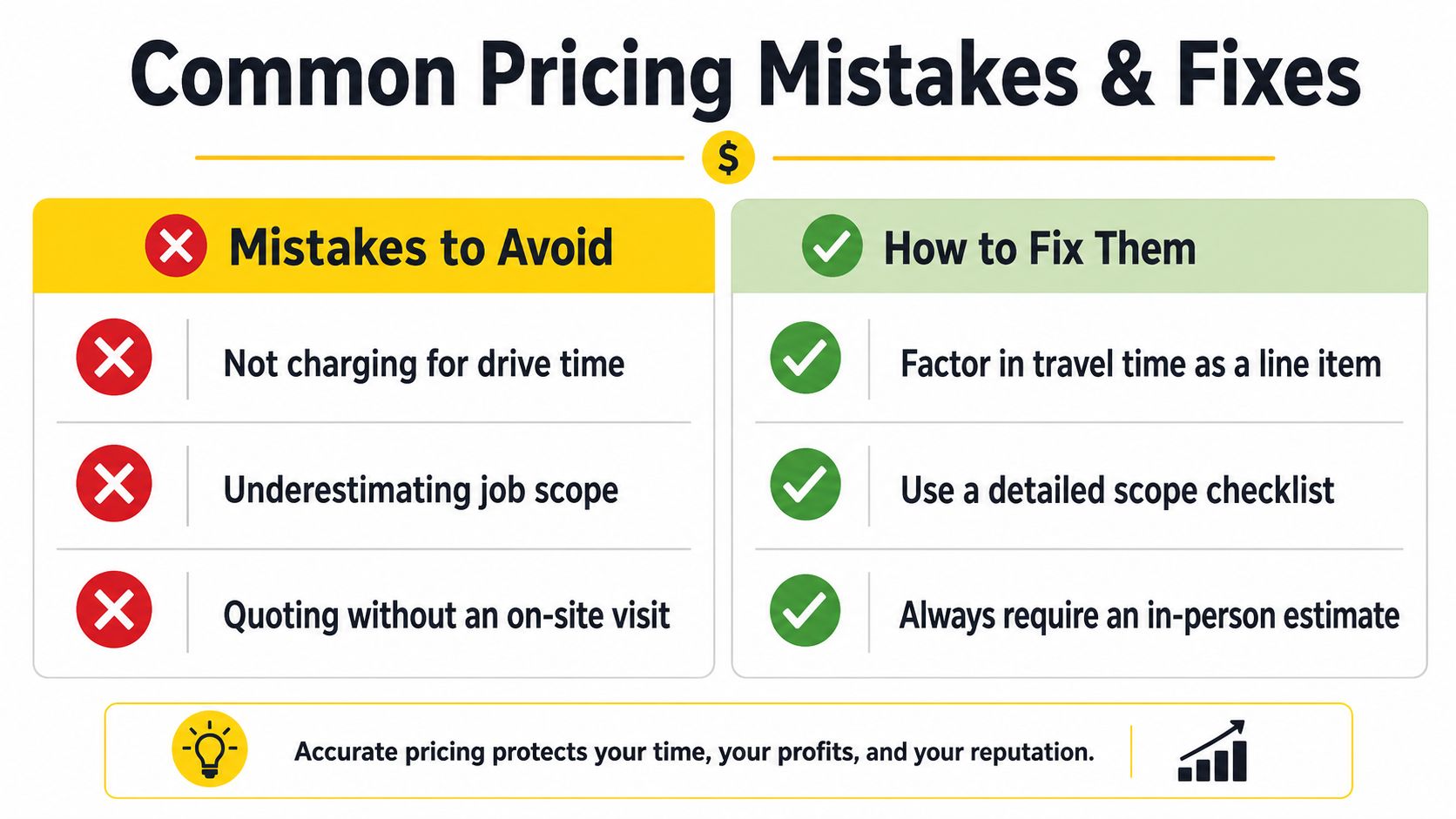
Fairness depends on clarity. Customers don't need every internal cost calculation, but they do need to understand the service scope, the factors that change the estimate, and what happens if conditions differ on arrival. Transparent, segmented pricing can preserve trust while protecting the margin required to pay crews, maintain equipment, and deliver dependable work.
Standardization also makes improvement possible. When estimates follow the same rules, you can identify whether a service is underpriced, whether an add-on is poorly presented, or whether a particular lead source needs a different response. Clever tactics may help at the edges, but consistent estimates, fast follow-up, and disciplined scope control do the heavy lifting.
Estimatty helps cleaning businesses apply configured pricing rules, capture job details, and send consistent estimates by SMS or email without waiting for a callback. Visit Estimatty to see how an AI-powered estimator can help you respond faster, reduce quoting variation, and stop preventable revenue leaks.