October 12, 2026
Cleaning Office Prices: A Practical Pricing Guide for 2026
Learn how cleaning office prices really work in 2026. Compare per square foot, hourly, and monthly models, plus tips to estimate and present winning quotes.

Thursday, July 9, 2026
Stop guessing profits. A job costing program transforms your cleaning business with accurate estimates, data-driven pricing, & real profit insight. Maximize
You land a new cleaning account, the calendar fills up fast, and everyone feels relieved for about a day. Then the familiar doubt shows up. Are these jobs making money, or are you just staying busy?
I've seen this pattern with residential cleaners, commercial crews, and owners who built solid local reputations on hustle alone. They win work, hire faster, buy supplies in bulk, cover schedule gaps, and still can't say with confidence which jobs carry the business and which jobs quietly drag margins down. When pricing is based on memory, rough averages, or what “sounds right,” profit becomes a guess.
That guess gets expensive in cleaning. Labor shifts. Drive time adds up. Deep cleans run long. Team A finishes on time and Team B burns an extra hour. A move-out that looked great on paper turns into a job that absorbs wages, chemicals, admin time, and rework.
A Job Costing Program fixes that problem. Not because it turns you into an accountant, but because it gives you a clean way to compare what you expected to spend against what you spent on each job. Once that happens, pricing gets sharper, staffing gets smarter, and bad-fit work becomes easier to spot before it hurts you again.
A cleaning owner I've advised once described the problem perfectly. “We're booked out, but I still don't know where the money goes.” That's more common than many admit.
It usually starts with growth that looks healthy from the outside. You add recurring homes, pick up more one-time deep cleans, maybe even win a commercial contract that feels like a breakthrough. Revenue is coming in. Crews are moving. The phone is ringing. But your bank balance and your stress level don't reflect the effort.
The reason is simple. Activity and profitability are not the same thing.
A packed schedule can hide a lot of mistakes:
If you've ever finished a month thinking, “We worked too hard for what we made,” you're already feeling the absence of job costing.
Busy businesses fail too. They just fail while everyone looks exhausted.
Gut-feel estimates can get a solo cleaner off the ground. They don't work for long once you have multiple crews, varied service types, and a real payroll to support.
A one-off post-construction clean doesn't behave like a recurring residential visit. A vacation rental turnover doesn't behave like a medical office. If you price all of them from instinct, you'll eventually subsidize your least efficient jobs with the profits from your best ones.
That's where better systems matter. Tools discussed in resources on service business software for growing operations can help owners standardize the front end, but the real shift happens when the estimate turns into a budget you can measure against after the work is done.
The owner who knows job-level profitability starts making different decisions. They stop asking, “Did we have a good month?” and start asking better questions:
That's the move from operating on effort to operating on evidence. It's also where a cleaning company stops being merely busy and starts becoming consistently profitable.
A Job Costing Program is the profit recipe for each cleaning job. It records what you planned, captures what occurred, and shows whether the work produced the margin you thought it would.

In plain terms, job costing assigns expenses to a specific job instead of leaving them buried in a monthly profit and loss statement. According to Deltek's explanation of job costing software, job costing is a fundamental cost accounting method that strictly tracks expenses for specific jobs against an estimated budget to determine the true profitability of each individual project. Deltek also notes that this process breaks costs into direct costs such as materials and labor, and indirect costs such as administrative expenses.
For a cleaning business, that means each appointment stops being “just another invoice” and becomes its own mini financial record.
A good job costing setup usually tracks costs in categories like these:
| Cost type | What it includes in cleaning |
|---|---|
| Direct labor | Cleaner wages tied to that specific job |
| Direct supplies | Chemicals, trash liners, microfiber replacement, consumables |
| Travel-related cost | Drive time or route-related labor allocation |
| Indirect overhead | Admin support, insurance, office time, scheduling effort |
The point is not to make your system complicated. The point is to make the job tell the truth.
If a deep clean took longer than planned, the extra labor belongs to that job. If a commercial site required more supervision and coordination than a recurring home, that burden should show up in the economics of that account too.
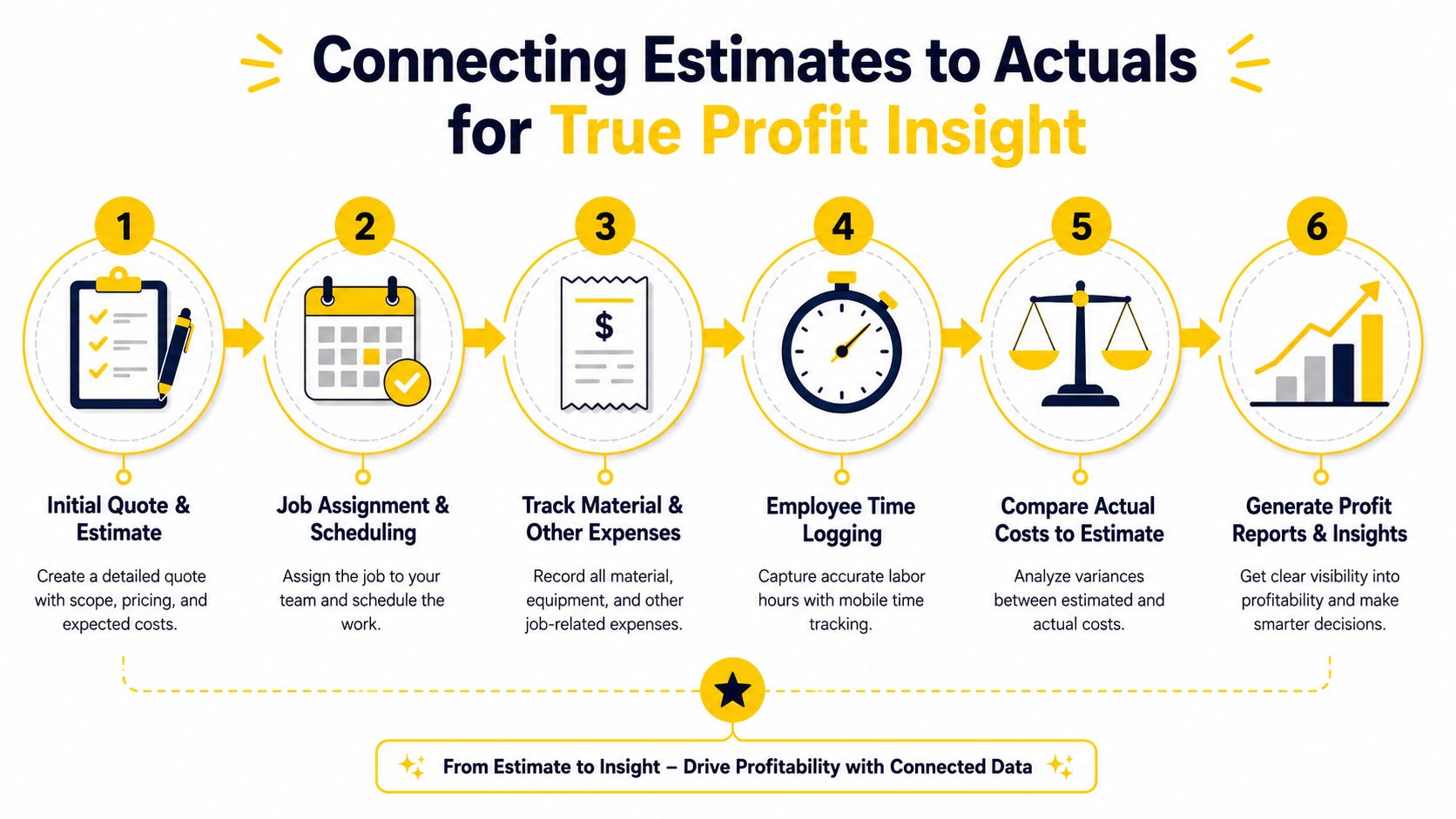
A modern program doesn't just store numbers. It connects the workflow. Labor gets tied to jobs. Expenses get categorized. Actual costs get compared with the original estimate. Managers can then review variance by service type, crew, or client.
That's why I often tell owners to stop thinking about job costing as bookkeeping and start thinking about it as operational control. If you want a broader view of how this fits into the numbers side of running a field service company, Snyp has a useful guide to contractor finance management.
Practical rule: If a cost can happen because of a job, your system should have a way to attach that cost to the job.
For cleaning businesses, generic accounting software often isn't enough on its own. You need job-level visibility, not just business-level reporting. That's the gap many owners start addressing after tightening up their cleaning business accounting workflow.
When the system works, the final output is simple. You can look at a completed job and answer three questions without guessing:
The biggest benefit of a Job Costing Program is clarity. Once you have that, better margins stop depending on memory and luck.
Manual tracking breaks under growth. Spreadsheets get missed. Time gets entered late. Supply purchases sit in the wrong category. Owners review reports after the damage is already done.
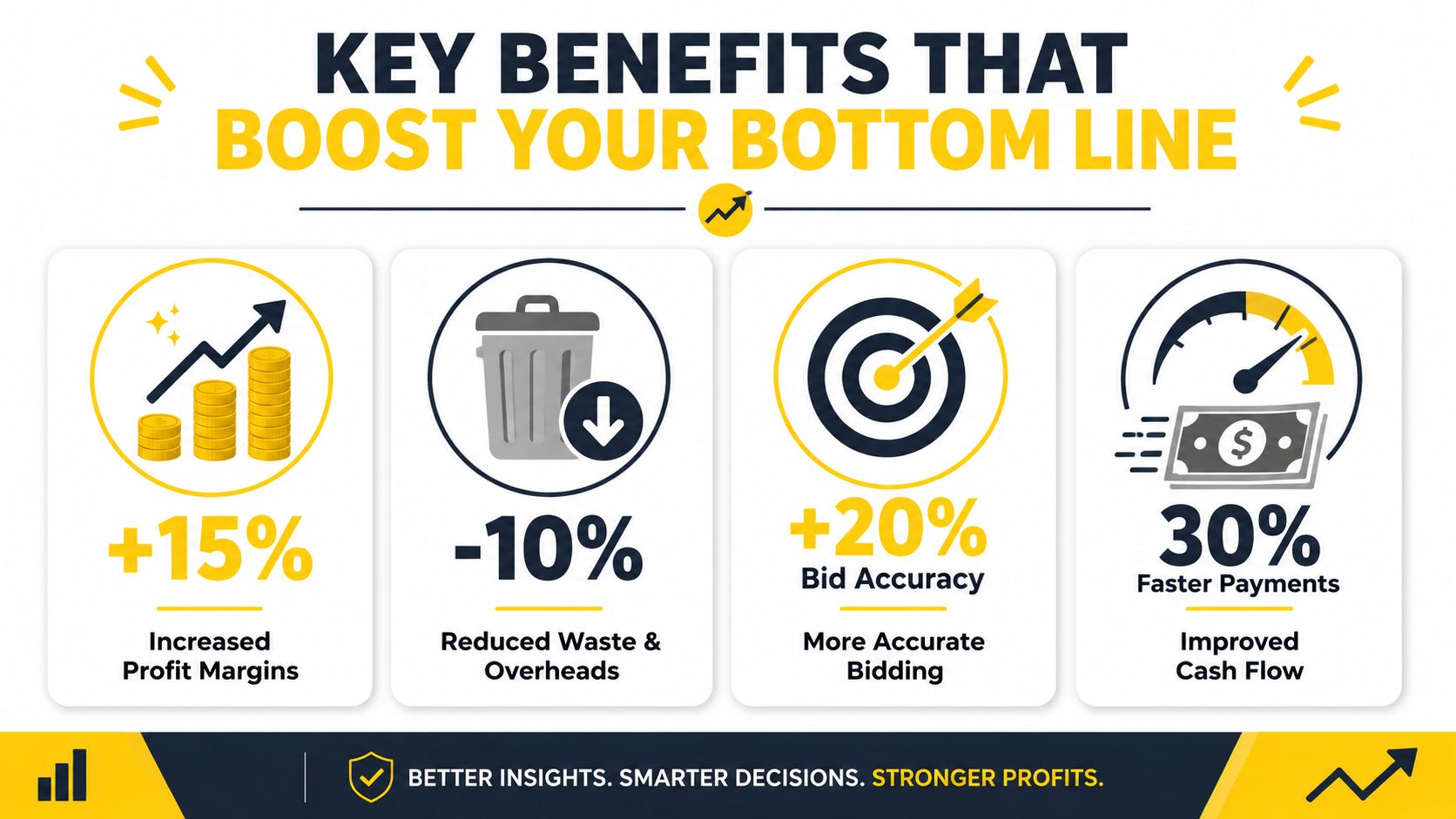
According to NetSuite's overview of job costing software, expert benchmark data shows job costing software can reduce manual accounting errors by 85–95%, and integration with payroll and accounting systems can lead to a 40% reduction in invoice dispute rates. The same source states that automated alerts for schedule deviations can reduce project delays by 25% and can reduce callback rates by up to 30% in service-based businesses.
Those numbers matter because cleaning companies usually lose margin in unglamorous places. A missed timesheet. A disputed invoice. A delayed visit that triggers rescheduling. A callback that turns one profitable stop into two unprofitable ones.
Historical job data gives you something most owners lack. Proof.
You stop pricing a move-out based on what one crew “usually” does. You price it from real labor patterns, actual supply use, and the service conditions that tend to slow your teams down. That feedback loop is what separates consistent operators from reactive ones.
If you're spending money to acquire leads, that precision also improves your marketing economics. Better pricing discipline makes it easier to protect margin while you work on mastering your CPA and deciding which jobs are worth buying through paid channels.
Not every booked job deserves your calendar.
A solid job costing process reveals where profit comes from. In many cleaning businesses, recurring work behaves differently from one-time work. Specialty cleans may command stronger prices but create more operational drag. Some commercial accounts look prestigious but consume admin time, after-hours coordination, and extra supervision.
A simple review like this becomes possible:
A service can be popular with customers and still be a weak product for your business.
That insight changes everything from staffing to sales follow-up to route planning. It also gives owners a more honest answer to the question many ask too late, which is whether a cleaning business is profitable at its current pricing and service mix.
A cleaning business doesn't need bloated software. It needs a Job Costing Program that matches the way field teams work.
If your cleaners can't log time from the field without friction, your labor data will be unreliable. That single problem can ruin the rest of the system.
You want something simple enough that a crew lead can clock in, clock out, switch locations, and flag exceptions without calling the office. If time entry depends on memory after the fact, labor cost gets distorted immediately.
Good mobile workflows usually support:
A lot of software can track expenses. Fewer tools compare those expenses cleanly against the original estimate that got sold.
That connection matters in cleaning because estimate quality drives almost every downstream number. If the front-end estimate lacks structure, your actuals won't teach you much. You'll know you went over, but you won't know whether the problem came from labor assumptions, service scope, route spacing, team assignment, or inconsistent intake.
That's why I prefer systems built around a defined pricebook. If your service definitions, add-ons, square-foot assumptions, and labor expectations are standardized first, the job costing side becomes much more useful. A structured cleaning pricebook setup gives owners a better baseline before actual costs start flowing in.
Cleaning owners often swing too far in one direction. They either track almost nothing, or they try to code every paper towel and burn out the team.
A workable system needs enough detail to expose margin problems without becoming a daily burden. For most cleaning companies, that means separating:
| Category | Why it matters |
|---|---|
| Labor | Usually the biggest variable cost |
| Supplies | Useful for spotting waste on specialty jobs |
| Travel and coordination | Important for mobile crews and spread-out routes |
| Overhead allocation | Necessary for seeing true job profitability |
You don't need academic precision. You need consistent categories.
The labor side is where many job costing rollouts break down. Owners know labor is their largest cost, but they still rely on disconnected systems for hiring, scheduling, payroll, and job review.
If your payroll data can't flow into your costing process, you'll spend too much time reconciling numbers by hand. If your hiring process is messy, your labor assumptions will stay unstable because turnover keeps resetting crew performance.
That's one reason I tell owners to treat staffing and costing as connected disciplines. Finding reliable cleaners through platforms like pipehirehrm.com is part of building a stronger labor model. The blogs at estimatty.com/blog and get.pipehirehrm.com/blog are both useful places to study operational systems and hiring practices that support cleaner cost tracking.
Software won't fix bad discipline, but bad software makes discipline harder than it needs to be.
A strong Job Costing Program should do more than collect data. It should help you act on it.
Look for reporting that makes exceptions visible fast:
What doesn't work is generic software that gives you broad monthly totals and expects you to figure out the rest. Cleaning is a high-frequency service business. You need job-level signals quickly, or the same leak repeats dozens of times before you catch it.
A Job Costing Program proves itself to be more than a back-office tool. It becomes the bridge between sales and operations.
Every profitable cleaning business needs a starting number. Not a rough guess. A defined estimate based on service scope.
For house cleaning, one standard guideline is 1.5 hours of labor for every 1,000 square feet of home, as noted in this house cleaning estimating reference. That doesn't replace judgment, but it gives you a baseline for labor planning.
Here's what that looks like in practice for an estimate:
That's the missing link in many cleaning companies. The sales process creates revenue, but it doesn't create a usable benchmark. Without that benchmark, actual costs are just isolated facts.
Consider a home with 2,000 square feet. Using the guideline above, the estimated labor time would be 3 hours. From there, you would apply your internal labor cost and pricing model.
After the job is complete, you review actuals:
I'm intentionally keeping the rest qualitative because your actual labor rates, burden, and overhead method are business-specific. The important point is the comparison itself. When a job runs over, your system should show where.
An invoice tells you what you charged. An estimate versus actual report tells you what you earned.
That report answers questions owners ask every week:
For a practical breakdown of the labor side, this resource on how to calculate labor cost per hour is worth reviewing before you build your internal model.
Here's a quick visual of the workflow in motion:
Once estimates and actuals are connected, the business gets smarter in a compounding way.
Sales improves because estimates become more consistent. Operations improves because labor assumptions become testable. Hiring improves because you can see which crews perform well under which job types. Client management improves because scope drift stops hiding in vague complaints and starts appearing in numbers.
The strongest pricing systems don't just win jobs. They teach the business how to price the next job better.
That's why the full value of a Job Costing Program isn't only in accounting. It sits at the intersection of estimating, scheduling, labor management, and profitability review.
Most owners delay this because they assume rollout has to be complicated. It doesn't. It does need discipline.
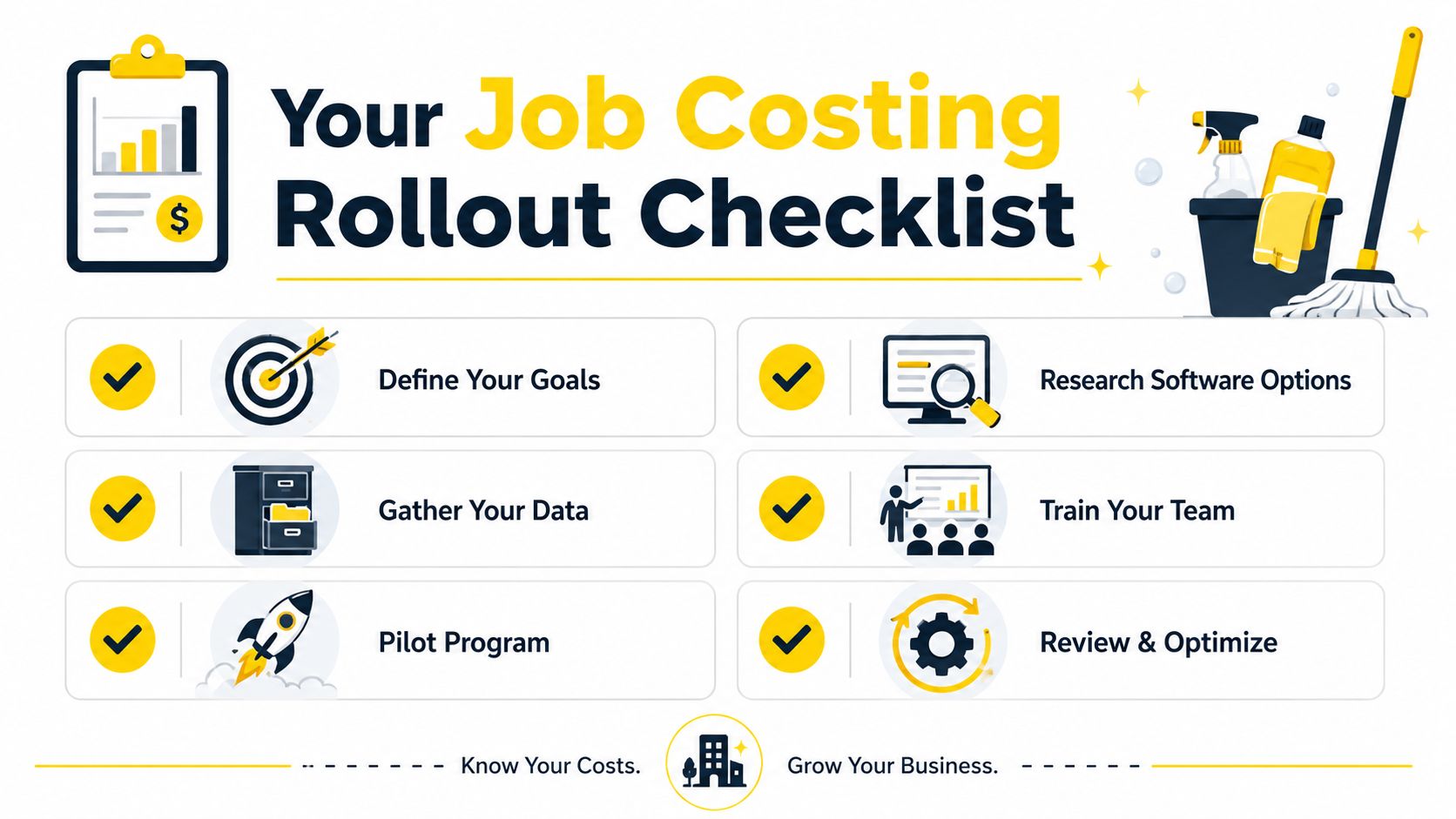
Before you evaluate software, decide what you want the system to reveal. If you skip this step, you'll buy features instead of solving problems.
For most cleaning companies, the first targets are practical:
Your Job Costing Program will only be as useful as the data flowing into it. Look at your current estimating method, payroll process, time tracking habits, and reporting rhythm.
If your office still builds estimates manually and crews report hours by text message, fix the data path before you expect meaningful job profitability reports. Clean inputs matter.
Don't ask which software is “best.” Ask which software fits a mobile cleaning operation.
A short evaluation list should include:
At this stage, many rollouts either succeed or fail. Don't push the whole company into a new process on day one.
Pick one crew, one manager, and one tight service segment. Run the system long enough to compare the estimate with actual labor, supplies, and job notes. Then look for friction. Maybe the clock-in flow needs work. Maybe your service categories are too broad. Maybe your estimate assumptions need tightening.
Small pilots protect morale. Company-wide confusion kills adoption.
Training shouldn't sound like finance school. It should sound like operational clarity.
Explain to cleaners and supervisors what the system is for:
Then review the data regularly. Weekly is usually better than waiting until month-end. Owners who win with job costing treat it as a management habit, not a software event.
The businesses that make the biggest leap are the ones that stop guessing. They standardize estimates, connect labor and expenses to the right jobs, and build a feedback loop that makes every future decision smarter. For more practical ideas on tightening operations and building the team behind them, both estimatty.com/blog and get.pipehirehrm.com/blog are worth following.
If you want cleaner estimates at the front end so your job costing process has better data to work with, Estimatty is built for exactly that. It helps cleaning businesses deliver fast, consistent estimates around the clock, giving your team a stronger starting point for tracking actual job profitability later.