September 21, 2026
Inside and Out Cleaning: A Practical Pricing Guide
Learn what inside and out cleaning really includes, how pricing works, and which add-ons actually pay off for residential and commercial estimates.

Friday, June 19, 2026
Transform your cleaning business with powerful service business software. Discover key features, ROI secrets, & how AI automates sales & profit in 2026.
.png)
You're probably feeling this already. The phone rings while your team is out on jobs, a website lead comes in after hours, and someone asks for pricing on a place you haven't seen yet. You either stop what you're doing to answer, send a rough number based on instinct, or tell them you'll get back to them later.
That “later” is where a lot of cleaning revenue disappears.
Most owners don't lose jobs because they can't clean well. They lose them because response time is slow, estimates are inconsistent, and the back office still runs on memory, text messages, and spreadsheets. That worked when you had a handful of clients. It breaks when you're trying to grow.
One of the most common patterns in cleaning businesses looks like this. A prospect calls during a house clean, gets voicemail, fills out a basic form, then moves on to the next company that replies faster. Another prospect does reach you, but the estimate changes depending on who answers the phone. One person prices by square footage. Another goes by bedroom count. The owner gives a number based on “what feels right.”
That isn't a sales problem. It's an operations problem.

Cleaning companies hit a ceiling when lead handling depends on one busy person. If the owner has to answer every call, review every property detail, build every estimate, and chase every follow-up, the business can't scale cleanly. It becomes reactive. Staff wait for direction. Prospects wait for pricing. Cash waits on admin.
The bigger shift is happening across the whole software market. The global business software and services market was estimated at USD 584.03 billion in 2024 and is projected to reach USD 1,153.75 billion by 2030, growing at a 12.1% CAGR, according to Grand View Research's business software and services market analysis. Cleaning businesses aren't outside that trend. They're part of it, because owners need systems that standardize work, not more apps that create extra clicking.
The pain usually shows up in four places:
Practical rule: If pricing lives in the owner's head, the business is harder to grow than it looks.
A lot of owners try to patch this with a receptionist, a website form, or a shared inbox. Those can help, but they don't solve the core issue. They collect requests. They don't run the estimating process.
That's why service business software matters. Not as another subscription. As the operating layer that handles intake, routing, estimates, invoicing, and reporting in a way your team can repeat.
If after-hours inquiry loss is already hurting you, 24-hour phone answering for cleaning businesses is a useful place to look at how response coverage affects booking volume.
The best cleaning operations stop treating estimate generation like a side task. They treat it like part of fulfillment.
When a lead comes in, the system should capture details, apply pricing logic, send the estimate, and move the opportunity forward without waiting on someone to “find time.” That's the difference between a business that feels busy and one that is controlled.
Service business software is the system that keeps a cleaning company consistent when the owner is not in the middle of every decision.
That matters more than many teams realize. A scheduler alone does not run operations. A CRM alone does not protect margin. In a cleaning business, the core problem is usually the handoff between lead intake, estimating, scheduling, job notes, invoicing, and follow-up. If those steps live in separate apps or in one manager's head, work slows down and mistakes multiply.
Good software fixes the handoff.
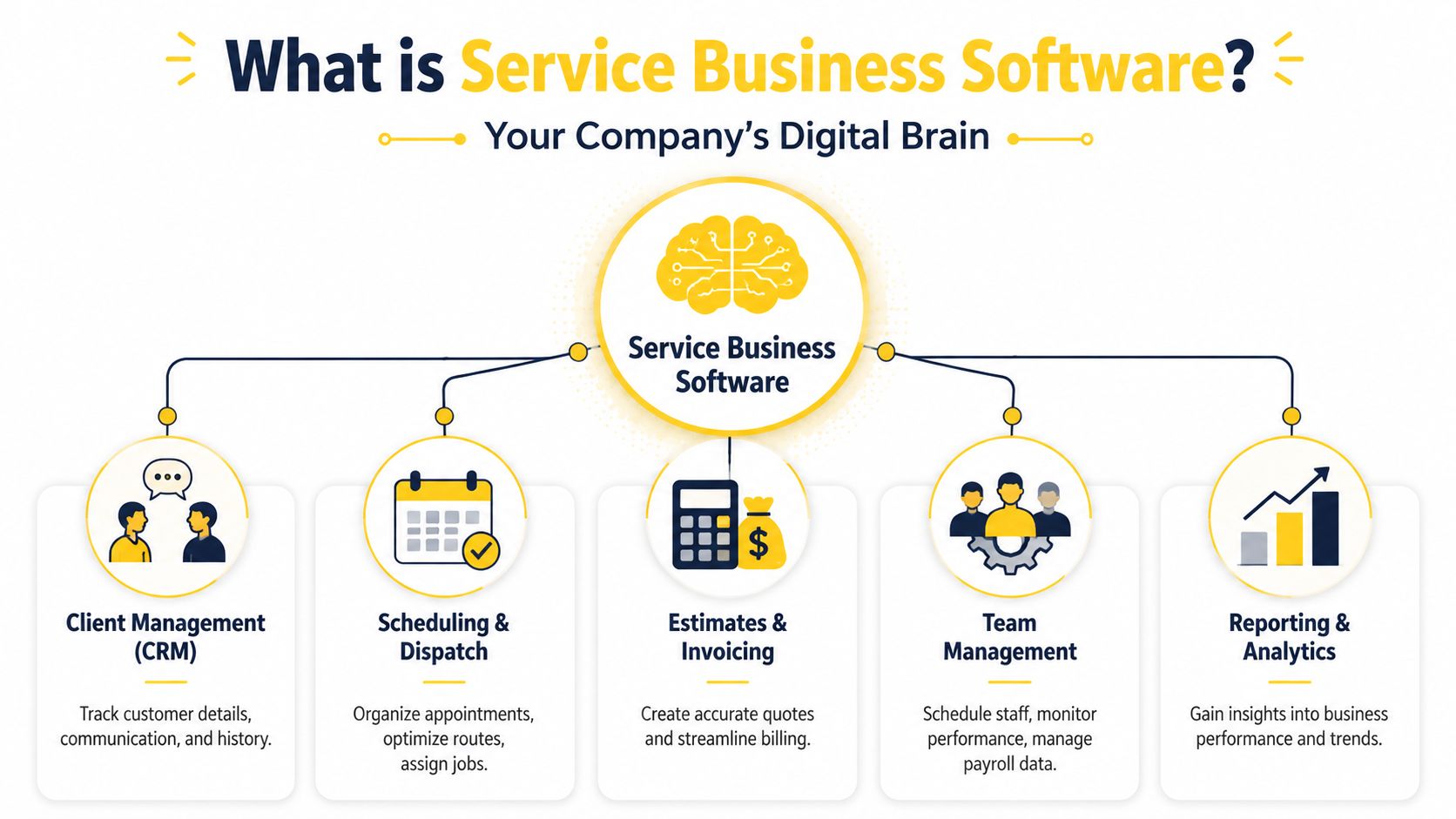
Cleaning companies do not need more tools. They need a system that carries information from the first inquiry to the final payment without forcing the office to re-enter, re-check, or re-explain everything.
This should hold more than names and phone numbers. It needs property details, pets, gate codes, service frequency, arrival preferences, exclusions, photos, and a clear record of past communication.
The higher-value point is consistency. If a new lead asks for a quote, the office should not start from scratch every time. Good lead management keeps the facts attached to the account so pricing, follow-up, and service setup all start from the same information.
That is the first step toward intelligent service automation. Basic forms collect inquiries. A real operating system helps turn those inquiries into usable estimates and booked work.
Scheduling controls labor, drive time, and capacity. It is one of the fastest places to lose profit.
A weak scheduler creates short, expensive days. Crews sit in traffic, supplies get missed, and reschedules turn into office chaos. A stronger setup connects recurring jobs, team availability, travel logic, and property notes so the day can run with fewer phone calls and fewer surprises.
If your current calendar only shows appointment blocks, it is worth reviewing what scheduling software for cleaning business operations should support.
As they grow, many cleaning businesses outgrow generic software.
An estimate is not just a price field. It should reflect the service type, square footage, room count, condition level, extras, frequency, and any rules you use to protect margin. If your team builds every quote manually, the process is slow and pricing drifts. One salesperson rounds down to win the job. Another adds too much cushion and loses it.
The best systems connect estimating to the rest of the workflow. Once the customer approves, the job details should move into scheduling, invoicing, and payment tracking without duplicate entry. That saves time, but its primary benefit is the protection of accuracy.
This is the line between task automation and service automation. Task automation gives you a form and an email alert. Service automation helps produce a quote, move it to the customer fast, and keep the work flowing after approval. For cleaning companies, that is where software starts affecting close rate, not just admin time.
Good service business software shortens the path from inquiry to estimate to booked job.
Owners need one place to see what is happening without chasing the team through texts and call logs.
Useful reporting is usually plain. It should show new leads, pending estimates, tomorrow's jobs, unpaid invoices, and exceptions that need attention. Fancy dashboards do not help much if the office still has to hunt for basic answers.
| Question | What the system should show |
|---|---|
| Are leads getting answered? | New inquiries, response status, estimate status |
| Is the schedule realistic? | Team assignments, travel gaps, recurring job load |
| Are we getting paid on time? | Invoice status, overdue accounts, follow-up queue |
| Is pricing consistent? | Estimate history, service mix, add-on patterns |
If a tool handles only one function, it helps with a task. It does not run the operation. Cleaning businesses usually feel the strain in the gaps between tasks, especially around lead response and estimate generation, where speed and consistency directly affect revenue.
A cleaning company usually feels software gaps in the middle of a normal workday. A lead asks for a quote before lunch. The office enters notes in one tool, checks availability in another, texts a supervisor for timing, then creates an invoice later from memory. Nothing is fully broken, but every handoff adds delay, and delay costs jobs.
That is why cleaning businesses need software built for field service operations, not a generic set of business apps. The goal is not just to store customer data. The goal is to price work consistently, schedule it profitably, deliver it cleanly, and collect payment without chasing loose ends.
The right system should reduce office touchpoints and protect margin at the same time. In practice, that usually means five capabilities working together.
Invoicing deserves more attention than many owners give it. Slow billing creates avoidable cash pressure, especially when the office waits until the end of the week to send invoices or track exceptions manually. Good software closes that gap by tying completed work to billing, then flagging unpaid accounts before they become a collection problem.
A lot of owners buy for administration first and revenue second. They compare calendars, checklists, and payment tools, then treat estimating like a separate problem the office will handle manually.
That choice creates friction at the highest-value point in the workflow.
If lead response and estimate creation are still loose, the business stays slow where speed matters most. A contact form can capture interest, but it does not qualify the job, apply pricing rules, or get a quote back to the prospect while they are still ready to buy. That gap is exactly why the jump from basic task automation to intelligent service automation matters in cleaning.
Here is the operational difference:
| Feature type | What it does | Operational result |
|---|---|---|
| Basic web form | Collects name, phone, message | Office has to review, interpret, and reply later |
| Static pricing page | Shows rough pricing guidance | Prospect still needs a custom answer before booking |
| Automated estimate workflow | Collects service details and applies structured pricing logic | Faster quote delivery and fewer pricing inconsistencies |
I have seen this pattern many times. A company can look organized after the sale and still lose profitable work before the sale because nobody fixed the estimate process. Software should help the office convert demand, not just document jobs that were already won.
Operations software also has to match your staffing reality. Better lead flow and tighter scheduling expose hiring gaps fast. If the team cannot cover the work, the system will show open slots, rushed reschedules, and margin loss with painful clarity.
That is useful. It tells you where the constraint is.
Resources on Pipehire and hiring content from get.pipehirehrm.com/blog can help owners review staffing alongside scheduling, because crew availability and schedule quality are tied together in daily operations.
Field note: If your office runs on clean processes but team coverage is unstable, software will not protect margin by itself. It will show you exactly where the breakdown starts.
There's a major difference between automation that collects information and automation that moves a sale forward.
A form collects. An intelligent estimator qualifies, prices, delivers the estimate, and prepares the team to act. That's the gap most cleaning businesses feel but can't always name. They've added software, but they still depend on humans to interpret the lead and turn it into a number.
That's where AI estimation changes the front end of the business.
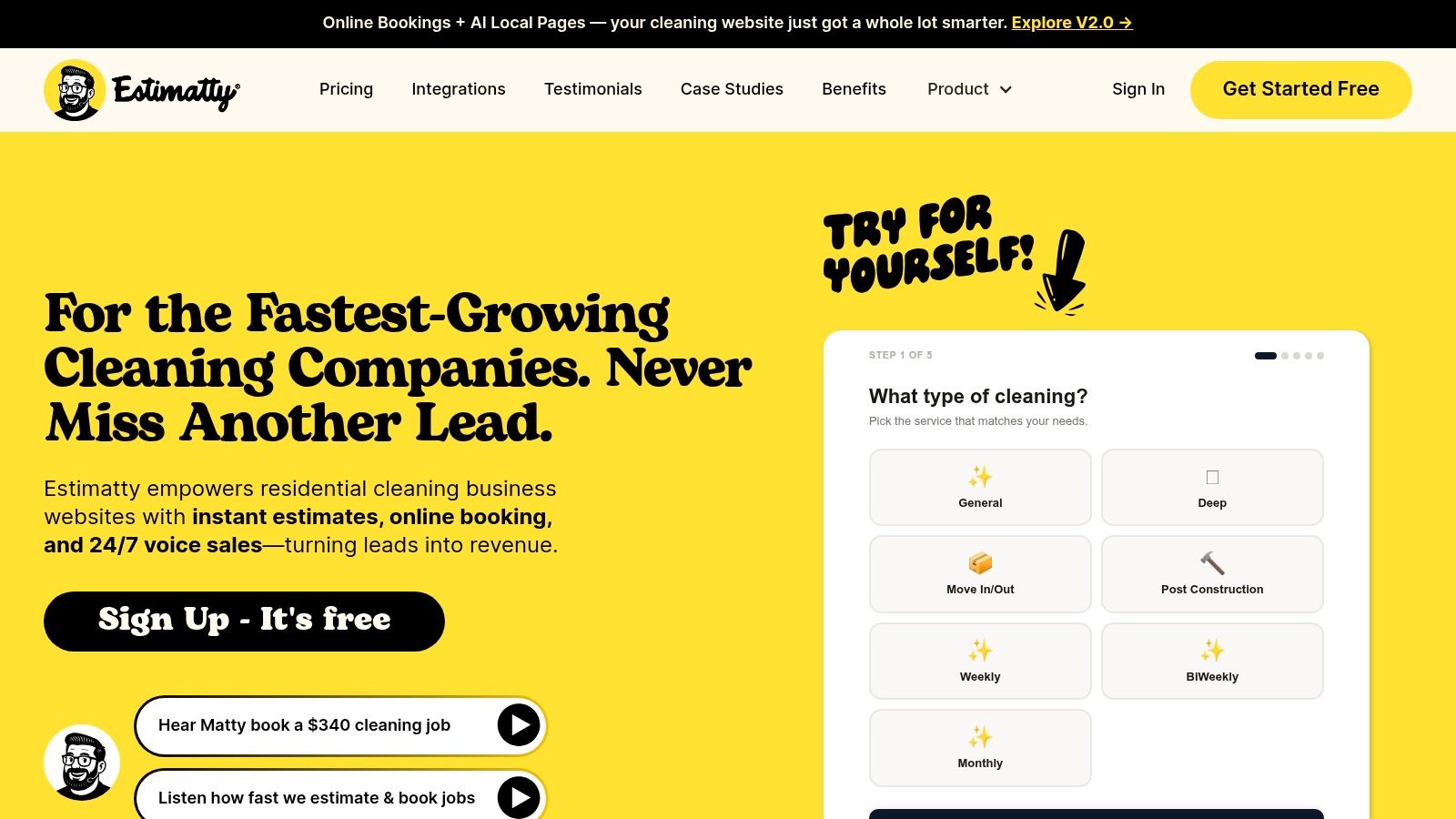
Traditional intake forms create delay in three ways. They make the prospect wait, they force the team to review and interpret every submission, and they leave too much room for pricing inconsistency.
That's why the operational jump from a form to AI estimation matters. In cleaning, a lot of the first estimate depends on structured information. Square footage, service type, surfaces, frequency, urgency, and add-ons can be collected in a repeatable flow. Once that logic is set up, the system can return an estimate without waiting for a callback.
According to the verified benchmark data provided for this article, service business software with AI-driven voice and SMS estimation can reduce quote-to-book conversion times by 60 to 80 percent compared to traditional forms, and businesses using these always-on automated systems see a 35 percent increase in qualified leads and a 25 percent reduction in callbacks. Those gains make sense in practice because the customer gets pricing while intent is still high.
A tool like AI estimate software for cleaning companies shows the model well. Estimatty uses web and voice workflows to engage a prospect when they visit the site or call, asks structured questions, captures job details, and sends an estimate by SMS and email. The team then gets the information in real time instead of sorting through voicemail and half-complete form entries.
That changes several parts of the operation at once:
Stop thinking of estimating as paperwork. In a cleaning company, estimating is part of sales velocity.
AI estimation works when the pricing model is clear. It struggles when the owner hasn't defined service packages, add-ons, exclusions, or thresholds for human review. If every property is a custom exception, the software can't create consistency because the business itself doesn't have consistency.
Use this rule of thumb:
The strongest setup isn't AI alone. It's AI first, human oversight where needed. The software should handle the repeatable front-end work and route exceptions to the team.
That's the advantage. You're not replacing judgment. You're removing latency from the part of estimating that shouldn't require judgment every single time.
Most cleaning owners don't buy too early. They buy too loosely. They pick tools one by one, based on whichever pain is loudest that month. First invoicing. Then scheduling. Then texting. Then hiring. A year later, the business is running on disconnected systems and manual patchwork.
A better buying process starts with one question. Where does your profit leak first?
If the answer is missed leads and slow estimates, you should evaluate software differently than a company whose main issue is payroll coordination or route density.
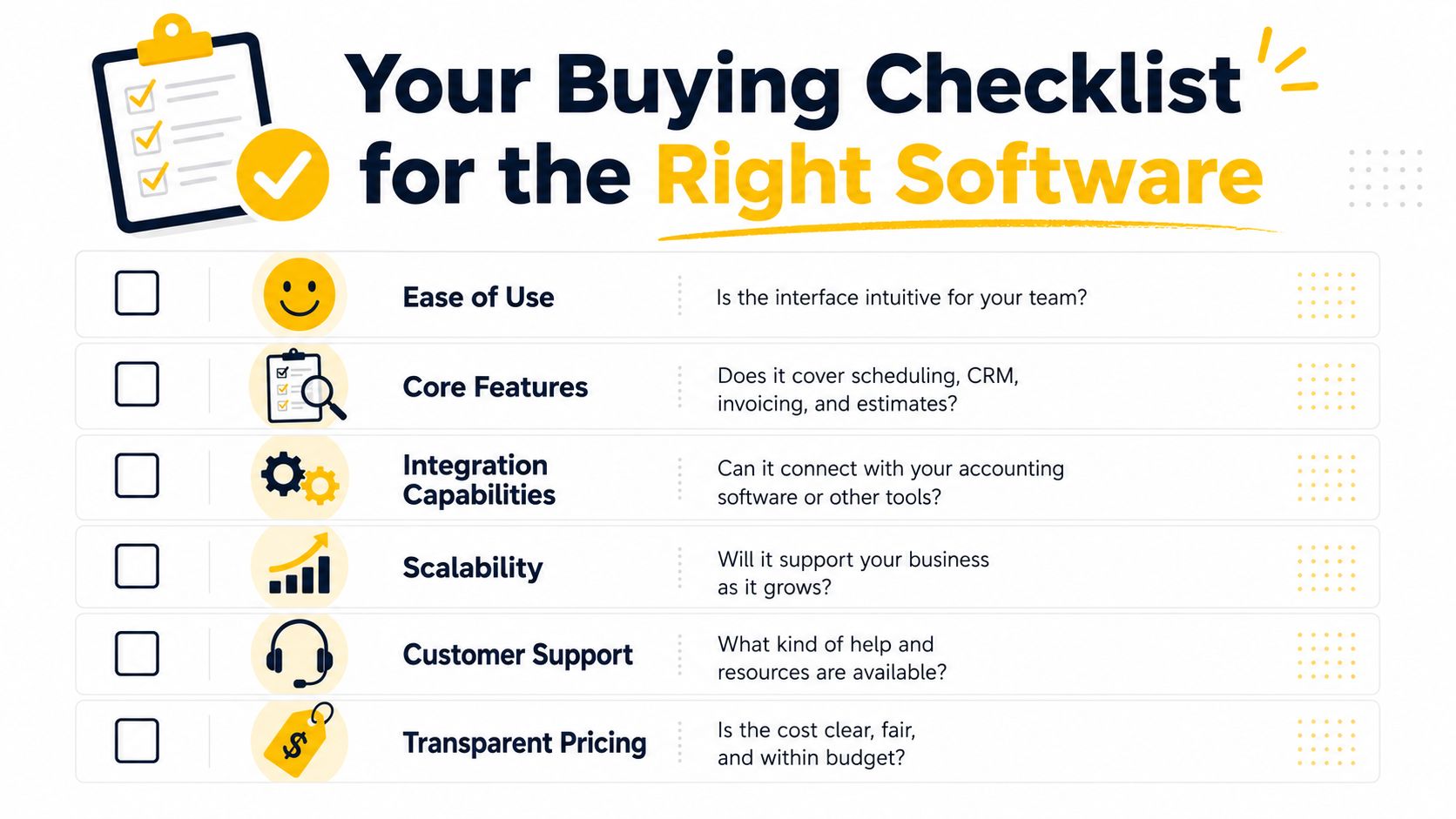
Use this checklist before you commit.
| Buying criterion | What to ask | Red flag |
|---|---|---|
| Cleaning-specific workflow | Does it support recurring cleans, add-ons, and property notes? | It's built for “appointments” but not service complexity |
| Integration capability | Can it connect to your CRM, forms, or other tools? | You'll have to retype data between systems |
| Scalability | Will it still work if you add teams, territories, or locations? | It's fine for a solo operator but weak for growth |
| Estimate handling | Does it help generate structured estimates, not just collect requests? | It sends inquiries into a queue and stops there |
| Ease of use | Can office staff and field staff learn it without constant rescue? | Only the owner knows how to use it |
| Support quality | Can you get help during setup and changes? | Training is thin and response is slow |
One practical test matters more than the demo. Ask the vendor to show your actual workflow. Not a polished sample. Your workflow. A recurring residential clean, a first-time deep clean with add-ons, a reschedule, an unpaid invoice, and a lead that comes in after hours.
These questions usually surface the truth faster than feature grids:
For teams already comparing options, Estimatty integrations is a good example of what to look for when judging whether a tool will fit into an existing process instead of forcing a full rebuild.
Buying advice: Don't ask whether the software has a feature. Ask whether your team will actually use that feature every day.
An all-in-one platform gives you simplicity. A more specialized stack can give you tighter performance in areas like estimating or hiring. There isn't one right answer.
The trade-off is management overhead versus operational depth. If you choose multiple tools, they need to connect and your team needs clear handoffs. If you choose one platform, make sure it's strong in the part of the workflow that drives revenue, not just admin.
Implementation goes wrong when owners try to switch everything at once. The cleaner approach is phased. Lock down your pricing logic, intake questions, service catalog, and follow-up steps first. Then move one workflow at a time into the new system.
For most cleaning businesses, this sequence works:
A lot of owners look only at subscription cost. That's too narrow. The better question is whether the software changed time-to-response, estimate consistency, booking speed, and add-on capture.
The verified benchmark data for this article shows that AI-powered estimation improves customer satisfaction scores by 40 percent, accelerates deal closure by 2 to 3 days, and drives a 30 percent increase in upsell rates when relevant add-ons are suggested during the estimate flow. Those are the kinds of results worth tracking because they tie directly to growth and margin.
Use a simple scorecard:
You don't need a complicated dashboard culture. A weekly review is enough if the numbers connect to behavior. Check where leads got stuck, where estimates required manual rescue, and which service types caused confusion.
Blogs like estimatty.com/blog and get.pipehirehrm.com/blog can help with deeper operational details, but the main point is simple. ROI comes from reducing delay, reducing inconsistency, and reducing owner dependency.
If you want an example of how instant estimating can affect the sales side of operations, review this case study on faster lead conversion after instant estimates.
If your cleaning business is still relying on missed-call callbacks, manual follow-up, and gut-feel pricing, it may be time to put a real estimating system in place. Estimatty gives cleaning companies a way to capture inquiries, deliver instant estimates by web or voice, and move leads forward without waiting on the owner to answer every request.