September 21, 2026
Inside and Out Cleaning: A Practical Pricing Guide
Learn what inside and out cleaning really includes, how pricing works, and which add-ons actually pay off for residential and commercial estimates.

Sunday, September 20, 2026
How much does a deep house cleaning cost in 2026? Get complete pricing insights, factors affecting rates, and money-saving tips in this guide.

Most U.S. homeowners pay between $200 and $400 for a standard deep clean, with costs rising significantly for larger homes, heavy buildup, or post-construction conditions. In many cases, a one-time deep house cleaning averages about $260, but that number only makes sense once you understand what the crew is walking into.
That's where people get tripped up. A homeowner sees one pricing page, then another, then a third, and every number looks slightly different. A cleaning business owner has the opposite problem. They know two homes with the same bedroom count can require completely different amounts of labor. The gap between those two viewpoints is why deep cleaning feels harder to price than it should.
If you're trying to answer how much does a deep house cleaning cost, the right answer isn't a single flat fee. It's a range shaped by labor, condition, layout, and scope.
A homeowner usually starts with a simple question. “How much for a deep clean?” Then they open a few tabs and see a spread of prices with very little explanation. One site gives a broad range. Another talks about bedroom count. A third lists add-ons but doesn't explain when those add-ons stop being optional and start being necessary.
That confusion isn't accidental. Deep cleaning isn't a shelf product. It's a scope-based service. The crew isn't just cleaning square footage. They're cleaning surfaces, buildup, edges, appliances, bathroom grime, kitchen grease, and whatever condition has built up since the last serious reset.
Homeowners tend to compare homes by size. Cleaners price them by work density.
A 1,500 square foot home that gets maintained regularly can be simpler than a smaller home with neglected bathrooms, sticky kitchen cabinets, pet hair packed into corners, and buildup around baseboards. From the customer's side, both homes may look “about the same.” From the operations side, they aren't close.
Deep cleaning prices feel inconsistent when people compare floor plans instead of comparing labor.
This is also why checklists matter more than headline prices. If you're reviewing what's typically included, a practical reference like this professional deep cleaning checklist helps you see the actual task load behind the number.
Most bad pricing conversations start with the wrong assumption. People assume deep cleaning should work like a simple menu item. It doesn't.
A better way to think about it is like repainting a room. The square footage matters, but prep work matters too. If the walls are damaged, greasy, or covered in old residue, the job changes. Deep cleaning works the same way.
Here's the practical takeaway:
Once you see deep cleaning as labor plus condition, the pricing starts to make sense.
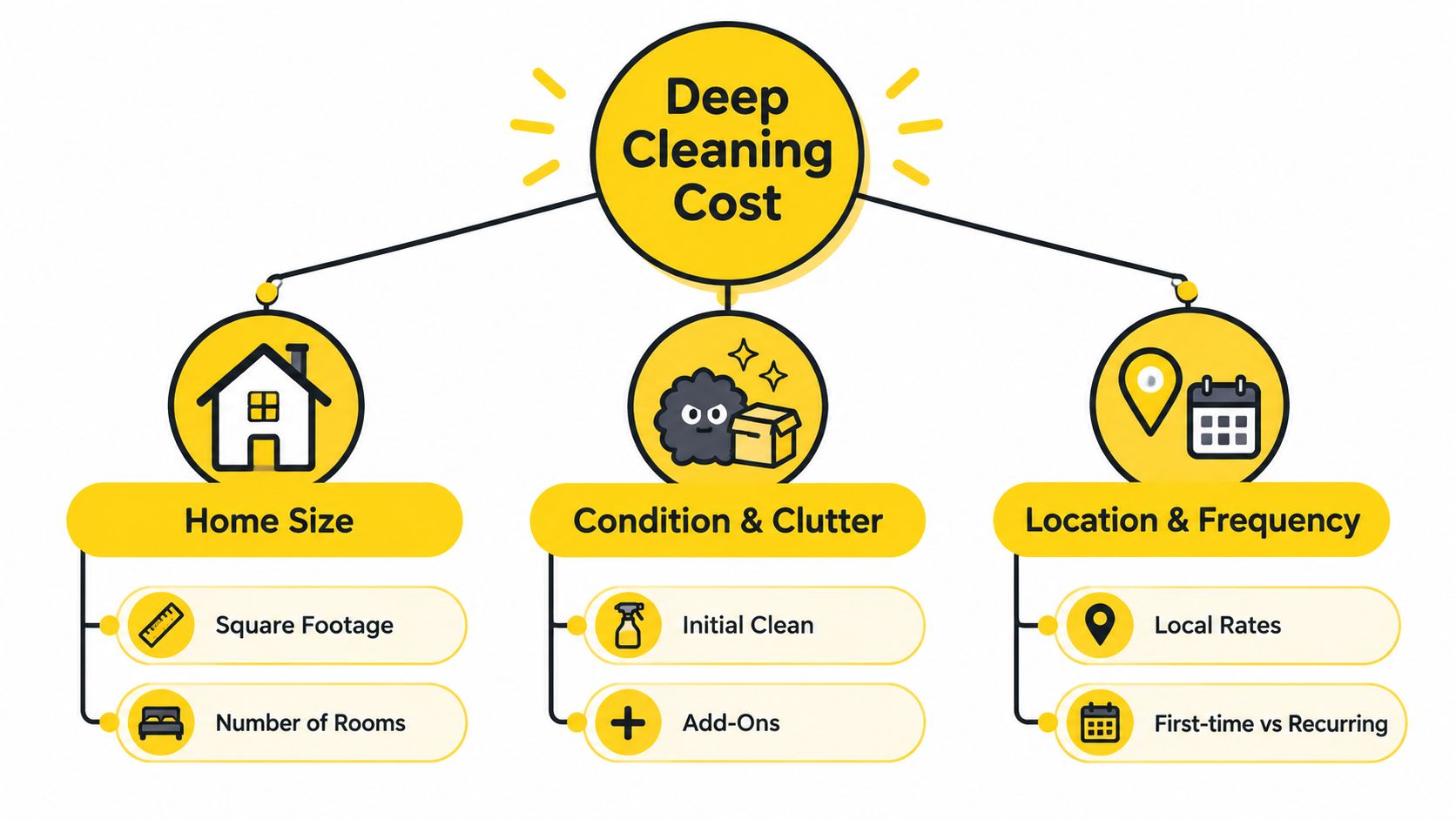
A homeowner may open three pricing pages for the same 2,000 square foot home and see three very different numbers. One quote starts near a basic reset. Another assumes hand-detailing in kitchens and baths. A third prices in extra time for buildup, pet hair, or first-time service work. The square footage matches. The labor assumption does not.
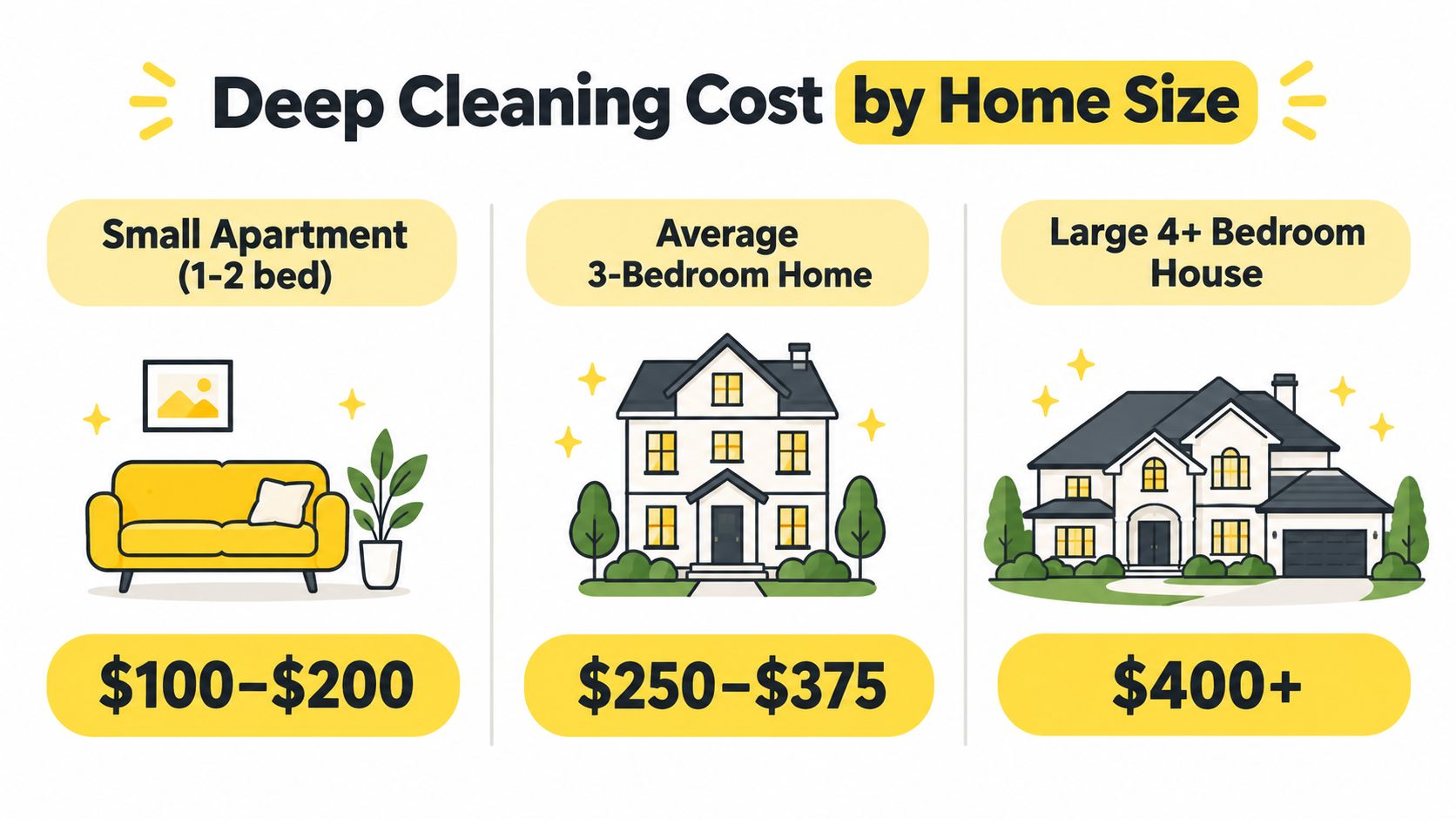
According to Angi's deep house cleaning cost guide, deep house cleaning in the U.S. is commonly priced as a one-time service averaging about $260, with many homeowners paying between $180 and $375. The same guide also shows broader market ranges around $200 to $400 per visit, with some very small jobs and very large jobs falling outside that middle band.
That range is wide, and that is normal.
Angi also notes that small apartments may start around $100 to $200, while very large homes can reach $330 to $900 in some cases. For a homeowner, that can look inconsistent. For a cleaning company, it reflects a simple reality. Deep cleaning is not one task. It is a bundle of tasks that expands or contracts based on the home.
That is why national averages work best as orientation, not as a final quote. They help a homeowner judge whether a price is generally in bounds. They also help a new cleaning business avoid pricing so low that the job turns unprofitable before the crew even unloads supplies.
For a wider pricing reference across one-time, recurring, and specialty service categories, this house cleaning cost guide gives useful context.
Local labor costs, travel patterns, housing stock, and customer expectations all shift the number. A downtown condo in a high-cost city and a suburban ranch in a lower-cost market may have the same square footage, but they rarely price the same in practice.
Many cleaning companies also use local pricing models based on square footage bands, room counts, or hourly equivalents. That is where homeowners and cleaners often talk past each other. The homeowner sees a price page and expects a neat category. The cleaner is trying to estimate crew time, detail level, and whether the home still fits the company's definition of a standard deep clean.
A local example makes this easier to see. In some markets, a 3-bedroom deep clean may sit near the middle of the national range. In others, the same home moves higher because wage expectations, parking time, setup friction, or heavier average soil levels add labor to the job.
AI estimating tools such as Estimatty help close that gap by turning visible home details, service selections, and condition signals into a faster first-pass quote. That gives homeowners a clearer starting number and gives cleaning businesses a quoting process that reflects actual operations instead of guesswork.
Later in the same section, it helps to hear the topic explained out loud too.
The cleanest way to price a deep clean is to stop asking, “How big is the house?” and start asking, “How many labor hours will this scope require?”
That shift matters because crew time is the strongest operational benchmark. According to LatestCost's deep cleaning and regular cleaning cost comparison, deep cleaning typically requires about 4 to 8 labor hours for an average home. Smaller homes can still take 2 to 3 hours if buildup is heavy, while larger homes may require a full day and two or more cleaners.
LatestCost also notes that many providers end up using hourly-equivalent pricing around $45 to $110 per cleaner or flat rates in the $220 to $440 range because total cost scales with both crew size and condition severity, not size alone.
That explains why two estimates can differ even when two homes look similar on paper. One cleaner may be pricing a straightforward reset. Another may be pricing detail work in bathrooms, degreasing in the kitchen, and extra time around neglected edges and fixtures.
Practical rule: If the condition lowers how much area a cleaner can cover in an hour, the estimate has to rise.
Bathrooms and kitchens are usually the cost accelerators. They contain more surfaces per square foot, more moisture-related residue, more corners, and more hand-detail work.
A wide living room adds area. A dirty bathroom adds intensity.
That's why these factors often move an estimate faster than raw square footage:
Many pricing pages fall short. They mention tasks like baseboards, grout, appliance interiors, window tracks, and behind-furniture cleaning, but they don't always explain when those tasks are part of a normal deep clean and when they trigger a higher-service tier.
A useful reality check for new operators is to compare how local businesses position their offerings. Browsing listings like Browse Clean S Express can help you see how service menus are framed in the market, even before you finalize your own estimating rules.
If you're running the business, your job isn't just to publish a price. It's to define the point where “deep clean” ends and “specialty work” begins.
A homeowner sees a price range on a website and expects a simple answer. The cleaner sees a floor plan, bathroom count, buildup level, and the number of crew hours the job will take. Home size helps connect those two views, but only as a starting point.
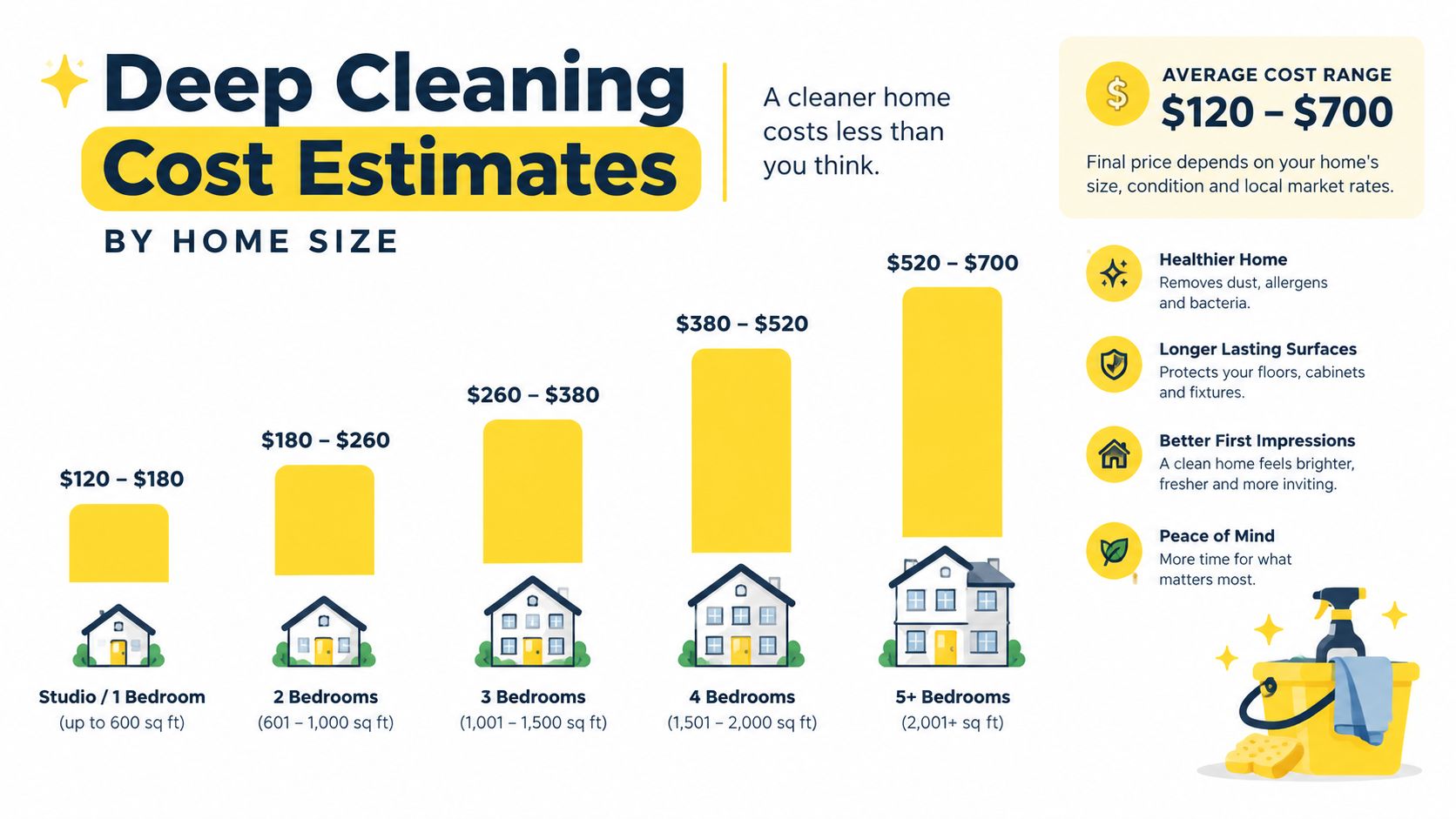
A useful way to read size-based pricing is to treat square footage like the frame of the estimate. The price gets filled in by labor density. Two homes with the same square footage can price very differently if one has one bathroom and light upkeep, while the other has three bathrooms, a worked-in kitchen, and months of catch-up detail work.
For a small apartment, the market often starts around $100 to $200, as noted earlier from Angi. That range usually fits a compact home where the cleaner can move room to room without many slowdowns.
Small does not always mean cheap.
A 700-square-foot apartment with one bathroom and light buildup may clean faster than expected. A 700-square-foot apartment with soap scum, greasy cabinet fronts, crowded surfaces, and neglected corners can absorb far more labor than the size suggests. That is the gap homeowners often miss when they compare pricing pages, and it is the gap cleaners have to price correctly to stay profitable.
Size-based estimates become more useful, because many quotes are built from a square-foot baseline and then adjusted. Fixr's deep house cleaning cost guide summarizes a common deep-clean range of $0.15 to $0.30 per square foot. For a 2,000 square foot home, that points to a rough estimate of about $300 to $600, before you account for local labor rates, condition, and task limits.
That range makes more sense if you picture crew time instead of just area. A typical three-bedroom home has more transitions, more fixtures, more trim, and more surfaces that need hand work. The square footage explains part of the quote. The stops and starts explain the rest.
For owners comparing service menus and common pricing logic, this guide on how much a house cleaning should cost helps place deep cleaning beside standard service without mixing the two.
At the large-home end of the market, national pricing ranges can stretch much wider. Angi's figures, cited earlier in the article, show that very large homes can land much higher than mid-size properties because the extra square footage often comes with extra bathrooms, more detailed trim, additional bedrooms, and longer walking time for the crew.
A large home works like a multiplier. Every detailed task shows up more times.
That matters for quoting. A 3,500-square-foot home is not just a 2,000-square-foot home with more floor to mop. It may have four bathrooms instead of two, double the baseboards, more window ledges, another staircase, and more rooms where dusting and wipe-down work resets the cleaner's pace. From the homeowner side, the quote can look inconsistent. From the operator side, the labor map is larger and more fragmented.
This is also why AI estimating tools help. They can start with home size, then layer in condition thresholds, room counts, and likely add-ons so the customer gets a faster estimate and the cleaning company gets a quote that matches the workload.
If you need a fast estimate before doing a walk-through, use simple math and then pressure-test it against condition.
One practical starting point is square footage. According to Fixr's deep house cleaning cost guide, several sources break deep-clean pricing into different billing mechanics, including about $0.15 to $0.30 per square foot as a common range. The same guide notes hourly pricing per cleaner is often cited around $25 to $60 per hour or $40 to $100 per hour, depending on market and provider.
Start with square footage. Then ask how dirty, how dense, and how detailed.
The biggest failure point isn't math. It's missing condition thresholds.
Current pricing guidance summarized by Tidy's house cleaning cost article points out that many pricing pages under-explain condition-based add-ons and exclusions, even though those often determine whether an estimate is accurate. The same guidance notes that deep cleaning often clusters around $200 to $500, while move-out and post-construction work can run higher once there's heavy buildup, large square footage, or multiple bathrooms.
That's why a calculator should ask better questions, not just collect room count. A useful estimating workflow needs to capture things like buildup level, appliance interiors, bathroom count, and whether the home is occupied, vacant, or fresh from renovation.
If you want a cleaner framework for building those rules into your process, this cleaning cost calculator article is a strong next read.
Most pricing errors don't happen because owners can't do math. They happen because intake is sloppy.
A prospect fills out a short form. They write “3 bed, 2 bath, deep clean.” The office calls back later. Someone asks a few extra questions. Another person reviews the job differently. By the time the estimate goes out, the business is relying on fragments instead of a structured scope.
That's where software has become useful. Some service businesses already use conversational tools to qualify leads before a person steps in. If you want a cross-trade example, this roundup of AI marketing tools for electricians shows how home service companies are using AI for faster response and cleaner lead handling.
For cleaning, the core value is straightforward. A conversational estimator can ask the questions static forms usually skip, such as property condition, appliance interiors, buildup level, urgency, and whether the home is occupied.

One example is Estimatty's AI estimating software for cleaning, which is built to engage prospects instantly, collect scope details like square footage, surfaces, and urgency, and return consistent estimates without relying on after-hours voicemail or gut-feel pricing.
That matters because deep cleaning estimates fail when businesses don't standardize their questions. If one office manager asks about oven interiors and another forgets, your pricing won't stay consistent.
The estimate gets more accurate when the system gathers the same scope details every time.
There's also an operations angle beyond estimating. If better lead flow creates a hiring bottleneck, resources like the blogs at estimatty.com/blog and get.pipehirehrm.com/blog can help owners think through process and staffing, and pipehirehrm.com is worth knowing if you're building a cleaning team.
The main point is simple. Better estimating starts before the number. It starts with structured intake.
Deep cleaning gets mispriced when people try to reduce it to a single average. The market doesn't work that way, and the labor doesn't either.
A homeowner wants clarity. A cleaning business needs margin protection. Both sides benefit when the estimate reflects actual scope instead of a rushed guess. That means looking beyond bedroom count and asking better questions about condition, bathrooms, kitchen intensity, add-ons, and whether the work is really deep cleaning or drifting into a heavier category.
A strong estimating process does a few things well:
When owners skip those steps, they usually underprice difficult jobs or overprice easy ones. Neither outcome helps the business grow.
If you're a homeowner, evaluate estimates by what's included, not just by the top-line number. Ask whether appliance interiors, baseboards, grout, window tracks, and buildup removal are part of the service or separate tasks.
If you're a cleaning business owner, tighten the process before you chase more leads. Standardize what qualifies as a deep clean. Define your condition thresholds. Build estimate logic around labor reality, not wishful pricing.
The companies that handle deep cleaning well usually aren't doing anything mysterious. They just ask better questions, classify jobs correctly, and send estimates that match the work.
If deep cleaning estimates still feel inconsistent inside your business, Estimatty gives you a structured way to capture scope details and return consistent estimates without relying on callbacks or gut feel. It's built for cleaning companies that want a cleaner intake process, clearer pricing, and fewer surprises when the crew arrives.