
October 23, 2026
How to Start Commercial Cleaning in 2026
Learn how to start commercial cleaning in 2026 with proven steps for pricing, staffing, licensing, and automation that win recurring contracts.

Tuesday, September 8, 2026
How Much Should a House Cleaning Cost. Learn how much a house cleaning should cost in 2026, with real pricing ranges by home size, service type, and tips

A standard house cleaning in the U.S. typically runs $120–$280 per visit in 2026. The actual cost depends on your home's size, the service type, and how often you book it.
You're probably looking at two numbers right now. One cleaner says $95 for your three-bedroom home. Another says $310. Neither feels obviously fair, and a fast phone quote doesn't tell you whether you're comparing the same work.
The reliable way to answer how much should a house cleaning cost is to price the actual job, not just the address. Square footage, bedrooms, bathrooms, condition, pets, included rooms, cleaning depth, and frequency all change the estimate. A number without those details is little more than a guess.
For mainstream residential service, $120–$280 per visit is the practical U.S. benchmark for a standard clean in 2026, according to current house cleaning price guidance. That range generally fits routine maintenance in a common two- or three-bedroom home. Deep cleaning and move-out work cost more because the cleaner has more labor-intensive tasks to complete.
A home between 1,000 and 2,500 square feet often falls inside that band for recurring maintenance, but size alone doesn't settle the price. A compact home with several bathrooms, heavy pet hair, or significant clutter can take longer than a larger, orderly property with fewer fixtures. A price far below or above the range usually means the cleaner and homeowner aren't discussing the same scope.
A phone quote might exclude the second bathroom, assume an empty kitchen counter, or treat a one-time cleaning like a weekly visit. The homeowner hears a total, while the cleaner mentally fills in missing details with assumptions. That's why a low number can become a higher bill, and a high number may include work you never requested.
A documented estimate is different. It connects the price to measurable inputs such as square footage, bedrooms, bathrooms, service depth, home condition, and schedule. If you're managing a cleaning operation and also hiring support staff, resources on how to streamline caregiver recruitment can help illustrate the same broader principle: define the workload before assigning a cost.
Use this order when checking a cleaner's number:
For a broader pricing framework, compare your expectations with this guide to house cleaning prices. The fair number for your home is the one that clearly states what the cleaner will do, how often they'll do it, and what conditions could change the total.
Cleaners usually price residential work in three ways: a flat per-visit rate, an hourly rate, or a square-foot rate. None is automatically superior. The important question is whether the method reflects the actual space and clearly defines the work.
Take an 1,800-square-foot, three-bedroom, two-bathroom home needing a standard clean.
A flat rate is easiest to budget. For this example, a standard visit might fall around $150–$250, based on the cleaner's assessment of the labor involved. That structure protects you from an unexpectedly long visit, but only if the scope is written down.
The cleaner is assuming a certain condition, room count, and task list. Ask whether the rate includes both bathrooms, kitchen surfaces, floors throughout, dusting, and trash removal. If the home hasn't been cleaned professionally in a long time, the first visit may need a separate estimate.
Hourly billing commonly falls around $25–$75 per cleaner, while some consumer data places cleaner pricing around $40–$55 per hour in 2026. See the Angi house cleaning cost data for those published market benchmarks.
Hourly pricing is transparent, but it puts more uncertainty on you. You may not know whether the job needs three labor hours or eight. It can also create the wrong incentive: a dirty home takes longer, while an efficient crew finishes sooner. If you accept hourly pricing, request an expected labor range and a spending cap in writing.
Square-foot pricing provides a clean mathematical baseline. Published guidance places standard residential cleaning around $0.06–$0.16 per square foot, with some market guidance citing $0.10–$0.20 for standard work and up to $0.25 for deep cleaning, as summarized by HomeGuide's pricing benchmarks.
For an 1,800-square-foot home, that method can produce a useful starting point, but it ignores clutter, pets, layout complexity, and fixture count unless the cleaner adds those variables separately. A good estimate uses square footage as its foundation, not its entire logic.
Practical rule: The pricing model matters less than the quality of the inputs. A detailed flat estimate beats a careless hourly promise.
Cleaning businesses also need to price labor, supplies, travel, and margin consistently. Owners reviewing software or operating costs can use Bragly plan costs as a comparison point when evaluating business tools. Homeowners can apply the same discipline by comparing the work behind each number, not just the number itself. More background on this process appears in business pricing strategies.
Square footage establishes the workload, but bedrooms and bathrooms often predict cleaning time more accurately than floor area alone. A small home with multiple bathrooms can demand more detail than a larger open-plan property. Condition and layout then decide whether the property sits at the bottom or top of its range.
The published rate card below gives practical per-visit tiers by home type. It lists studio or efficiency homes at $85–$115, one-bedroom apartments at $100–$140, two-bedroom, one-bath homes at $120–$170, three-bedroom, two-bath homes at $150–$215, four-bedroom, 2.5-bath homes at $195–$275, five-bedroom homes at $250–$350, and six-bedroom-plus estates at $325–$500 or more, based on this cleaning pricing guide.
| Home Size | Bedrooms / Baths | Typical Price Range | Assumptions |
|---|---|---|---|
| Studio or efficiency | Studio, one bath | $85–$115 | Compact layout, one kitchen area, average condition |
| Small apartment | One bedroom, one bath | $100–$140 | Routine surfaces, floors, kitchen, and bathroom |
| Smaller home | Two bedrooms, one bath | $120–$170 | Standard maintenance, moderate room count |
| Family home | Three bedrooms, two baths | $150–$215 | Typical kitchen, living areas, and two bathrooms |
| Larger family home | Four bedrooms, 2.5 baths | $195–$275 | More rooms and fixtures, average condition |
| Large home | Five bedrooms | $250–$350 | Multiple living areas and a larger cleaning footprint |
| Estate | Six or more bedrooms | $325–$500+ | Extensive rooms, bathrooms, and possible specialty areas |
A studio usually lands near the lower end when it has minimal clutter and one bathroom. A one-bedroom apartment moves upward when the kitchen has heavy grease, floors require special handling, or the cleaner must spend extra time on pet hair.
A three-bedroom, two-bath home has more surfaces and fixtures than its bedroom count suggests. Bathrooms require detail work, and the second bathroom can shift the estimate upward even when the square footage remains moderate. Bonus rooms, finished basements, staircases, and separate living spaces create the same effect.
Four-bedroom homes above 2,500 square feet generally command higher totals. A property with several bathrooms, a finished basement, and a complicated layout can exceed the listed tier because the cleaner is pricing labor, not empty floor area.
Use a house cleaning cost calculator to organize the inputs before contacting providers. Give the cleaner exact square footage, bedroom and bathroom counts, and the rooms you want serviced. That turns a broad tier into a defensible estimate.
A standard maintenance clean, deep clean, and move-out clean are different jobs. Treating them as interchangeable is the fastest way to receive a misleading number.
A standard clean maintains an already manageable home. It usually covers dusting, surface wiping, kitchen counters, bathroom cleaning, vacuuming, mopping, and routine tidying. A deep clean reaches neglected areas such as baseboards, cabinet fronts, grout, detailed fixtures, and buildup. Move-out work adds a reset of the entire property, often with empty rooms, appliance interiors, and areas exposed only after furniture leaves.
The verified market data supports a clear frequency pattern. Weekly visits are often 15–25% lower per visit, biweekly visits 10–15% lower, and monthly or every-four-weeks service 5–10% lower than comparable one-time work because the home stays cleaner between visits, according to recurring cleaning cost guidance.
| Service Type | Multiplier vs. Standard | Frequency | Typical Adjustment |
|---|---|---|---|
| Standard maintenance | Baseline | One-time | Full routine rate |
| Standard maintenance | Baseline | Weekly | Often 15–25% less per visit |
| Standard maintenance | Baseline | Biweekly | Often 10–15% less per visit |
| Standard maintenance | Baseline | Monthly or every four weeks | Often 5–10% less per visit |
| Deep cleaning | Higher than standard | One-time or occasional | More labor and detailed work |
| Move-out cleaning | Highest scope | One-time | Full-property reset and added detail |
Don't use unsupported multipliers to force a price. The available verified data supports the recurring discounts above, but it doesn't establish a universal percentage for deep or move-out work. Those services should be estimated from the added tasks and condition.
A weekly visit can remain efficient because the cleaner is maintaining a baseline. A one-time deep clean may require extra time to remove buildup before maintenance becomes practical. Move-out work can rise further because empty rooms reveal edges, floors, fixtures, and appliance interiors that routine service may not include.
For a detailed task comparison, review this deep cleaning price list. Ask for separate estimates for the initial reset and the recurring service that follows. That prevents a cleaner from hiding a deep-clean workload inside an unrealistic maintenance price.
The following examples are useful yardsticks, not universal rates. Each assumes an average regional labor market and a clearly defined scope. Change the condition, pets, bathrooms, or service depth, and the estimate should change with it.
| Home Scenario | Square Footage | Service Details | Estimated Cost |
|---|---|---|---|
| Studio apartment | 600 sq ft | One bath, no pets, average condition, standard biweekly service | $95–$135 |
| Family home | 1,800 sq ft | Three bedrooms, two baths, one pet, maintained condition, weekly service | $150–$220 per visit |
| Deep-clean home | 2,500 sq ft | Four bedrooms, two baths, pets, moderate buildup, one-time deep clean | $350–$500 |
| Move-out property | 3,200 sq ft | Four bedrooms, three baths, no furniture, average condition, full move-out clean | $650–$900 |
A small studio with one bathroom and no pets should sit near the lower end of the table when the condition is average and service is biweekly. Clutter, heavy kitchen grease, or a long gap since professional cleaning can push the estimate upward. The cleaner still needs to price floors, bathroom fixtures, kitchen surfaces, and the time required to work around belongings.
The 1,800-square-foot family home has more rooms and two bathrooms, but weekly service keeps the workload controlled. A pet adds hair and dander to the labor, especially on floors and upholstery-adjacent surfaces. If the homeowner expects only standard maintenance, the estimate should remain within the displayed band. If the first visit requires a reset, that should be a separately explained amount.
At 2,500 square feet, four bedrooms, two bathrooms, pets, and moderate buildup, a one-time deep clean requires substantially more detail than recurring maintenance. Baseboards, cabinet fronts, grout, window sills, and neglected surfaces must be addressed rather than merely wiped during a routine pass.
The 3,200-square-foot move-out home carries the highest estimate because the service covers a larger footprint and a full property reset. Empty rooms help cleaners work efficiently, but they also expose floors, edges, and surfaces that furniture previously concealed. If the property includes appliance interiors or heavy residue, those items need to appear as separate scope lines.
If a provider's estimate falls well outside the comparable band, don't accept or reject it immediately. Ask which assumption differs. A higher number may include more rooms or deeper work. A lower number may exclude bathrooms, supplies, travel, or the first-visit reset.
A verbal quote based on a quick description is usually a guess. The cleaner can't verify your true square footage, surface count, pet-hair load, clutter, fixture condition, or the number of rooms you expect them to service.
An estimate is a documented range tied to measurable inputs. It should identify square footage, bedrooms, bathrooms, service type, condition, included rooms, add-ons, and frequency. That gives both sides a record of what the number means.
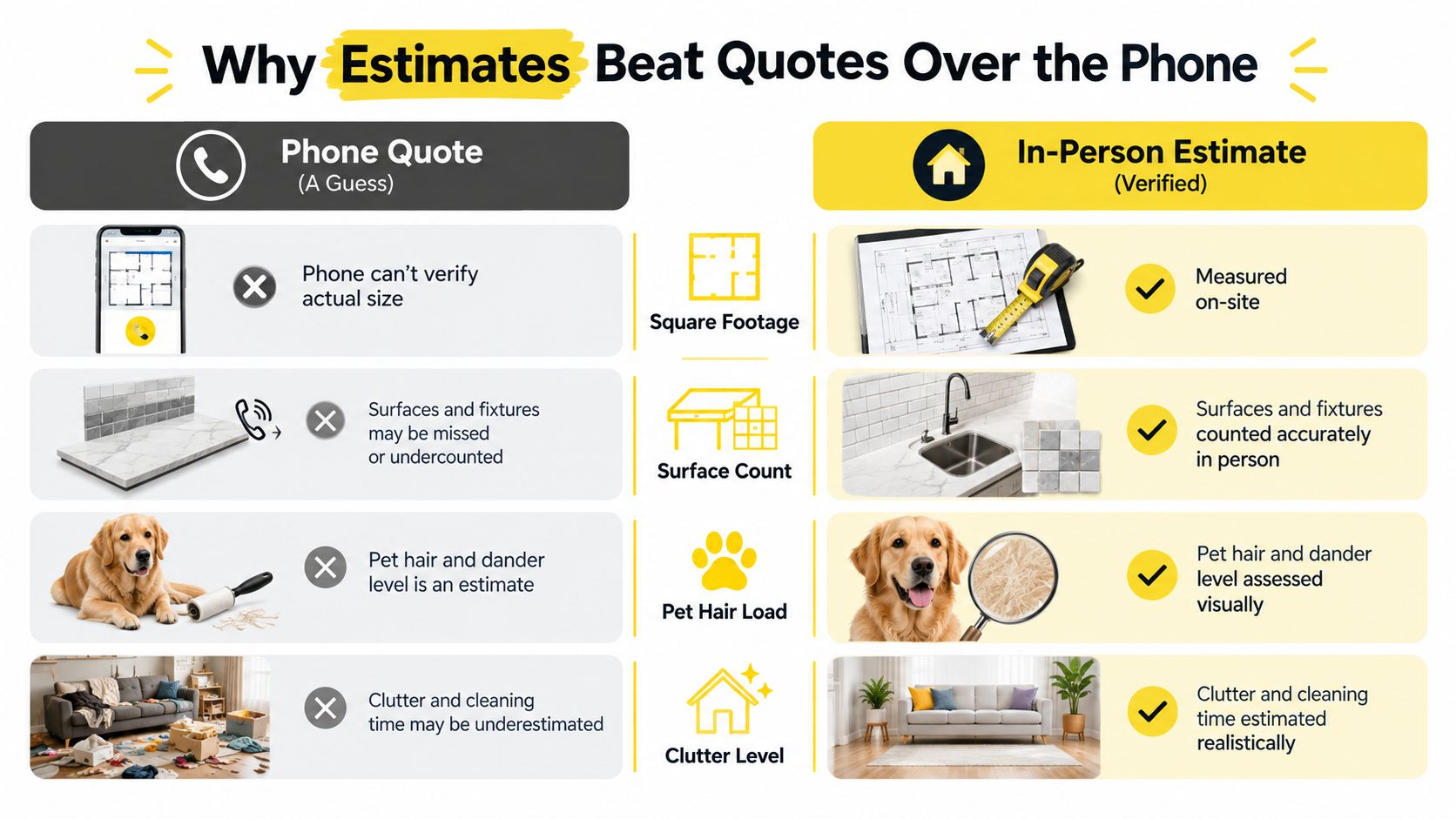
A cleaner doesn't need to visit every home if you provide a complete description, clear photographs, or a video walkthrough. But the provider must collect enough information to price the labor fairly. A proper estimate should state what happens if the condition differs when the crew arrives.
A 10–15% adjustment can occur once work begins when the actual condition differs from the information provided, according to the supplied cleaning cost guidance. The adjustment should be explained before extra work starts. A fixed number given over the phone gives the cleaner two bad choices: pad the price in advance or absorb the loss when the job takes longer.
Watch for these warning signs:
Read this explanation of a quote by phone before accepting a verbal total. A trustworthy provider will explain assumptions instead of pretending uncertainty doesn't exist.
The same distinction matters for cleaning businesses. An estimate is an operational document that can be revised when inputs change. A phone quote is only useful when the job is simple, the scope is already standardized, and the provider has enough detail to defend the number.
Give every cleaner the same information before asking for a price. Vague requests produce vague numbers, and “standard clean” means different things to different providers.
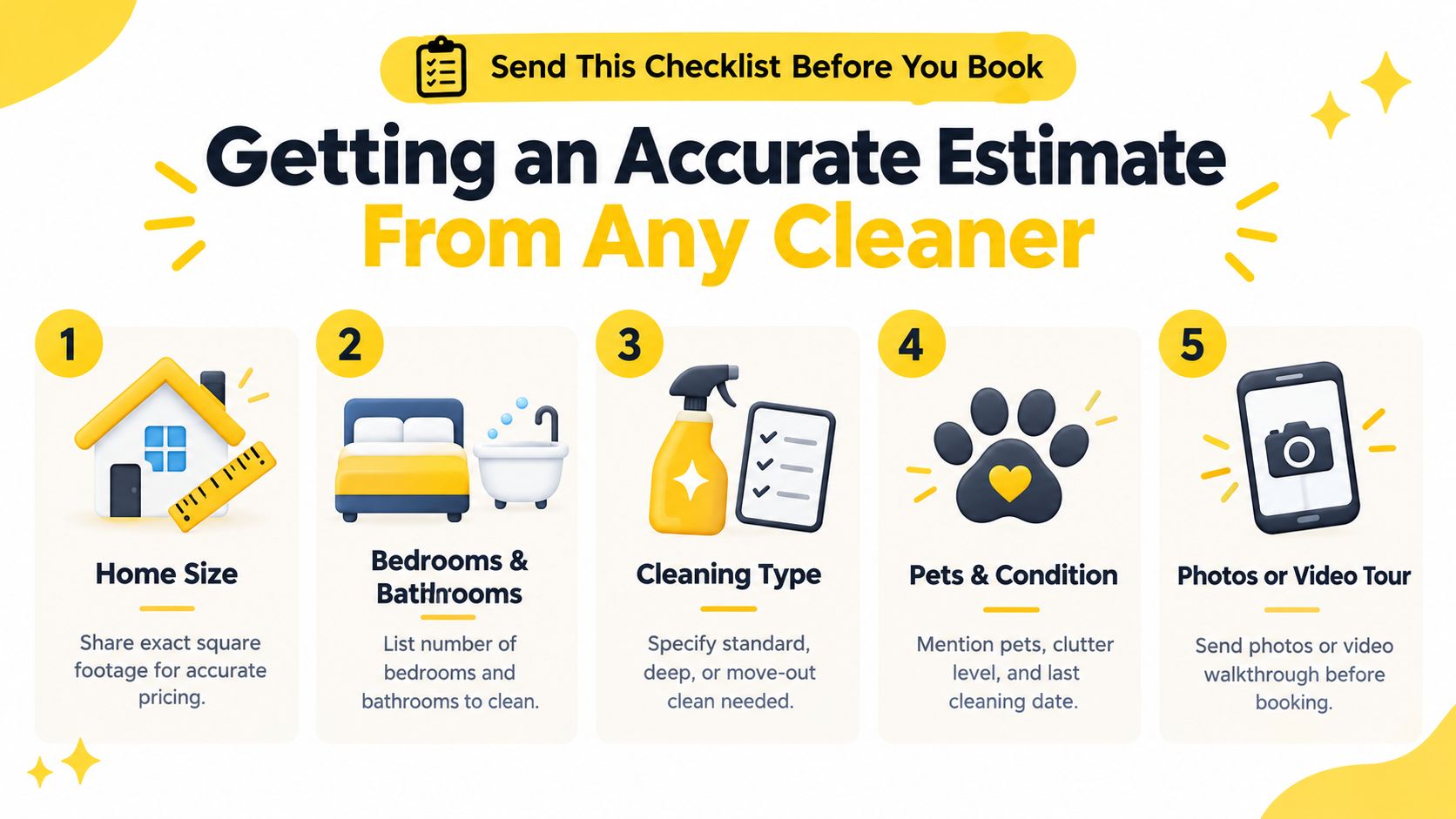
Include these facts in your first message:
Photos or a short video walkthrough can settle questions that a room list can't. Show kitchens, bathrooms, floors, pet areas, cluttered spaces, and any unusual layout. Don't hide the worst room. Accurate details protect you from a surprise and help the cleaner assign the right labor.
Ask the provider to separate labor, supplies, included tasks, add-ons, travel fees, cancellation rules, and any first-visit adjustment. If the cleaner charges hourly, request an expected labor range and a cap that requires your approval before the team exceeds it.
Compare two or three written estimates using identical scope, frequency, and home details. The lowest number isn't a bargain if it excludes bathrooms or interior appliance work. The highest number may be reasonable if it includes more labor, insured service, or a deeper checklist, but the provider should show you exactly why.
Push back on unclear terms:
Use this script: “Please turn this into a written estimate showing the square footage, rooms included, service type, frequency, labor assumptions, add-ons, fees, and the maximum I should expect to pay. If the condition changes the price, please explain the trigger before starting.”
That request separates a defensible estimate from a casual number.
Five rules will keep you from overpaying or accepting a misleading number.
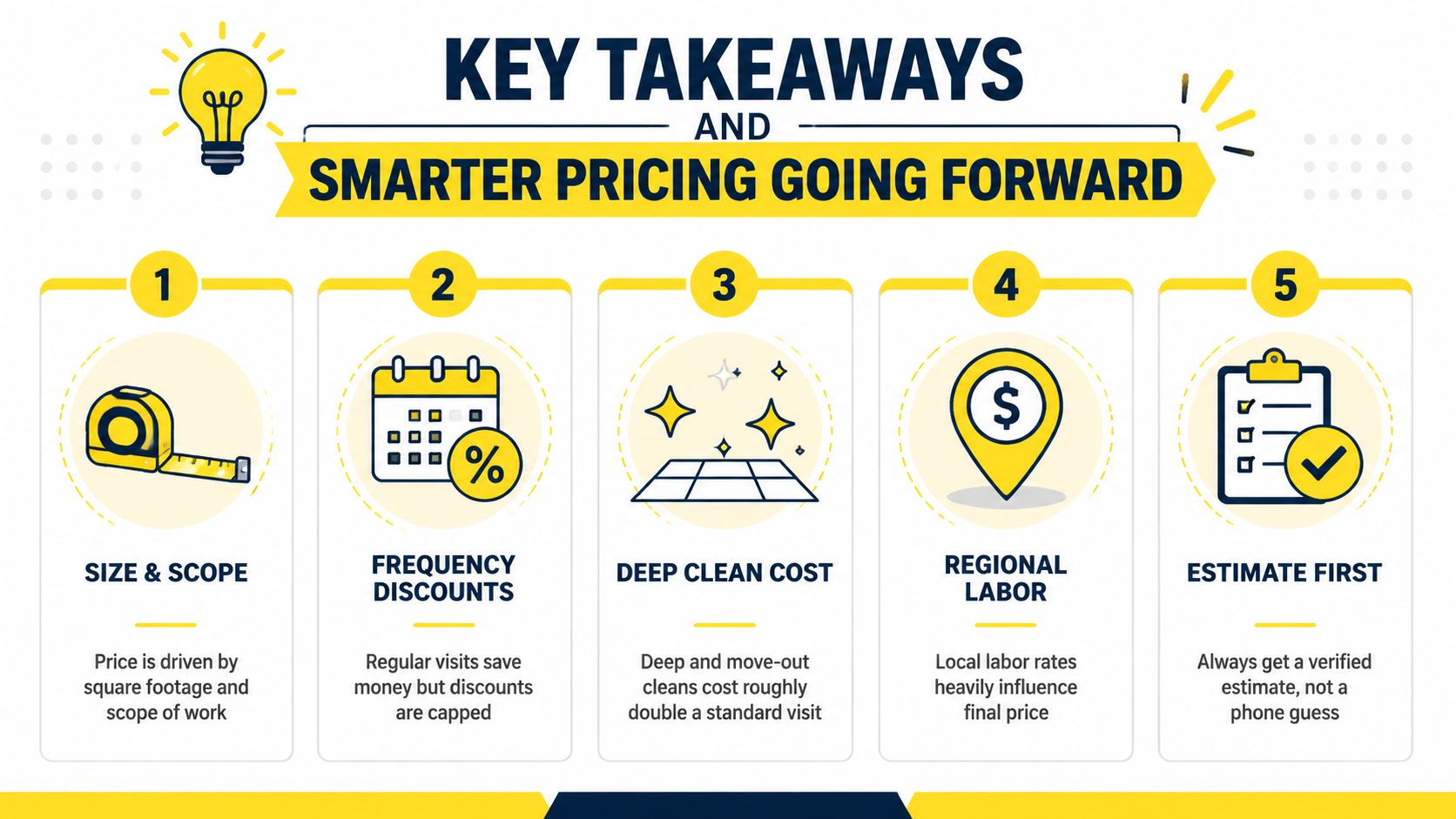
The central distinction is simple. A phone quote is a guess when the cleaner hasn't verified the home. An estimate grounded in square footage, service type, condition, scope, and cadence gives you a number you can evaluate.
Cleaning businesses are also moving toward standardized digital estimating. Homeowners can increasingly enter property details once and receive structured estimates from local providers instead of repeating the same information through phone tag and unclear forms. Tools such as Estimatty can collect details like square footage, surfaces, and urgency, then send estimates by text or email while notifying the cleaning team, giving owners a consistent process for handling inquiries.
Don't negotiate against yourself. Start with the applicable market range, demand matching scope, and ask the provider to explain every meaningful difference.
Visit Estimatty if you run a cleaning business and want to collect property details, standardize estimates, and respond to prospects beyond normal business hours. It can help turn scattered inquiries into documented pricing conversations without relying on rushed phone guesses.