September 8, 2026
How Much Should a House Cleaning Cost in 2026
How Much Should a House Cleaning Cost. Learn how much a house cleaning should cost in 2026, with real pricing ranges by home size, service type, and tips

Sunday, March 15, 2026
Build a better deep cleaning price list today. Explore 7 real-world examples and templates to create accurate, profitable estimates for your cleaning business.
.png)
Are you leaving money on the table with inconsistent deep cleaning estimates? A well-structured deep cleaning price list is the bedrock of a profitable cleaning business, but creating one that's competitive yet profitable feels like a constant battle. Many cleaning business owners struggle with the choice between flat rates, per-room pricing, or square-footage models. This uncertainty often leads to under-bidding that kills your margins, estimates so high they scare away leads, or overworked crews trying to make up for inaccurate pricing.
This guide is designed to end that guesswork for good. We're breaking down 7 real-world examples of deep cleaning price lists from actual companies, ranging from local independents like Seattle Green Cleaning Fairy to regional players like True Clean NYC. You will get a behind-the-scenes look at their pricing strategies, complete with screenshots and direct links for your own review.
For each example, we provide a deep strategic analysis of their chosen model, whether it’s flat-rate packages, detailed add-on menus, or hourly rates. You’ll get actionable takeaways you can use immediately to refine your own pricing. More importantly, we'll show you how to turn these insights into a systematic approach using tools like Estimatty, so you can stop losing leads to voicemail. The goal is to help you deliver instant, accurate estimates that convert browsers into booked jobs, 24/7. Let’s build the pricing strategy that will scale your residential cleaning business.
Estimatty isn't a template generator; it's an AI-powered sales automation platform designed to turn your website traffic and after-hours phone calls into booked jobs. It acts as a virtual sales assistant for your cleaning business, delivering instant, consistent, and professional estimates 24/7. This system is engineered to capture leads you might otherwise miss, converting curious browsers into confirmed customers without requiring manual intervention from you or your team. By standardizing how you present your deep cleaning price list, Estimatty eliminates inconsistent pricing and revenue leakage, presenting a unified, professional front to every potential client.
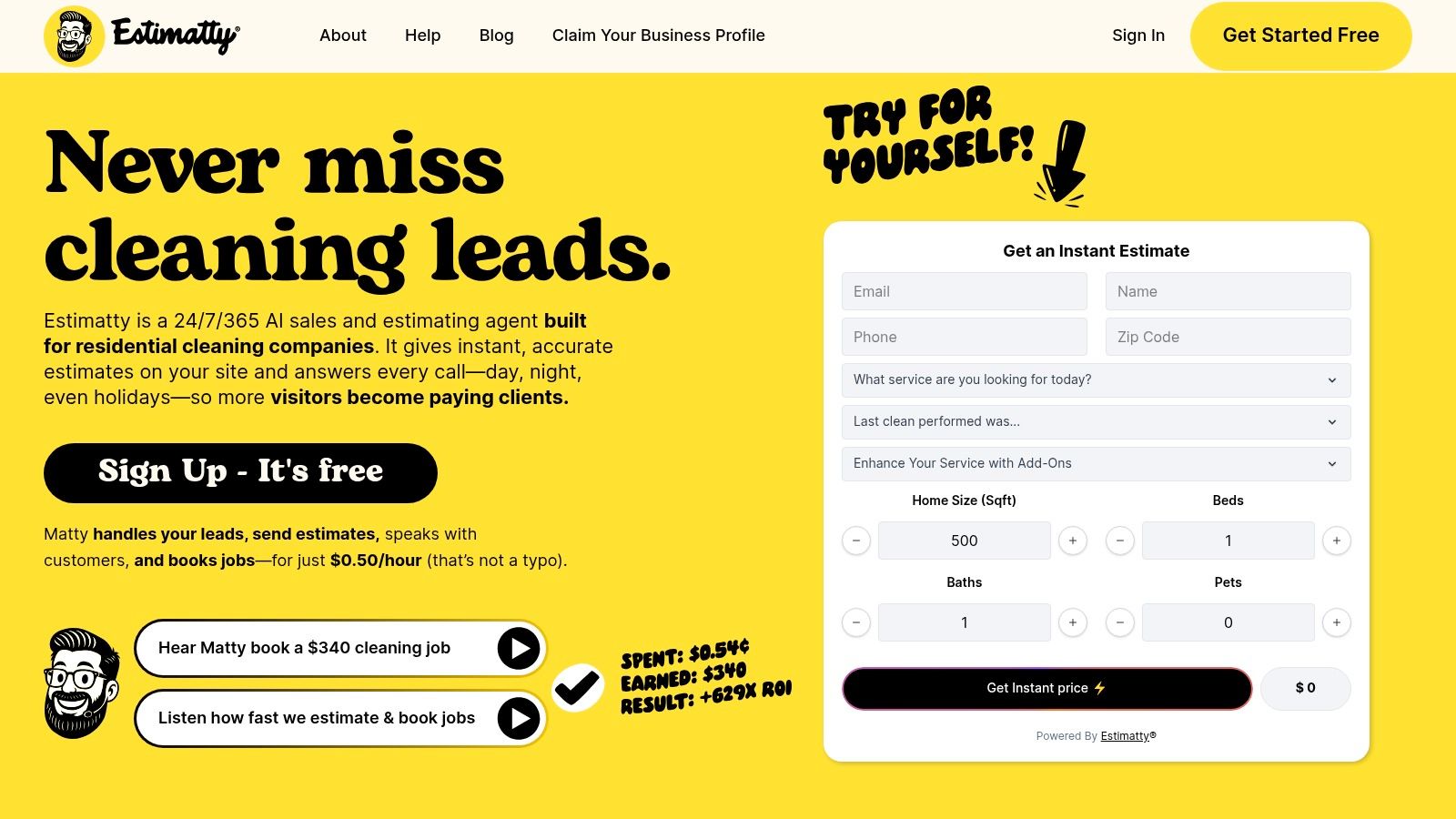
This platform stands out because it was built by cleaning industry veterans who understand the daily operational hurdles of running a service business. It’s designed not just to provide a price, but to guide a customer through the sales process, automate upsells for high-margin add-ons, and integrate directly into your existing workflow. For businesses struggling to answer every call or respond to every website inquiry immediately, Estimatty provides a powerful solution that works around the clock.
Estimatty’s primary advantage is its ability to provide true 24/7/365 lead capture and conversion. The AI-powered web and voice estimator ensures you never lose a lead because you missed a call or a late-night website inquiry.
Another major strength is the no-code setup and seamless integration. You can customize your entire deep cleaning price list, including per-room rates, square footage pricing, and special add-ons, without writing a single line of code.
Estimatty is designed for immediate impact. Customer case studies report tangible results, including a 15-35% increase in lead generation, doubled booking rates, and new customer acquisition within the first 30 days. The user experience is straightforward: you configure your pricing once inside the platform, and the AI handles the rest. This consistency is crucial for building brand trust and protecting your profit margins.
The platform also includes a human backup system with U.S.-based receptionists, ensuring that if the AI cannot handle a complex request, the lead is escalated to a person rather than being lost. For more insights on optimizing your team and operations alongside tools like this, the blogs at estimatty.com/blog and get.pipehirehrm.com/blog offer valuable articles on hiring and management.
Pros:
Cons:
Website: https://www.estimatty.com
HelloCleaners.us presents a prime example of a transparent, national-level pricing strategy that any cleaning business can study and adapt. As a nationwide, on-demand service, they publish a comprehensive menu of their cleaning prices, which serves as an excellent benchmark for understanding what a broad market is willing to pay. Their approach centers on clarity and giving the customer control over the final service package.
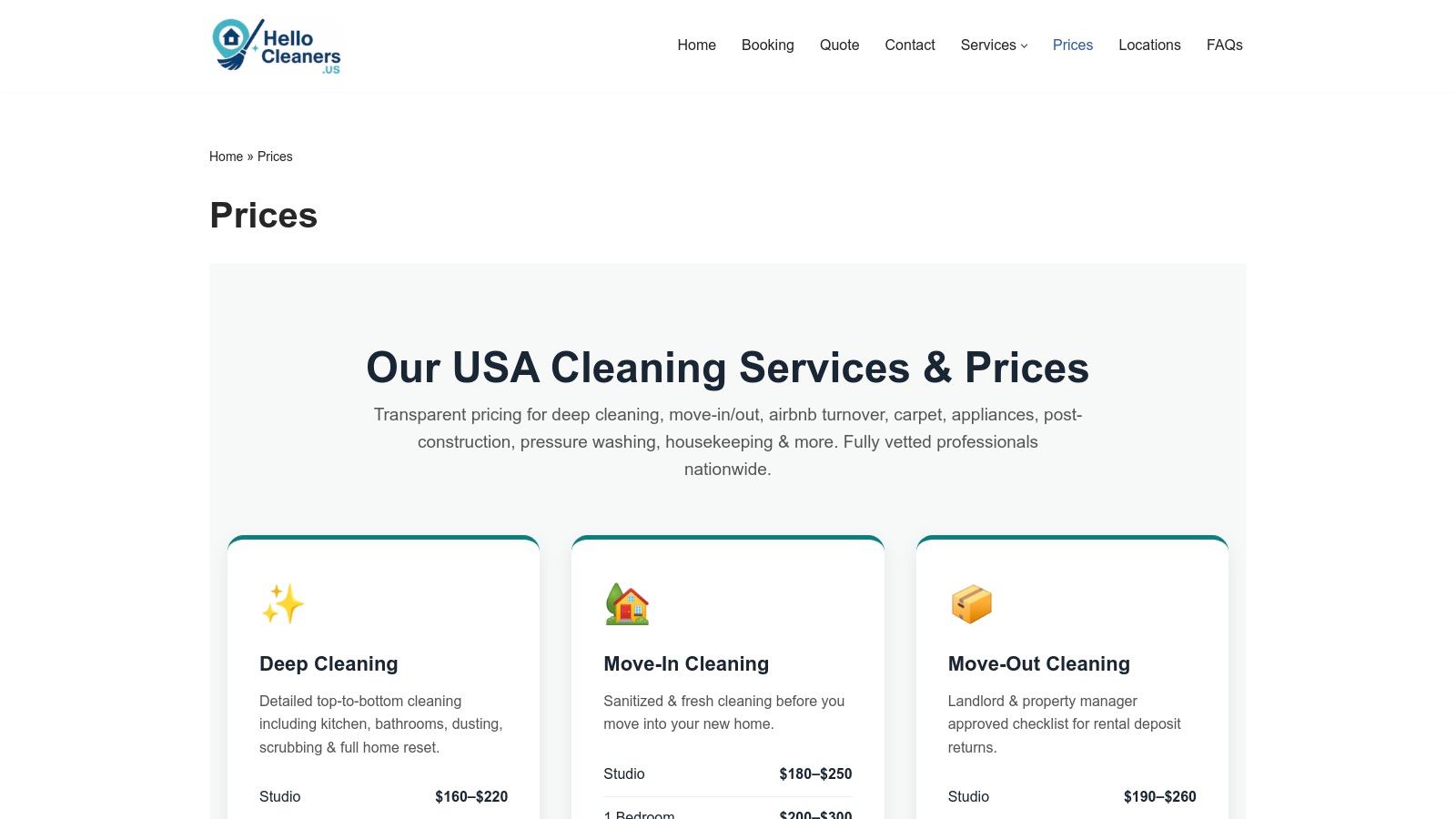
What makes their model so effective is its tiered structure combined with a-la-carte add-ons. They build their deep cleaning price list around the number of bedrooms, providing a price range for everything from a studio apartment to a 5+ bedroom home. This range-based pricing is a crucial tactic; it sets customer expectations while giving the company flexibility to adjust the final estimate based on the home's actual condition.
HelloCleaners.us excels by creating a public-facing price list that builds trust while managing profitability. Their website acts as an automated estimator, guiding potential customers through the process and upselling them on high-margin extras.
Key Strategy: The company uses price ranges (e.g., $180-$240 for a 1-bedroom deep clean) to anchor the customer's perception of value. This prevents sticker shock and creates a negotiation buffer, allowing the final estimate to account for unexpected soil levels or job complexity without appearing to deviate from the advertised rates.
Their add-on menu is a masterclass in itemized pricing. Each extra service, from inside the oven to deep carpet cleaning, has a fixed, clearly stated price. This empowers the customer to build their own service package, increasing the average transaction value organically. They feel in control, while the business systematically boosts revenue on every job.
Your cleaning business can directly apply the principles from the HelloCleaners.us model to refine your own deep cleaning price list.
By studying their public pricing, you gain a solid reference point for national averages, which you can then adjust for your local labor costs and market demand. You can find their complete pricing structure at https://hellocleaners.us/prices/.
Seattle Green Cleaning Fairy provides a superb model for local cleaning businesses looking to build authority through transparency and a niche focus. Unlike national chains, this company targets specific Seattle neighborhoods, demonstrating how a localized deep cleaning price list can attract ideal customers. Their website openly publishes flat-rate prices, removing the guesswork and building immediate trust with potential clients who value both clarity and eco-friendly practices.
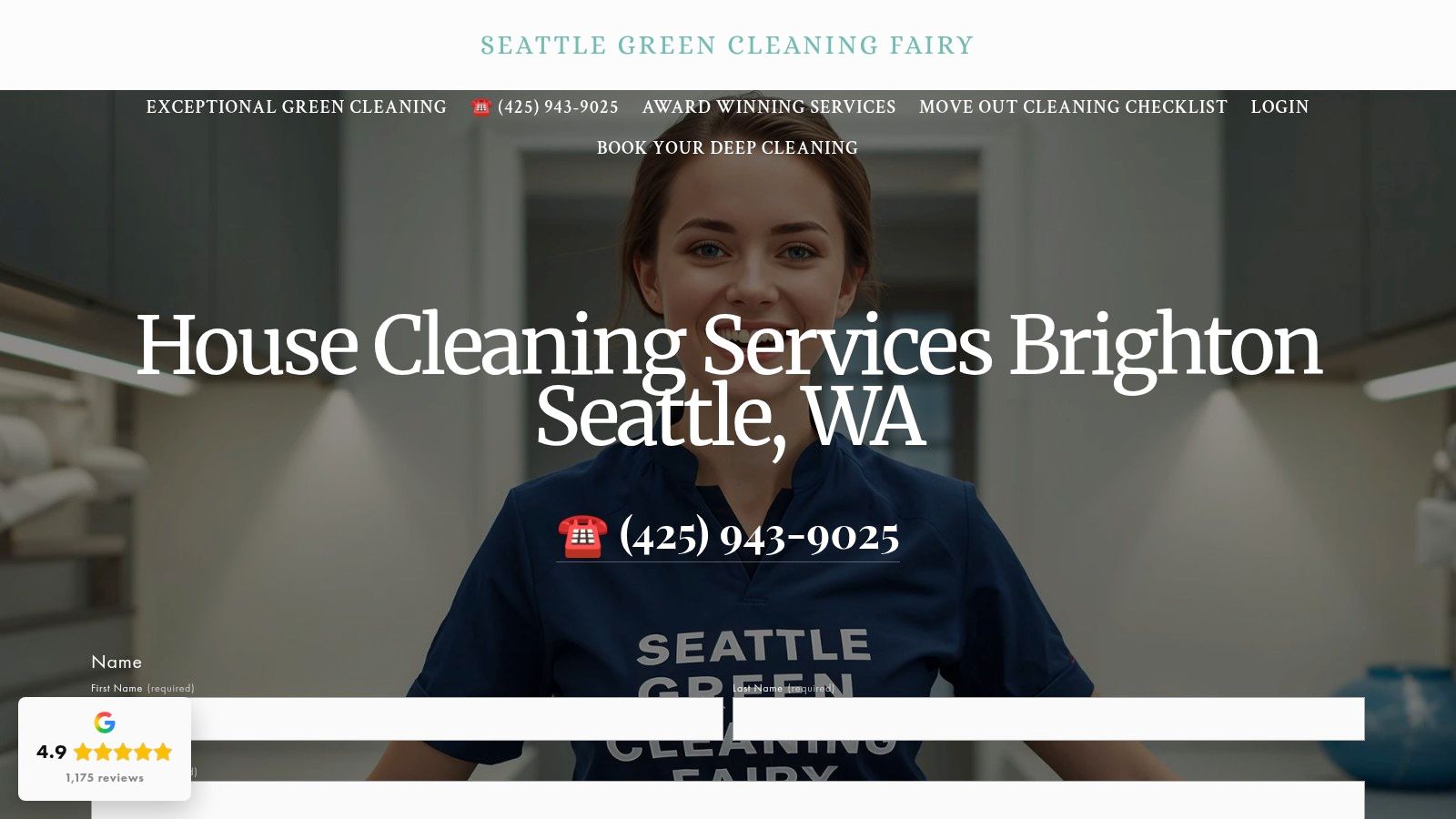
The strength of their approach lies in its simplicity. They offer fixed prices for deep cleans based on home size categories like "Studio/1 Bedroom," "2 Bedroom," and "3+ Bedroom." This flat-rate strategy is highly effective in a competitive local market, as it directly answers the customer's primary question: "How much will it cost?" By pairing this with a clear checklist of what's included in a deep clean, they set firm expectations from the start.
Seattle Green Cleaning Fairy masters the art of combining niche marketing (eco-friendly) with straightforward, non-negotiable pricing. This positions them as confident experts in their specific service area and methodology. Their website isn't just a brochure; it’s a direct sales tool that converts visitors by providing all the necessary information upfront.
Key Strategy: The company uses flat-rate pricing to eliminate friction in the buying process. A customer visiting their site sees a clear price (e.g., a set dollar amount for a 2-bedroom deep clean) and can book immediately. This confidence in their pricing signals quality and expertise, filtering out clients who are purely price shopping and attracting those who value reliability.
Their clear service descriptions are also a critical component. By explicitly stating what a "deep clean" entails-from baseboards to light fixtures-they prevent scope creep and disputes later on. This detailed checklist effectively defines the value a customer receives for the advertised flat rate, reinforcing the fairness of the price and managing client expectations perfectly.
Your local cleaning business can borrow from the Seattle Green Cleaning Fairy playbook to dominate your own neighborhood or city.
By analyzing their localized strategy, you can see how to build a powerful brand in a specific geographic area. You can find their full service details at https://www.seattlegreencleaningfairy.com/house-cleaning-services-brighton-seattle.
True Clean NYC offers a masterclass in clarity and operational transparency with its downloadable PDF price list. For cleaning businesses operating in dense, high-cost urban markets, their model is a must-study. The document is compact yet packed with detail, providing a fantastic framework for how to communicate value, manage client expectations, and plan job logistics all in one place. It serves as a powerful, tangible sales tool.
What makes this approach so effective is its directness. Instead of a dynamic web form, they provide a static PDF that clearly outlines flat-rate pricing for deep cleaning based on home size. More importantly, it includes estimated hours and the number of cleaners assigned to each job size. This preemptively answers the client's unspoken questions about what their money is actually paying for, tying price directly to labor.
True Clean NYC’s strategy is built on setting firm, transparent boundaries that build confidence with high-end clientele. By publishing their time and crew size estimates, they justify their premium New York City pricing and frame the service as a well-defined project rather than an open-ended hourly job.
Key Strategy: The inclusion of "Estimated Time" and "Team" size on their deep cleaning price list is a brilliant operational move. It helps the customer visualize the work involved (e.g., "10-12 man-hours for a 2-bed, 2-bath home") and sets a clear scope. This protects the company from scope creep and educates the client on the resources required, anchoring the value of the service in tangible labor.
Their add-on menu is equally direct. Each extra task, like cleaning inside the oven or washing walls, has a non-negotiable price. This removes ambiguity and makes the estimating process straightforward for both the client and the company’s internal team. They also clearly delineate different service types like "Move In/Out" and "Post-Construction," each with its own specific pricing logic, demonstrating specialization.
Your business can adopt the core principles of True Clean NYC's price sheet to create a powerful, no-nonsense estimating tool.
By examining their price list, you can learn how to communicate your pricing structure with authority and clarity, which is especially important in competitive, high-value markets. You can review their full price list at https://truecleannyc.com/pdf/Price%20List.pdf.
CLEENLY’s Seattle-focused landing page provides a brilliant blueprint for local cleaning companies aiming to dominate a specific geographic market. Instead of casting a wide net, they concentrate their messaging on the unique needs of a single city, demonstrating how to build authority and trust with a targeted audience. Their approach is a masterclass in local marketing, combining transparent price bands with a detailed service checklist.
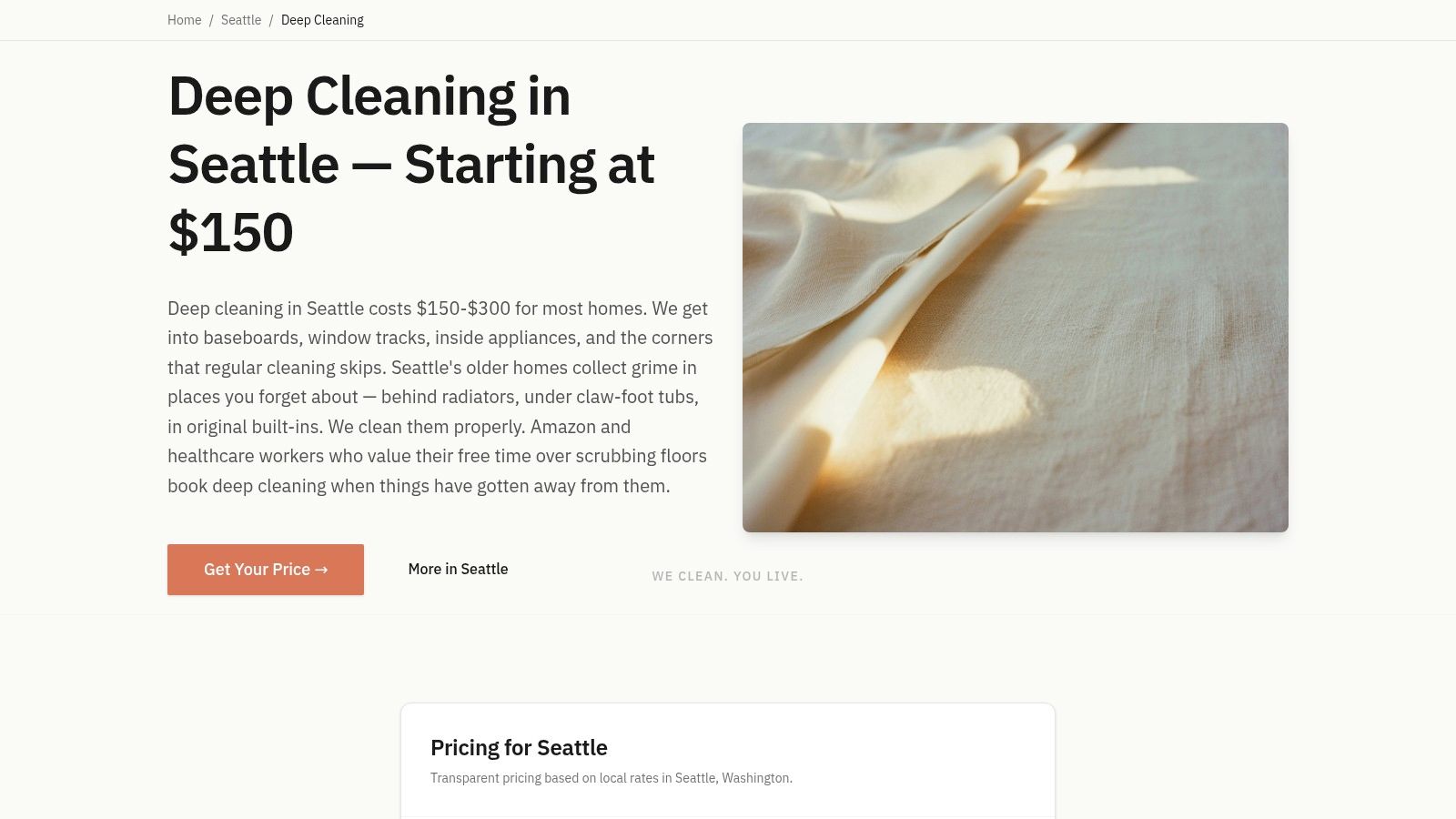
What sets their model apart is the fusion of a starting price point with an exhaustive "What's Included" checklist. By clearly stating that a deep clean includes tasks like cleaning baseboards, inside appliances, and window tracks, they preemptively answer the most common customer questions. This builds confidence and justifies the price, turning the deep cleaning price list from a simple number into a tangible value proposition.
CLEENLY succeeds by positioning itself as a specialized local expert. Their website speaks directly to Seattle homeowners, acknowledging the challenges of older homes and delicate surfaces common in the area. This hyper-local focus makes their service feel more personal and trustworthy than a generic national chain.
Key Strategy: The company uses a "starting from" price combined with a detailed checklist to set a clear value baseline. By showing a customer exactly what they get for the entry-level price, they anchor expectations and frame the service as comprehensive. The estimate for job duration (3-5 hours) further manages expectations about the intensity of the work involved.
This strategy effectively educates the customer. Instead of just seeing a price, a potential client understands the scope of work and the labor involved. The detailed checklist also acts as a subtle upselling tool; by seeing what's included, customers can more easily identify what’s not included, opening the door for conversations about custom add-ons.
Your local cleaning business can adopt CLEENLY’s focused strategy to build a strong regional presence and a more effective deep cleaning price list.
By studying CLEENLY’s local-first approach, you can learn to transform your pricing page from a simple list of numbers into a powerful, trust-building sales tool. You can review their targeted strategy at https://www.cleenly.app/seattle/deep-cleaning.
Soji Cleaners provides an insightful pricing model that uniquely blends flat-rate ranges with hourly labor costs, offering a transparent look into the financial mechanics of a multi-city cleaning operation. Their approach is especially valuable for businesses trying to balance the simplicity of package pricing with the reality of time-and-materials work. By publishing both, they give competitors a clear blueprint for building a flexible and profitable deep cleaning price list.
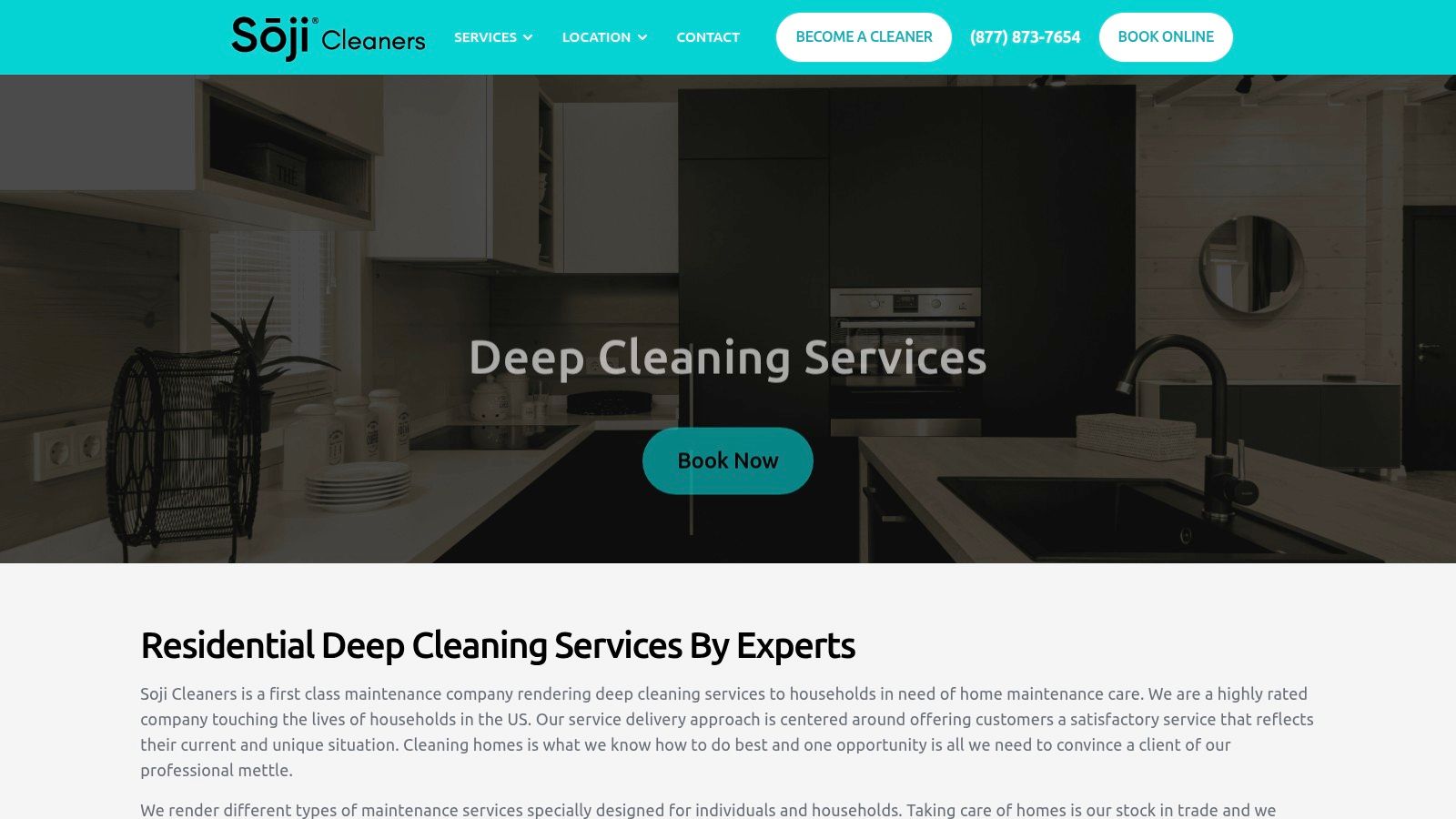
Their deep cleaning page presents price ranges based on bedroom and bathroom count, similar to other national players. However, they go a step further by also stating an hourly rate per cleaner. This dual approach helps manage customer expectations about both the potential total cost and the labor involved, making it a fantastic resource for modeling your own operational costs and profitability.
Soji’s model is built on educating the customer while protecting the business. The combination of price ranges and a public hourly rate serves as a powerful tool for justifying final costs, especially for homes in poorer condition that require more time than average. It bridges the gap between a fixed price and the variable nature of deep cleaning.
Key Strategy: By publishing an hourly rate (e.g., "$55/hour per cleaner") alongside package ranges, Soji anchors their value in labor time. If a 2-bed, 2-bath deep clean advertised for $350-$450 ends up taking more time due to extreme buildup, the company can point to the hourly rate to explain the final cost. This prevents disputes and reinforces the idea that customers are paying for expert time, not just a checklist of tasks.
Their pricing page also clearly outlines what is included in a standard deep clean, from window interiors to baseboards. This detailed scope of work acts as a baseline, making their separate pricing for add-ons like carpet and upholstery cleaning feel like logical, specialized extensions rather than hidden fees. This structure allows for natural upselling and service bundling.
You can adopt elements from Soji’s hybrid pricing strategy to create more accurate and defensible estimates for your own cleaning business.
By studying Soji’s approach, you can build a pricing structure that is both customer-friendly and resilient to the unpredictability of deep cleaning jobs. You can view their complete pricing details at https://soji.us/home-cleaning/deep-cleaning/.
MarMaids, a cleaning company based in Hampton Roads, VA, provides an excellent example of a per-square-foot pricing model. For businesses that prefer to estimate jobs based on home size rather than the number of rooms, this approach offers a simple, scalable alternative. Their public-facing pricing is clear and direct, giving potential customers a fast way to calculate a baseline cost for their service.
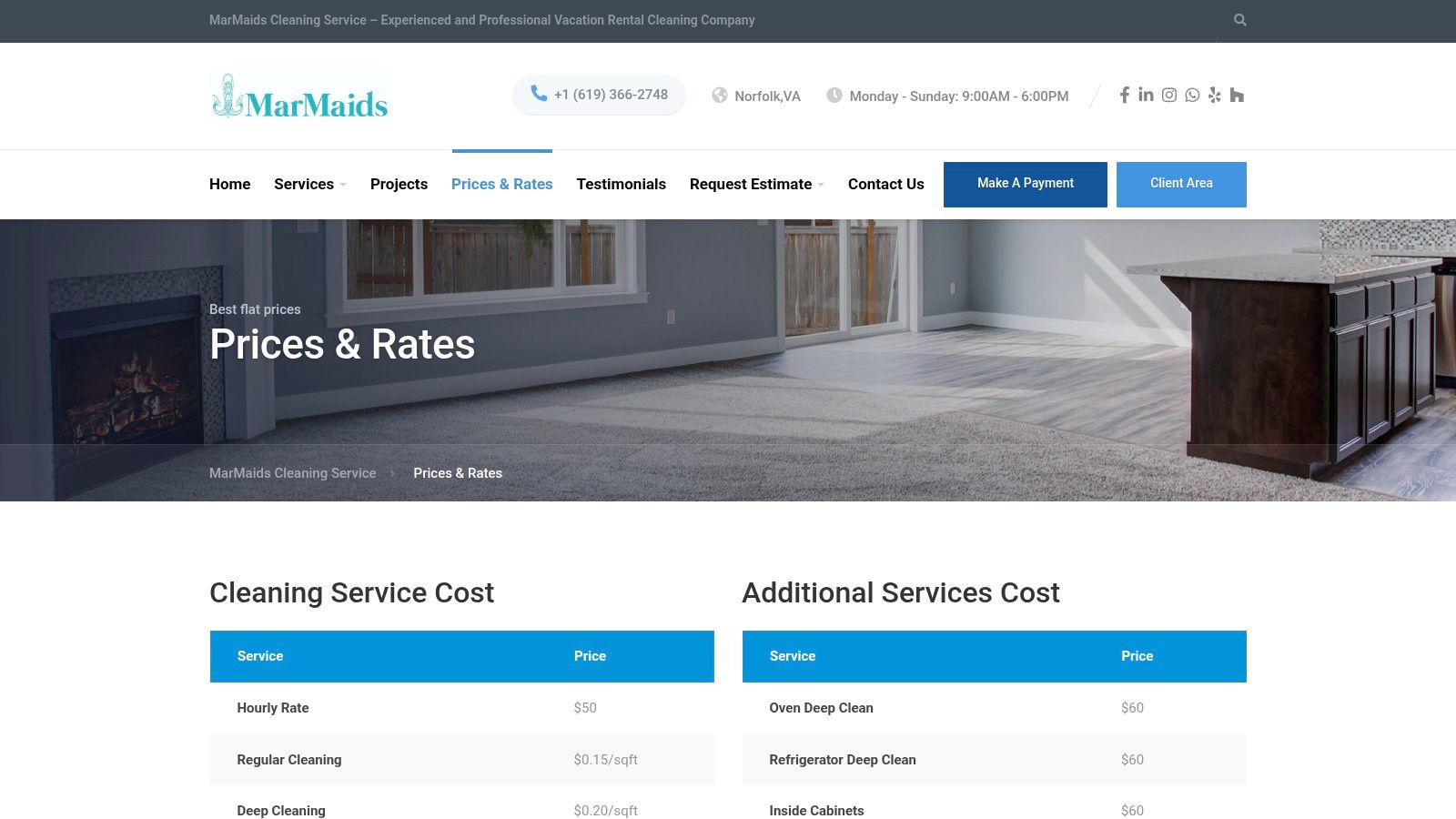
What makes their model noteworthy is its simplicity. By advertising a flat rate of $0.20 per square foot for a deep clean, they remove the ambiguity often associated with room-based pricing. This is complemented by a fixed-price menu for common add-ons like oven cleaning and interior window washing, creating a hybrid model that combines scalability with customization.
MarMaids’ strategy succeeds by targeting customers who know their home's square footage and want a quick, transparent cost projection. This method is especially effective for quoting jobs remotely or for clients moving into a new home where the property listing provides the exact size.
Key Strategy: The company anchors its deep cleaning service to a single, easily understood metric: price per square foot. This simplifies the initial estimation process dramatically. A customer with a 2,000 sq ft home can immediately calculate a base price of $400, setting a firm starting point before any extras are considered.
Their clear separation of service tiers (regular, deep, and construction cleaning) is also a critical part of their deep cleaning price list. By defining what is included in each, they manage customer expectations and correctly price jobs based on the required labor intensity. For instance, a post-renovation clean requires far more work than a standard deep clean, and their pricing rightly reflects that difference.
You can adopt a per-square-foot model like MarMaids to add a new dimension to your pricing strategy. This is particularly useful for winning over customers who value speed and transparency in the estimation process.
By studying the MarMaids model, you gain a powerful framework for creating estimates when square footage is the most reliable data point available. You can see their straightforward pricing at https://marmaids.com/prices/.
You've explored the pricing strategies of successful companies like Seattle Green Cleaning Fairy and Soji Cleaners. We've dissected everything from flat-rate packages and per-room charges to intricate add-on menus. The core lesson is clear: a well-defined deep cleaning price list is the foundation, but its true power is only unlocked through automation. Relying on manual estimates, spreadsheets, and phone tag means leaving money on the table and stunting your growth.
The most successful cleaning businesses, from solo operators to multi-location brands, don't just have prices; they have a system. This system delivers instant, accurate estimates to potential customers 24/7, capturing leads while competitors are still checking voicemails. It’s about building a consistent and professional customer experience from the very first touchpoint.
Reviewing the examples from HelloCleaners.us to MarMaids reveals a few critical truths about effective pricing strategy:
Translating these insights into action is your next priority. First, decide on a primary pricing model that best fits your local market and operational capacity. Will it be per-square-foot, hourly, or a flat-rate system? Once you have your core structure, build out your list of high-value add-ons. These are your profit maximizers.
The next step is to codify this logic. You need to turn your deep cleaning price list from a document into an interactive tool. This is precisely what Estimatty is built for. It allows you to load your unique pricing rules, add-ons, and even regional modifiers into an automated system that works for you around the clock.
As your business grows from the new leads your automated system generates, your next bottleneck will be staffing. Finding and hiring dependable, skilled cleaners is a constant challenge. This is where dedicated platforms like pipehirehrm.com can be a game-changer, connecting you with pre-vetted cleaning professionals. To truly turn your price list into a profit machine, consider optimizing your operational efficiency with tailored solutions for industries like cleaning and maid services. For more in-depth strategies on marketing and operations, the blogs at estimatty.com/blog and get.pipehirehrm.com/blog are excellent resources.
The journey from simply cleaning homes to building a profitable, scalable business begins with systemizing your prices and automating your sales. This is your path to creating a company that not only thrives but can one day run without your constant hands-on involvement.
Ready to stop giving estimates manually and start closing deals automatically? Estimatty transforms your deep cleaning price list into a 24/7 automated sales tool on your website. Try Estimatty today and see how you can capture more leads and win more jobs, even while you sleep.