October 27, 2026
Electrical Service Contract: Key Clauses and Checklist
Learn what an electrical service contract covers, the clauses that matter, sample language for each, and a checklist to customize it before you sign.

Monday, October 26, 2026
Professional commercial cleaning guide: service types, OSHA rules, staffing, equipment, pricing and how to scope a contract that holds up.
You're comparing three cleaning proposals for the same building, and none of them agree. One lists restrooms nightly, another buries them in a general task line, and the cheapest doesn't mention high-touch disinfection at all. That's the normal starting point for professional commercial cleaning, and it's exactly why price means nothing until scope is fixed. Define the work by area, task, frequency and proof, then ask providers to price that same scope. Everything below helps you do that before you sign.
Say a facilities manager runs a 40,000-square-foot office and finds her nightly crew has been skipping restrooms and door hardware because the contract only promised general janitorial service. The crew isn't necessarily dishonest. The scope was never written tightly enough to audit.
Professional commercial cleaning is recurring or scheduled cleaning of non-residential buildings, sold on a defined scope, staffing plan and proof of work rather than a single visit. Most contracts bundle a nightly janitorial core with periodic add-ons. That core drives both your budget and your complaints, so get it right first.
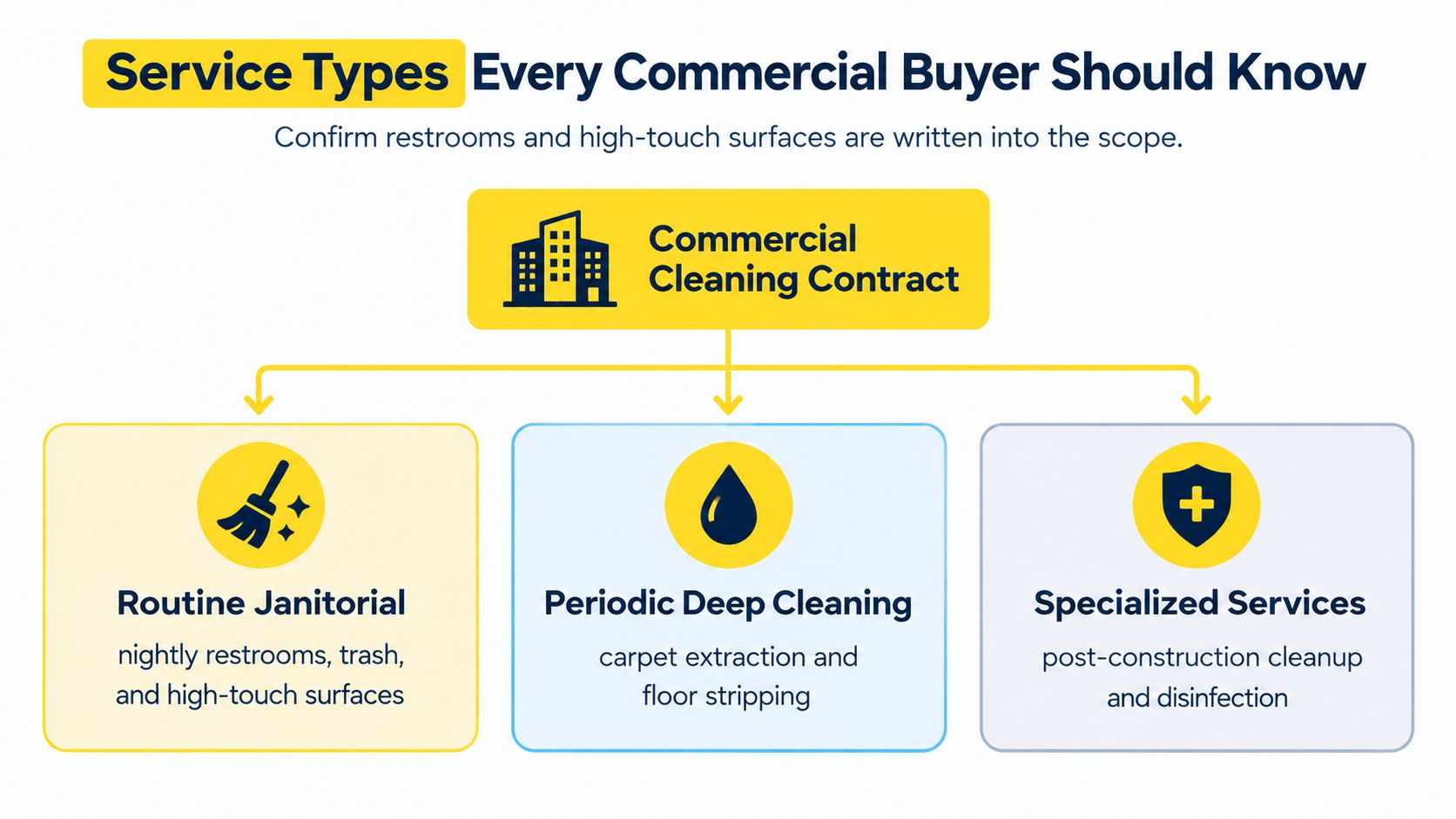
| Service Type | What It Covers | Typical Frequency | Typical Buyer |
|---|---|---|---|
| Nightly janitorial | Trash, restrooms, floors, dusting, supplies | Nightly or 3-5 times a week | Offices, schools |
| Periodic deep cleaning | Stripping and waxing, detailed dusting, vents, baseboards | Quarterly or semi-annual | Retail, offices |
| Post-construction cleaning | Dust and debris removal, final detail clean | One-time, before occupancy | Developers, property managers |
| Carpet and hard-floor care | Hot water extraction, scrubbing, sealing | Quarterly to annually | Offices, hotels |
| Disinfection of high-touch areas | Label-matched disinfectant with timed dwell | Daily or as required | Healthcare, gyms, schools |
| Window and exterior care | Interior and exterior glass, pressure washing | Monthly to quarterly | Storefronts, office towers |
The labor behind those services is substantial. The U.S. Bureau of Labor Statistics occupational outlook for janitors and building cleaners reported approximately 2,432,600 janitor and building-cleaner jobs in 2025, with services to buildings and dwellings accounting for 35% of employment in the occupation. Availability, scheduling and productivity therefore shape service more than chemical choice does.
Map every room to one service type before you request estimates. A café manager faces the same mapping problem on a smaller scale, which is why practical cleaning schedules for cafés are useful as a frequency starting point, not as a substitute for your own scope. If an area doesn't appear on your map, a provider won't price it, staff it or clean it consistently.
A homeowner buys a visit. A commercial buyer buys a contract with a written scope, a schedule and evidence that the work happened. That single difference changes who decides, how work is measured, when crews enter and what happens when quality slips.
Say you price a three-bedroom house by rooms. Now price a 3,000-square-foot clinic with 12 restrooms, 40 patient-contact surfaces and an evening cleaning window. Rooms tell you almost nothing. You need square footage by floor type, fixture counts, touchpoints, waste streams, access rules and labor hours by area.
| Factor | Residential | Commercial |
|---|---|---|
| Who decides | Homeowner | Facilities manager, owner or procurement |
| Scope unit | Rooms and bedrooms | Square footage, fixtures, surfaces and task list |
| Schedule | One visit on an agreed day | Nights, weekends or fixed windows with access rules |
| Compliance duties | General hygiene | SDS files, hazard training, documented audits |
| Contract term | Pay per visit, cancel anytime | Monthly or multi-year agreement with service levels |
| Insurance and bonding | Rarely requested | Certificate of insurance, often bonding |
| Staffing | One or two cleaners | Crews, leads, supervisors and route plans |
| Pricing unit | Flat fee per home | Per square foot, per hour, per visit or monthly fixed |
After-hours work adds steps a house cleaner never meets. Crews need badges, alarm codes, key control, tenant coordination and a lockup procedure. If a cleaner can't enter until 7 p.m. and must finish restrooms before a 9 p.m. alarm reset, that window determines crew size.
That's why residential booking tools break down here. A flat per-home rate can't absorb fixture density, elevator time, secure floors or supply restocking. Our comparison of commercial and residential cleaning models breaks out those buying differences in more detail.
If an offer doesn't list areas, frequencies and access arrangements, it was built for a house, not a building.
I would reject any proposal that gives you a monthly number without the scope unit behind it. Ask what was counted, what was excluded and how extras get approved. A serious provider answers in fixtures, surfaces and hours, not adjectives.
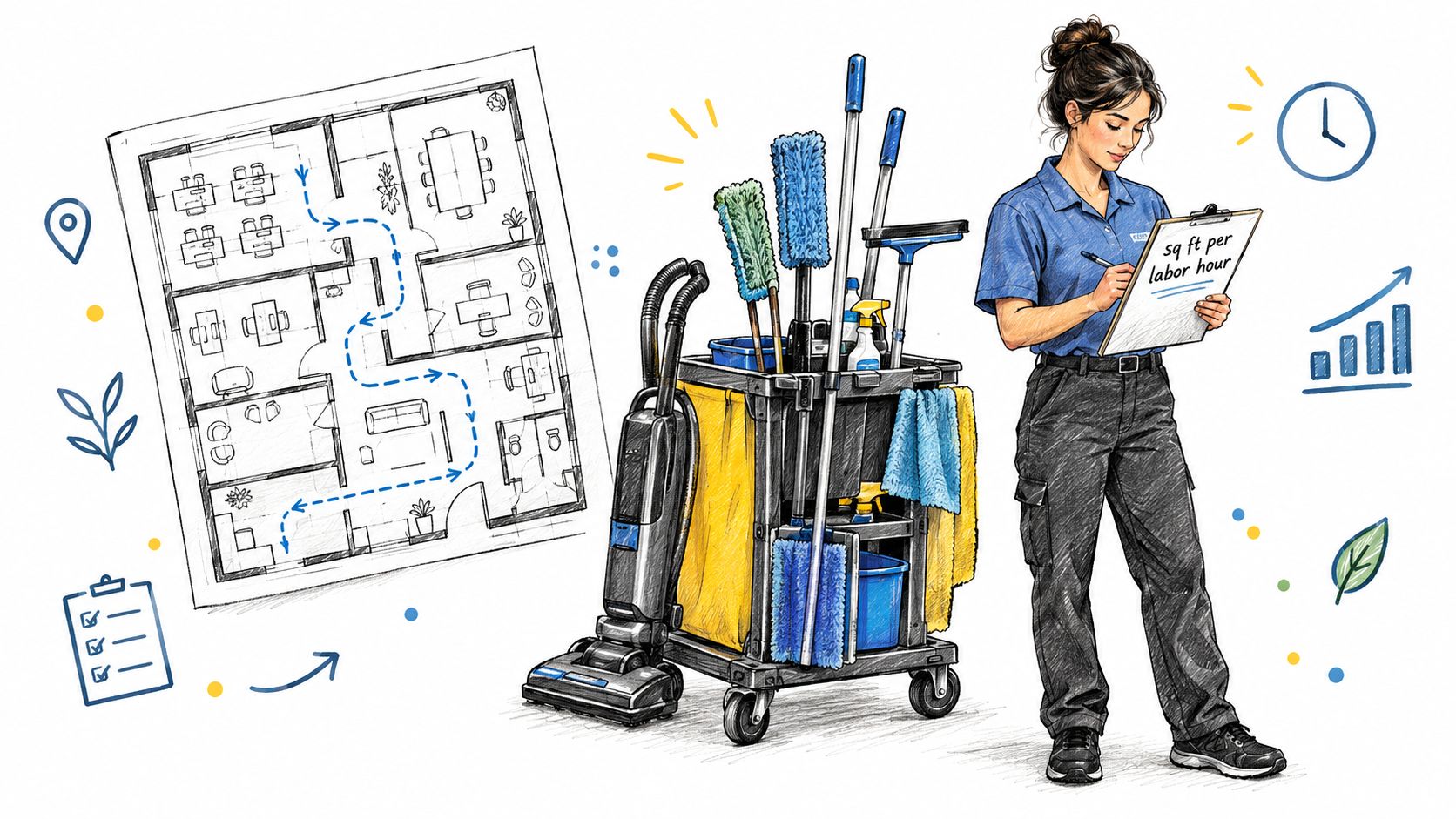
Good operators size crews from production rates, meaning square feet cleaned per labor hour adjusted for surface, soil and fixture density. They don't guess headcount. A carpeted open office moves faster than a restroom bank, a locker room or a clinic exam suite, even at the same square footage.
The crew below illustrates the floor plan review that should precede any staffing promise.
Route density comes next. One team can cover several nearby buildings in a shift if drive time, access windows and supply staging line up. Spread those buildings across a city and the same team needs another vehicle, another lead and more paid non-cleaning time.
A lead cleaner who inspects restrooms, checks chemical dilution and closes the building correctly matters more than an extra pair of hands. Without that role, missed tasks stay invisible until tenants complain.
The injury risk is real and should shape equipment choices. The U.S. Bureau of Labor Statistics snapshot for janitors and cleaners recorded 21,100 nonfatal injury and illness cases involving days away from work among private-industry janitors and cleaners in 2020, a rate of 191.6 cases per 10,000 full-time-equivalent workers. The largest categories included 6,130 sprains, strains, and tears, 4,740 exposures to harmful substances or environments and 4,190 cases involving soreness or pain.
Lifting training, ergonomic carts, lighter backpack vacuums and task rotation aren't perks. They protect continuity. An injured cleaner means a substitute who doesn't know your alarm, your tenants or your restroom sequence.
This short walkthrough shows how route planning and cart setup affect a shift before cleaning even starts.
Use a complete commercial cleaning supplies list to decide who buys consumables, who stores them and what par levels trigger reorder. For operators building crews, pipehirehrm.com focuses on cleaning employee hiring, and the guides at get.pipehirehrm.com/blog cover recruiting and retention steps.
A credible staffing plan assigns labor hours by area, names the lead, lists backup coverage and shows inspection time as its own line. If inspection time is zero, quality control is a promise, not a plan.
Quality means measured output, not a clean look under bright lights. A shiny lobby can still have under-disinfected elevator buttons, faucet handles and break room surfaces if crews spray and wipe too fast.
Use this sequence for disinfection work and write it into the procedure for each area.
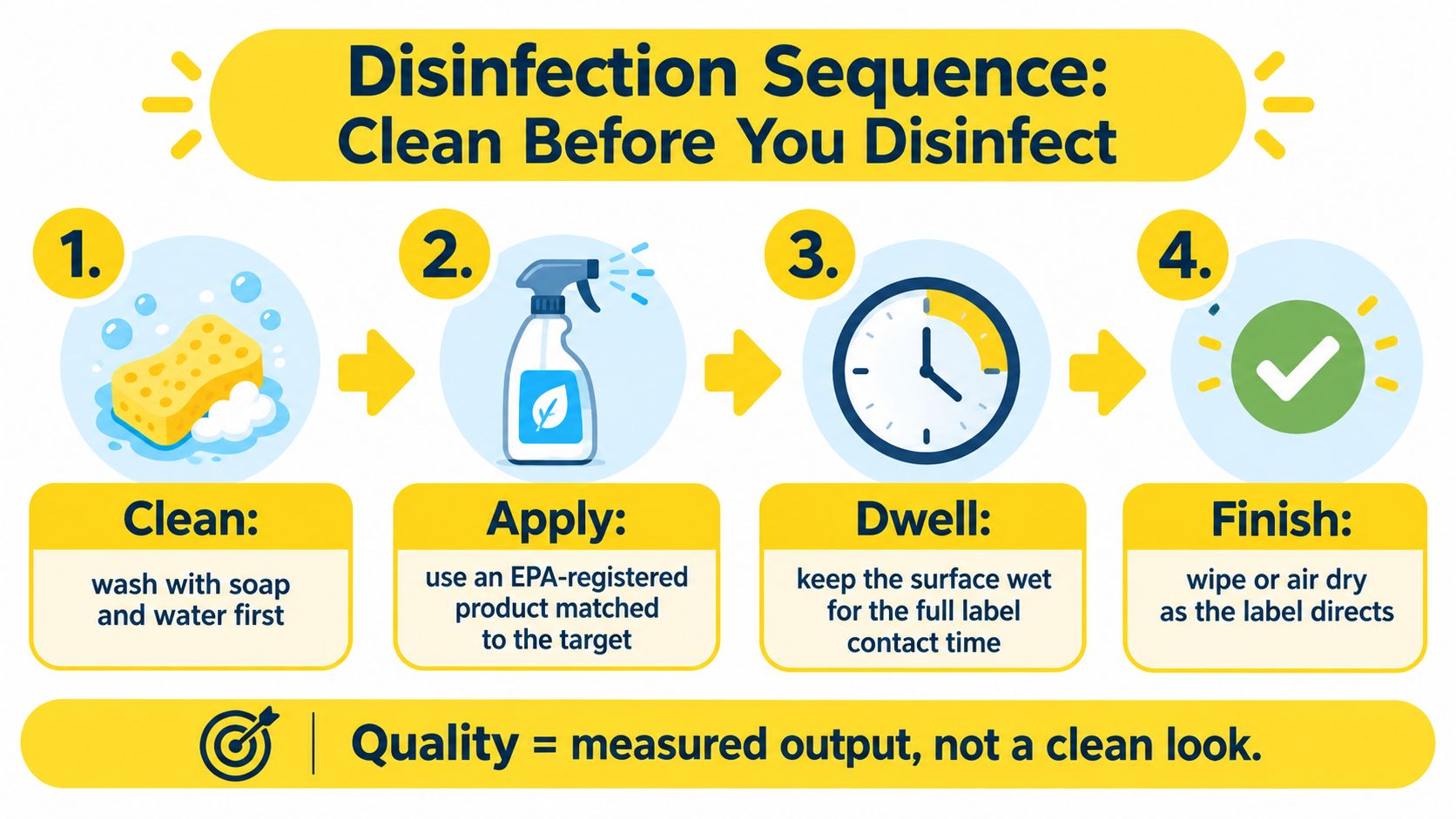
The EPA list of selected registered disinfectants defines contact time as the period the product must remain visibly wet, and crews must reapply product if a surface dries early. That same guidance context notes many EPA-registered healthcare disinfectants historically specify 10 minutes, although some products use one-to-three-minute times and research has demonstrated substantial microbial reduction with 30-to-60-second exposures under specified conditions.
Those times aren't interchangeable. A one-minute product only helps if its registration and label claims support your organism, surface and dilution. I would rather see a slower product used correctly than a fast product wiped dry at ten seconds.
Schedule labor for dwell time. If a restroom route gives a cleaner six minutes per restroom and the label requires ten, the route itself creates failure. Product selection, staffing and audit design have to match.
Timing also matters after illness exposure. The CDC facility guidance for suspected or confirmed COVID-19 recommends waiting 24 hours before cleaning and disinfecting when feasible, and states that if more than seven days have passed since the person visited, additional cleaning and disinfection is not necessary under that guidance.
Audit high-touch areas with timed observations. Watch whether surfaces stay wet, check dilution, and score restrooms and touchpoints separately from general appearance. ATP testing can support training, but it doesn't replace label compliance or visual soil inspection.
Track complaints by area and task, then review them monthly with the provider. Repeated restroom complaints usually point to frequency, supply par levels or route order, not effort. The broader framework in our guide to cleaning industry standards helps you set those measures before service starts.
Write three numbers into the contract. Audit frequency, passing score and response time for a failed check turn quality from a conversation into an obligation.
Never mix bleach with ammonia. That combination can generate gases capable of serious lung injury or death, and it remains the clearest example of why chemical control is not paperwork for its own sake.
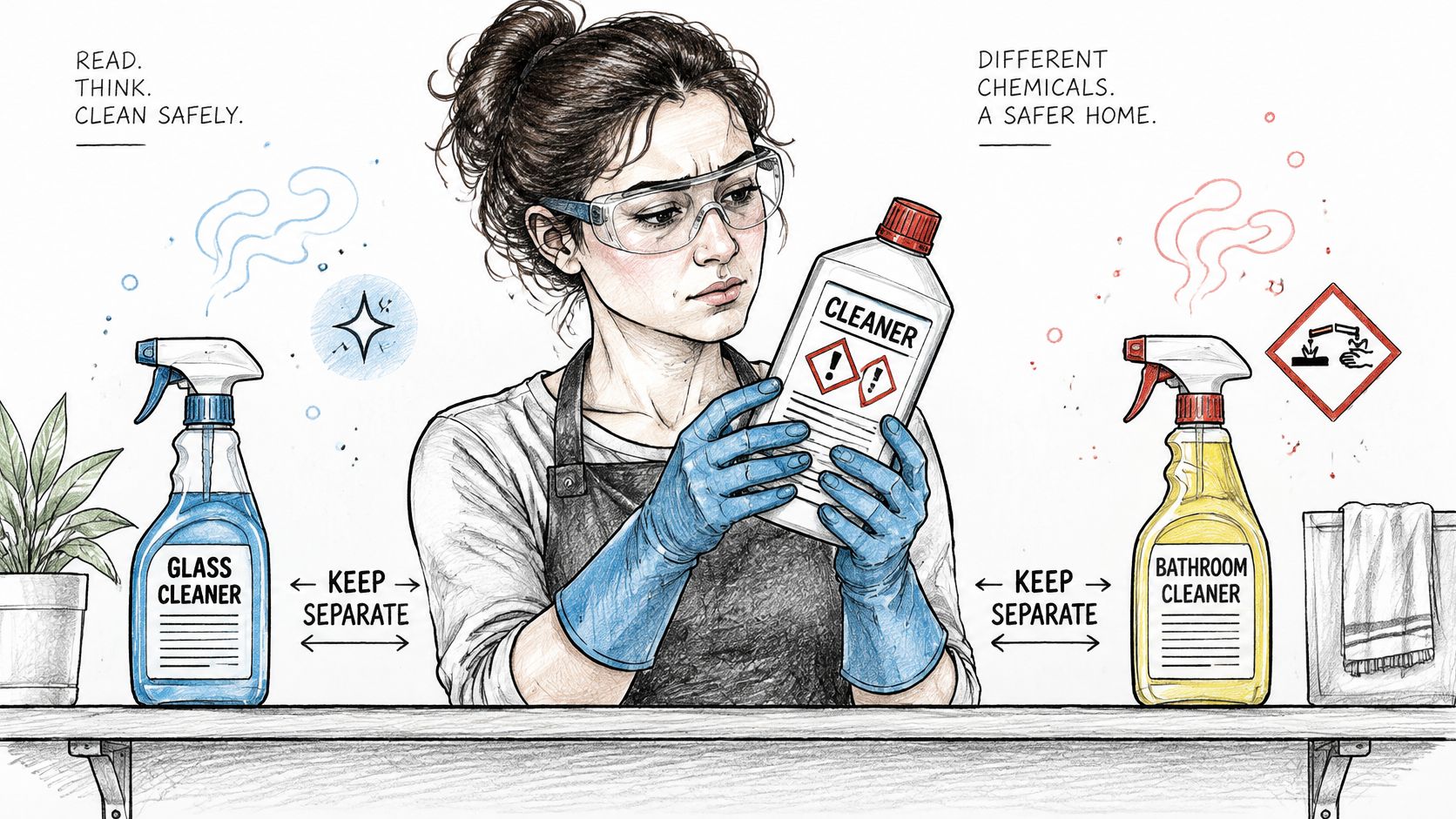
The OSHA guidance on chemical hazards in cleaning identifies inadequate ventilation, incorrect chemical mixing, spray or aerosol application, and mechanized equipment as pathways that can increase exposure to vapors, mists, or gases. Product hazard, application method, ventilation and worker behavior all interact. Changing only the gloves doesn't fix a bad system.
Start with engineering and administrative controls. Provide airflow or local exhaust, choose low-mist or microfiber application where it achieves soil removal, control dilution and limit spraying in small enclosed rooms. Use personal protective equipment as the last layer, matched to splash, skin and eye risk.
Employer duties are concrete. The OSHA hazard communication guide for cleaning employers requires a Safety Data Sheet for every hazardous cleaning product used, kept readily accessible to workers, plus training before an employee begins using a hazardous cleaner. Training covers health and physical hazards, handling and storage, dilution, spill response, required PPE and how to interpret labels and Safety Data Sheets.
These habits protect quality too. Wrong dilution leaves residue, damages floors and reduces disinfection performance. Rushed spraying creates exposure and missed soil at the same time. A crew that controls chemicals usually controls routes, keys and inspections with the same discipline.
Buyer test: Ask to see the SDS binder and the training log. If a provider can't produce both quickly, don't trust its safety claims.
Check where Safety Data Sheets live during the shift, not just in an office across town. Night crews need access when a spill, splash or tenant question happens.
Judge a green program with three tests. Is it safer, is it effective and can it be measured? A leaf on a bottle answers none of them.
Market reporting summarized in the Dataintelo janitorial service market report places green formulations at about 22.3% of commercial cleaning-supply purchases in 2025, up from 15.7% in 2019. Adoption is rising, but certification alone doesn't prove superior pathogen control. Every disinfectant claim still has to match its EPA registration and label contact time.
Separate product swaps from program design.
Measure chemical volume per 1,000 square feet, water per visit, labor hours per area and complaints before and after the change. Keep a baseline for at least one quarter. I would ask any provider to show those numbers and the pathogen-control basis for every product in its green line.
Why do two offers for the same building differ so widely? Usually they aren't pricing the same building. One counts restrooms, after-hours access and supplies. The other prices square footage and hopes the details sort themselves out.
| Pricing Model | How It Is Billed | Best Fit | Watch-Out |
|---|---|---|---|
| Per square foot | Price per square foot per visit or per month | Large open offices with uniform floors | Ignores fixture density and after-hours premiums |
| Hourly | Labor hours times an agreed rate | Irregular jobs, post-construction, one-time resets | Final cost depends on crew speed, so ask for time estimates |
| Flat fee per visit | Fixed price for each scheduled visit | Small offices with a consistent scope | Scope creep if the task list is vague |
| Monthly fixed contract | One fee covering all scheduled visits | Multi-site or long-term buyers | Check how extra services are billed |
| Per task or per unit | Price per restroom, window, carpet area or treatment | Specialty services added to a base contract | Adds up quickly across many units |
Per-square-foot pricing works for steady, open offices with uniform floors. Hourly pricing fits irregular work where soil and access are hard to predict. Monthly fixed contracts simplify budgeting for multi-site buyers, but only if extra services and supply costs are defined.
For carpet specifically, the commercial cost breakdown from J G Carpet is a useful check on how per-square-foot carpet billing is presented, separate from nightly janitorial labor. Don't let a provider bury periodic carpet work inside a monthly number without a separate frequency.
Demand-based cleaning can improve how labor is allocated. The Research and Markets commercial cleaning services market report identifies a shift toward demand-based cleaning using occupancy analytics and IoT sensors, and notes 63% of contractors identified staffing as their biggest risk entering 2025. Put more labor into busy restrooms and entrances, less into empty offices, but keep contractual minimum frequencies so low-traffic areas don't look neglected. Add trigger-based extras for events, spills and complaint spikes, and document exceptions.
Keep estimates and quotes separate. An estimate is a fast, consistent range based on captured inputs like square footage, surfaces, urgency and service windows. A formal quote follows a site walkthrough and locks scope, access and exclusions. Estimatty's web or phone agent captures those inputs and sends an instant estimate by SMS or email in under a minute, which helps cleaning businesses respond before a prospect moves on. It doesn't replace the walkthrough quote, and it shouldn't be sold that way.
Our notes on business pricing strategies for cleaning companies cover how operators protect margin while keeping that distinction clear.
Comparison rule: Divide each offer by the same cleaned square footage only after both offers list the same restrooms, frequencies and after-hours tasks.
For example, a 12,000-square-foot office at $2,400 per month costs $0.20 per square foot per month, while the same space at $3,000 per month costs $0.25. That math is useful, but it's fair only when scope matches line by line.
Don't sign a price. Sign a scope you can audit. Use this checklist with every finalist and keep the answers in the contract file.
A single office with steady needs usually fits a per-visit or monthly janitorial contract, with quarterly deep cleaning priced separately. That structure keeps nightly work predictable and prevents periodic tasks from slipping off the schedule unnoticed.
A multi-site operator needs a monthly fixed contract with one shared audit template across locations. Without a common scorecard, each site manager invents a standard and the provider gets conflicting instructions.
A healthcare or food facility needs disinfection written as its own service line, with products, contact times and records specified. Don't accept sanitized as a task description. Require the method that proves it.
Ask at least three providers to price the same written scope, then compare their formal quotes line by line. Initial estimates help you screen quickly, but the walkthrough quote is where access problems, worn floors and fixture counts should change the number. Our guide to cleaning contracts for small business buyers gives you clause language to adapt with your own adviser.
Cleaning businesses on the selling side should apply the same discipline to intake. Capture scope inputs after hours instead of letting inquiries sit in voicemail, then follow up with a walkthrough before issuing quotes. Follow-up guides at estimatty.com/blog cover estimating and contracts, while get.pipehirehrm.com/blog covers the hiring side.
I would start today with one page per area. List tasks, frequencies, supplies and proof of completion. Then request estimates against that page. You'll get fewer surprises, cleaner comparisons and a contract a supervisor can enforce.
Stop losing commercial inquiries to slow follow-up and inconsistent pricing. Estimatty captures square footage, surfaces, urgency and service windows through your website or phone, sends instant estimates by SMS and email, and alerts your team in real time so you can schedule the walkthrough and issue a formal quote. Visit Estimatty today to standardize your estimates and turn more inquiries into booked cleaning jobs, day or night.