October 24, 2026
Area of Service for Cleaning Businesses: How to Map Yours
Learn how to define and map your area of service for a cleaning business using drive time, travel fees and job minimums that protect profit.

Sunday, October 25, 2026
Compare pressure cleaning prices for homes and commercial jobs in 2026, with size bands, per-square-foot rates and sample estimates you can use.
Residential pressure washing commonly runs about $0.10 to $0.50 per square foot, and Thumbtack's national data puts the average home between $241 and $418. That's the starting point, not a price you should send to every customer.
The most popular advice in this trade is to get three estimates and pick the middle one. That advice is weak. Three estimates built on three different assumptions don't tell you who priced the job correctly, and for owners, copying a competitor's number copies their mistakes too. Build a formula you can defend instead. Measure the area, classify the surface, grade the buildup, then label every adjustment. That's how you protect margin without looking arbitrary.
Pressure cleaning prices are not one-size-fits-all. HomeAdvisor lists residential exterior work at $0.10–$0.50 per square foot, with a typical project total of $213–$449 and an average of $312 (HomeAdvisor's nationwide exterior pressure washing pricing). The same guide gives a minimum charge of about $100 for travel, setup and equipment. Treat that as a floor for small jobs, not as a fee to add automatically to every project.
Published averages reflect different job mixes. Bark's 2025 broad U.S. average for washing a home's exterior is $450 (Bark's house pressure washing price guide). That figure can sit above other national estimates without making them wrong. Use each benchmark for context, then price the actual surfaces, access and condition in front of you.
Commercial work has its own benchmarks. Ordinary commercial flatwork is listed at $0.05–$0.20 per square foot in published commercial pressure washing benchmarks. HomeGuide puts commercial projects at $200–$3,000 or more (HomeGuide's commercial pressure washing prices). Open areas can lower the per-square-foot rate, while grease, compliance requirements and difficult access raise the total.
Typical US pressure cleaning benchmarks
| Job or Benchmark | Typical Price | What It Covers |
|---|---|---|
| Residential per-square-foot rate | $0.10–$0.50 | Standard house washing on flat exterior surfaces |
| Thumbtack average home pressure wash | $241–$418 | Typical US home exterior, national pricing data |
| HomeAdvisor typical nationwide project | $213–$449, average $312 | Professional exterior project total |
| Bark broad average, home exterior | $450 | Full exterior of a house, 2025 average |
| Labor-based hourly rate | $50–$100 per crew hour | Irregular, detailed or heavily soiled work |
| Minimum charge | About $100 | Travel, setup and equipment on small jobs |
| Commercial flatwork | $0.05–$0.20 per sq ft | Parking lots, garages and ordinary commercial surfaces |
| Commercial project | $200–$3,000 or more | HomeGuide commercial range |
Per-square-foot pricing suits measured, open surfaces. The $50–$100 per crew hour figure is a working example for irregular, detailed or heavily soiled jobs, where setup and labor matter more than a clean area measurement. Keep the basis clear on every estimate. Don't combine hourly and area pricing unless you explain which work each covers.
Set a minimum-job floor, then list add-ons for specific complications. That makes a short job worth dispatching and lets customers see what changes the price. Use the closest benchmark as a starting point, not the finished quote: the same square footage can require very different labor when access, soil and surface type change.
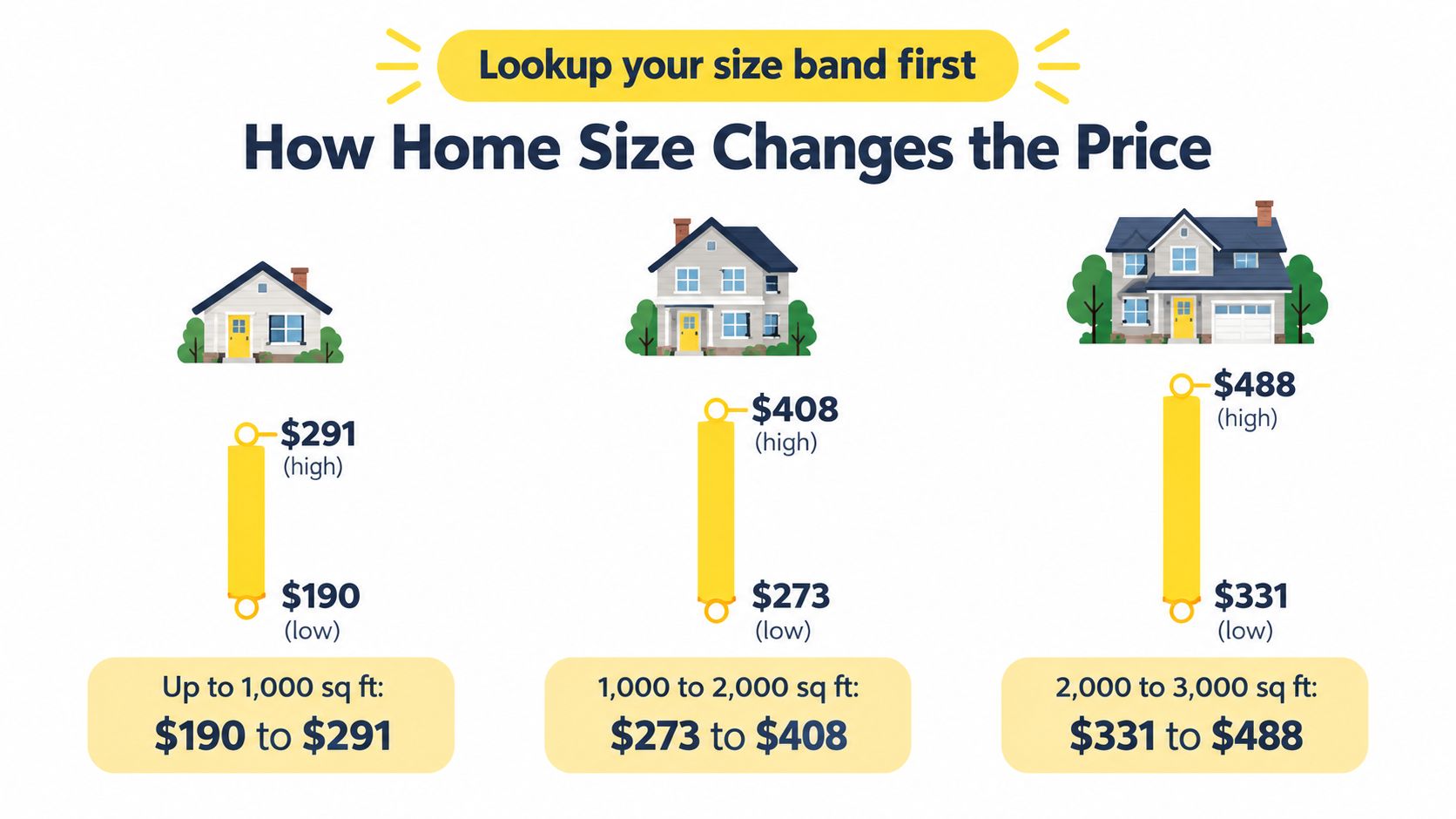
Square footage gives you a starting band, not a finished quote. Thumbtack's national power washing pricing data lists homes up to 1,000 square feet at about $190–$291, 1,000–2,000 square feet at $273–$408, 2,000–3,000 square feet at $331–$488, 3,000–4,000 square feet at $414–$599, and 4,000–5,000 square feet at $550–$834. Its estimated rates run from approximately $0.08 to $0.47 per square foot.
The chart offers a quick visual comparison of the first three size bands.
Typical pressure washing price by home size
| Home Size | Typical Price Range | How to Quote It |
|---|---|---|
| Up to 1,000 sq ft | $190–$291 | Set a flat band price with a minimum-job floor |
| 1,000–2,000 sq ft | $273–$408 | Use a band price or per-square-foot formula |
| 2,000–3,000 sq ft | $331–$488 | Calculate by area, then check access |
| 3,000–4,000 sq ft | $414–$599 | Calculate by area and confirm stories and access |
| 4,000–5,000 sq ft | $550–$834 | Measure the area and itemize adjustments |
A home twice as large does not automatically cost twice as much to clean. Travel, setup, and equipment costs stay largely fixed after arrival, so they account for less per square foot on larger jobs. Labor still depends on the property's condition. Two houses in the same size band can justify very different quotes.
The 4,000–5,000-square-foot band spans $550–$834, a $284 difference in the size-based estimates cited above. A narrow lot, multiple stories, and heavy buildup can push a quote higher than an open, one-story property of the same size. Treat square footage as the base of your formula, then label any access or condition adjustments clearly so customers can see what changes the price.
Watch this walkthrough on measuring and pricing before setting your own bands.
Collect dimensions before quoting. Apply your size band or area rate, add clearly explained job-specific adjustments, and enforce a minimum-job floor. A single flat rate for every home leaves you undercharging for difficult work and overcharging for easy jobs.
The same measured area can justify different estimates. A clear pricing formula ties the number to crew time, job conditions and the work included. Use the model that fits the surface, then show customers any adjustments as labeled line items.
| Model | How It Is Calculated | Best Fit | Main Risk |
|---|---|---|---|
| Per square foot | Measured area multiplied by a rate | Driveways, patios and other measurable surfaces | A large area can hide setup and travel costs |
| Hourly crew rate | Crew hours multiplied by an hourly rate | Stairs, restricted access and labor-intensive work | Customers may worry about an open-ended bill |
| Flat job price | Set price for a defined job or package | Standard house washes and repeat work | Unexpected buildup can cut into margin |
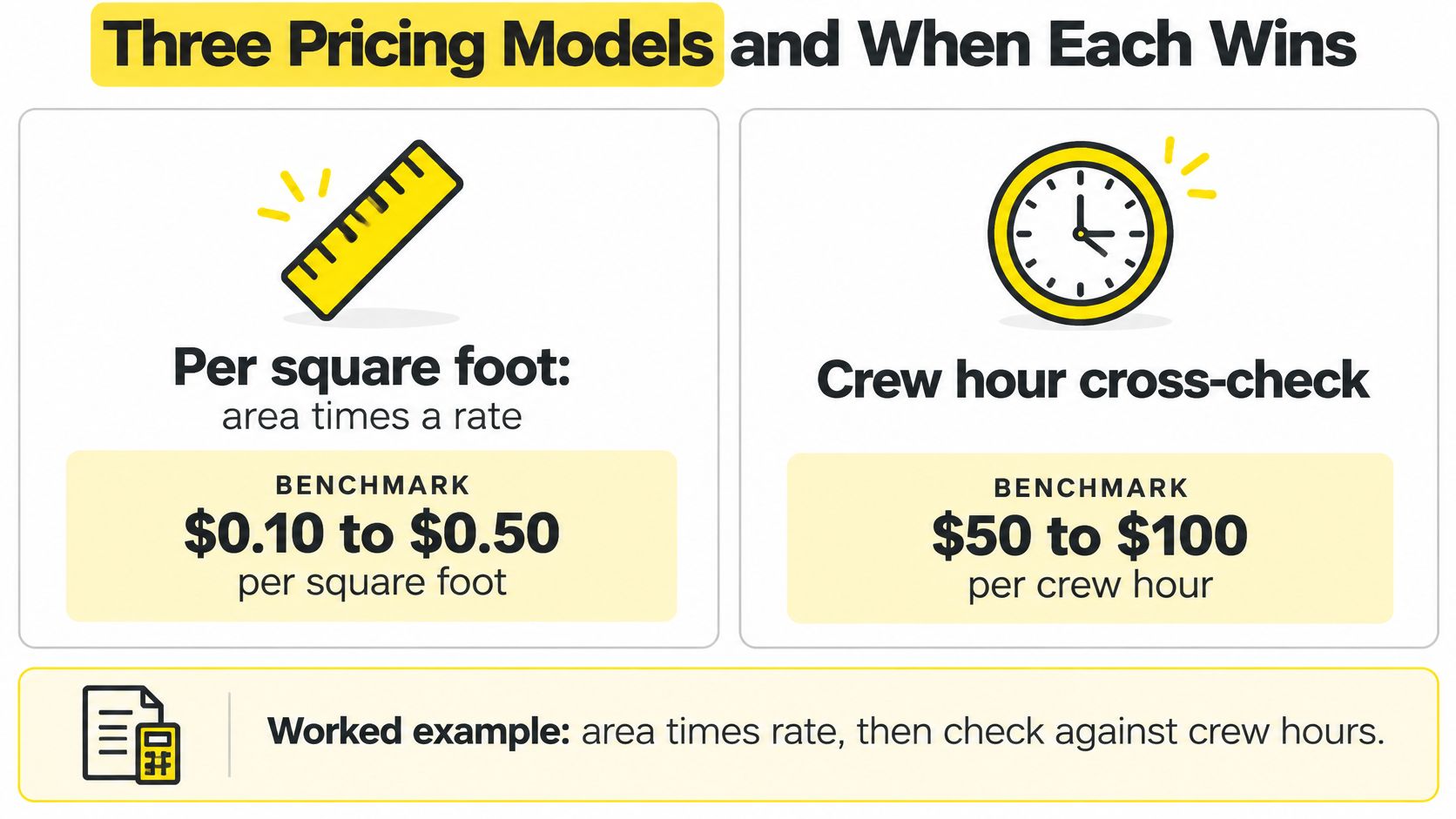
Use area-based pricing for surfaces you can measure and clean predictably. Housecall Pro's pressure washing pricing guide gives a residential benchmark of $0.10–$0.50 per square foot. Separately, the guide lists $50–$100 per crew hour as an hourly benchmark. These are distinct pricing units, not equivalent rates.
For example, at $0.30 per square foot, 2,000 square feet comes to $600 before any adjustments. That is a straightforward calculation, not a quoted guide example. Larger areas can support a lower rate per square foot because mobilization, fuel, insurance and travel costs are spread across more billable area.
Hourly pricing fits jobs where the footprint understates the labor. Stairs, tight access and heavy staining can take much longer than open, flat surfaces. State the expected crew time and hourly rate before work begins, so the customer knows how the bill is calculated.
Flat pricing works for standard house washes and repeat customers when you know what the job involves. Set clear limits for the package. If buildup or access falls outside those limits, list the adjustment separately rather than absorbing extra labor.
Keep add-ons visible. Customers can judge a clearly labeled adjustment; unexplained totals invite pushback.
Minimum-job floor: Set a minimum of about $100 across your pricing models to cover short jobs that still require travel, setup and equipment. Explain the floor in one plain sentence instead of burying it in a higher base rate. To build the operating choices behind your pricing, see this guide to starting a power washing business.
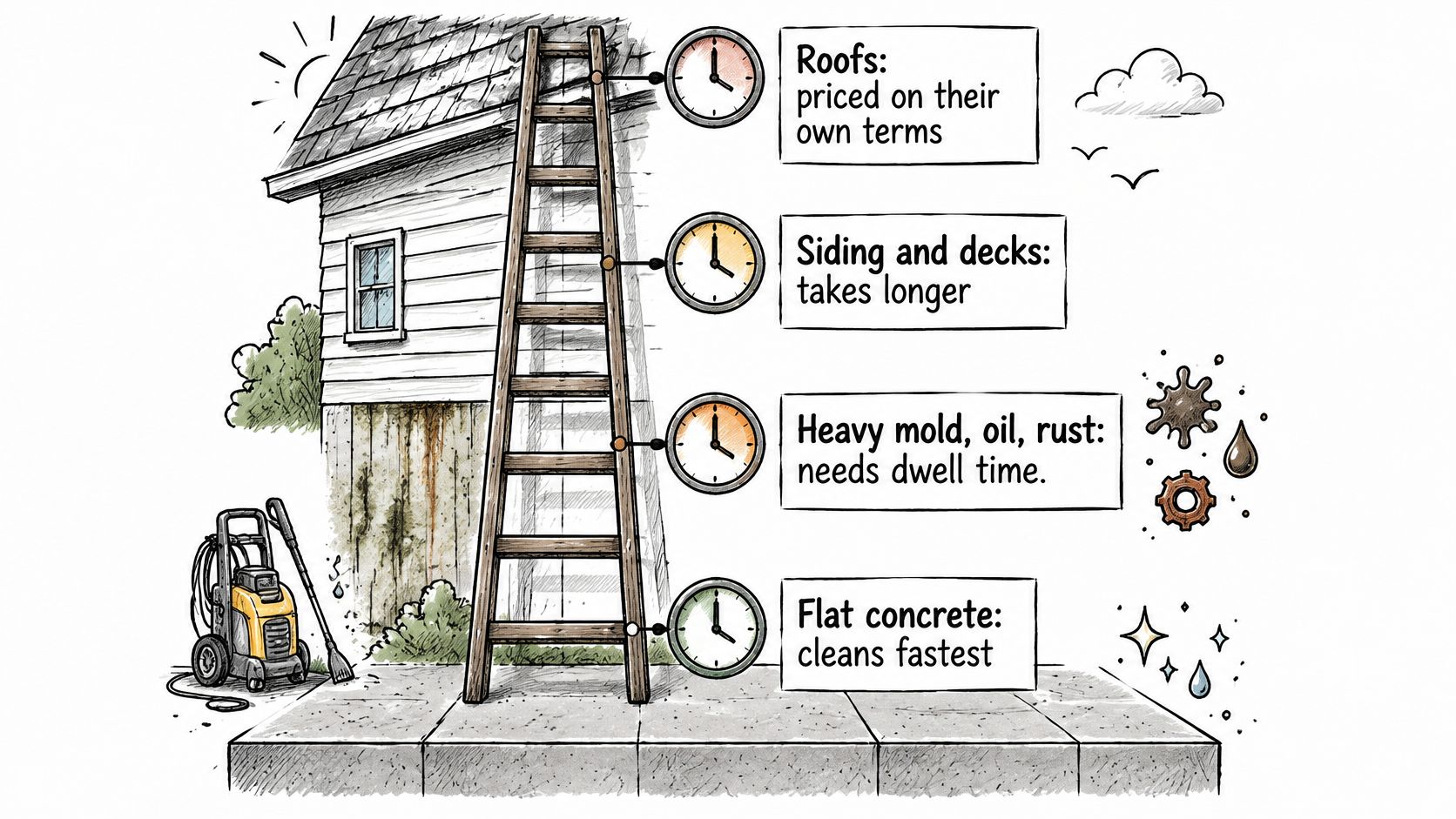
Square footage alone cannot defend an estimate. The same area can take very different crew time depending on the surface, access and soil. Price the production work first, then list specific add-ons so customers can see what changes the total.
The image below shows how surface type affects pressure cleaning prices.
Use published driveway prices as a market benchmark, not a labor-time promise. HomeAdvisor's driveway pressure washing costs report an average professional cost of $210, with most projects at $100–$350 and typical rates of $0.30–$0.55 per square foot. Its example for a standard 576-square-foot driveway is about $175–$320. That total is not explained by a generic one-to-two-hour time estimate, so do not use that unsupported duration to justify your quote. Base your labor allowance on your crew's actual production rate, then add a clearly labeled charge for heavy oil or grease treatment when the job requires it.
Roof pricing needs a separate calculation. HomeAdvisor's roof cleaning cost guide says professionals may charge by square foot or by a roofing square of 100 square feet, with some providers charging approximately $35–$80 per hour. Labor is usually the largest component. Steep pitch, height, heavy moss and difficult access add time and risk, while delicate materials can require a different method. Know when to soft wash exterior surfaces before quoting siding or roofing as if it were concrete.
Ask for these details before setting the price:
Set labor-based adjustments using your real crew costs. This guide on how to calculate labor cost per hour can help you calculate a defensible rate. A smaller, oil-stained driveway can cost more to clean than a larger, lightly soiled one. Condition often matters more than area.
A commercial estimate needs a production rate and clearly priced add-ons. Keep the open-area cleaning rate separate from charges for containment, degreasing, after-hours work, water access, or access equipment. That breakdown lets you defend the price and keeps costly requirements from eating into your margin.
Parking lots and garages generally sit at the low end because crews can cover large, open areas quickly. Gum, grease, and wastewater handling slow production or add specific costs. Commercial pressure washing benchmarks place wastewater containment at $0.05–$0.15 per square foot and oil-stain treatment at another $0.05–$0.10 per square foot. Keep those charges separate from the base rate so the customer can see what the work requires.
Commercial and apartment pricing benchmarks
| Property Type or Add-On | Typical Rate or Price | Why It Moves |
|---|---|---|
| Parking lots and garages | $0.05–$0.10 per sq ft | Large open areas clean rapidly |
| Ordinary commercial flatwork | $0.05–$0.20 per sq ft | Mixed surfaces at moderate output |
| Wastewater containment add-on | +$0.05–$0.15 per sq ft | Capture and handling requirements |
| Oil-stain treatment add-on | +$0.05–$0.10 per sq ft | Chemical-intensive removal |
| Apartment complex | $173–$311 typical, $211 average | Per-square-foot rates of $0.35–$0.77 |
Apartment pricing varies with the property and scope, so treat Today's Homeowner's apartment complex pressure washing costs as a benchmark, not a fixed quote.
Offer a lower unit rate for recurring work only when visit frequency and site conditions are predictable. Write down what the base price covers and list extra work separately. A commercial cleaning bid template helps keep those terms consistent across properties.
A defensible estimate is a formula, not a square-foot rate applied blindly. Start with the base, list each adjustment separately, then show the total. That structure explains why similar-sized jobs can cost different amounts and gives customers a clear choice.
The diagram shows a base price becoming a customized estimate through labeled adjustments.
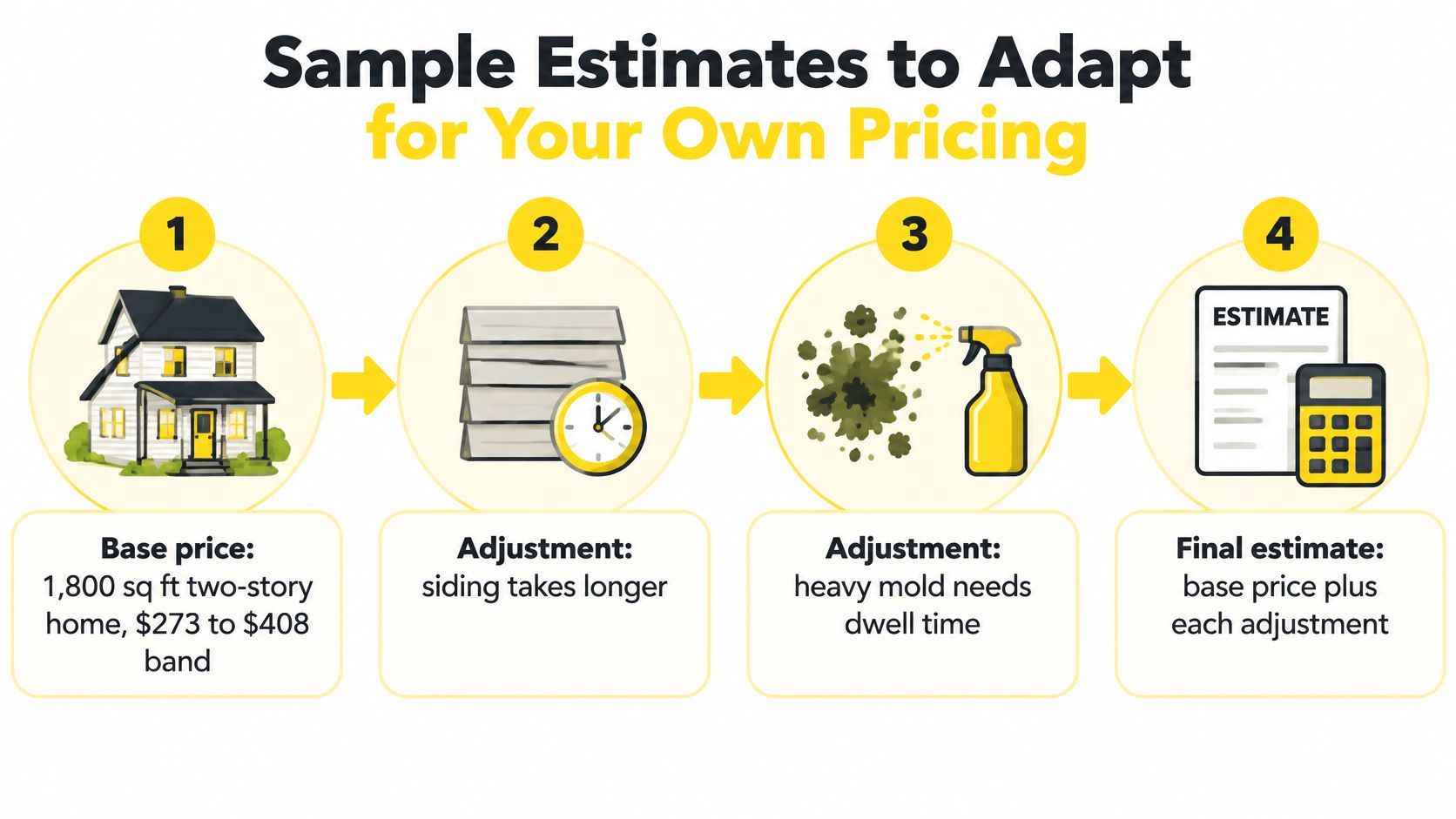
Two-story house, 1,800 sq ft. At $0.30 per square foot, the base is $540. Add $75 for second-story access, bringing the estimate to $615. Keep the access charge on its own line. It explains the higher total without disguising the rate.
Mold-stained patio, 600 sq ft. At $0.30 per square foot, the base is $180. Add $40 for treatment and dwell time, for a $220 total. Naming the adjustment shows what the extra charge covers.
Front walk, 250 sq ft. The area-based price falls below a viable service call, so use a $100 minimum. State plainly that it covers travel, setup and equipment. A firm minimum protects the schedule and makes the price predictable.
Commercial lot, 20,000 sq ft. At $0.05–$0.10 per square foot, the base is $1,000–$2,000, using the parking-lot and garage benchmarks cited earlier. Wastewater containment at $0.05–$0.15 per square foot adds $1,000–$3,000, bringing the total to $2,000–$5,000. Show the containment charge as a labeled add-on, so clients can see its cost before approving the work.
Owner's test: If you cannot point to the line explaining why one estimate costs more, the estimate is not finished.
Published house-washing prices vary. Angi's pressure washing cost guide reports $0.10–$0.50 per square foot. Use published ranges as context, not as a substitute for measuring the job and pricing its conditions. Square footage alone creates false precision.
Compare estimated line items with actual job costs using a job costing program, then adjust your template rates. Keep the format simple: a standard base, clearly named adjustments and a range when job details remain unknown. That gives customers a price they can understand and gives your business a formula it can defend.
The most expensive mistake I see is a price sent without checks. It's fast, and that's the problem. Run this short review before any estimate leaves your desk.
Speed still matters. An estimate sent minutes after an inquiry beats a better one sent tomorrow, so your process has to be standardized before the lead arrives. Use a consistent cleaning cost calculator approach so every team member prices the same way, and browse the Estimatty blog for more pricing guides.
Estimatty gives cleaning businesses a practical way to do that at scale. Its AI agent, Matty, captures square footage, surfaces and urgency, sends instant estimates by SMS and email, and keeps pricing consistent across the team. Setup is no-code, coverage runs around the clock for web visits and calls, and U.S. human receptionists can step in to finalize bookings. Start this week: build three estimates from the samples above, then compare each price against actual job time.
Stop sending gut-feel numbers and start sending estimates built on measured area, labeled adjustments and a firm minimum floor. Estimatty puts that system on your website and phone line around the clock, capturing job details and delivering consistent instant estimates by SMS and email while your crew stays on site. Visit Estimatty, set up your pricing once, and turn every pressure cleaning inquiry into a fast, defensible estimate your team can stand behind.