
October 10, 2026
How to Increase Qualified Leads for Cleaners
Learn how to increase qualified leads for your cleaning business. Discover AI estimators, speed-to-lead tactics, and scoring strategies that book more jobs.

Sunday, October 11, 2026
Discover essential cleaning contracts for small business owners. Learn key clauses, avoid common pitfalls, and secure reliable service agreements in 2026.
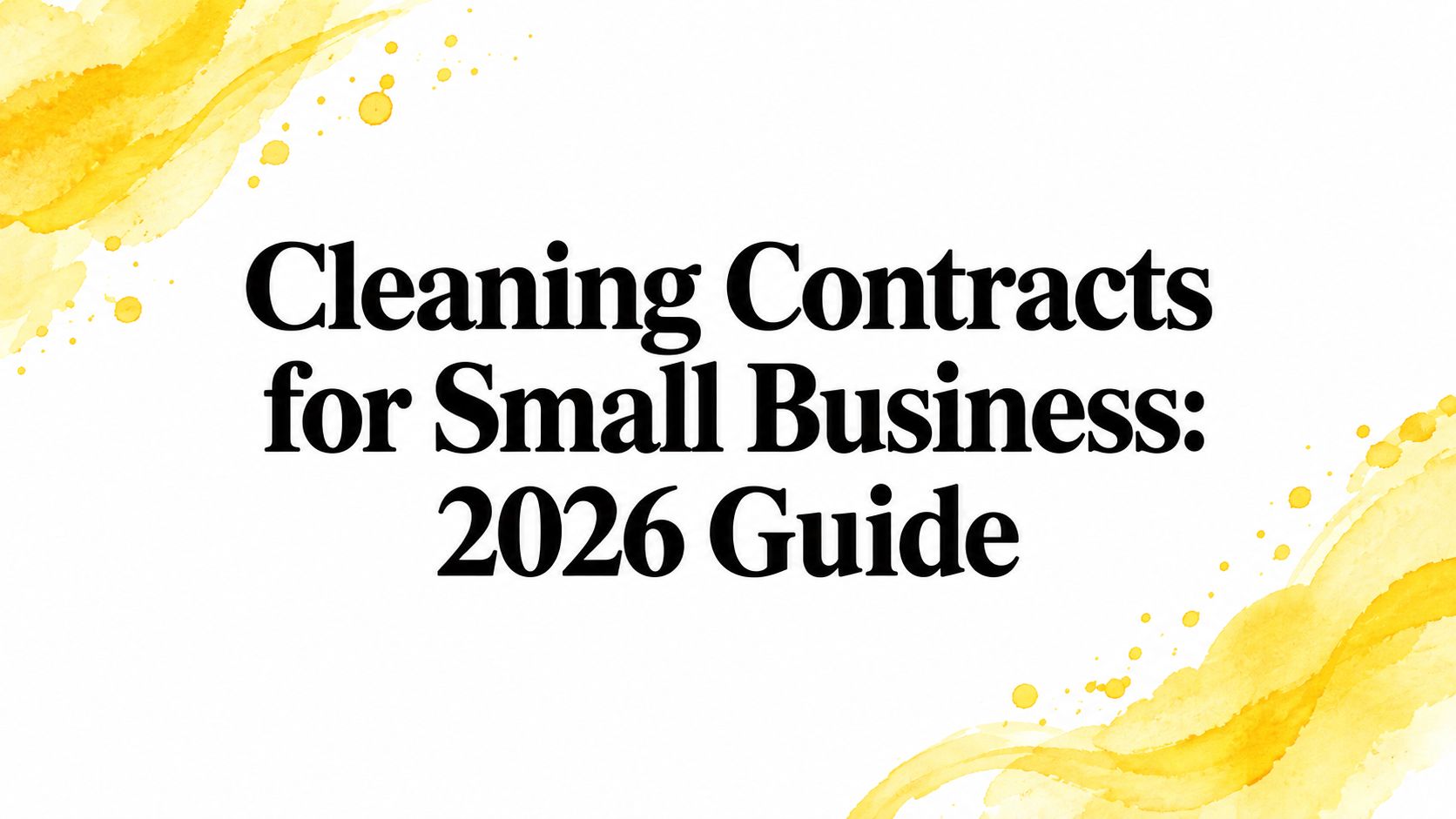
A client calls on Monday asking for “regular cleaning.” By Friday, the cleaner is expected to scrub baseboards, remove pet hair from upholstery, clean inside appliances, and stay longer because the household has become busier. None of that appeared in the original agreement, yet the customer treats it as part of the monthly price.
That situation is common in cleaning contracts for small business. The problem usually isn't that the owner chose the wrong hourly or flat-rate formula. The problem is that the contract never recorded what the price was supposed to buy. A strong agreement protects the service standard, the payment schedule, the labor plan, and the right to stop accepting work that no longer fits the original assumptions.
A solo cleaner can lose an entire day of margin through one vague phrase. “Routine cleaning” sounds friendly during a sales conversation, but it doesn't tell either party whether interior windows, appliance interiors, laundry, heavy soil, or pet-hair removal are included. When expectations expand after the first visit, the cleaner either absorbs the extra labor or challenges the client after the work is complete.
The second option often produces a disputed invoice. The cleaner points to the original conversation, the customer points to what they believed “monthly cleaning” meant, and both sides feel misled. The relationship then stalls, even if the actual cleaning quality was good.
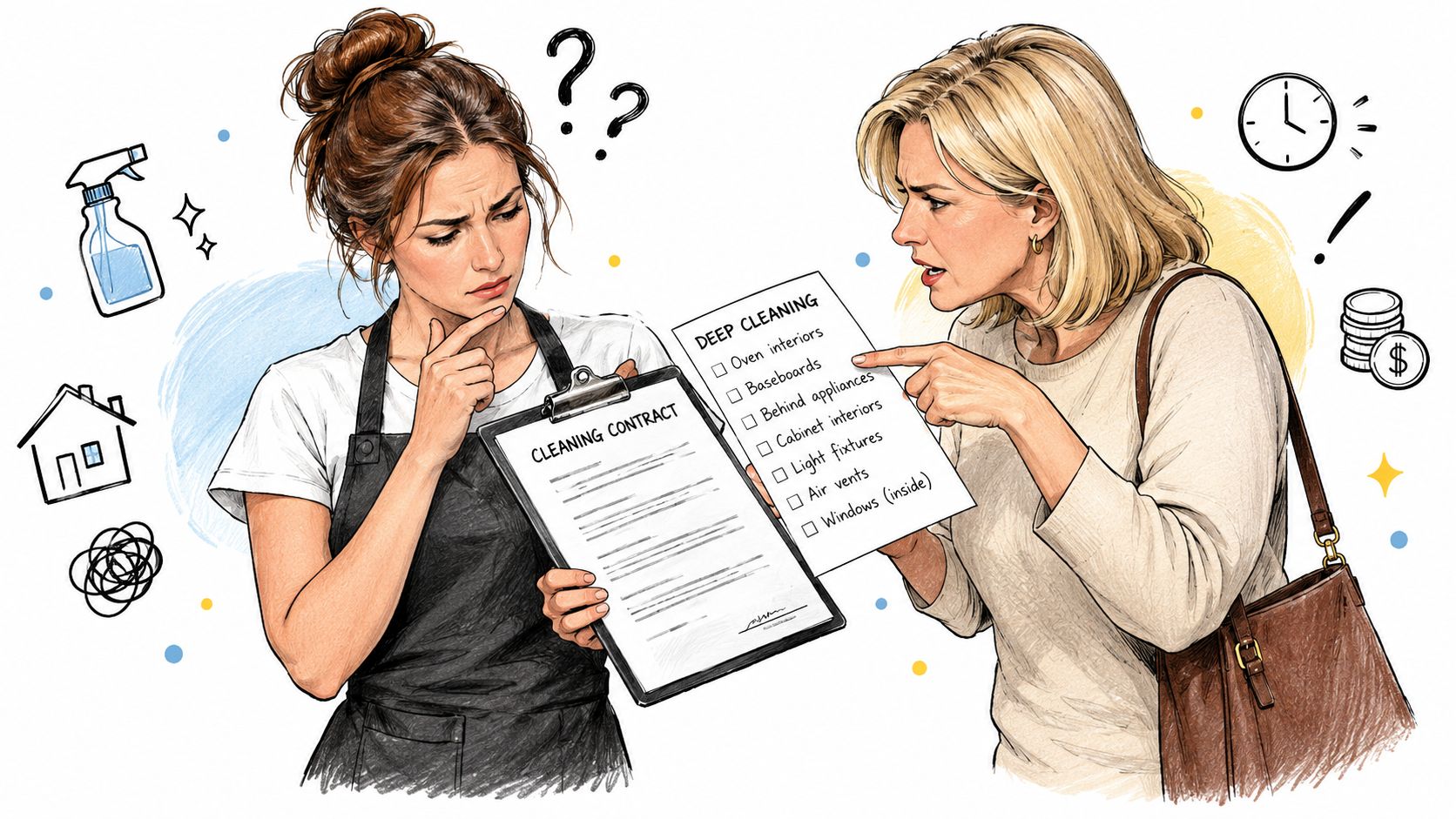
A contract should tell the team what to do before anyone enters the property. It should identify the rooms or areas covered, task frequency, access arrangements, products, exclusions, quality standard, and process for approving additional work. That information becomes a practical operating sheet, not just a document waiting in an email folder.
For commercial work, the same discipline matters at a larger scale. The U.S. janitorial-services industry recorded approximately $74.03 billion in receipts in 2022, with 62,970 firms, according to industry figures for NAICS 561720. Small operators represented 89.0% of firms, so repeatable systems aren't an enterprise luxury. They're how a small company delivers consistently while competing for recurring work.
Practical rule: If a task changes labor time, equipment, risk, or access requirements, it belongs in the written scope or the add-on schedule.
A useful agreement also protects reputation. Clients don't want surprise charges, and cleaners don't want to appear evasive when they refuse an unpriced request. Write the boundary before the first service, then use a written variation when the property, occupancy, or requested standard changes.
The video below illustrates why a visual checklist can make the service conversation clearer before work begins.
Start with a service specification, not a general promise. A workable clause might read: “Provider will clean the listed rooms and surfaces according to the attached checklist, at the frequency and during the service window stated in Schedule A.” Attach the checklist, because a contract that refers to an invisible schedule creates the same uncertainty as a vague paragraph.
Include these elements:
The phrase “provider supplies standard cleaning products” isn't enough if the client expects fragrance-free products, disinfectants, specialty floor care, or environmentally preferred materials. State who supplies consumables and what happens when a required product isn't available.
Separate recurring services from priced add-ons. Interior oven cleaning, carpet extraction, high-reach dusting, biohazard remediation, post-construction cleaning, and excessive-mess surcharges should never hide inside a routine-service paragraph.
Use language such as: “Any work outside the listed scope requires written approval before performance. The approval will state the added task, price or pricing method, expected labor, and any change to the service schedule.” This protects the customer from unauthorized charges and gives the cleaner a safe way to accept legitimate extras.
The drafting principles in this Coto & Waddington contract drafting guide are useful when adapting clauses for your jurisdiction and business structure. A cleaning template still needs local legal review where employment, consumer, tax, or licensing rules apply.
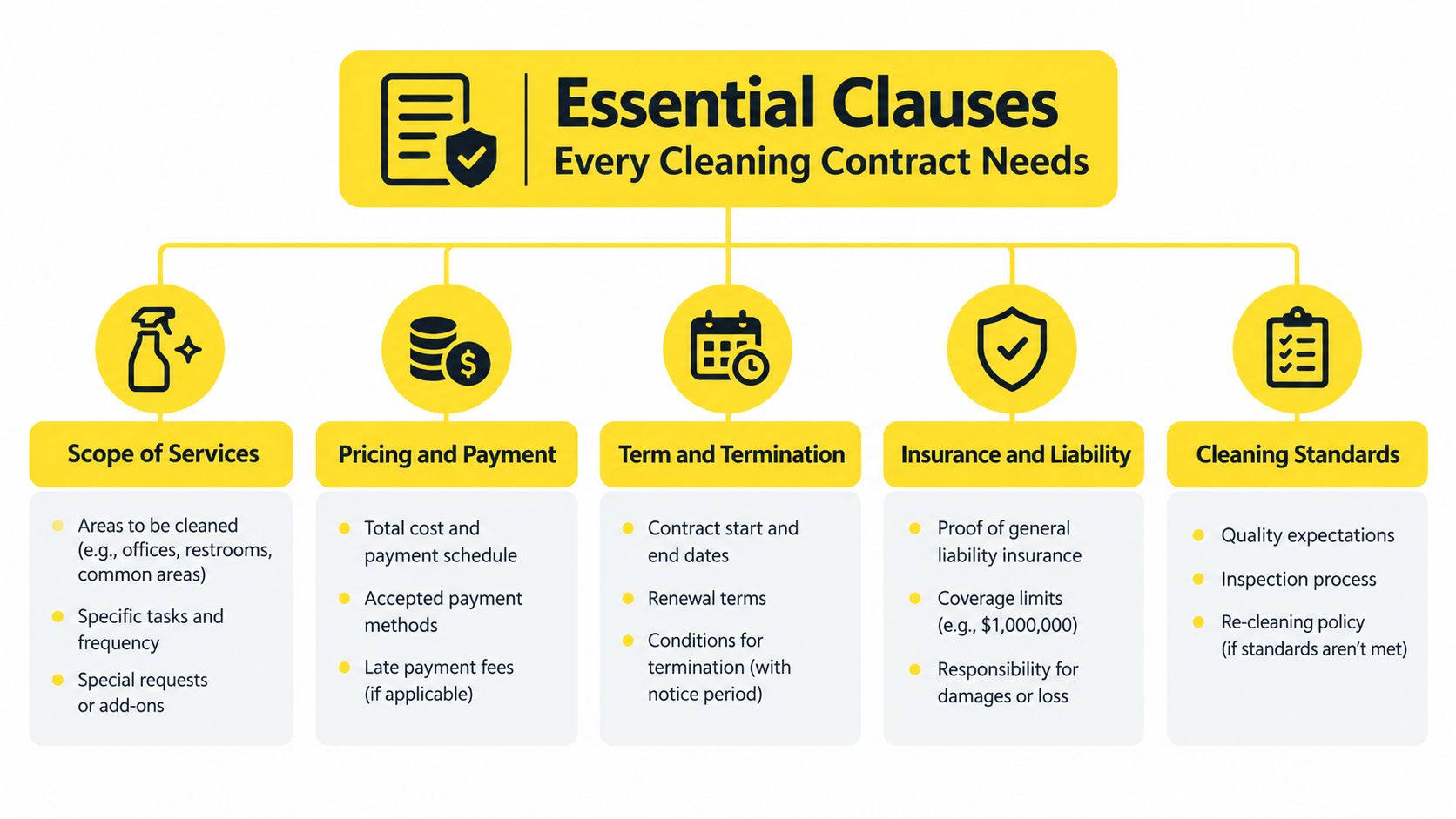
The framework stays the same in both markets, but the inspection language changes. A residential client thinks in rooms and household tasks. A commercial buyer thinks in zones, service levels, access controls, inspection records, and escalation.
For commercial operations, ASTM E1971-19 provides a recognized framework for stewardship of cleaning and housekeeping operations in commercial and institutional buildings. A small contractor doesn't need to copy a standard blindly. The practical move is to convert its principles into a usable task list, frequency schedule, acceptance criteria, inspection process, and escalation path.
| Clause Category | Residential Example | Commercial Example |
|---|---|---|
| Areas covered | Kitchen, bathrooms, bedrooms, living areas, stairs | Offices, restrooms, reception, break rooms, corridors |
| Included tasks | Dusting, vacuuming, mopping, bed making if selected | Floor care, waste removal, restroom sanitation, touchpoint cleaning |
| Exclusions | Dishes, laundry, interior windows, appliance interiors, and pet-hair removal unless listed | High-reach work, construction debris, bodily fluids, and specialty floor restoration |
| Frequency | Weekly, biweekly, monthly, or one-time | Scheduled service by room, zone, shift, or agreed service window |
| Inspection | Customer checklist and re-clean request | Supervisor inspection, service report, escalation contact |
| Change trigger | Added rooms, heavier soil, pets, or changed household needs | Occupancy, square footage, access restrictions, or added areas |
For residential work, define whether beds, dishes, interior windows, laundry, pet-hair removal, and appliance interiors are included. For commercial work, record surfaces, occupancy assumptions, consumables, keys, alarms, security rules, and who can approve extras. A reusable master template saves time, but the property-specific schedule is what makes the agreement credible. See this comparison of commercial and residential cleaning when deciding which inputs belong in each version.
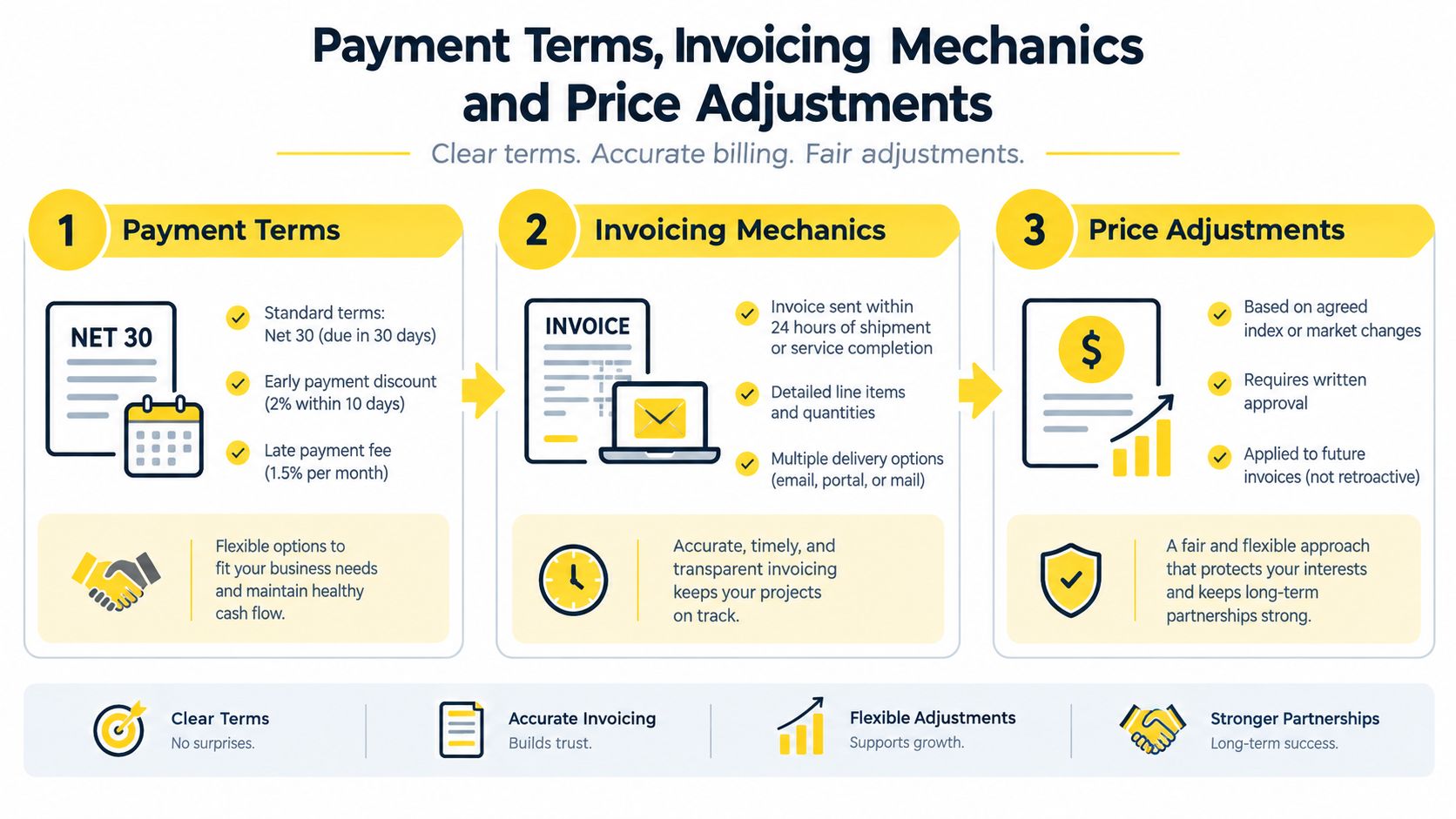
You feel the damage from a weak contract at invoice time. The crew finished the work, the client asks why the amount changed, and nobody can point to a clause that settles it. Payment terms are not admin filler. They protect margin when staffing shifts, access changes, or the customer asks for “one extra thing” every visit.
Spell out the invoice date, due date, payment method, late-payment process, disputed-invoice procedure, and the last day you can bill for completed work. Tie that language back to the scope section. If extra work needs written approval before it is done, the invoice section should say the same thing. That is how you stop a scope dispute from turning into a collection problem.
A published government cleaning-service agreement shows what clear mechanics look like: payment 30 days in arrears, payment only for time service is provided, written approval for added services, and a right to reject an invoice submitted more than six months late. You do not need the same terms in every job, but you do need the same level of precision.
Fixed pricing only holds if the assumptions hold. If occupancy rises, access gets tighter, supplies cost more, or you need more supervision to keep the same standard, the old price can turn into underpriced work fast.
Write the adjustment trigger into the contract. Annual review is one option. Material changes in labor, supplies, insurance, occupancy, access restrictions, or service frequency are another. Then set the notice rule and the client's options if they do not accept the revised rate.
Use wording such as: “The parties may review the service price when labor, supplies, insurance, occupancy, access, or required service frequency changes materially. Provider will give written notice describing the changed assumption and proposed price before the revised charge begins.”
Labor pressure is not theoretical. The occupation outlook projects about 351,300 openings per year on average, with employment rising from about 2,447,700 workers in 2024 to roughly 2,495,500 by 2034. If your contract ignores replacement labor, travel, supervision, and schedule disruption, the job can look profitable and still drain cash.
Use a practical cleaning invoice template guide, then make the invoice match the signed scope, approvals, and adjustment rules.
An estimate is the provider's best prediction. It can change when the property, soil level, access, requested tasks, or materials differ from the assumptions used to calculate it. A quote is an offer to perform defined work for a specified price, so the provider generally can't increase it unless the customer approves extra work or the scope changes.
The agreement should label the pricing method in plain language. For an estimate, write: “This amount is an estimate based on the stated property details and assumptions. Provider will notify the customer when observed conditions are likely to change the expected price.” For a quote, write: “This is a fixed quote for the listed tasks and materials. Additional work requires written customer approval before performance.”
New Zealand Consumer Protection guidance describes an estimate as a prediction and a quote as an offer for defined work. Its guidance also says a final amount should generally remain within 10–15% of an estimate, while a deposit, where requested, should not exceed 10% of the total price. Review the consumer guidance on estimates and quotes and confirm how local law applies before using those figures in your own agreement.
List every included task, material, service window, and assumption. Then state how variations are approved. This proposal versus quote explanation can help keep the sales document and the binding price offer distinct.
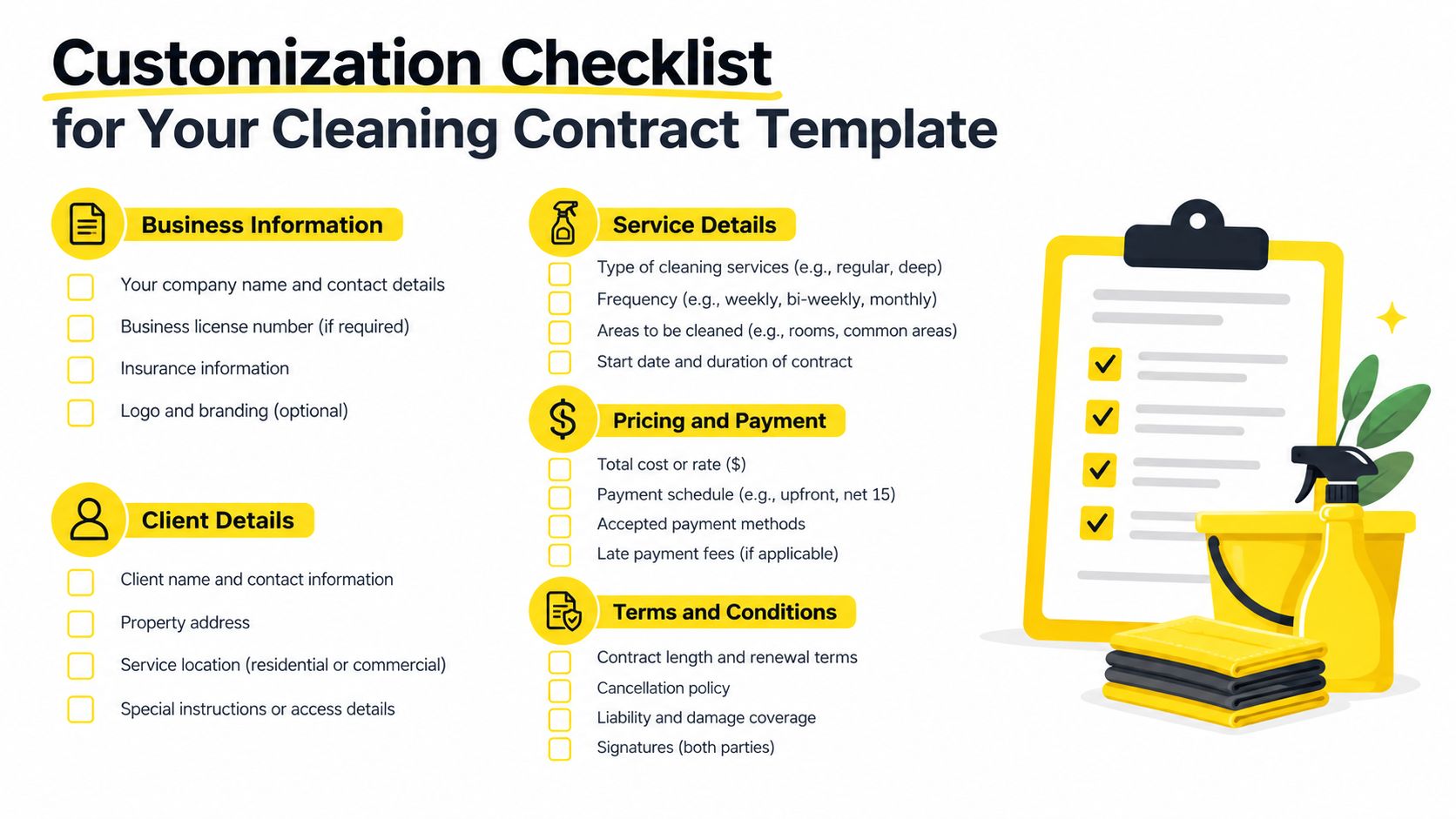
Before sending an agreement, compare the document against the actual job. A template is only useful when its assumptions match the property your team can service.
Save the completed inputs with the agreement. When a customer asks for a change, you can compare the new request against the original assumptions instead of negotiating from memory.
A cleaning contract stops protecting your margin the moment the insurance clause gets vague. I learned that the hard way. A client asked for a certificate after a water damage claim, then questioned subcontractor coverage, deductibles, and who approved the chemical used on site. If the agreement only says “adequate insurance,” you are arguing from memory while the invoice sits unpaid.
Write the clause to answer four points clearly. List the required coverage types and minimum limits in a schedule. Require certificates that show coverage, limits, expiration dates, relevant endorsements, and the insured business name that matches the contracting party. State when proof must be delivered, when renewals must be provided, and whether policy copies or premium evidence can be requested on reasonable notice. Then assign deductible responsibility in plain language, and say whether employees, subcontractors, and approved add-on services are covered under the same protection.
A published government cleaning-service agreement gives a useful example of how to handle evidence of insurance and deductible responsibility. Use the structure, then have your broker confirm what fits your area and client type. Owners comparing neighboring service risks can also learn something from insuring an extermination company, especially how specialized trades describe exclusions, site risk, and proof requirements. For a practical overview written for this trade, see this liability insurance guide for cleaning companies.
Liability language should also control how work is performed. If your team uses hazardous cleaning chemicals, the contract should line up with your actual safety process. OSHA's hazardous-chemicals guidance explains that covered employers handling hazardous chemicals need a written program, chemical inventory, labels, accessible Safety Data Sheets, and worker training under 29 CFR 1910.1200.
Put the operating rules in writing. State who chooses products, whether substitutions are allowed, how dilution and ventilation are handled, what PPE is required, and how incidents are reported. For businesses outside the U.S., use the applicable local standard. Add a site-risk questionnaire covering pets, children, vulnerable occupants, asthma sensitivities, sharps, mold, bodily fluids, electrical hazards, and restricted rooms.
A contract needs an orderly exit, not just a start date. State the initial term, renewal method, notice period, and what happens to scheduled services during the notice period. If the agreement renews automatically, require a reminder before renewal and give the customer a clear way to decline it.
Use separate rules for cause and convenience. For cause, write: “Either party may terminate after written notice if the other party materially breaches this agreement and fails to cure the breach within the stated cure period.” For no-cause termination, write: “Either party may terminate for convenience by giving the agreed written notice.”
Early termination fees should reflect a real, disclosed commitment, not punish a customer for leaving. If a customer cancels a reserved recurring schedule, identify what approved work, nonrecoverable preparation, or committed staffing costs remain payable. Don't leave the fee to an invoice writer's judgment.
Also address final access, keys, equipment, unpaid invoices, customer property, records, and service handover. The agreement should state whether work continues during a dispute and which obligations survive termination, such as confidentiality, payment, insurance claims, and indemnity provisions.
A contract becomes more reliable when the estimator captures the same facts every time. Use a no-code workflow to record square footage, surfaces, rooms, occupancy, frequency, urgency, access conditions, add-ons, travel, equipment, supplies, crew size, and expected labor. The output should preserve the assumptions, not just produce a price.
That record gives the agreement an auditable baseline. If the customer later adds rooms, changes service frequency, restricts access, or requests a higher standard, you can compare the new requirement with the original inputs and prepare a documented variation. The same history supports a price review when labor, supplies, insurance, or occupancy assumptions change.
Set the estimator to ask questions that change the service plan. A residential flow may ask about bedrooms, bathrooms, pets, dishes, laundry, appliance interiors, and heavy soil. A commercial flow may ask about zones, floor surfaces, restrooms, waste handling, security procedures, consumables, and inspection requirements.
Then connect each answer to a contract-ready output:
A no-code estimator should support the agreement, not replace judgment. Review unusual properties, hazardous conditions, regulated environments, and capacity constraints before accepting the work. Resources on no-code AI tools can help owners evaluate implementation options without building a custom software project.
For cleaning companies, the useful result isn't just a faster price. It's a repeatable chain from customer answers to scope, labor plan, payment terms, and renewal conversation. That chain makes vague promises harder to create and margin leaks easier to find.
Estimatty helps cleaning businesses capture property details, generate consistent estimates, and turn approved scope into a repeatable quoting workflow without code. Visit Estimatty to see how a 24/7 web and voice estimator can support clearer cleaning contracts and faster customer response.