
October 23, 2026
How to Start Commercial Cleaning in 2026
Learn how to start commercial cleaning in 2026 with proven steps for pricing, staffing, licensing, and automation that win recurring contracts.

Saturday, September 5, 2026
Compare 10 no-code ai tools for cleaning businesses, including estimates, chatbots, voice agents, integrations, pricing, pros, cons, and setup tips.
A prospect visits your cleaning website after dinner, calls while your team is driving between jobs, or submits a form during the weekend. Nobody answers immediately. By the time someone follows up, the prospect has contacted another cleaner. Even when your team does respond, manual estimates can vary by employee, omit add-ons, or take too long to reach the customer.
The right no-code AI tools can handle the work between inquiry and booking. Some are built for instant web and phone estimates. Others capture leads through chat, answer common questions, connect systems, or help you build a custom internal app. They don't all solve the same problem, and choosing the wrong category creates more work instead of less.
This list evaluates each platform against three revenue-critical cleaning workflows: capturing leads, answering web and phone inquiries, and automating estimates. You'll see where each tool fits, what it connects to, how pricing visibility affects your budget, what setup it demands, and where it can fail. Estimatty uses the word estimates, not quotes, because the goal is to give prospects a fast, consistent price while preserving a clear path to human review when a job needs it.
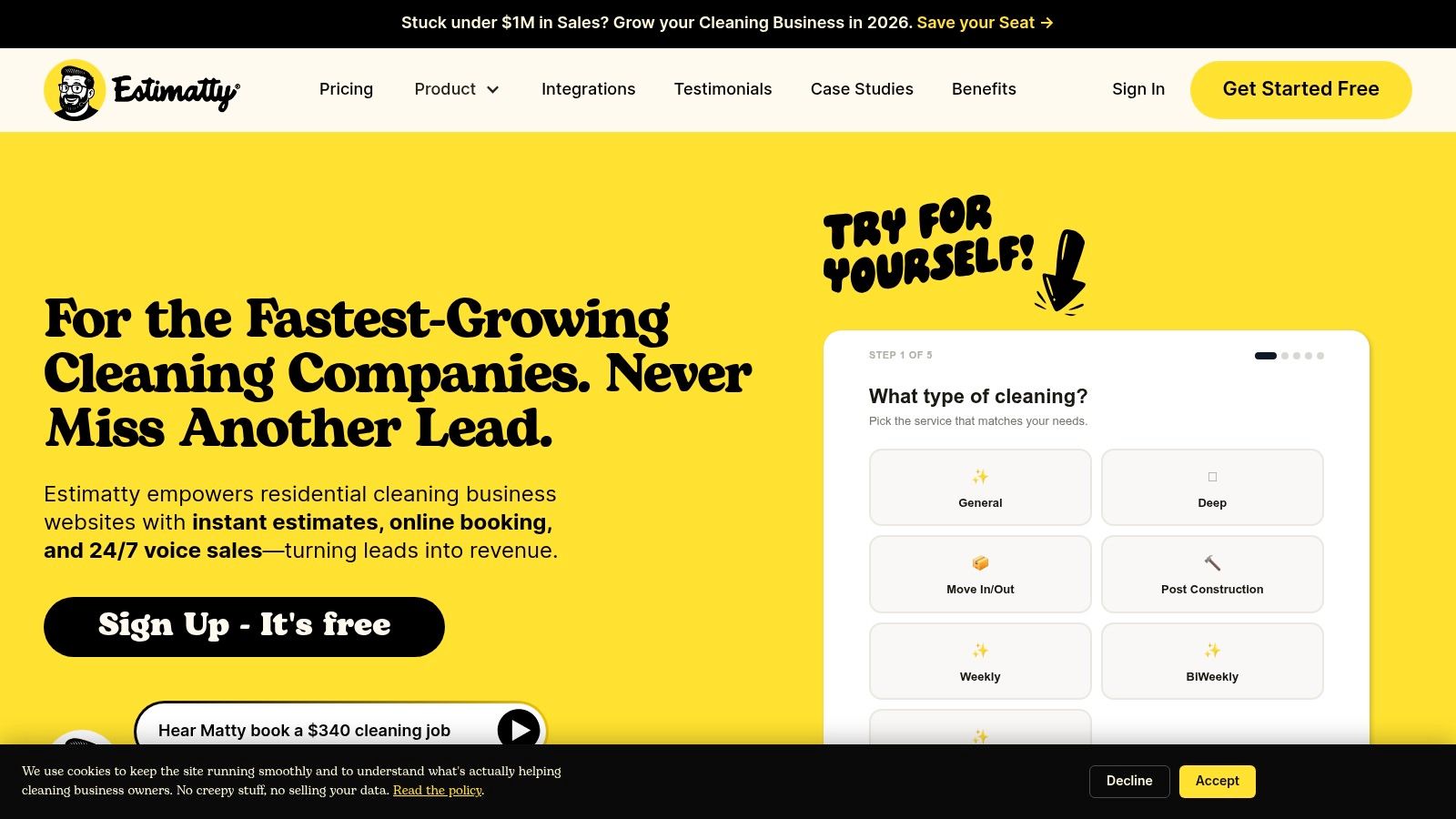
Best for: Cleaning companies that need immediate web and phone lead capture paired with automated estimates.
If a prospect calls after hours or visits your site between appointments, Estimatty can answer the inquiry, collect job details, and provide an estimate without waiting for an employee. It is built for residential and commercial cleaning workflows rather than general customer support. The agent can ask about square footage, surfaces, urgency, service type, and other factors, then return an estimate through the website or phone.
That direct response is its main revenue advantage. Estimatty can answer web visitors and callers around the clock, send estimates by SMS or email, and alert your team when a new opportunity arrives. Its customizable pricebook supports recurring services, deep cleans, move-out work, and add-ons, giving staff a consistent starting point for pricing instead of relying on voicemail, incomplete forms, or memory.
Estimatty belongs at the immediate-deployment stage. Setup is no-code: configure services, add-ons, pricing, and FAQs, select a voice, and place the widget on your website. It can connect with Zapier or a CRM, supports bilingual voice interactions, and can transfer a prospect to U.S.-based receptionists when the conversation needs human judgment.
The platform also presents customer-reported outcomes, including increased bookings and lead volume, along with examples of users gaining customers soon after adoption. Audio demonstrations feature after-hours bookings for higher-value cleaning jobs. Treat these as vendor-reported examples, not guaranteed results. Review Estimatty's cleaning-business estimator to check whether its questions, service logic, and pricing flow match your operation.
Practical rule: Load your actual pricebook and qualification rules before evaluating the agent. Fast responses are useful only when the underlying pricing is accurate.
The main constraint is pricing transparency. Estimatty promotes an hourly equivalent of less than $0.54 per hour and offers a free trial with no credit card, while larger teams may need to contact sales for exact plan details. Complex or unusually large jobs can still require a walkthrough and human review. For standard residential and commercial inquiries, it is a practical first layer for capturing leads, answering questions, and automating estimates before you build a broader integration stack.
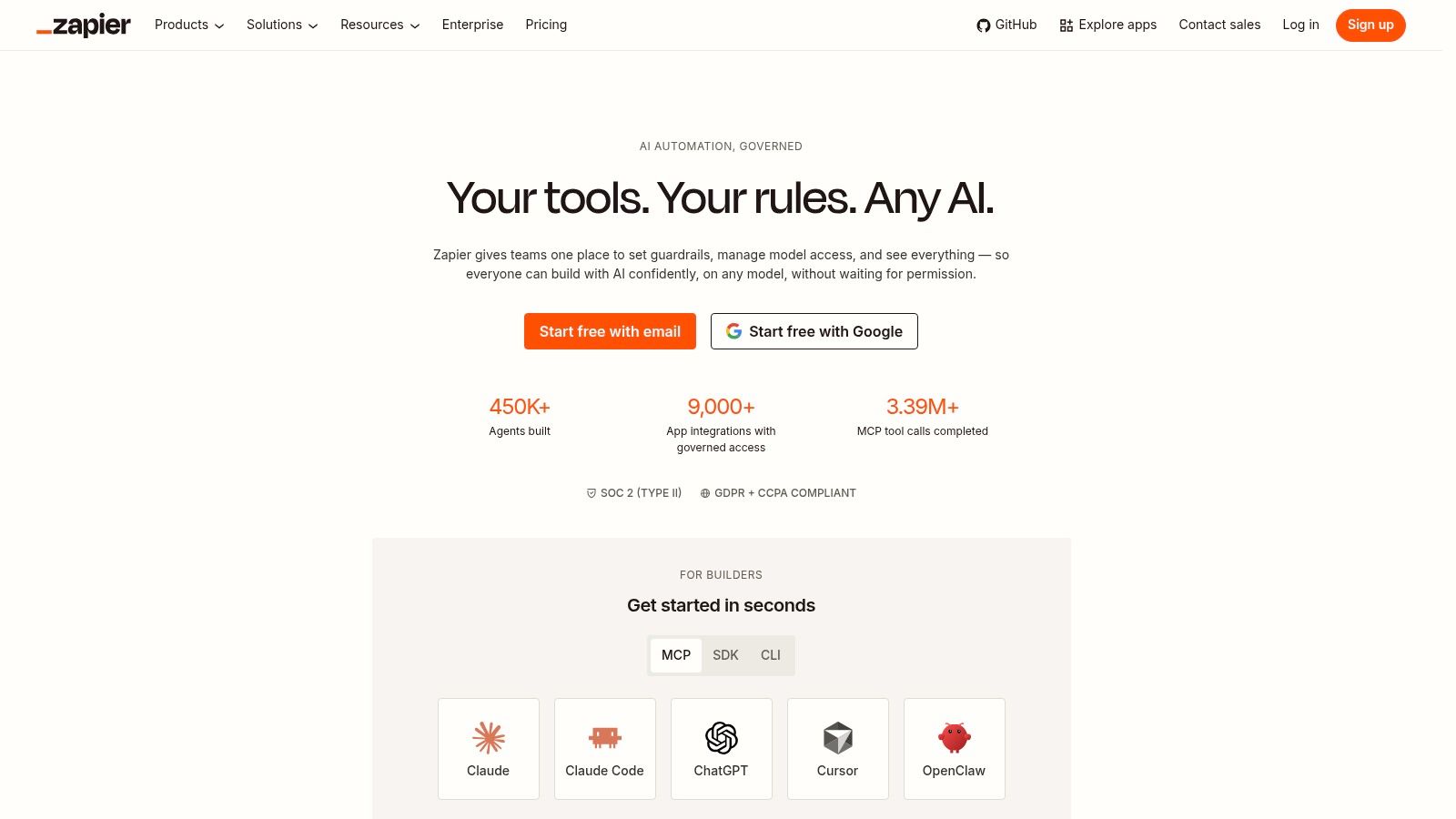
Best for: Connecting lead capture, estimates, CRM records, calendars, and follow-up messages.
Zapier is the automation layer to choose when your cleaning business already has several systems but they don't share information reliably. A website inquiry can become a structured CRM lead, trigger an internal notification, create a follow-up task, and send booking information to a calendar without a developer. Zapier supports workflows across more than 3,000 apps, according to its product positioning, and its platform page reports 593,138,971 automated AI tasks. See Zapier's automation platform.
For cleaning operators, the value isn't a flashy chatbot by itself. It's the movement of information after a prospect gives you details. A completed Estimatty interaction, web form, chatbot conversation, or receptionist call can pass service type, property size, urgency, and contact details into the systems your team already uses. The automation can then alert an owner, assign a lead, send a confirmation, and start a follow-up sequence.
Use Zapier after you've decided how pricing and qualification work. It won't replace a cleaning-specific estimator out of the box. It excels at making sure the estimate and lead data reach the right destination.
Zapier Chatbots can sit on a website and use connected knowledge sources. Its Agents layer can coordinate multi-step actions across apps with guardrails, although advanced agent features are aimed at enterprise users. Model tiers and task accounting help you balance response quality against usage, but AI steps can consume more tasks when you use higher model tiers.
Use this guide to connect Zapier with a CRM when your main problem is lead handoff rather than lead generation. Start with a narrow workflow, such as new estimate submitted, CRM record created, team notified. Expand only after the basic path runs without duplicate records or missed alerts.
Best for: Complex estimate rules, branching lead triage, and teams that need detailed workflow visibility.
Make is the better automation choice when a cleaning workflow has many conditions. You can route a recurring residential cleaning inquiry differently from a post-construction request, send commercial prospects to a sales queue, or require a human review when property details fall outside your standard pricebook.
Its visual scenario builder uses routers, filters, scheduling, and data transformation. The platform includes an AI Toolkit, AI Web Search, AI Agents in beta, and more than 350 AI app connections according to the supplied product information. Explore Make's visual automation platform. Strong logs and observability give operators a useful way to inspect where an estimate workflow failed, which is important when a lead reaches the CRM without the details your estimator collected.
Make uses a credits model. That can be cost-effective for controlled workflows and prototypes, but heavy scenarios can consume credits quickly. A scenario that repeatedly analyzes long customer messages, searches documents, and branches through multiple steps needs monitoring from the start.
Make also asks more from the person building the workflow. Variables, error handling, and data mapping can become confusing when the scenario grows. The platform supports a free tier for prototyping, and you can use Make's AI provider or bring your own large language model key.
For a cleaning business, choose Make when your process has genuine complexity. If you only need every new lead copied into a CRM and emailed to a manager, Zapier is easier to maintain. If you need detailed routing for service areas, property types, urgency, add-ons, and escalation rules, Make gives you more control. You can also review Estimatty's integrations when deciding where an estimator should hand data into a more advanced scenario.
Best for: Controlled website chat and voice agents that qualify inquiries before a human takes over.
Voiceflow suits cleaning companies that want to design a conversational receptionist rather than install a simple question-and-answer widget. You can combine AI responses with deterministic steps, guardrails, and structured workflows. That lets the agent answer service questions, collect property details, identify urgency, and book a callback without allowing the conversation to wander.
This is especially useful for businesses with several service lines or locations. A prospect asking about recurring house cleaning should follow a different path from a property manager asking about commercial janitorial service. Voiceflow can connect with tools such as Zendesk, Salesforce, HubSpot, and Make, which gives your team a route from conversation to CRM or automation.
Voiceflow supports chat and voice deployments, collaboration, environments, and role-based workflows. It also supports multiple model providers, including OpenAI, Anthropic, Google, and Meta. That flexibility can reduce dependence on one model vendor, but it also means your team needs to test responses across the flows you care about.
Public pricing is usage-based and/or sales-led, so don't build your budget from a headline plan alone. Run a trial with real cleaning inquiries, including vague requests, urgent move-outs, commercial scope questions, and prospects who ask for a human. A richer platform can produce a better customer experience, but it requires someone to maintain prompts, knowledge, routing, and analytics.
Use this live-chat software guide if you're deciding whether your website needs basic chat support or a production-grade conversational experience. Voiceflow is the right pick when control and iteration matter more than the quickest possible launch.
Best for: Pricing-aware sales and support chatbots with structured rules and clean human escalation.
Botpress gives cleaning businesses a visual way to build an agent that can reason about a request while still following defined logic. Its Studio, knowledge bases, tools, channels, and Autonomous Engine support workflows that go beyond static FAQ answers. A webchat agent can explain service differences, collect cleaning requirements, apply approved rules, and escalate when the request needs a person.
The distinction from a basic chatbot is control. You can ground answers in your own knowledge, connect tools, choose among model providers such as OpenAI, Anthropic, and Groq, and keep a white-label webchat experience. That makes Botpress useful for a cleaning brand that wants a branded sales assistant without building a custom application from scratch.
Botpress supports no-code and developer-oriented paths, so a small operator can begin visually while a more technical team can extend the system. The trade-off is that advanced capabilities benefit from technical familiarity. You still need to understand how the agent uses tools, what information it can access, and which conversations must stop for human approval.
LLM token costs are billed by the model provider, so usage monitoring matters. A long conversation about a commercial facility can cost more to process than a short recurring-cleaning inquiry. Set clear handoff rules, keep knowledge sources focused, and avoid asking the agent to invent prices outside your approved service logic.
For a practical service workflow, this customer-service automation guide can help frame which questions should be automated and which should go to staff. Choose Botpress when you need a flexible sales chatbot with stronger logic than a simple form, but don't choose it as your first tool if your urgent problem is phone coverage and instant estimates.
Best for: Predictable chat-based lead qualification on websites and WhatsApp.
Landbot is a practical option for small cleaning companies that want a guided conversation without building a full voice system. Its visual builder supports rule-based flows and AI agents, so you can ask required questions in a fixed order while allowing natural-language answers where they help. A prospect can select a service, provide property details, answer an urgency question, and request a callback.
The platform supports web, Messenger, API chat, and WhatsApp automation, with a human takeover inbox. That makes it valuable when customers prefer messaging and your team wants to continue the conversation in one workspace. CRM integrations can pass the collected details to sales staff instead of leaving them trapped in a chat transcript.
Landbot publishes chat and AI chat allowances with overage pricing. That visibility is useful for a small cleaning company testing demand because you can estimate the cost of a lead-capture experiment before committing to a complex enterprise platform. WhatsApp numbers and message volume can create additional costs, so include those in the operating plan.
The starter plan may limit branding and integrations, which can push a growing company toward Pro. That isn't necessarily a problem, but it means your initial setup should include the CRM and messaging channels you expect to keep.
Landbot is not the strongest choice for automated estimates that depend on detailed cleaning price logic. Use it to capture and qualify the lead, then send the structured information to an estimator, CRM, or human estimator. Choose it when chat is the immediate bottleneck and you want a straightforward path from visitor to conversation.
Best for: Small cleaning websites that need simple chat, FAQ answers, and human fallback.
Tidio combines live chat, a help desk, and Lyro AI Agent in one workspace. Lyro can use your FAQ and knowledge content to answer common questions, qualify leads, and hand the conversation to a person. For a cleaning company, that can cover service areas, recurring-cleaning expectations, preparation instructions, cancellation policies, and basic scheduling questions.
The appeal is speed. You can place the chat on a small-business website and let staff take over from the same inbox. The system can connect with CRM and email tools, which helps a team move from a web inquiry to a follow-up without checking multiple dashboards.
Tidio isn't a dedicated cleaning estimator. It can collect information and explain basic pricing guidance, but service businesses should validate the workflow carefully before allowing the agent to produce a final price. A standard cleaning request may fit a guided script. A large property, unusual surface, post-construction job, or urgent commercial request may need a trained estimator.
Tidio's plan structure combines the base product with AI add-ons, so verify the total cost for your expected conversation volume. Its examples and positioning lean toward ecommerce, which means a cleaning business must adapt the knowledge base, handoff rules, and intake questions to service operations.
Choose Tidio when you want an approachable chat-and-human workspace today. Choose Estimatty when the business need is immediate web and phone coverage with a cleaning-specific estimate. Those are different jobs, and treating them as interchangeable will create an incomplete workflow.
Best for: Custom estimating portals, customer dashboards, and complex internal applications.
Bubble is for the cleaning business that has outgrown off-the-shelf workflows. Its visual editor supports full web applications with databases, workflows, plugins, and user accounts. Bubble AI can help generate an application scaffold and refine features, but the owner or implementation team still needs to define how the system stores services, calculates prices, manages scheduling, and handles permissions.
A custom Bubble app could let customers log in, review prior estimates, request add-ons, approve recurring service changes, and see booking history. Internally, it could provide a location dashboard for lead status, estimate approvals, staff assignments, and follow-up queues. Those capabilities go well beyond a website chatbot.
Bubble demands more effort than a chatbot or dedicated estimator. Workload units, overages, hosting, and scaling need monitoring as usage grows. AI-generated features also require manual refinement, testing, and security review. The platform's large template and plugin ecosystem accelerates development, but it doesn't remove the need to make sound process decisions.
A cleaning company should choose Bubble when the custom application itself creates operational value. It isn't the right first move for missed after-hours inquiries. Start with these small-business app ideas and decide whether you need a custom portal or need better lead capture and estimate delivery.
Bubble is powerful, but it belongs in a later implementation stage. Build the revenue path first. Then use Bubble to consolidate unusual workflows that standard tools can't handle cleanly.
Best for: Turning messy lead information into organized operational data.
Airtable works well when your cleaning business has information scattered across forms, spreadsheets, messages, and staff notes. Its database foundation gives teams a structured place to store leads, property details, estimates, service types, locations, follow-up status, and operational notes. Omni adds a conversational app builder and analyst, while Field Agents can perform structured actions such as classifying, extracting, and linking information.
That makes Airtable useful for intake cleanup. A prospect may write, “Need a deep clean for a five-bedroom home before Friday, lots of glass, and maybe the oven too.” An Airtable workflow can organize those details into fields for service type, urgency, property characteristics, and add-ons. Staff can then review the record before sending an estimate or assigning a follow-up.
Airtable's all-in-one combination of database, interfaces, AI, and automation can reduce app sprawl. It supports AI credits pooled by plan and multiple model providers, which gives teams a manageable way to pilot classification and document workflows. Heavy document analysis and web research can consume credits quickly, however, and advanced administration or model controls may require higher-tier plans.
Airtable won't answer a phone inquiry by itself or replace a cleaning-specific estimator. It becomes valuable after information enters the system. Use it to create a clean operating record, build manager dashboards, assign follow-ups, and analyze which inquiry types need better pricing rules.
Choose Airtable when the problem is disorganized data and inconsistent internal handoffs. Choose an estimator or chatbot first when prospects are waiting for a response right now.
Best for: Fast internal apps for job intake, simple pricing logic, and field-team coordination.
Glide lets cleaning companies turn spreadsheet or database information into a mobile or web app without maintaining servers. Its AI columns and actions can work inside data, layout, and action editors. That makes it a sensible way to create a field-friendly intake tool where staff capture job details, review service requirements, apply simple pricing logic, and share an estimate with an office team.
A small cleaning company could use Glide for a supervisor app that records property information during a walkthrough. A multi-location operator could give managers a shared lead and job-status interface with role-based access. The platform also offers business-oriented plans and integrations for teams that need a more organized alternative to spreadsheets.
Glide's biggest advantage is speed and low maintenance. It's easier to launch than a full Bubble application and more structured than passing information through scattered forms and messages. Documentation and plan details support straightforward adoption for teams that want a lightweight operational tool.
The limitation is flexibility. Glide is less suitable for complex pricing logic, unusual booking rules, or a customer portal that needs extensive customization. Public details on newer AI capabilities may lag behind product changes, so verify current limits before building a central process around them.
Use Glide after you've defined your data and workflow. It's a strong internal layer for collecting job details and coordinating teams, but it isn't the best answer to unanswered calls or instant web estimates. For that, start with a customer-facing estimator or conversational tool, then let Glide organize the work behind it.
| Solution | Primary use case | Key features | Best for | Pricing & predictability | Differentiator |
|---|---|---|---|---|---|
| Estimatty | 24/7 web + voice estimating and booking for cleaning businesses | AI voice + web agent; customizable pricebook; SMS/email estimates; Zapier/CRM integrations; no-code widget | Residential & commercial cleaning owners; single & multi-location ops | No public line items; advertises ultra-low hourly equivalent (< $0.54/hr); free trial/no-CC | Industry-specific estimator built by cleaning veterans; proven lift (double bookings, higher lead capture); bilingual + US receptionist handoff |
| Zapier | No-code automation & workflow orchestration | 3,000+ app connectors; Zapier Chatbots; AI steps; Agents (enterprise) | Teams needing integrations, CRM syncs, and automated follow-ups | Task-based pricing; AI steps increase task use, monitor for cost | Deep app ecosystem and granular task/model controls for integrations |
| Make (Integromat) | Visual scenario-based automations with AI | Drag-and-drop scenarios; AI toolkit & Agents (beta); BYO-LLM; strong logging | Complex branching flows and mid-size ops needing flexible data shaping | Credits model with free tier; heavy scenarios can exhaust credits | Very flexible routing/branching for complex pricing rules |
| Voiceflow | Design, test, and deploy voice & chat agents | Agent builder; multi-model support; analytics; CRM integrations | CX teams building IVR-style receptionists or chat concierges | Usage-based / sales-led pricing; trial recommended for budgeting | Production-grade voice + chat agent tooling with team collaboration |
| Botpress | GPT-native agent platform for bots & automation | Visual studio; knowledge bases; Autonomous Engine; BYO-LLM; white-label | Teams needing customizable, developer-friendly agents and webchat | Pay-as-you-go model; LLM token costs billed by provider | Strong developer + no-code paths with white-label options |
| Landbot | No-code chatbot (web & WhatsApp) for lead capture | Visual builder; hybrid rule+AI; WhatsApp add-on; clear chat allowances | Small cleaning businesses wanting predictable chat costs & WhatsApp | Transparent chat/AI allowances and published overage pricing | Predictable pricing and strong WhatsApp support for SMBs |
| Tidio (Lyro AI) | SMB-friendly live chat with AI agent | Lyro AI grounded in FAQs; Claude-powered agent; human takeover inbox | Small service businesses wanting fast deployable site chat | Base plan + AI add-ons, verify total cost | Quick to deploy unified AI + live chat workspace for SMBs |
| Bubble (Bubble AI) | Build custom web apps and portals without code | Visual app editor; Bubble AI; workflows, DBs, plugins | Businesses needing bespoke estimating portals or customer dashboards | Workload units metering; requires effort to optimize costs | Full app-level customization and scalable hosting ecosystem |
| Airtable (Omni & Field Agents) | Database-driven apps + AI automations | Omni conversational builder; Field Agents; pooled AI credits | Teams needing unified data, intake cleanup, and automation | Credit-based AI packs; included monthly credits per plan | All-in-one data + AI + automation that reduces tool sprawl |
| Glide | Fast no-code mobile/web apps | AI columns/actions; app from spreadsheets; quick publishing | Teams wanting lightweight customer/internal apps fast | Clear business plans; good predictability for small apps | Very quick to ship polished, low-maintenance customer/internal apps |
Cleaning businesses shouldn't choose no-code AI tools by counting features. Choose based on the point where revenue is currently leaking. If prospects wait too long for an answer, you need customer-facing coverage. If staff spend too much time copying information between systems, you need an automation layer. If pricing rules live in memory or separate spreadsheets, you need a controlled estimating process.
Choose Estimatty when instant web and voice estimates are the priority. It is the clearest fit for residential and commercial cleaning companies that lose after-hours inquiries, rely on inconsistent manual pricing, or need a no-code way to collect square footage, surfaces, urgency, and service details. Its web and phone coverage addresses the first failure point, while SMS, email, notifications, and CRM connections support the handoff after the estimate.
Choose Landbot or Tidio for simpler chat-based qualification. Landbot is the better option when you want a guided web or WhatsApp flow with more visible usage allowances. Tidio is the better fit when a small team wants live chat, AI answers, and human takeover in one accessible workspace. Neither should be treated as a complete substitute for a cleaning-specific estimator when the price depends on detailed service rules.
Choose Voiceflow or Botpress for more controlled conversational agents. Voiceflow is suited to production customer experience teams that need voice and chat, analytics, collaboration, and model flexibility. Botpress is a strong choice when the agent must combine knowledge grounding, tools, structured logic, and white-label webchat. Both require more planning than a basic chat widget, and both need clear escalation rules.
Use Zapier or Make to connect intake to CRMs, calendars, notifications, and follow-ups. Zapier is easier for common app-to-app workflows and broad integrations. Make is better when you need branches, data shaping, logs, and complex routing. Neither platform fixes unclear pricing rules. They move information efficiently after you define what the information means.
Reserve Airtable, Glide, or Bubble for custom data and app workflows. Airtable is the strongest choice for organizing intake and building internal records. Glide is the fastest route to a lightweight field or manager app. Bubble is the right choice when you need a full custom portal, dashboard, or application that off-the-shelf tools can't provide. These platforms require more design and maintenance, so don't deploy them before validating the basic lead-to-booking process.
Document pricing rules and FAQs. Write down service types, add-ons, minimum requirements, service areas, escalation conditions, and the information required before an estimate can be sent.
Select one lead path. Start with website inquiries or phone calls. Don't automate every channel at once. Pick the path where missed responses create the most immediate loss.
Connect the CRM or automation platform. Send each inquiry to one source of truth. Include contact information, property details, requested service, urgency, estimate status, and human-handoff status.
Test common and edge-case inquiries. Run recurring-cleaning requests, deep cleans, move-outs, commercial requests, unclear property sizes, urgent jobs, unusual surfaces, and prospects who ask for a person.
Review usage costs. Check task consumption, credits, model charges, message volume, workload units, and overages before expanding the workflow. A low initial bill can change when conversations become longer or more frequent.
Add human handoff before scaling. The agent should know when it cannot confidently estimate, when a customer is frustrated, and when a high-value or unusual job needs staff review. Human escalation protects the customer experience and your margin.
The best implementation usually starts with one visible bottleneck and one measurable handoff. Put an estimator in front of the right inquiries, or put a chatbot on the page where prospects ask questions. Then connect the resulting data to your CRM and follow-up process. Governance matters after deployment too, because no-code AI can create undocumented changes, inconsistent answers, and shadow workflows if nobody owns approvals, testing, and review. The wider enterprise trend supports taking that operational discipline seriously. Gartner's benchmark projects that 70% of new enterprise applications will use low-code or no-code technologies by 2026, up from less than 25% in 2020. Read the benchmark context for low-code adoption.
No-code AI won't eliminate the need for good pricing, clear service definitions, or trained staff. It can make those decisions available at the moment a prospect is ready to buy. Start with the tool that handles your current bottleneck, measure the handoff, and add complexity only when the workflow earns it.
Estimatty gives cleaning businesses a no-code web and voice sales estimator that answers inquiries, captures job details, delivers fast estimates, and connects leads to your team day and night. Visit Estimatty to test a practical path from missed inquiry to booked cleaning job.