September 21, 2026
Inside and Out Cleaning: A Practical Pricing Guide
Learn what inside and out cleaning really includes, how pricing works, and which add-ons actually pay off for residential and commercial estimates.

Tuesday, September 29, 2026
Compare commercial and residential cleaning markets in 2026. Explore pricing, staffing, compliance, and how AI estimators streamline operations.

You're balancing two very different businesses under one cleaning-company name. A residential customer wants a fast, clear estimate for a lived-in home, while a facility manager expects documented scope, dependable crews, and pricing that survives a contract term. If you use the same labor assumptions and sales process for both, one division will eventually subsidize the other.
Commercial and residential cleaning can both produce recurring revenue, but they behave differently operationally. Commercial work is built around facility access, schedules, compliance, and contract scope. Residential work depends more heavily on trust, convenience, condition, and personalized service. In 2026, the companies gaining control of both markets are treating them as two operating engines, not one generic cleaning service.
A cleaning owner may start Monday by estimating a recurring home, spend Tuesday preparing a proposal for an office, and finish the week trying to cover a commercial shift after an employee calls out. The work may look similar from a distance, but the business mechanics aren't. A home has personal belongings, individual preferences, and variable access. A commercial facility has defined zones, service windows, procurement processes, and often more formal expectations around documentation.
The scale of each market reflects that difference. The global commercial cleaning market was estimated at USD 67.2 billion in 2025 and is projected to reach USD 140.4 billion by 2035, representing a 7.6% CAGR, according to this commercial cleaning market analysis. In the United States, the same analysis estimated commercial cleaning and sanitation services revenue at about $75.3 billion in 2026, with 885,000 businesses operating in the sector.
Residential cleaning is also a mainstream category rather than a niche convenience. U.S. residential cleaning services revenue was estimated at $18.8 billion in 2026, while another industry summary placed the residential maid services segment at $17.2 billion in 2025 and projected growth of 5.5% in 2026. Those figures come from the IBISWorld residential cleaning services overview and the market estimate referenced in the commercial cleaning analysis.
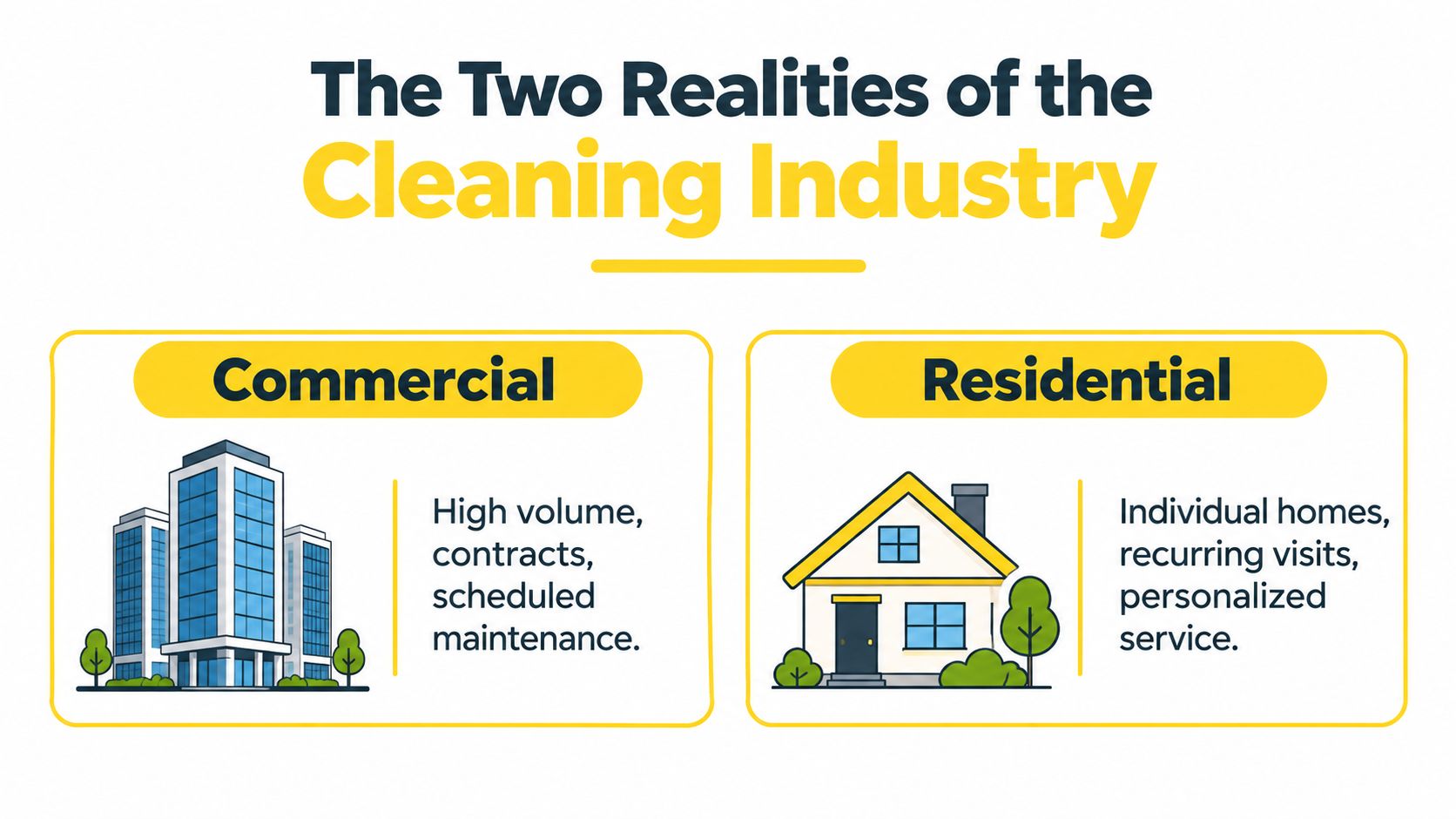
Commercial revenue usually comes from scheduled maintenance across offices, healthcare locations, retail sites, schools, and industrial environments. A strong account can create a stable route, but it also locks you into service-level expectations. Missing a shift, underestimating restroom work, or accepting an unrealistic scope can turn recurring revenue into recurring losses.
Residential revenue is more fragmented and relationship-driven. The customer often evaluates the experience as much as the result, including arrival communication, product preferences, handling of personal items, and consistency between visits. Recurring home service can be highly valuable, but the estimate must account for the home's actual condition and the client's requested tasks, not just floor area.
Owner's rule: Keep separate production standards, service checklists, sales scripts, and labor assumptions for each division.
The mistake is assuming success transfers automatically. A residential team accustomed to detailed kitchens may struggle with large floor plans and after-hours access. A commercial crew trained for throughput may frustrate a homeowner who expects careful attention to fragile or personal items. Owners who want both markets should build shared administration and finance, while keeping the customer experience and operating playbooks distinct. A practical foundation for that structure is outlined in this cleaning service business guide.
Accurate estimates begin with the physical work, not the selling language. The basic planning formula is straightforward: square footage divided by production rate converts the job into labor time. The difficult part is selecting a production rate that matches soil load, access, furniture, touchpoints, equipment, and the requested level of service.
Residential work is slower because cleaners operate inside personal spaces with more variation. A standard home may contain clutter, occupied rooms, stairs, delicate surfaces, and kitchens that require hand detailing. Field benchmarks place standard residential cleaning at roughly 400 sqft/hour, while deep cleaning is closer to 250 sqft/hour, as reflected in the Unger microfiber cleaning case study. Those rates aren't interchangeable. Applying a maintenance rate to a first-time deep clean is one of the fastest ways to underprice the job.
Commercial work often offers better repetition and clearer zones. A microfiber flat-mop system can remove up to 14% more soil than looped mops and 16% more than cut-end mops, according to the same case study. That doesn't mean every facility can be cleaned faster by the same amount. It means tool selection affects first-pass efficiency, re-soiling, and the amount of labor required to reach a consistent result.
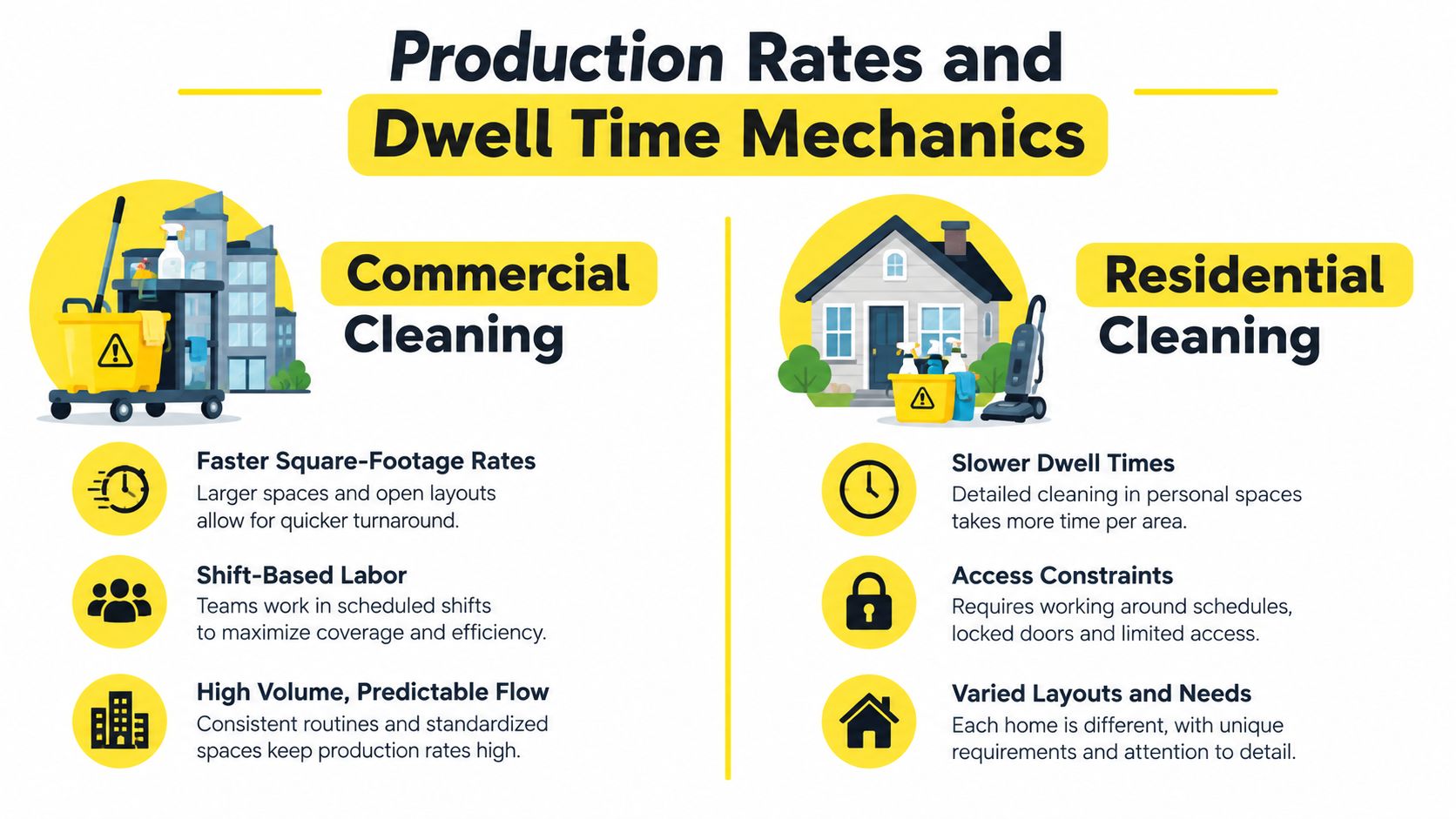
Disinfection adds a constraint that production-rate spreadsheets often miss. A disinfectant must remain visibly wet for the labeled contact time, which can range from 30 seconds to over 10 minutes depending on the product, target microbe, and surface type. If a cleaner sprays and immediately wipes the surface dry, the task may be cleaning, but it hasn't achieved the product's disinfection claim. The Head Start guidance on cleaning, sanitizing, and disinfecting products explains why label contact time matters.
For commercial routes, crews may need to divide a floor into zones, apply product in sequence, and return after the dwell period. For residential teams, the same principle can turn a kitchen or bathroom into a staged workflow. Spray first, move to another task, then return to wipe when the required wet time has passed.
A workable production plan records more than square footage:
The schedule should reflect what cleaners do. A route that looks profitable on paper can fail once dwell time, travel inside the building, restocking, and inspection are included.
A small medical clinic, a busy retail store, and a maintained home can share the same cleaning company while requiring entirely different quotes. A single hourly rate may look simple on a website, but it hides differences in access, documentation, traffic, detail level, and service frequency. Commercial estimates need a facility-specific scope. Residential estimates need a clear visit condition and task list.
Facility type creates a wide commercial pricing range. Healthcare facilities average $0.14 to $0.29 per square foot, while retail averages $0.07 to $0.15 per square foot, according to the State of Commercial Cleaning 2026 pricing summary. Healthcare work can require controlled procedures, product restrictions, and documentation. Retail work may involve public traffic, glass, entrances, sales floors, and changing operating hours. Square footage sets a starting point, not the final price.
| Segment | Primary Pricing Metric | Key Cost Drivers |
|---|---|---|
| Commercial office | Square foot, visit, or contract scope | Frequency, restrooms, shared areas, access window, staffing |
| Healthcare | Square foot plus specialty scope | Disinfection requirements, risk level, documentation, controlled procedures |
| Retail | Square foot or scheduled visit | Public traffic, entrances, glass, floor care, operating hours |
| Residential maintenance | Visit or recurring plan | Home condition, frequency, rooms, access, preferences |
| Residential deep clean | Task-based estimate | Soil load, detail work, appliances, buildup, add-ons |
Start with task minutes, then price the paid work surrounding them. Supply loading, movement between zones, equipment setup, access delays, inspection, and corrections all consume labor. A facility with an efficient floor plan may need fewer paid minutes than a smaller site with long corridors, restricted rooms, or difficult parking.
Commercial guides cite average costs of $0.10 to $0.20 per square foot. Hourly pricing may start around $20 per hour for office and retail jobs and reach $90 per hour for industrial and medical work. Total visits can range from $70 to $1,500 or more, depending on size and frequency, according to this commercial cleaning cost guide. Use those figures as market context, then measure the actual scope. A generic rate cannot account for every access window, service requirement, or correction risk.
Labor can account for 50% to 65% of revenue in a well-run commercial cleaning business, according to the State of Commercial Cleaning 2026 pricing summary linked above. Wage changes, paid travel, supervision, supplies, and rework can turn a signed contract into a loss if the estimate leaves them out.
Residential quotes need different safeguards. Confirm whether the home is maintained or overdue, whether pets or clutter restrict access, which rooms are included, and whether the customer wants appliance interiors, baseboards, interior windows, or other add-ons. Record each assumption before scheduling. This prevents unpaid extras from becoming an expected part of routine service.
For a closer examination of labor, frequency, and scope decisions, use this commercial cleaning pricing guide. An AI estimator can standardize those inputs, but the operator still needs to verify unusual facilities and labor conditions before sending the quote.
Labor is where a cleaning estimate becomes real. A customer sees a total price, but the business carries the cost of recruiting, onboarding, scheduling, absence coverage, supervision, payroll, and replacement hiring. When staffing changes, the original production assumption can stop matching the crew assigned to the job.
Turnover rates in the cleaning sector exceed 200% annually, while median janitorial wages rose 6.1% in 2024, according to Cleaning Services Market coverage from Kings Research. That combination makes labor stability a direct pricing issue. A company that estimates using yesterday's wage and today's ideal crew may win work while slowly losing margin.
Use a labor budget that reflects the role, location, shift, and required skill. U.S. labor summaries report a median hourly wage of $17.71 and a mean wage of $18.64 for janitors and cleaners, based on Bureau of Labor Statistics figures cited by RapidEye Inspections. The same source describes regional variation, with Northeast markets around $17.50 to $22.00 per hour and Southern markets around $13.50 to $16.00.
Don't bury volatility inside an unexplained price increase. Instead, define the assumptions behind recurring service:
Hiring software can help organize applicants, screening, onboarding, and employee records, but it won't fix an inaccurate estimate by itself. Platforms such as PipeHire HRM are relevant when a growing cleaning division needs a more structured employee pipeline. For owners reviewing the broader economics, these practical cost reduction strategies provide useful ways to reduce waste without treating underpayment or rushed work as a strategy.
Margin check: If the estimate only works when every shift is fully staffed and every cleaner works at the ideal rate, the estimate isn't robust enough.
A stable hiring pipeline also improves customer retention. Commercial clients notice missed visits and inconsistent teams. Residential clients notice late arrivals, substitutions, and repeated explanations of the home's preferences. The guide to hiring cleaning employees is a useful reference for turning hiring from an emergency task into an operating process.
A one-off move-out clean can fill tomorrow's schedule while leaving next month's labor uncertain. Recurring packages give the owner a clearer production plan, steadier revenue, and better information about the property. The offer should define what happens, how often it happens, what is excluded, and which conditions trigger a revised estimate.
Residential demand supports this model. 41% of U.S. households use recurring cleaning services, according to Jobber's cleaning industry trends coverage. The operational benefit extends beyond repeat revenue. After several visits, the team knows the home's condition, access routine, preferences, and realistic production time. That knowledge makes quoting more accurate and scheduling less fragile.
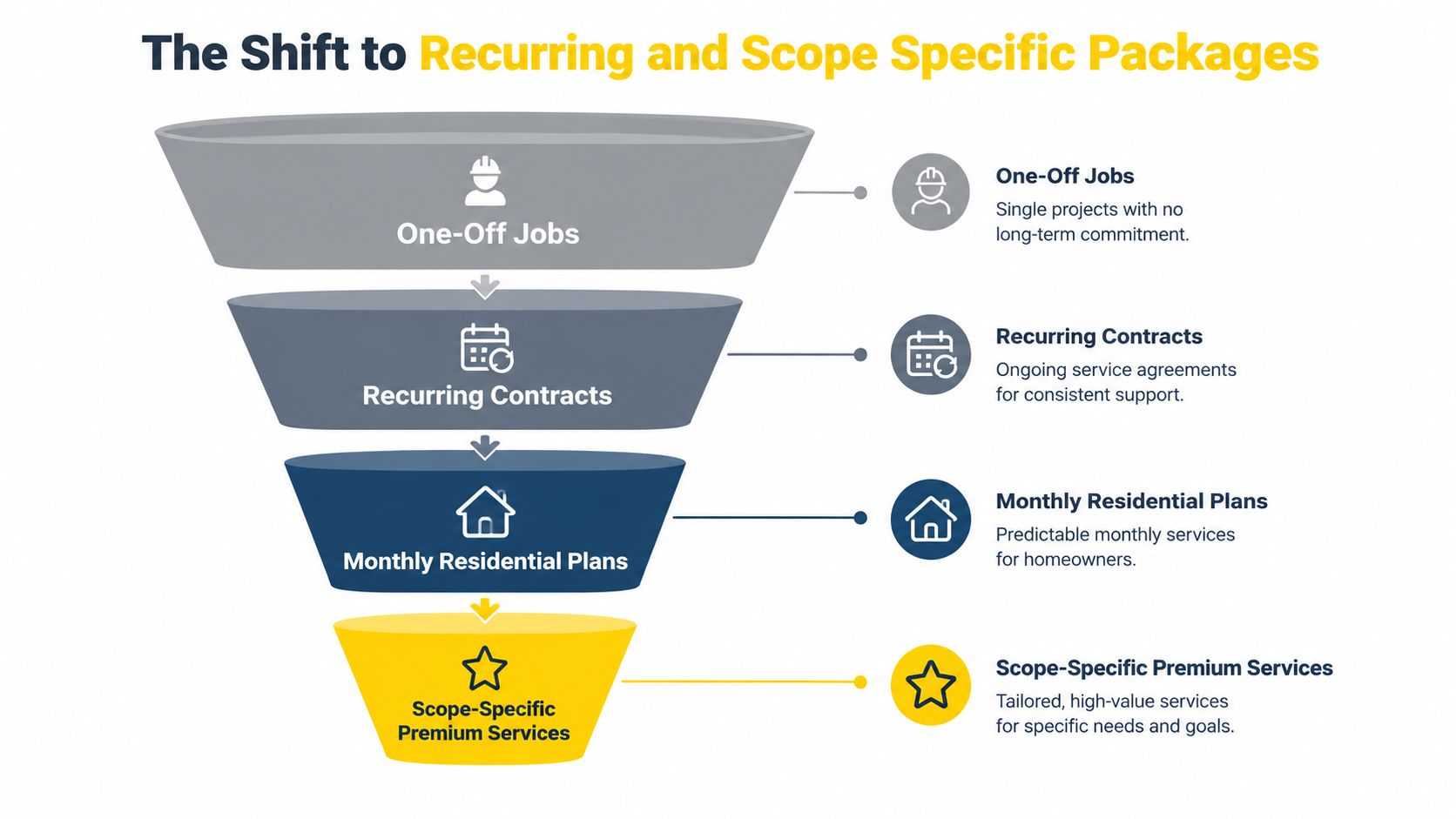
A standard maintenance clean should list the rooms and routine tasks included on each visit. A deep clean should identify the extra detail work, buildup, neglected areas, and interior features that require additional labor. A standard clean commonly falls around $150 to $300, while a deep clean can cost 50% to 100% more, as summarized in the same Jobber resource. Explain the labor difference instead of presenting the higher price as an arbitrary premium.
Commercial packages need the same clarity, with facility-specific controls:
The package should state when the estimate changes. Substantial clutter in a home, extended retail hours, added office space, or a new access restriction can invalidate the original labor assumptions. In commercial work, scope drift often appears gradually, so review the account after operational changes rather than absorbing extra tasks indefinitely.
A disciplined intake prevents many disputes. The person answering the phone or web chat should ask about condition, frequency, rooms, surfaces, urgency, and special requests. These top call center scripts for home services can provide a structured starting point while leaving room for a natural conversation.
Recurring plans also make add-ons easier to sell. Offer work that matches the property's needs, such as a periodic deep kitchen service for a residential client or scheduled floor care for a commercial account. Automation can manage reminders, renewals, and scope reviews, while managers verify that the package still matches actual labor. That check matters as staffing conditions change and AI-assisted estimates make initial quoting faster but do not replace field judgment.
Manual estimating becomes a bottleneck when the business serves both segments. A basic residential inquiry may arrive after hours and need only a handful of qualifying details. A commercial inquiry may require floor area, facility type, service frequency, access conditions, disinfection expectations, and specialty tasks. Sending every inquiry into the same slow form guarantees inconsistent data.
An AI estimator can standardize the first conversation without replacing operational judgment. A web or voice agent can ask for square footage, surfaces, urgency, rooms, facility type, and requested scope, then apply the pricing rules the owner has configured. It can send an estimate by SMS or email and notify the team when a prospect needs human follow-up.
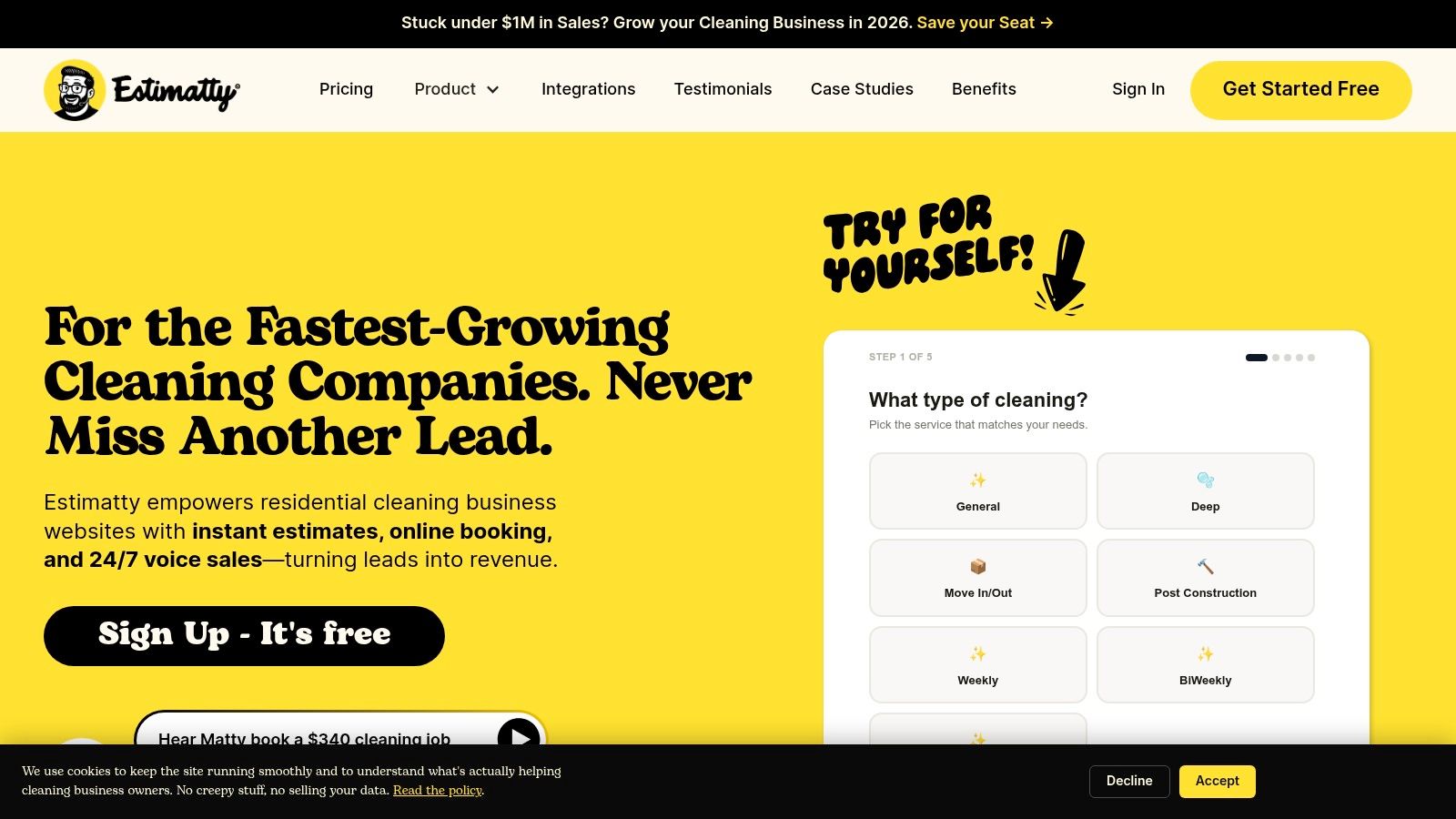
Fast response matters, but speed without good inputs only produces fast mistakes. The estimator should branch according to the segment. Residential prospects need questions about home condition, recurring frequency, rooms, pets, access, and add-ons. Commercial prospects need facility type, floor area, service windows, traffic, touchpoints, compliance requirements, and whether the request is maintenance or specialty work.
The owner still controls the rules. Set different production rates for maintenance and deep cleaning. Add labor for restricted access or long internal travel. Require a human review for healthcare, industrial, hazardous, unusually large, or otherwise complex work. Use the system to collect consistent information and handle routine demand, not to pretend every property has the same risk.
AI estimates software for cleaning businesses fits into the operating model by serving as a front-line intake tool. Estimatty is an AI-powered web and voice sales estimator for residential and commercial cleaning businesses. It engages prospects through a website or phone, captures job details, sends estimates by SMS and email, answers common questions, and can connect with workflows through Zapier or a CRM. Human receptionists can step in when a prospect is ready for a more complex conversation.
The correct automation target isn't the cleaner's judgment. It's the repetitive intake that prevents the cleaner or manager from using judgment where it matters.
Review estimate outcomes every week. Compare accepted work with actual labor minutes, identify which questions were missed, and adjust the pricing rules. If deep cleans consistently overrun, change the condition logic or rate. If commercial inquiries require site visits, create a clear threshold instead of allowing an AI-generated estimate to stand as a final proposal.
The practical result is consistency across channels. A prospect who calls at night receives the same core qualification as someone who completes the website conversation during business hours. Your team starts with structured information rather than a voicemail, an incomplete form, or a guess.
A cleaning company that serves both segments needs one financial dashboard and two operating playbooks. The dashboard should show revenue, labor, supplies, rework, cancellations, and retention by segment. The playbooks should define how a residential maintenance visit differs from a commercial contract, including estimating questions, crew skills, inspections, and escalation rules.
Consider an owner expanding from residential work into offices. The first temptation is to use existing cleaners, copy the residential hourly rate, and accept any commercial request that looks large. That approach creates avoidable risk. The owner should first choose a narrow commercial profile, document the service scope, test the production assumptions, and confirm that the hiring pipeline can cover the required schedule before pursuing larger contracts.
Audit estimates first. Pull recent residential and commercial jobs and compare estimated labor with actual labor. Look for patterns, not isolated failures. A recurring underestimation of kitchens, restrooms, touchpoints, travel, or setup time deserves a pricing-rule change.
Split the sales intake. Keep shared contact details and booking infrastructure, but use segment-specific questions. The commercial path should identify facility and compliance needs. The residential path should identify condition, frequency, preferences, and access.
Package the work. Turn common requests into defined maintenance, deep-clean, periodic, and specialty services. Make exclusions visible. A clear scope is more useful than a low starting price that invites negotiation later.
Stabilize staffing. Maintain recruiting activity even when the schedule looks full. A business with no bench is forced to overwork reliable cleaners, decline profitable work, or send an unprepared replacement.
Protect reputation through execution. Reviews and referrals matter in both markets, but commercial buyers also evaluate communication, documentation, consistency, and recovery when something goes wrong. Owners building a formal reputation process can use TheBestReputation contractor growth guide as a reference.
The workforce is substantial enough to require systems. IBISWorld reported 720,263 people employed in U.S. residential cleaning services in 2023, while broader janitor and cleaner employment was reported at 2,209,760, with median hourly pay of $17.71 and annual pay of $36,840, in the residential cleaning employment data. That scale reinforces a simple operational truth: hiring, scheduling, and estimate accuracy can't remain in the owner's head.
The expansion plan should be staged. First, make the current division profitable and measurable. Then add the adjacent segment only where the existing team, equipment, insurance, and sales process can support it. The broader principles in this guide to scaling a service business apply particularly well when commercial and residential cleaning operate side by side.
Estimatty gives cleaning businesses a 24/7 web and voice estimator that captures job details, applies your pricing rules, and sends consistent estimates by SMS or email. If labor volatility and slow follow-up are costing you residential bookings or commercial opportunities, visit Estimatty and build a faster estimating process around the way your teams work.