October 23, 2026
How to Start Commercial Cleaning in 2026
Learn how to start commercial cleaning in 2026 with proven steps for pricing, staffing, licensing, and automation that win recurring contracts.

Tuesday, September 1, 2026
A practical commercial cleaning pricing guide for 2026 covering per-sq-ft, hourly, and flat-rate models, cost drivers, bidding strategy, and contract terms that
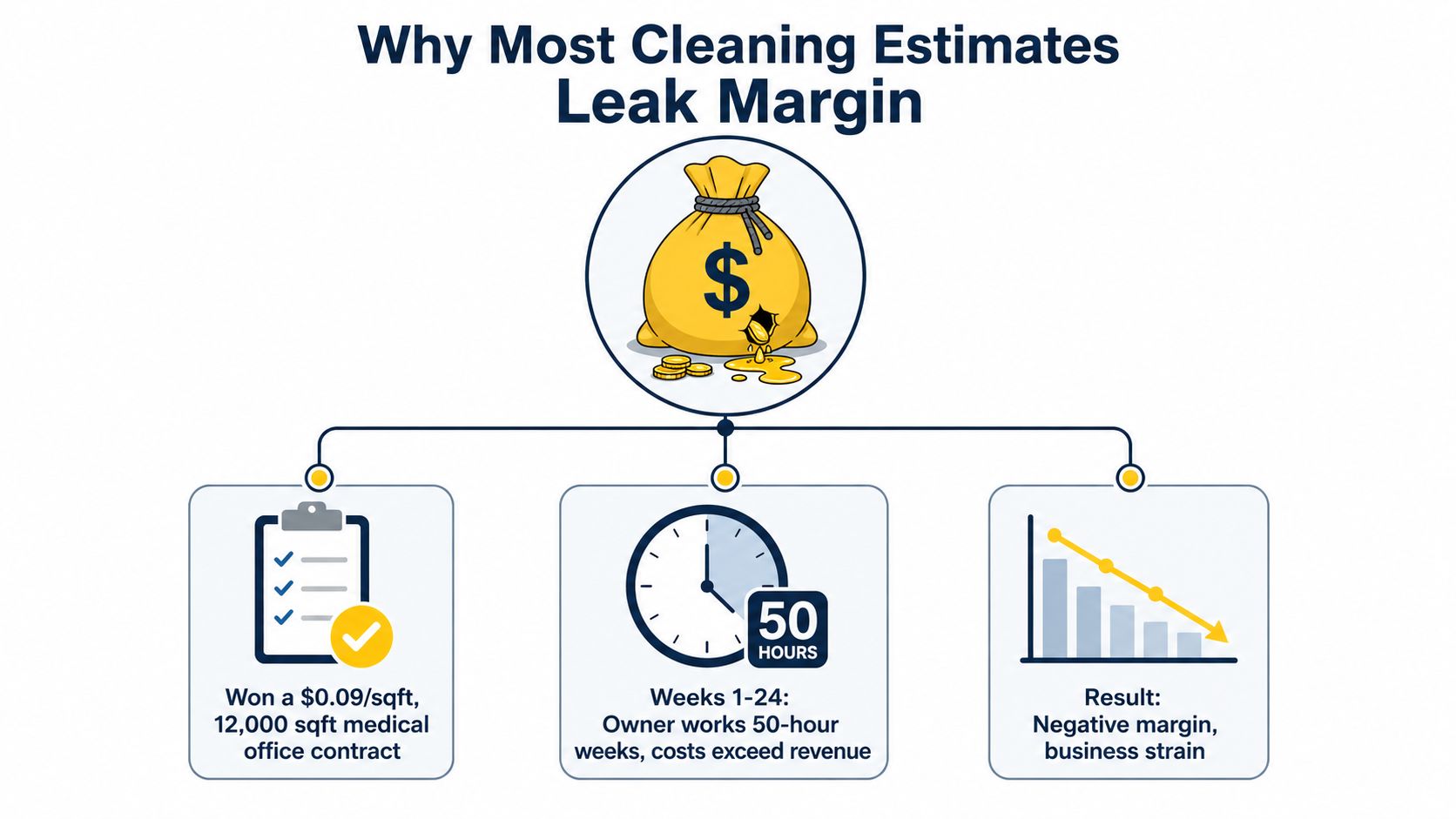
You've just walked a 12,000-square-foot medical office, heard the prospect say they need a “competitive” rate, and typed $0.09 per square foot into your estimate. The math looks clean. The win feels good. Six months later, you're covering labor gaps yourself, spending more time on the account than planned, and wondering why the revenue never turns into profit.
That failure usually isn't bad luck. It's a pricing system with missing layers. A reliable commercial cleaning pricing guide has to connect the market rate, the true cost build-up, and the contract terms that define what you'll deliver. Skip any one of them and a profitable-looking account can become a drain.
A medical-office bid can look competitive at $0.09 per square foot and still lose money. Standard office cleaning often falls near $0.05 to $0.20 per square foot, while medical facilities may reach $0.14 to $0.29 per square foot because sanitation and compliance add labor and risk (Angi's commercial cleaning cost guide). Those ranges provide a market reference, not a finished estimate.
The margin leak starts when the estimator stops at square footage. Dense restrooms, restricted access, extra disinfection, supply restocking, and client callbacks can push labor beyond the original plan. Price the building in three layers: what the market recognizes, what the work truly costs, and what the contract requires you to absorb.
Layer one is market rate. Use local comparisons to set a defensible starting point. Hourly work can range from about $20 to $90 per hour, making it suitable for variable-scope jobs but less predictable for recurring office service. Treat national figures as a sanity check, not your final price.
Layer two is true cost. Count labor hours, payroll burden, supplies, equipment wear, supervision, travel, insurance, software, and administrative time. A labor cost calculator for cleaning businesses can organize the labor portion, but only a site walkthrough can confirm productivity and access conditions.
Layer three is contract structure. A vague “general cleaning” scope can include extra glass, floor care, restocking, or emergency callbacks. Frequency changes labor density. Access restrictions change staffing. Termination language can leave you carrying setup costs after the client leaves.
Estimator's rule: A rate can win the account and still lose the business.
Write the scope, calculate the hours, then test the price against the market. Skipping any layer turns a clean-looking estimate into a margin problem.
Commercial cleaning owners generally work with per-square-foot, hourly, flat-rate, and contract pricing. They solve different problems, so treating them as interchangeable is a fast way to underprice difficult work.
| Pricing Model | Best Fit For | Common Failure Mode | Margin Risk |
|---|---|---|---|
| Per-square-foot | Standard offices and predictable recurring spaces | Ignores dense restrooms, glass, and detail work | High when labor intensity varies by zone |
| Hourly | Move-outs, post-construction, and changing conditions | Scope expands while the client watches the clock | High when productivity and boundaries aren't defined |
| Flat-rate | Repeatable jobs with a stable task list | “General cleaning” hides unpriced work | High when the scope is vague |
| Contract pricing | Recurring service packaged with frequency and term | Fixed revenue meets rising labor or supply costs | High without protective clauses |
Square-foot pricing is fast and easy to compare. Current office guides commonly place general work around $0.09 to $0.17 per square foot, with broader recurring ranges of about $0.04 to $0.32 per square foot per month depending on the facility and service mix (ISSA's commercial cleaning rate guidance).
Use it when: the space is predictable, access is easy, and the task mix is consistent.
Avoid it when: restrooms, glass, clinical areas, kitchens, or specialty floors consume disproportionate labor. A small restroom cluster can take as much attention as a much larger open office.
Hourly billing fits work where the condition is uncertain. Post-construction cleanup, move-outs, and changing industrial environments often reveal additional labor after the job begins.
Use it when: the client understands that conditions determine time and you can define a minimum, crew composition, and stop point.
Avoid it when: the client expects a finished outcome but wants to challenge every hour. You'll spend too much energy defending time instead of delivering the work.
A flat rate rewards efficiency. Once your scope and labor plan are accurate, faster production improves your margin without changing the client's invoice.
Use it when: the task list repeats and your team has reliable production data.
Avoid it when: the first visit requires restoration, heavy buildup removal, or significant setup that the recurring rate doesn't cover.
A contract isn't a separate production method. It packages a pricing method with frequency, term, service level, access rules, and adjustment language. Monthly office-cleaning marketplaces report recurring totals around $715 to $2,800 per month, showing why the package can matter as much as the unit rate (Thumbtack's commercial cleaning pricing guide).
Use it when: the client values predictable service and you can protect the economics with clear terms.
Avoid it when: the prospect wants a long commitment but refuses scope limits, price adjustments, or access requirements.
For a deeper look at how to combine these approaches, review business pricing strategies for cleaning companies.
A 5,000-square-foot dental clinic can cost more to clean than a 5,000-square-foot warehouse. The footprint matches, but the work does not. Operatories, fixtures, touchpoints, waste protocols, and tight movement between zones create more labor than open floor space.
Square footage starts the estimate. The labor density, facility requirements, service frequency, risk controls, and overhead determine whether the quoted rate protects profit.
| Cost Driver | What It Changes | Typical Impact |
|---|---|---|
| Labor density | Minutes required in each zone | Raises or lowers the effective rate |
| Facility type | Products, procedures, and training | Medical and specialty sites demand more control |
| Frequency | Soil level and setup time per visit | Frequent service usually creates a steadier workflow |
| Risk and compliance | Screening, training, documentation, and insurance | Adds costs that must be allocated to the account |
| Overhead | Travel, supervision, admin, equipment, and systems | Determines whether revenue becomes profit |
Walk the site and build a zone count. Mark restrooms, sinks, partitions, kitchens, break areas, entry mats, glass, trash points, touch surfaces, and floor transitions. Record the fixtures and tasks inside each zone, then assign production time to the actual work.
This method exposes scope that a floor plan hides. Two buildings with the same area can require different rates because one contains more fixtures, traffic points, or detail work. Price the zones, not the square footage alone.
Medical spaces may require stricter sanitation routines and compliance controls. Restaurants bring degreasing and kitchen sanitation. Childcare facilities often require careful touchpoint and cross-contamination procedures. Generic office assumptions fail when the facility demands additional dwell time, product changes, or documentation.
Some pricing guides place offices around $0.09 to $0.11 per square foot, while medical spaces are often around $0.15 to $0.18 per square foot or higher because of sanitation, compliance, and turnover requirements (CleanEstimator's commercial cleaning cost guide).
Nightly crews usually maintain a rhythm. Weekly crews may face more soil and more setup during each visit. Frequency changes the workflow, so the service schedule belongs in the estimate rather than as an afterthought.
Risk costs also belong in the account, including background checks, bonding, training, infection-control procedures, and insurance. Allocate those expenses across the contract so the client pays for the operating standard the site requires. A market rate may win attention, but true cost and contract terms decide whether the job makes money.
A profitable estimate starts with the work required to service the building, not with the price you hope the client will accept. Build the number from productive labor, direct job costs, overhead, markup, and contract requirements. Then compare it with the market rate.
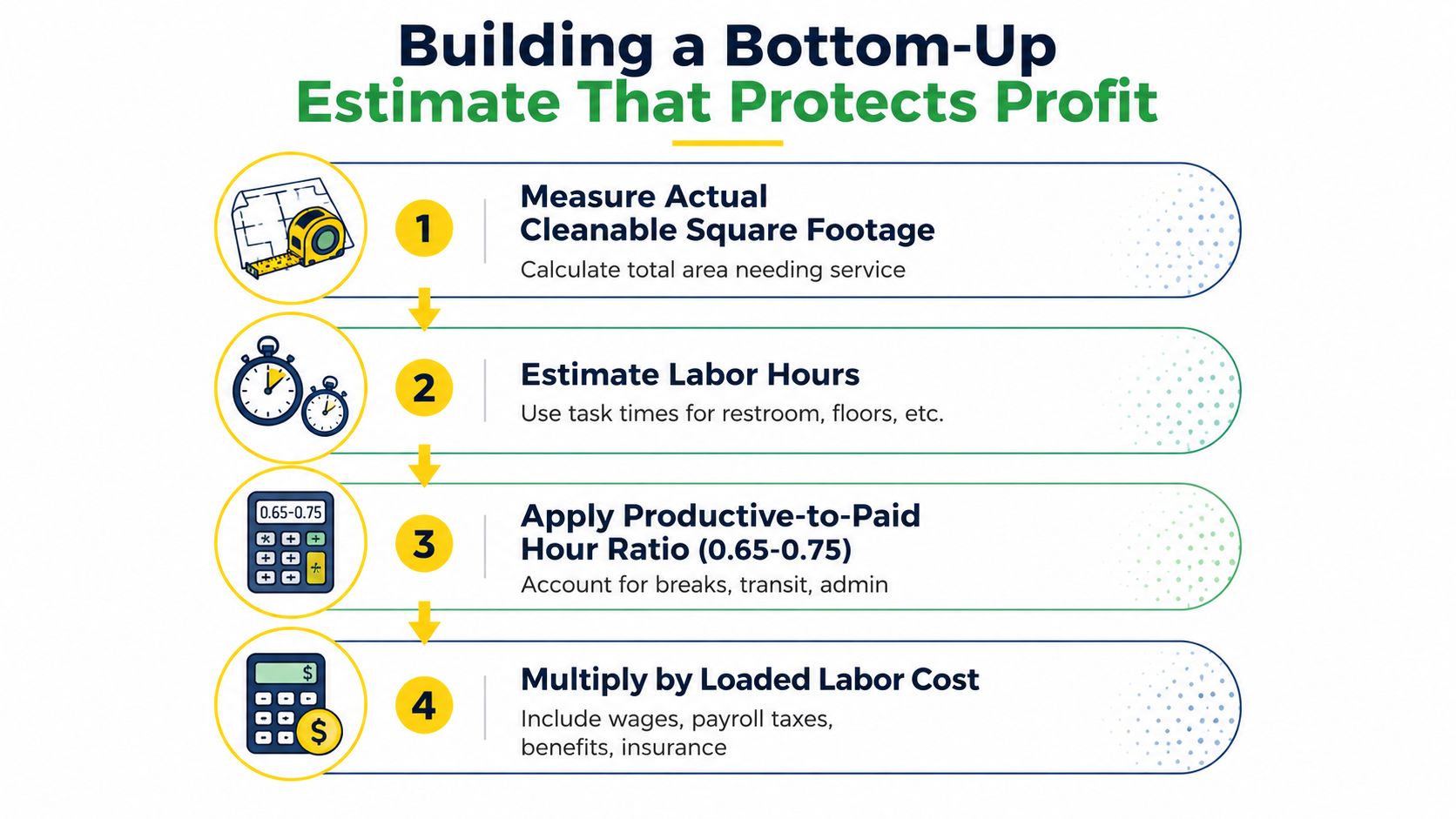
List every recurring task by zone. Estimate labor hours for restrooms, floors, trash, touchpoints, kitchens, glass, and specialty surfaces. Then account for the difference between paid time and productive cleaning time. A productive-to-paid-hour ratio of 0.65 to 0.75 covers breaks, movement, transit, setup, and administrative interruptions within the supplied estimating framework.
Calculate loaded labor cost next. Include wages, payroll taxes at roughly 7.65% to 10%, workers' compensation at 8% to 25% depending on classification, plus PTO and training. Treat these as operating costs, not optional padding.
Chemicals, paper products, liners, equipment wear, uniforms, and protective supplies belong in the account's cost stack. If the client supplies consumables, assign that responsibility clearly in the scope. If your company supplies them, estimate usage instead of assuming the expense will stay minor.
Travel time belongs in the calculation too. An isolated account can consume paid hours even when the building itself is efficient to clean.
Assign job-specific overhead for supervision visits, invoicing, callbacks, scheduling, and account management. The supplied estimating data recommends allocating around 15% to 25% of labor for office costs, insurance, software, and sales time.
Then add markup for risk and profit. The framework uses 10% to 20% for this layer, while broader industry guidance commonly places profit margins around 10% to 30% (Nilfisk's commercial cleaning rate methodology). Set your margin floor before reviewing the prospect's budget.
A 10,000-square-foot office at $0.15 per square foot creates a different starting revenue point than the same office at $0.22 per square foot. Neither rate proves profitability. Labor hours, loaded cost, overhead allocation, and markup do.
Practical rule: Use the market rate to pressure-test your bottom-up number, not to generate it from the outside in.
Owners strengthening their acquisition pipeline can review examples of local SEO results for contractors to understand how qualified local inquiries are generated. More leads will not fix a weak cost model, but better lead flow gives you room to reject work that misses your margin floor.
Track estimated hours against actual hours after service begins. A job costing program for cleaning companies helps identify recurring tasks that consume more labor than the walkthrough indicated, so the next estimate reflects the true cost of delivery.
A profitable bid follows a repeatable workflow. Don't start by opening a calculator and typing in a rate. Start by documenting the building.
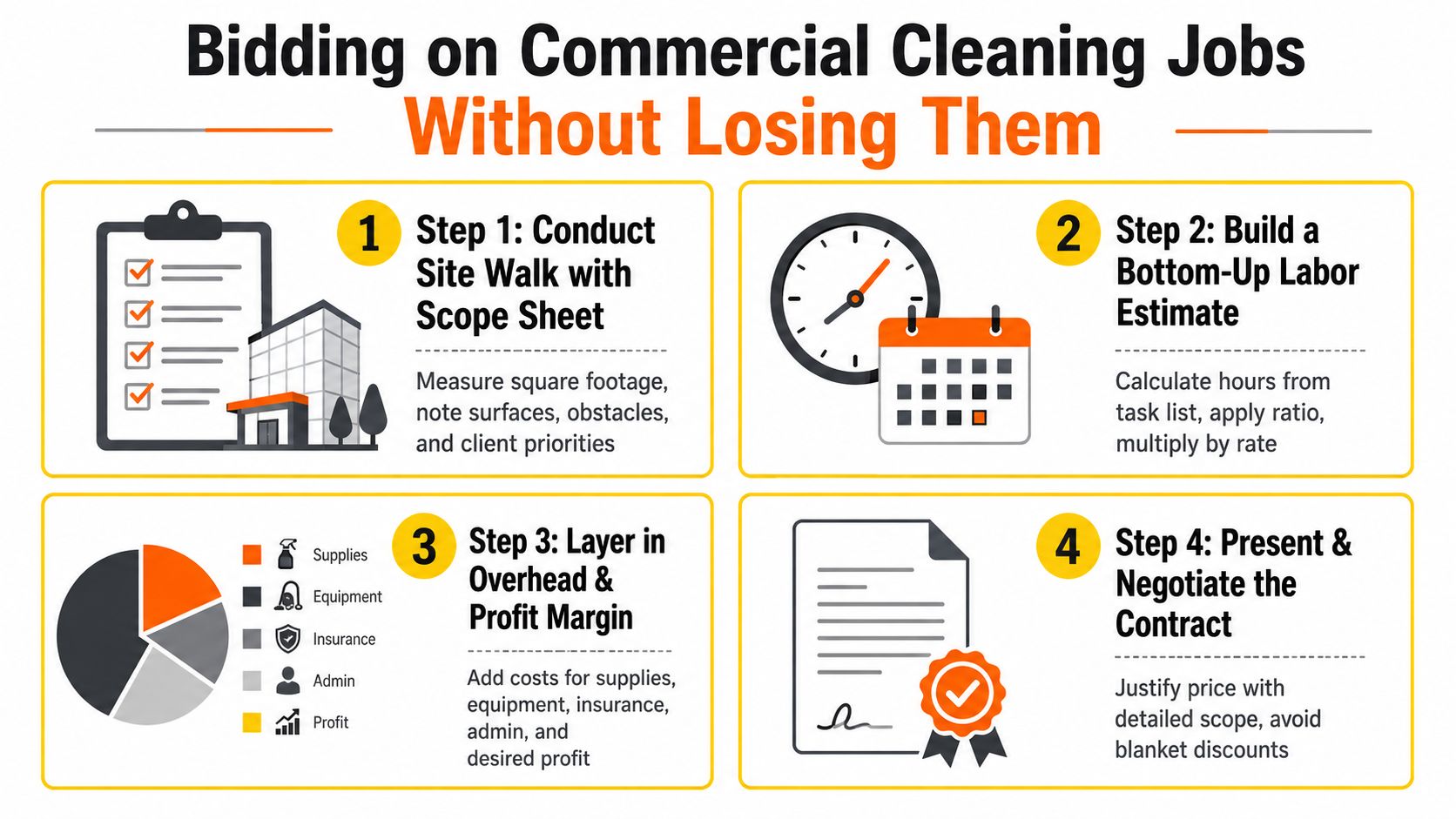
Carry a printed scope sheet. Measure actual cleanable square footage, not rentable area. Count restrooms, fixtures, sinks, dispensers, kitchens, glass partitions, and floor types. Photograph problem areas such as entry mats, buildup, high glass, and grease.
A walkthrough that skips fixtures underprices labor before the estimate even exists.
Separate nightly, weekly, and monthly tasks. State what happens in each service frequency. List exclusions for floor stripping, carpet extraction, window cleaning, post-construction cleanup, high dusting, and disinfection unless they're specifically included.
Some current guides place post-construction cleanup around $0.15 to $0.50 per square foot, floor stripping around $0.30 to $0.60 per square foot, and commercial window cleaning around $4 to $12 per pane (CleanEstimator). Add-ons need their own line items because they don't belong inside a vague recurring rate.
Show recurring service, initial service, add-ons, consumables, and special access charges separately. A single total invites a price fight. Clear line items let the client choose scope without forcing you to discount the entire account.
Address objections by changing scope, frequency, or start date, not by immediately cutting your rate. If the prospect wants a lower monthly number, offer a defined reduction in deliverables and document the result.
For a more detailed workflow, use this guide on how to bid for cleaning contracts. The estimate should make every margin decision visible before the contract is signed.
The contract is where a profitable estimate can become a bad account. Read every clause as a labor and cash-flow decision.
| Clause | Risky Wording | Protective Language |
|---|---|---|
| Scope of work | “General cleaning” | Attached task list with areas, frequencies, and standards |
| Frequency and term | Fixed service with no adjustment | Defined schedule, term, renewal, and adjustment mechanism |
| Exclusions and supplies | “Supplies included” with no detail | Named consumables, restocking duties, and exclusions |
| Access and keys | Informal access arrangement | Key, alarm, lockout, and after-hours procedures |
| Termination and cure | Immediate termination for any dispute | Written notice and defined cure process |
Attach a task exhibit. If the client wants restrooms deep-cleaned, glass polished, or floors restored, the document should say how often. “Included cleaning” is not a usable production standard.
Frequency also affects cost. A recurring contract can make revenue predictable, but it can lock your labor plan in place while wages and supplies move. Current market guidance shows monthly totals commonly ranging from $715 to $2,800, which reinforces why frequency and service level need to be explicit (Vanta Insights commercial cleaning rates).
Name who supplies paper, liners, and soap. State who restocks them. A recurring consumables line can disappear when responsibility isn't written down.
Put keys, alarm codes, lockouts, and after-hours access in writing. For termination, define notice, non-payment procedures, and a cure period. The safest language gives both parties a clear process instead of leaving the owner exposed to sudden labor and scheduling disruption.
The cheapest contract to sign is often the most expensive contract to live with for a year. Read it as if you'll inherit every ambiguous sentence.
When a prospect says your number is high, don't automatically lower the per-square-foot rate. A rate cut reduces revenue on every visit. A scope adjustment removes a defined cost.
Offer choices such as:
| Scope Lever | Concession | Rate Impact | Margin Impact |
|---|---|---|---|
| Restroom deep cleaning | Move deep work to a less frequent schedule | Lowers recurring service | Preserves labor on routine visits |
| Glass polishing | Change from regular service to periodic service | Reduces task frequency | Keeps detail labor from spreading across every visit |
| High-traffic zones | Increase service only where soil requires it | Concentrates labor | Improves production efficiency |
| After-hours access | Use an available service window | Removes a premium condition | Avoids unnecessary staffing pressure |
The exact dollar effect belongs in your estimate, not in a generic rate promise. Show the prospect the revised amount per visit after each change, then let them choose the deliverable.
“The current estimate includes these tasks at this frequency. If you need to lower the monthly amount, we can remove or reduce a defined service. I'll show you the revised per-visit cost so you can choose without weakening the cleaning standard.”
That script keeps the conversation commercial. You're not defending an arbitrary number. You're explaining what the client receives and what changes when the deliverable changes.
Never negotiate the unit price first. Negotiate the deliverable, frequency, access, and term.
A site walk gives you facts. An estimate turns those facts into a price. Enter square footage, facility type, cleaning frequency, and labor rate into Estimatty's commercial cleaning estimating tool, then add overhead, markup, add-ons, and specialty work. That sequence keeps market rate, true cost, and contract terms in the same pricing decision instead of leaving margin to guesswork.

Use the tool to standardize math, not judgment. The walk determines whether the account is a dense medical facility, a straightforward office, or a specialty site with hidden labor.
Print this checklist for the next visit:
Use the completed checklist beside your estimating tool to lock in a defensible number before presenting it to the prospect.