October 23, 2026
How to Start Commercial Cleaning in 2026
Learn how to start commercial cleaning in 2026 with proven steps for pricing, staffing, licensing, and automation that win recurring contracts.

Monday, September 7, 2026
Learn how to start a residential cleaning company with our step-by-step guide on planning, pricing, legal essentials, hiring, marketing, and scaling your

You've cleaned homes for friends, neighbors, or referrals, and now you're considering turning that work into a real company. The first serious inquiry usually exposes the gap. A prospect wants to know what the service includes, how much it will cost, whether you're insured, and whether they can book without waiting for a phone call. Meanwhile, another cleaning company may already be answering online.
That's the reality behind how to start a residential cleaning company in 2026. The cleaning itself matters, but your customer experience starts before you enter the home. A slow response, vague estimate, or missed booking can cost you the job before a cleaner touches a surface.
A modern launch combines solid operations with fast digital access. You need a legal structure, insurance, repeatable service standards, reliable equipment, and pricing that protects labor margins. You also need a simple way to collect property details, calculate an estimate, accept a booking, and follow up when a prospect isn't ready.
A solo cleaner who handles every inquiry manually can get buried in messages. An owner who builds a clear process from day one can use the same customer information for estimating, scheduling, payment, and quality control. Tools such as AI-driven estimate widgets and online booking systems support that process without replacing judgment.
The opportunity is real, but it favors disciplined operators. Read this analysis of cleaning business profitability before spending heavily, then build a company that sells consistency, not just labor.
You can start small, but you can't start casually. Treat the first inquiry as the beginning of an operating system, not an isolated sale.
A cleaning company becomes durable when the owner separates the business from personal finances, documents the service properly, and handles compliance before taking on volume. Start by choosing whether a sole proprietorship, LLC, or another permitted structure fits your risk tolerance and local rules. An LLC often deserves serious consideration because residential cleaning involves entering private homes, handling property, and managing workers, but a local attorney or accountant should confirm the right structure for your situation.
Your business name matters, too. If you operate under a name other than your legal name, U.S. guidance commonly requires a DBA registration. Most states also require a general business license for a house cleaning business. Review the requirements that apply to your location in this guide to cleaning business licenses, because city and state rules can differ.
The market supports a professional launch. The U.S. residential cleaning services industry is estimated at $18.8 billion in 2026, signaling strong recurring demand rather than one-time jobs, according to BusinessWire's home cleaning services market coverage. That scale doesn't guarantee success, but it does mean you're entering an established category with household demand.
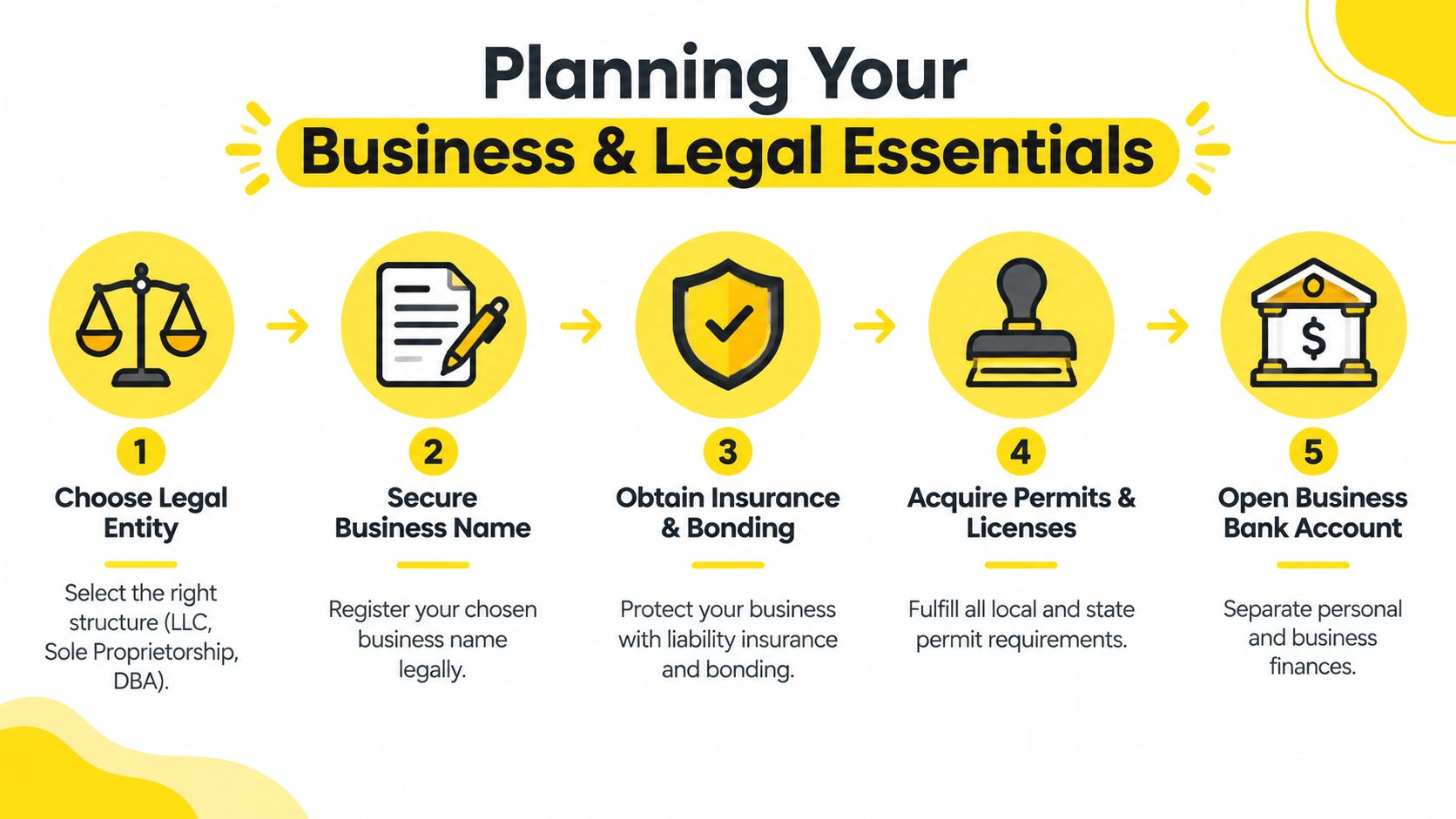
Open a dedicated business bank account as soon as your entity and name are settled. Use basic accounting software or a spreadsheet to separate revenue, supplies, mileage, insurance, software, payroll, and owner draws. Don't mix personal purchases with business expenses and hope you'll sort them out later.
Insurance should cover the risks your company carries. General liability protection is a starting point, while bonding can address client concerns about honesty and property-related risk. If you bill clients for cleaning supplies or other taxable items, confirm whether you must register to collect and report sales tax. The house cleaner insurance guidance from Insureon provides useful context on licensing, DBA registration, and insurance considerations.
Safety responsibilities also extend beyond paperwork. If you hire people, establish procedures for chemical handling, slips, lifting, protective equipment, keys, and incident reporting. For broader workplace-safety context, review PCBU duties under WHS law, especially if your business operates in a jurisdiction influenced by WHS terminology.
Keep your launch documents together:
Underpricing is the fastest way to create a busy company that loses money. Start with the time required to clean the home, then add every cost that follows the job.
A defensible formula looks like this:
Estimated price = direct labor + payroll burden or subcontractor cost + supplies + travel and drive time + overhead + profit.
Estimate labor by service type and property details. A recurring standard clean may require less time than a first-time deep clean, while bathrooms, pets, clutter, stairs, and add-ons can change the labor requirement. Don't price from square footage alone. Use square footage as an input, then adjust for condition, scope, and frequency.
Startup guides place realistic solo launch costs around $1,000 to $2,500, while residential pricing benchmarks sit around $0.10 to $0.17 per square foot and target gross margins commonly fall between 30% and 50%, according to CleanerHQ's cleaning business launch guide. Treat those figures as planning benchmarks, not automatic prices for your city.
| Service Type | Price per sq ft | Gross Margin Target |
|---|---|---|
| Standard recurring clean | $0.10–$0.17 | 30%–50% |
| Deep clean | Use the standard benchmark as a floor, then adjust for condition and labor | 30%–50% |
| Move-in or move-out clean | Use the standard benchmark as a floor, then price for expanded scope | 30%–50% |
Your estimate should state what the client is buying. List rooms, surfaces, frequency, add-ons, access conditions, and any exclusions. A prospect who sees a clear scope is less likely to compare your price with an undefined competitor offer.
Pricing rule: If the estimate doesn't account for labor hours, travel, supplies, and rework, it isn't a price. It's a guess.
Use a consistent estimate form for every inquiry. Capture home size, bathrooms, bedrooms, service type, last professional cleaning, pets, preferred frequency, urgency, and extras such as inside appliances or interior windows. An AI estimator such as Estimatty can collect those details and produce a standardized result, but you still need to audit the pricing logic against actual labor.
Review your first jobs closely. Compare estimated labor with actual labor, record callbacks, and adjust the price book when a service repeatedly takes longer than expected. For a deeper framework on structuring cleaning estimates, use this cleaning service estimates guide.
Buy equipment for repeatability, not appearance. A reliable starter setup includes microfiber cloths separated by use, labeled spray bottles, scrub pads, dusters, a dependable vacuum, mop systems, protective gloves, shoe covers, trash bags, and products suited to the surfaces you clean. A HEPA-filtered vacuum can be useful in homes where dust control matters, but no piece of equipment compensates for poor technique or inconsistent checklists.
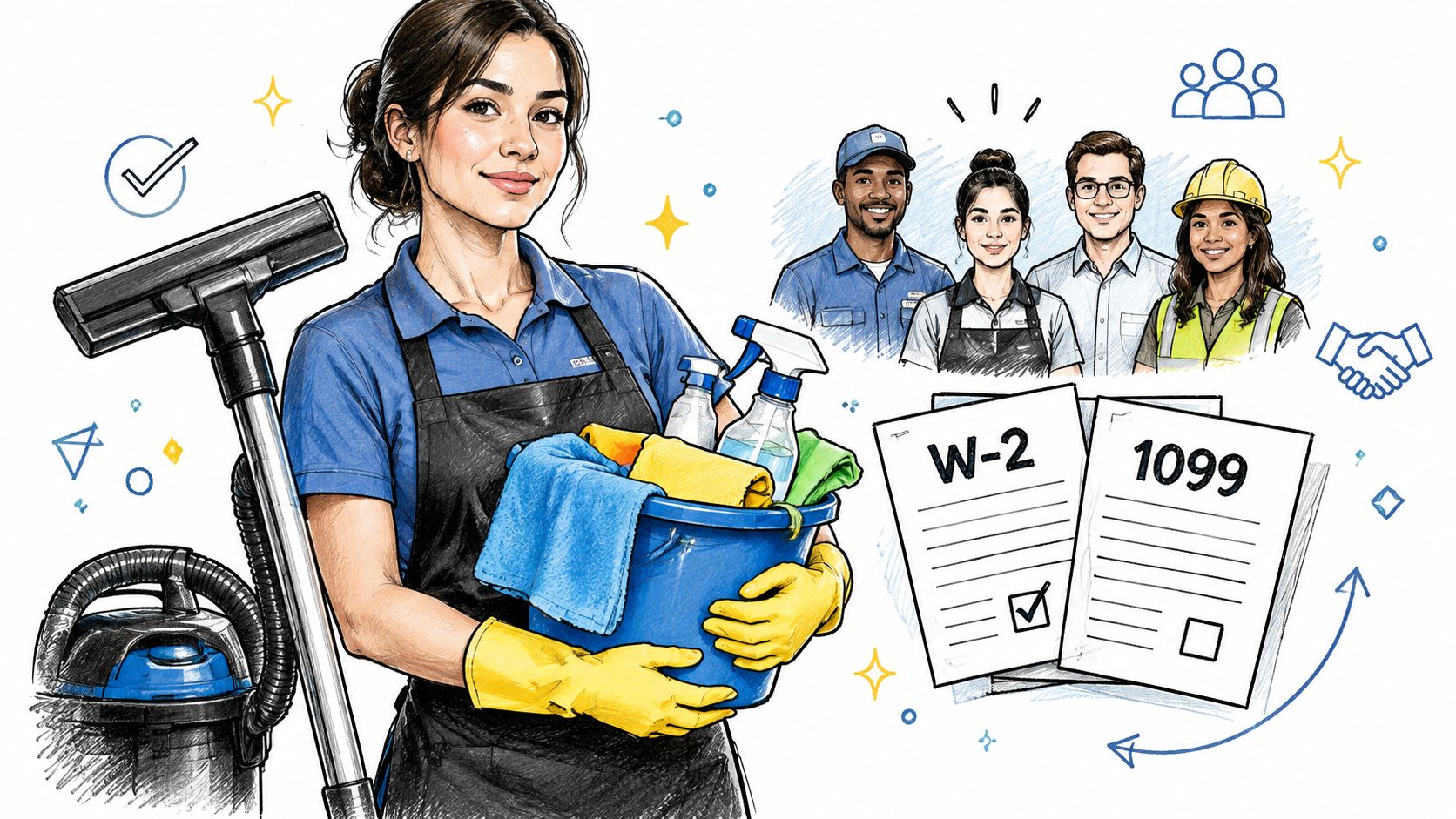
Start with a lean staffing plan. If you're solo, document how long each service takes before hiring. If you add help too early, you may multiply scheduling problems before you understand your own route economics.
The U.S. Department of Labor says employers are responsible for determining whether a worker is an employee under the Fair Labor Standards Act. That means you can't label someone a subcontractor just because the arrangement is convenient. Review the Department of Labor guidance on worker misclassification and get professional advice when the facts are unclear.
California requires particular care. Under the ABC test, a worker generally must satisfy all three prongs to qualify as an independent contractor, including freedom from control, work outside the company's usual business, and an independently established trade or business. A cleaning company should review the California employee versus independent contractor guidance before using contractors there.
Payroll must enter the estimate before you hire. A 2026 U.S. salary benchmark places the average house cleaner at about $15 per hour, or $30,995 per year, according to Salary.com's house cleaner salary data. Your real labor cost may also include payroll taxes, workers' compensation, paid time, recruiting, training, and management time.
Use a hiring workflow that tests reliability:
Job boards and hiring resources such as PipeHire HRM's cleaning employee hiring blog can help you organize recruitment content and candidate flow. Once applications start arriving, an applicant tracking system for cleaning businesses can keep candidate records from disappearing into email threads.
Show your team the standard before sending them alone.
Your marketing should lead to a booking path, not a dead-end phone number. Local flyers, neighborhood groups, referrals, Google Business Profile activity, and service-area pages can all create demand, but each channel needs a clear next step.
Clients increasingly expect fast digital responses, and AI-assisted quoting and online booking now function as competitive levers rather than optional extras, according to Service Autopilot's cleaning industry trend coverage. If a prospect reaches you after work and your only response is “call tomorrow,” you've created friction at the exact moment they're ready to act.
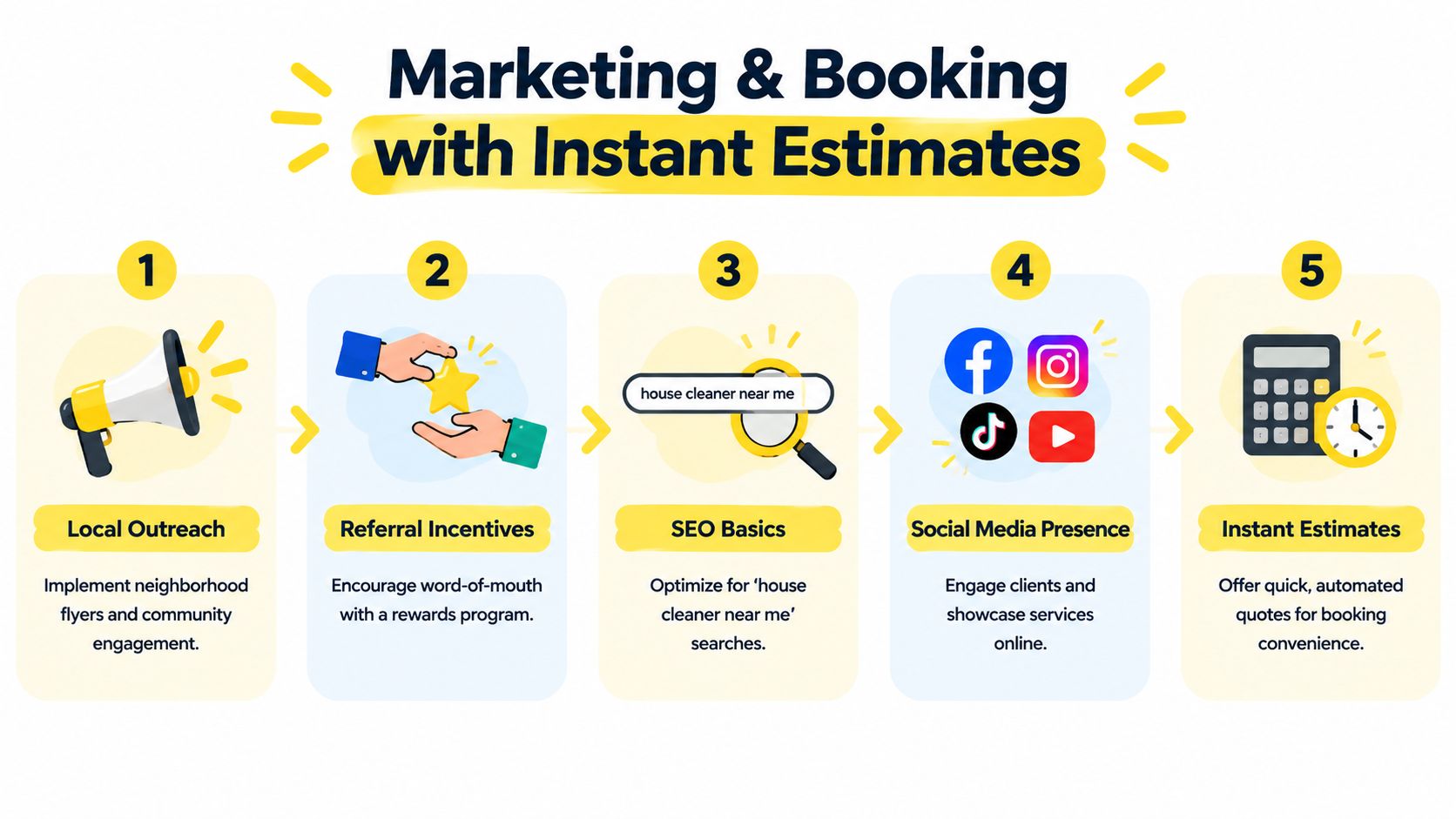
Use this sequence:
Estimatty can be used as an AI-powered web and voice estimator that captures property details, provides an instant estimate through SMS or email, and supports online booking. It can also connect with workflow tools through Zapier, which is useful when you want a prospect's information to reach scheduling or customer relationship systems without manual copying. See this AI estimates software guide for cleaning businesses for implementation ideas.
Keep the website simple. Put the service area, core service types, estimate button, proof of insurance if appropriate, reviews, and contact options near the top. Don't force every visitor through a long form. A voice or chat interaction can capture the same operational details while making the experience easier for people who are busy or calling outside office hours.
For location pages, service descriptions, and map visibility, use a practical local SEO playbook for service businesses. Track which channel produced each inquiry, whether the lead received an estimate, whether the prospect booked, and why a lost lead declined. That record tells you whether the problem is visibility, speed, price, or trust.
Don't expand into every cleaning service at once. Specialization gives a small company a sharper message, simpler training, and a more predictable estimate process.
Demand is shifting toward specialized services such as eco-friendly cleaning and short-term rental turnovers, along with deep cleaning, move-in and move-out work, and organizing add-ons, according to Appscrip's cleaning business ideas coverage. Choose a niche based on local access and repeatability. A short-term rental route may suit an area with active property turnover, while eco-friendly recurring service may fit neighborhoods where homeowners care about product choices.
Offer weekly, biweekly, and monthly plans when the service and route support them. Recurring plans make staffing and supply planning easier, but only if you protect the schedule. Define the rescheduling policy, cancellation window, lockout process, and minimum service scope before customers join.
Route density matters more than vanity growth. Group homes by neighborhood, avoid crossing the service area for one low-margin appointment, and set geographic boundaries on the booking form. A full calendar can still underperform if cleaners spend too much time driving.
Track a small operating dashboard:
Automate confirmations, reminders, payment requests, review invitations, and team alerts. Keep human approval for unusual homes, fragile surfaces, complaints, and estimates outside your normal service rules.
Bundle add-ons only when they fit the route and crew capability. Interior refrigerators, ovens, baseboards, interior windows, and organizing support can raise order value, but every add-on needs a labor standard and checklist. Never sell an add-on your team can't deliver consistently.
Your first growth hire may be an operations coordinator rather than another cleaner. That person can monitor schedules, answer exceptions, inspect quality records, and protect the owner's time for sales and recruiting. Scale when the process works without constant rescue, not solely because inquiries increase.
A successful residential cleaning company rests on six decisions: form the business correctly, insure it, price from labor and overhead, standardize quality, respond digitally, and build recurring plans that fit your routes.
Use this launch checklist:
Start with one service area, one dependable process, and estimates you can defend. Consistency will outperform improvisation.
Estimatty gives cleaning businesses AI-powered web and voice estimating, property-detail capture, SMS and email delivery, and booking support that stays available beyond office hours. Visit Estimatty to set up a faster estimate-to-booking process for your new residential cleaning company.