September 21, 2026
Inside and Out Cleaning: A Practical Pricing Guide
Learn what inside and out cleaning really includes, how pricing works, and which add-ons actually pay off for residential and commercial estimates.

Saturday, June 20, 2026
Start and scale a profitable cleaning service business in 2026. This complete guide covers business models, pricing, AI-powered estimates, marketing, and KPIs.
.png)
Your phone rings while you're inside a bathroom scrubbing grout. A website form comes in while you're driving. A prospect texts asking for a price "real quick." Another one wants recurring service, but they won't answer basic questions. By the end of the day, you've worked hard and still lost leads you already paid to attract.
That's how a lot of cleaning service businesses operate in the beginning. Not because the owner is lazy or disorganized, but because the business is running on memory, callbacks, and gut-feel estimates.
The problem isn't just workload. It's leakage. Every missed call, delayed reply, and inconsistent estimate creates friction. In a business where people often hire the first company that sounds responsive and trustworthy, friction costs money fast.
Most owners see the daily mess and assume the industry itself is messy. It isn't. It's large, established, and growing.
Fortune Business Insights values the global cleaning services market at USD 451.63 billion in 2025 and projects it to reach USD 859.20 billion by 2034, with a 7.50% CAGR. The same source says North America held 37.52% of the market in 2025, which tells you demand is concentrated in mature outsourcing markets where professional cleaning is normal, not optional (Fortune Business Insights cleaning services market data).
That changes the way you should think about a cleaning service business. This isn't a side hustle category. It's a real market with room for specialization, repeat service models, standardized estimating, and operational systems.
If your day gets hijacked by inbound calls, pricing questions, reschedules, and follow-up, the issue usually isn't demand. It's that demand is hitting a business without a clean intake process.
Three symptoms show up early:
Practical rule: If the owner has to touch every lead before it becomes a job, the business isn't built to scale.
A fragmented industry creates room for operators who are faster, clearer, and more consistent. That starts with how you capture demand, how you price work, and how quickly a prospect can move from interest to booked service.
Most owners don't need more leads first. They need to stop wasting the ones they already generate.
That applies whether leads come from referrals, Google Business Profile, door hangers, or paid search. If you're investing in search engine marketing, Silva Marketing's SEM guide is a useful resource for thinking about what to measure beyond clicks, especially if you're trying to connect ad spend to booked work instead of just traffic.
The hidden opportunity in this industry isn't glamorous. It's operational. The cleaning companies that build tight systems early can outcompete bigger-looking companies that still run on voicemail, handwritten notes, and inconsistent pricing.
At 6:15 p.m., a homeowner wants a price for Friday. At 6:17, an office manager asks whether you can clean three nights a week after 7. Those two leads may look similar on your phone. Operationally, they are different businesses.
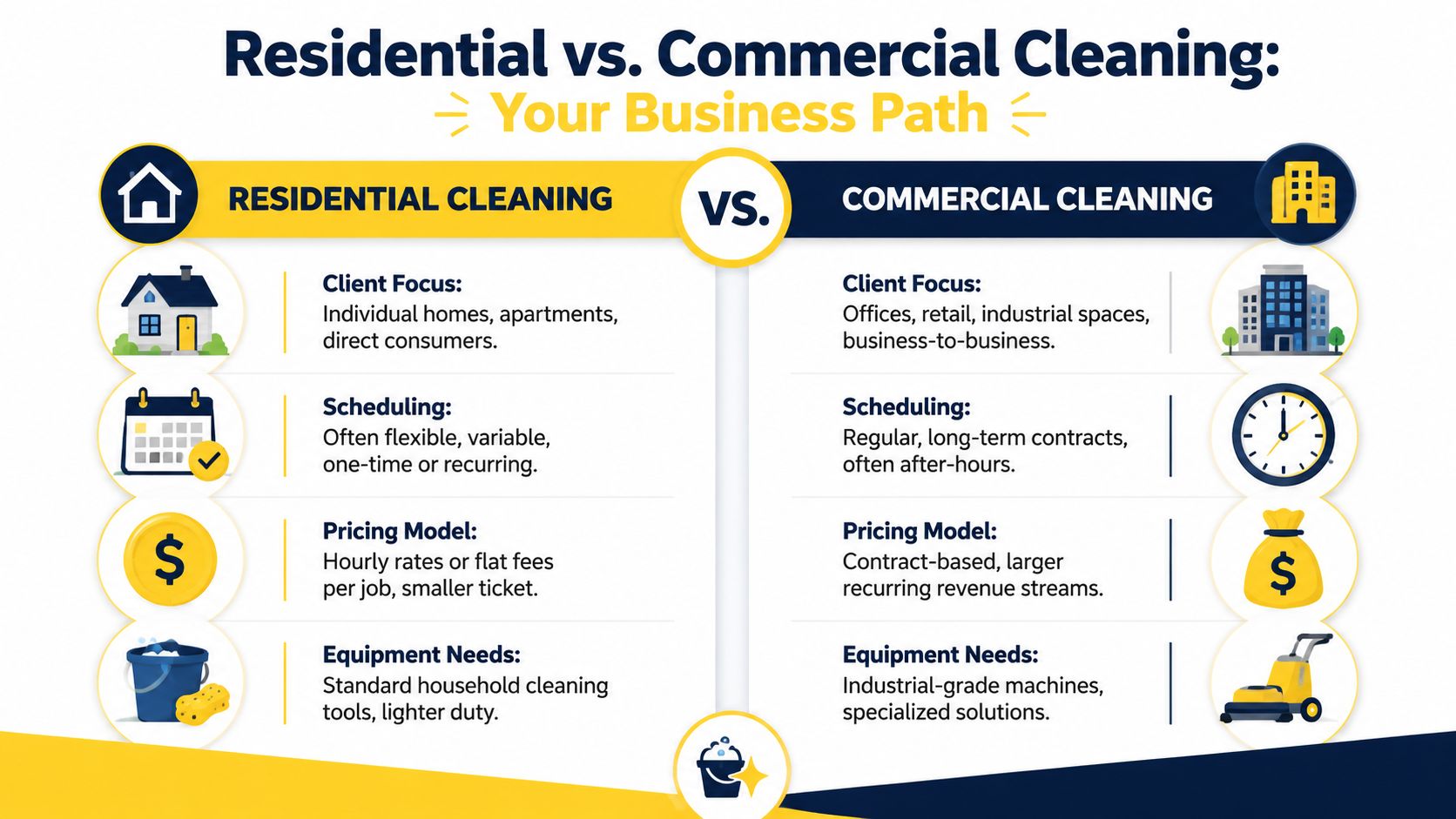
The mistake I see early is trying to take both at once without building separate systems for quoting, scheduling, staffing, and quality control. That usually creates messy routes, uneven pricing, and a team that has to switch standards all day. Pick the model that fits your cash needs, sales ability, and tolerance for operational complexity.
Analysts at IBISWorld's janitorial services industry snapshot describe a market made up largely of small, independent operators. That matters because scale in cleaning does not come from looking big. It comes from tighter systems, faster follow-up, and a service model you can repeat without owner intervention on every job.
Residential is usually the faster launch.
Homeowners decide quicker, the scope is easier to explain, and you can test your pricing with standard tools and a small service radius. For a solo owner or a new company, that speed matters because it gets you into the field, exposes pricing mistakes fast, and gives you enough job volume to build checklists that reflect real homes instead of guesses.
The trade-off is friction. Residential clients reschedule more, ask for extras on site, and judge quality at a detail level that can wreck your margin if your scope is loose. You also need tighter communication systems because missed texts, lockout issues, pets, and arrival windows create admin work that does not show up in your hourly math.
Residential tends to reward operators who are strong at service design. Clear packages, add-on rules, arrival policies, and recurring-clean standards matter more here than a fancy sales process.
Commercial usually takes longer to close and less time to defend once the account is running well.
Office managers, property managers, and facility contacts want proof that you will show up, follow scope, and avoid creating complaints. They care about insurance, communication, access procedures, and consistency across every visit. If you can sell reliability and document your process, commercial accounts can produce steadier recurring revenue and better route density than scattered house cleans.
The cost is slower sales and tighter scope management. Bid too low, and a bad contract can trap you for months. Bid too high without explaining the scope, and you lose before the second conversation. Commercial also exposes weak management faster because night crews, keys, alarm codes, supply restocking, and site inspections all require process.
| Model | Good fit for | Watch-outs |
|---|---|---|
| Residential | Fast launch, quicker sales, easier market testing | More reschedules, more client communication, more scope creep |
| Commercial | Recurring contracts, steadier scheduling, denser routes | Longer sales cycle, formal bidding, tighter quality control |
If office accounts are your target, this guide on how to start an office cleaning business covers the sales process and scope expectations that make commercial work different from house cleaning.
Commercial clients rarely stay loyal because you are friendly. They stay because your systems reduce risk for them.
A lot of owners choose based on what sounds more profitable. The better question is what you can deliver consistently with the people, hours, and tools you have right now.
Use this filter:
That last point matters most. Profit follows standardization. The right lane gives you repeatable quoting, cleaner training, fewer exceptions, and better labor planning. The wrong lane keeps you custom-selling every job and solving new problems on every stop.
You can add specialties later. Start with the service line that lets you build a quoting system, an operating rhythm, and a team people can train into without you standing beside them.
Most cleaning businesses don't fail because there isn't demand. They fail because the owner underprices early, mixes personal and business money, and treats pricing like a negotiation instead of a system.
You need a financial foundation before you need a fancy logo.
Your startup costs will depend on your model, but the categories are predictable. Think in buckets, not random purchases.
A lot of owners underestimate administrative drag. Insurance certificates, reschedules, customer communication, payment issues, and follow-up all take time. If your prices only cover labor and supplies, you're undercharging.
Hourly pricing feels safe when you're new because it hides uncertainty. The problem is that customers hate uncertainty too. They want to know what they'll pay, and your team needs guardrails.
Here's the trade-off:
| Pricing model | Good for | Risk |
|---|---|---|
| Hourly | Early-stage learning and unusual jobs | Rewards slow work and creates customer anxiety |
| Flat-rate | Standardized recurring and common one-time jobs | Requires tighter scope definitions |
| Per-square-foot | Certain commercial environments | Can miss detail-heavy conditions |
Flat-rate pricing is usually easier to scale because it forces you to define scope. That's healthy. It makes your estimates more consistent, your upsells clearer, and your training cleaner.
If two team members would price the same job differently, your pricing system isn't finished.
A strong estimate system usually accounts for condition, size, frequency, access, and add-ons. It also draws hard lines around what's included and what triggers an extra charge.
That doesn't mean every customer gets a rigid script. It means your business has rules.
A practical pricing workflow looks like this:
If you want to tighten your financial side before you scale, this cleaning business accounting guide is worth reading. Good pricing and good books work together. One without the other creates blind spots.
The fastest way to lose money in a cleaning service business is to make every lead wait for you.
Manual estimating looks harmless at first. A missed call here, a callback later, a few texts, maybe a photo, then an estimate sent that evening. Owners do this for months and wonder why growth feels heavy. The answer is simple. The process is slow, inconsistent, and built around one person's availability.
Fieldcamp notes that cleaning businesses face rising customer expectations and competition, making standardized pricing and service consistency more important. It also points to a shift away from ad hoc quoting and toward faster, systemized estimating models that can handle after-hours inquiries and maintain consistency at scale (Fieldcamp on cleaning business systems and estimating).
The old way usually breaks in the same places:
None of that looks dramatic in isolation. Together, it creates a weak sales process.
A modern sales estimator handles first contact immediately. It asks the same qualifying questions every time, captures job details, applies your pricing logic, and sends the estimate without waiting for you to finish a cleaning route.
Used correctly, that changes more than speed. It standardizes your sales process.
A good setup should do four things well:
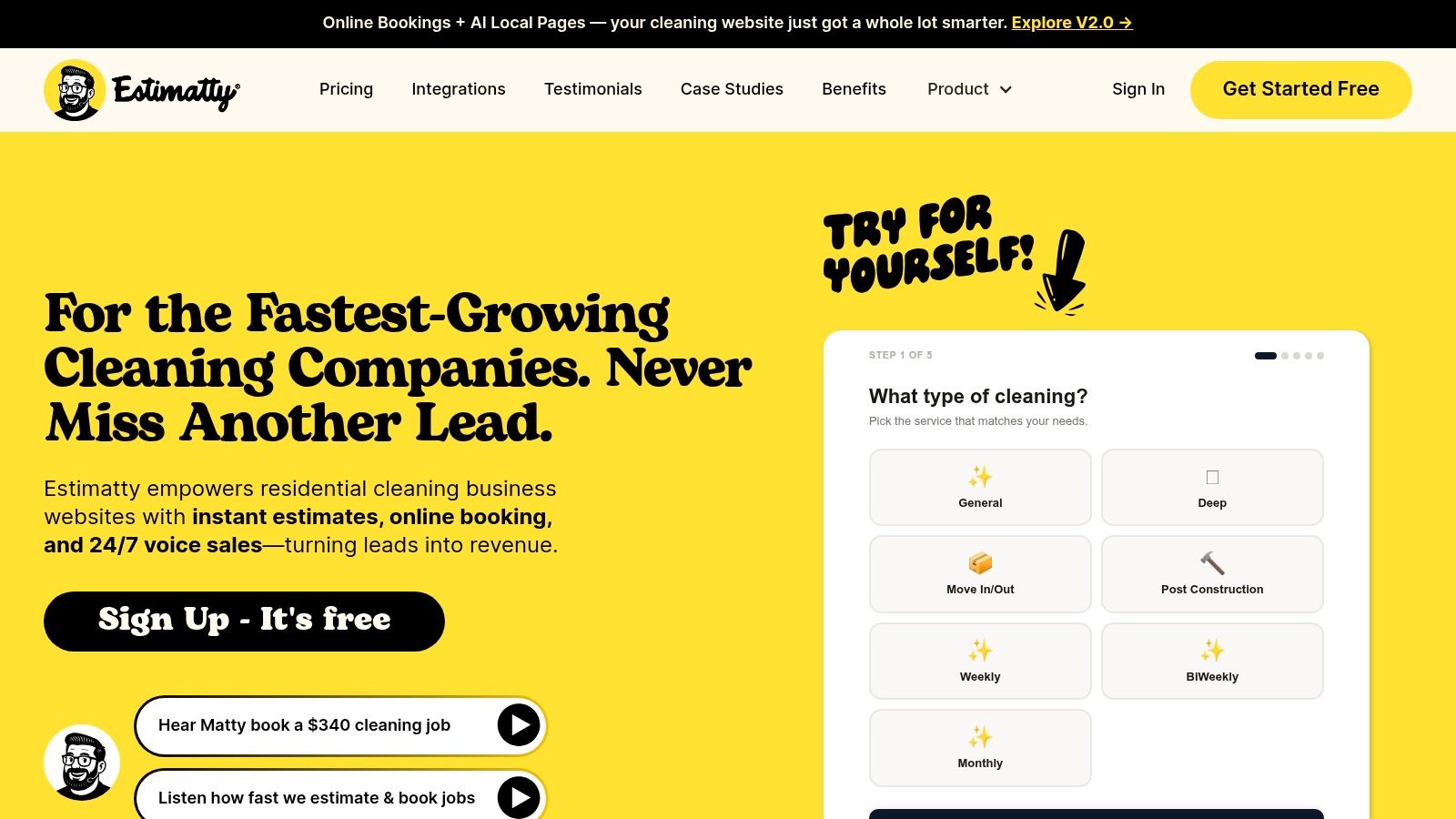
One option in this category is Estimatty, which provides AI-powered web and voice estimates for residential and commercial cleaning businesses and can send estimate details by SMS and email based on the pricing rules you configure. If you want the product-specific workflow, this overview of AI estimate software for cleaning shows how these systems fit into a service business.
A fast estimate doesn't replace judgment. It reserves your judgment for the leads that deserve human attention.
Owners sometimes buy software before they define service packages. That usually creates frustration. Automation can't fix muddy pricing.
Before you automate, tighten these inputs:
| Area | What needs to be defined |
|---|---|
| Service menu | What you offer and what you don't |
| Pricing logic | Base service, add-ons, frequency, condition adjustments |
| Coverage area | Zip codes, travel boundaries, or route limits |
| Escalation rules | Which leads need a human review |
Once those rules are in place, automation becomes a force multiplier instead of a mess generator.
A short walkthrough helps make the concept more concrete.
The biggest benefit isn't that software can answer faster. It's that your business stops depending on whether you're available at that exact moment. That's the shift from owner-operated sales to system-operated sales.
A cleaning service business can survive sloppy sales for a while. It can't survive sloppy delivery for long. Customers might forgive one delayed callback. They won't forgive inconsistency inside their home or facility.
Operations become your real brand.
Even if it's just you, act like you're training a future employee. That means documenting what happens before, during, and after every job.
Start with simple operating tools:
This sounds basic because it is. Basic systems beat good intentions.
Most owners wait too long to formalize hiring. They tell themselves they need a unicorn. They don't. They need a trainable person in a role with clear standards.
When you're ready to recruit, use channels that already understand cleaning labor. Platforms like Pipehire HRM are built around hiring for cleaning businesses, and the content on the Pipehire HRM blog is useful if you're tightening job posts, screening, and retention processes.
What matters most in early hiring isn't charisma. It's reliability, coachability, and whether the person can follow a checklist without freelancing the service.
The first bad hire usually isn't a people problem. It's a clarity problem.
As soon as multiple people clean under your name, every "small exception" becomes expensive. Standard Operating Procedures keep quality from drifting.
Good SOPs should cover:
Don't bury SOPs in a giant manual no one reads. Keep them short, visual, and tied to actual job types. A move-out clean should have its own flow. A recurring residential maintenance clean should have another. Small office service should have another.
The goal isn't robotic service. The goal is consistent service. Customers should feel like they hired one company, not a random collection of different cleaners.
Monday starts with three new leads. One wants a cheap move-out two zip codes outside your route. One wants recurring service in a neighborhood your team already covers. One asks for post-construction cleanup, but you do not have the crew or setup to do it well. All three can fill the calendar. Only one is likely to strengthen the business.
That is the job of marketing. It should bring in work that fits your pricing, your routes, and your operating model.
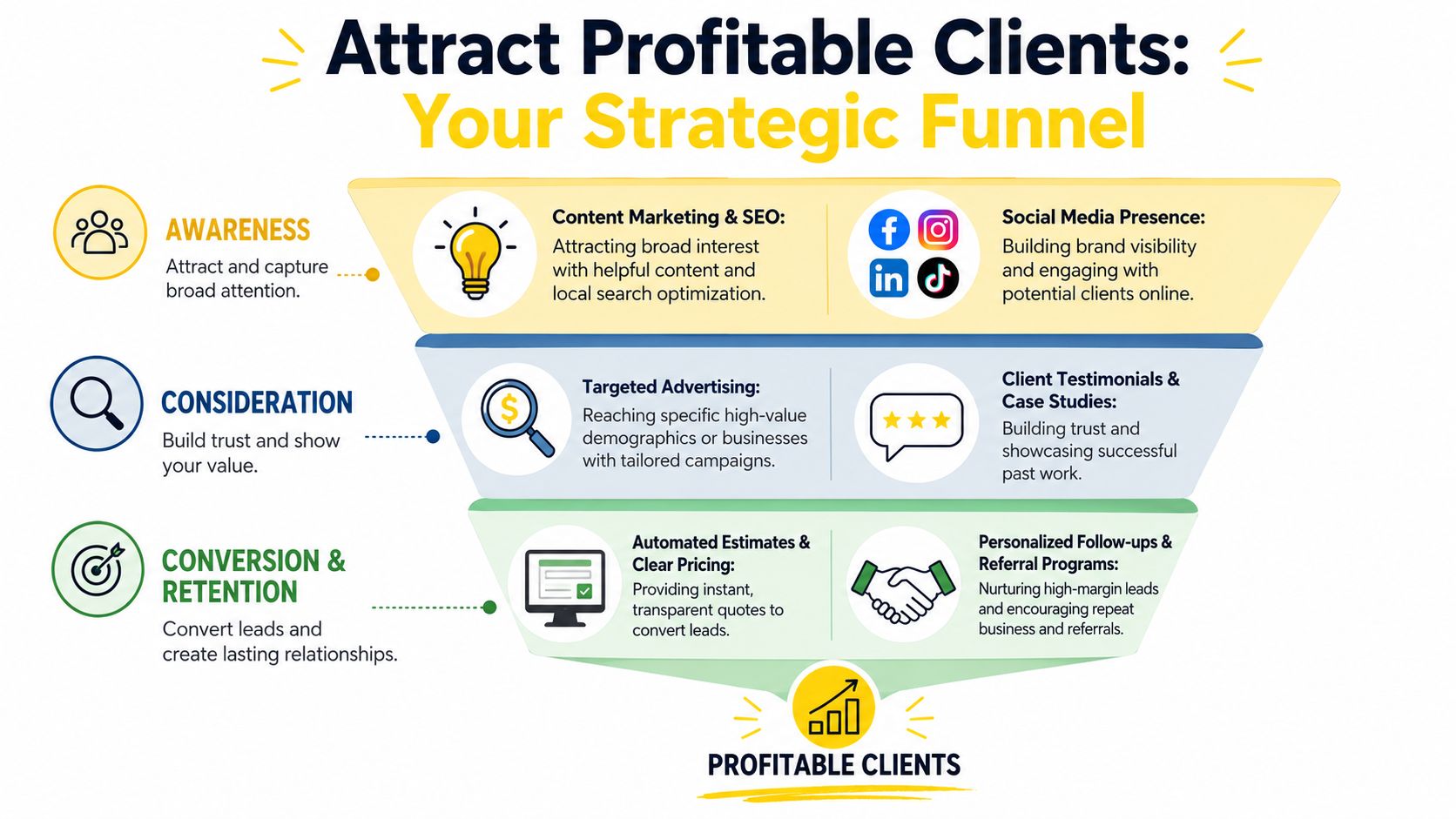
Profitable marketing begins with selection. If you try to market every service to every customer type, you usually attract price shoppers, oddball requests, and jobs your team handles inconsistently.
Pick a few service lines that meet three tests:
That decision shapes everything else. Your website copy gets sharper. Your ad targeting gets cheaper. Your sales process gets faster because the incoming leads are closer to your ideal job.
The highest-value leads are usually looking for help now, not browsing for ideas. They search by problem, service type, and location. Your marketing needs to match that behavior.
Focus on channels that capture active demand:
If you run paid campaigns, this guide to ads for cleaning services lays out how to match keywords, landing pages, and offer structure to higher-intent leads.
A lot of owners advertise services they plan to get good at later. That creates expensive problems. You close a job, then the team struggles to deliver it, the customer complains, and your margin disappears in rework.
Sell what your company can do well, on schedule, at your target margin.
For example:
| Marketing angle | Works when | Fails when |
|---|---|---|
| Eco-friendly cleaning | Your process, products, and training support the claim | It is just homepage language with no operational follow-through |
| Specialty add-ons | The crew is trained and the pricing covers the extra labor and setup | You offer them before the team can perform them consistently |
| Commercial reliability | You can handle keys, alarms, reporting, and after-hours schedules | Jobs are still coordinated ad hoc and quality depends on who shows up |
The same rule applies to your service area. A wider radius can raise lead volume, but it often lowers profit. Route sprawl eats labor hours fast. I have seen owners celebrate a booked week, then realize half the margin was spent in vans.
Marketing gets expensive when every lead requires phone tag, manual quoting, and inconsistent follow-up. Strong operators tie marketing directly to a sales system.
The flow should be simple:
The profitability angle matters. If your estimator, intake form, and follow-up process are standardized, marketing can scale without turning the front office into chaos. AI estimating tools help here because they shorten response time and keep pricing logic consistent across lead sources.
The cleaning companies that win better clients are usually easier to buy from. They answer the right question fast, set clear expectations, and avoid selling work that does not fit the system.
Owners get into trouble when they judge the business by busyness. A packed week feels good until payroll, refunds, drive time, and underpriced jobs expose what's really happening.
You need a dashboard that tells the truth.
One expert metric guide recommends a gross margin target of 40% to 50%, an annual churn rate around 5% or lower, and a close rate where roughly half of inquiries convert into customers (cleaning business KPI benchmarks video).
Those three numbers give you a practical read on pricing, service quality, and sales execution.
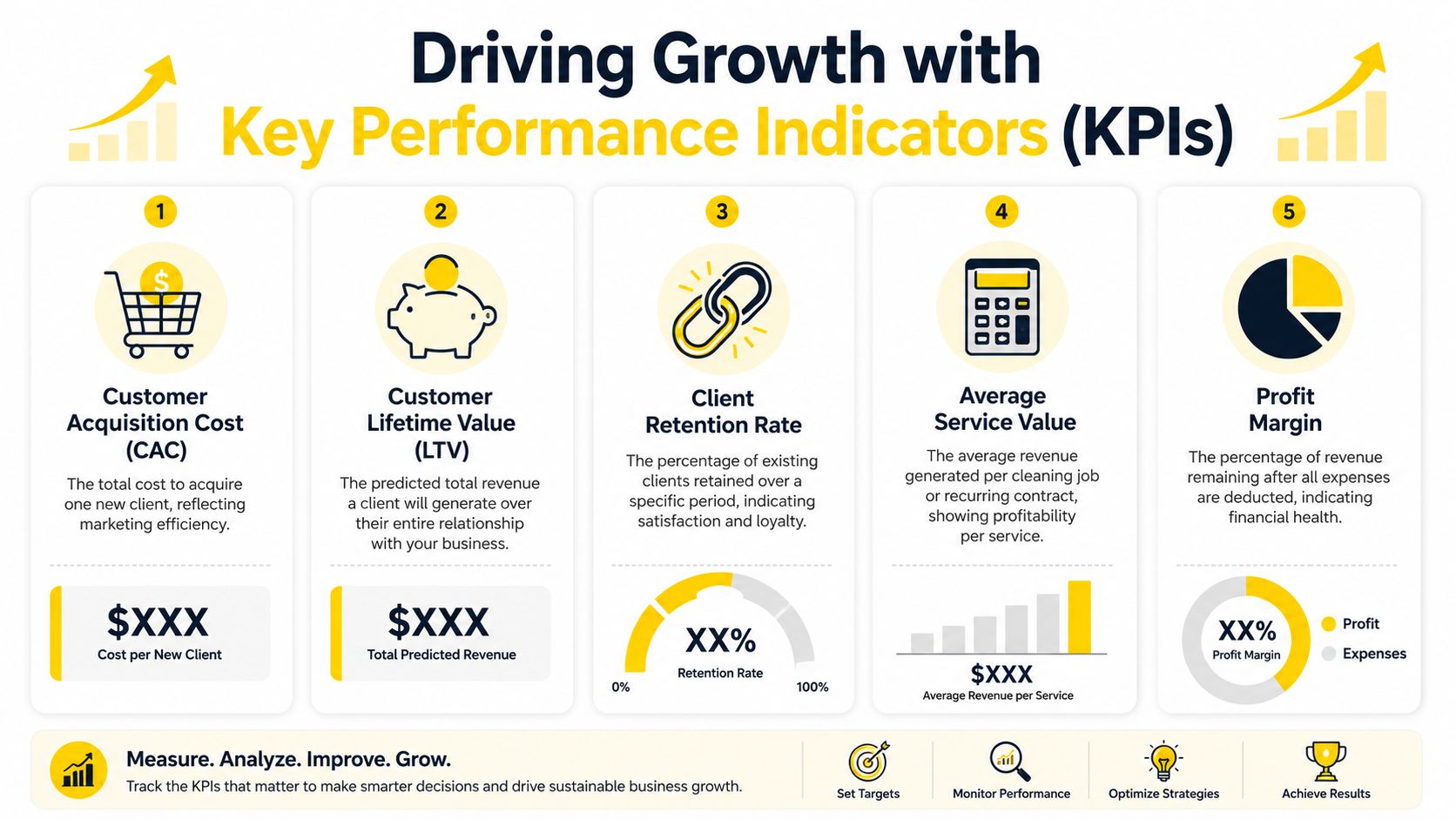
Here's how to use them:
The three benchmark metrics are your core scorecard. Around them, you need supporting indicators that explain why the score changes.
Track these consistently:
| KPI | Why it matters |
|---|---|
| Lead source | Shows where qualified work actually comes from |
| Average service value | Helps you spot weak job mix and upsell opportunities |
| Retention by client type | Reveals which segments stay and which ones drain time |
| Schedule density | Tells you whether route design is helping or hurting margin |
For lead attribution, this guide to lead source tracking is useful because it helps tie marketing effort to real booked work instead of vague assumptions.
If you don't know which leads close, which clients stay, and which jobs hold margin, you're steering from the rearview mirror.
Numbers are only useful when they trigger decisions.
If your close rate is weak, review your estimate process before you spend more on ads. If margin slips, inspect job-level pricing and labor assumptions. If churn rises, audit service handoffs, quality checks, and expectation-setting.
The best operators don't track metrics for appearances. They track them to catch problems early.
A scalable cleaning service business isn't built on hustle alone. It's built on repeatable estimates, disciplined pricing, tight operations, focused marketing, and a scoreboard that tells you when something is drifting.
If your business is losing leads to slow follow-up or inconsistent pricing, Estimatty gives cleaning companies a way to automate estimates through web and voice, standardize pricing logic, and capture inquiries after hours without relying on voicemail or manual callbacks.