September 8, 2026
How Much Should a House Cleaning Cost in 2026
How Much Should a House Cleaning Cost. Learn how much a house cleaning should cost in 2026, with real pricing ranges by home size, service type, and tips

Saturday, March 14, 2026
Learn how to start office cleaning business with practical pricing, effective marketing, and proven steps to land your first commercial contracts.
.png)
So you want to start an office cleaning business? Smart move. The real secret isn't just about cleaning—it's about building a business that generates stable, predictable income.
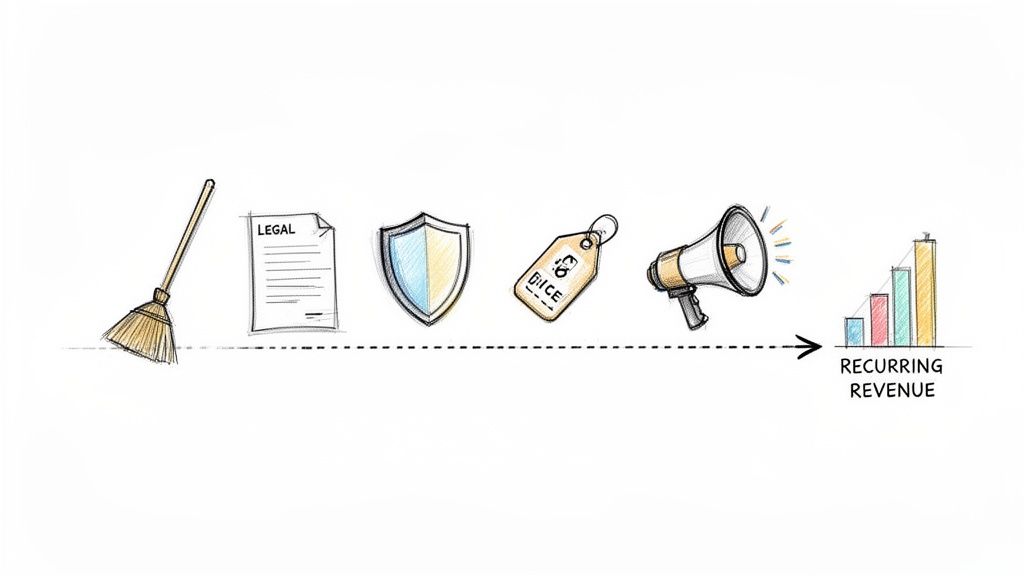
The path is straightforward: figure out your services, get the legal and insurance ducks in a row, learn to price jobs for real profit, and then go win those first few local clients. From there, it's all about locking in recurring contracts. That’s where the magic happens.
Let's be honest, starting from scratch can feel like a mountain to climb. But the opportunity in office cleaning is massive, and it’s right there for the taking. I've seen it firsthand.
The key difference here is commercial versus residential work. While home cleanings are often one-time gigs, commercial clients—think offices, medical clinics, and retail shops—need you on a consistent schedule. This is the foundation of a healthy business.
You're not just getting a job; you're building a source of recurring revenue. That stability allows you to forecast your income, manage cash flow without stress, and strategically plan your growth. For a more detailed look at getting started, we cover all the fundamentals in our guide on how to start a cleaning business.
This isn't just a stable market; it's a rapidly growing one. Recent industry reports project the global cleaning services market will jump by a staggering $24.93 billion between 2026 and 2030. Why? A much bigger focus on workplace health and hygiene.
And that's not some far-off global trend. Right here in the U.S., the janitorial services industry pulled in $96.4 billion in revenue in 2023 alone. You’re not just starting a small business; you’re entering a booming sector with a ton of financial upside.
My Two Cents: The real beauty of an office cleaning business is how it scales. You land one small office, they refer you to another business in their building, and suddenly you're looking at hiring your first employee. This model is built for growth from day one.
As you map out your business plan, you can find some fantastic high-level advice in this guide to starting a service business, which really nails the fundamentals of branding and winning clients.
Okay, let's talk money. Forget hypotheticals—what does it actually cost to get this off the ground? The great news is that you don’t need a massive bank loan to get started.
To give you a clear picture of what to expect, here’s a realistic breakdown of the initial investment for a solo operator or a small team.
This table outlines the typical one-time and initial monthly costs you'll face. These are the core investments needed to launch a professional, client-ready operation from day one.
As you can see, you can get a legitimate, professional business up and running for a surprisingly low initial investment, often under $2,500.
When you combine that low barrier to entry with the potential for high-margin, recurring revenue, you have a recipe for a truly attractive and achievable business venture.
Alright, let's talk about the serious stuff. Before you even think about buying your first mop, you need to get your business set up the right way. This isn’t just about checking boxes; it’s about protecting your personal assets and showing potential clients you're a professional they can trust from day one.
Getting the legal structure and insurance right is the bedrock of a successful cleaning company.
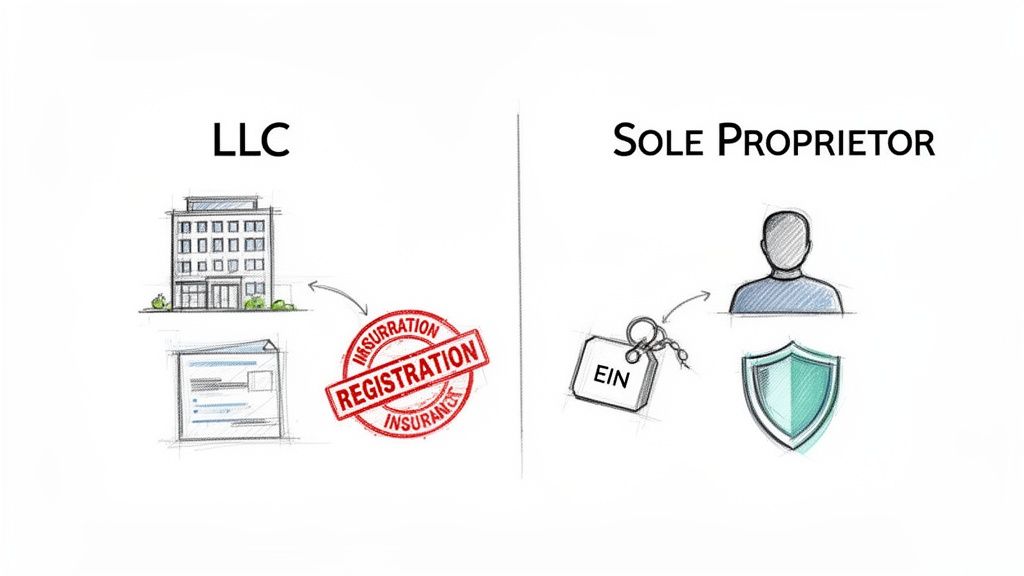
Your first big decision is how to structure your business. This choice directly impacts how you're taxed, your level of personal liability, and the amount of paperwork you'll be handling. For most newcomers in the cleaning game, it boils down to two options.
A Sole Proprietorship is the default. If you start cleaning and get paid, congratulations, you're a sole proprietor. It's simple and fast. But that simplicity comes at a cost—there's no legal separation between you and your business. If something goes wrong on a job and you get sued, your personal assets (your house, your car, your savings) are on the line.
A Limited Liability Company (LLC), on the other hand, creates a protective wall between your business and your personal life. It takes a bit more effort—you'll need to register with your state and pay a small filing fee—but the peace of mind is worth every penny. In a business where your team is working inside someone else's valuable property, this protection is absolutely essential.
Here's a real-world scenario: Imagine a new hire accidentally uses the wrong chemical and permanently stains a law firm's expensive conference room carpet. With an LLC, any legal action is aimed at the business's assets. As a sole proprietor, they could come after your personal bank account.
Getting a handle on the full incorporation process will give you a clear roadmap for all the state filings you'll need to complete.
Once you’ve picked a structure, you need to make it official. These next few steps are what turn your idea into a legitimate, functioning business.
Don't look at these as chores. They are what make you a real company in the eyes of the government and your clients.
If there is one thing you absolutely cannot afford to skip, it’s business insurance. Seriously. One accident without proper coverage can kill your business before you've even landed your second client.
You'll need a few key policies to be fully protected:
These policies do more than just protect you from disaster; they're a marketing tool. For a deeper dive into what’s needed, our guide on liability insurance for a cleaning company breaks it all down. Walking into a sales meeting fully insured and bonded immediately tells a potential client that you're a serious, low-risk professional.
Alright, let's talk about the one thing every new cleaning business owner obsesses over: money. Specifically, "How much should I charge?" This isn't just a simple question; getting the answer right is what separates a frustrating side-hustle from a genuinely profitable company.
If you price yourself too high, you'll hear crickets. But price too low, and you'll quickly find yourself running on fumes, essentially working for free. This is the moment you stop thinking like a cleaner and start thinking like a business owner. Let's break down the pricing models that work in the real world so you can approach any job with confidence.
There's no magic bullet for pricing. In fact, the smartest owners I know have all three of these methods in their toolbox and know exactly when to use each one.
A piece of advice I learned the hard way: Never, ever guess your rates. You have to know your numbers. Add up all your costs—your supplies, insurance, gas, labor—and then add the profit you need to make. If your total cost to have a cleaner on-site is $25 an hour, charging $30 is just a slow road to going out of business.
Here’s a small change in wording that makes a huge difference: always call your proposals estimates, not quotes. The word "quote" sounds final, like a price locked in stone. "Estimate," on the other hand, suggests a professional assessment based on the known information. It gives you wiggle room.
Think about it. You bid a job based on the client telling you their breakroom is "lightly used." You show up for the first clean and find a disaster zone that looks like it hasn't been touched in a year. An estimate gives you the professional standing to go back to the client and adjust the price based on reality. It protects your profits and prevents arguments before they even start.
Your estimate is more than just a number—it's your first real sales pitch. A single line item with a price scribbled down looks amateurish and cheap. A detailed, professional estimate shows you’re serious and justifies your price.
Here’s what a winning estimate absolutely must include:
A great estimate proves you’ve actually thought about the job. It builds a case for your value before you ever plug in a vacuum. For a deeper dive, check out our detailed guide on creating effective cleaning service estimates that get you hired.
Picture this: it's 10 PM on a Friday. A potential client finds your website. Instead of just filling out a "contact us" form and hoping you'll call back on Monday, they answer a few questions and get a polished, professional estimate emailed to them instantly.
That's not science fiction; it's the edge you get with modern tools. An estimating platform like Estimatty can deliver 24/7 estimates for you, capturing hot leads while you're sleeping or out on a job.
That kind of speed and responsiveness immediately sets you apart from the competition. It tells clients you're an efficient, forward-thinking company—even if you're just a one-person show just getting started. You're not just selling a cleaning service; you're selling convenience from the very first click.
Your equipment is your reputation on wheels. Having the right tools isn't just about getting the job done—it's about efficiency, professionalism, and landing those bigger, better-paying contracts. The gear you choose is the backbone of your service, and a smart investment here pays for itself almost immediately.
This isn't just a hunch; the market is telling us exactly where the money is. The commercial cleaning world, which already accounts for a massive 31% of the entire industry, is set to explode from $262.35 billion in 2024 to an incredible $443.23 billion by 2033. Why? Because businesses are demanding higher standards for everything from floor care to sanitation. This growth is your open invitation.
When you’re just starting out, forget the massive warehouse of specialty machines. You need to focus on a core set of durable, reliable tools that let you deliver an exceptional clean for a standard office.
This is a good time to think about how your services scale with the client. Your pricing strategy will often depend on the size and complexity of the job, which influences the kind of equipment you'll need.
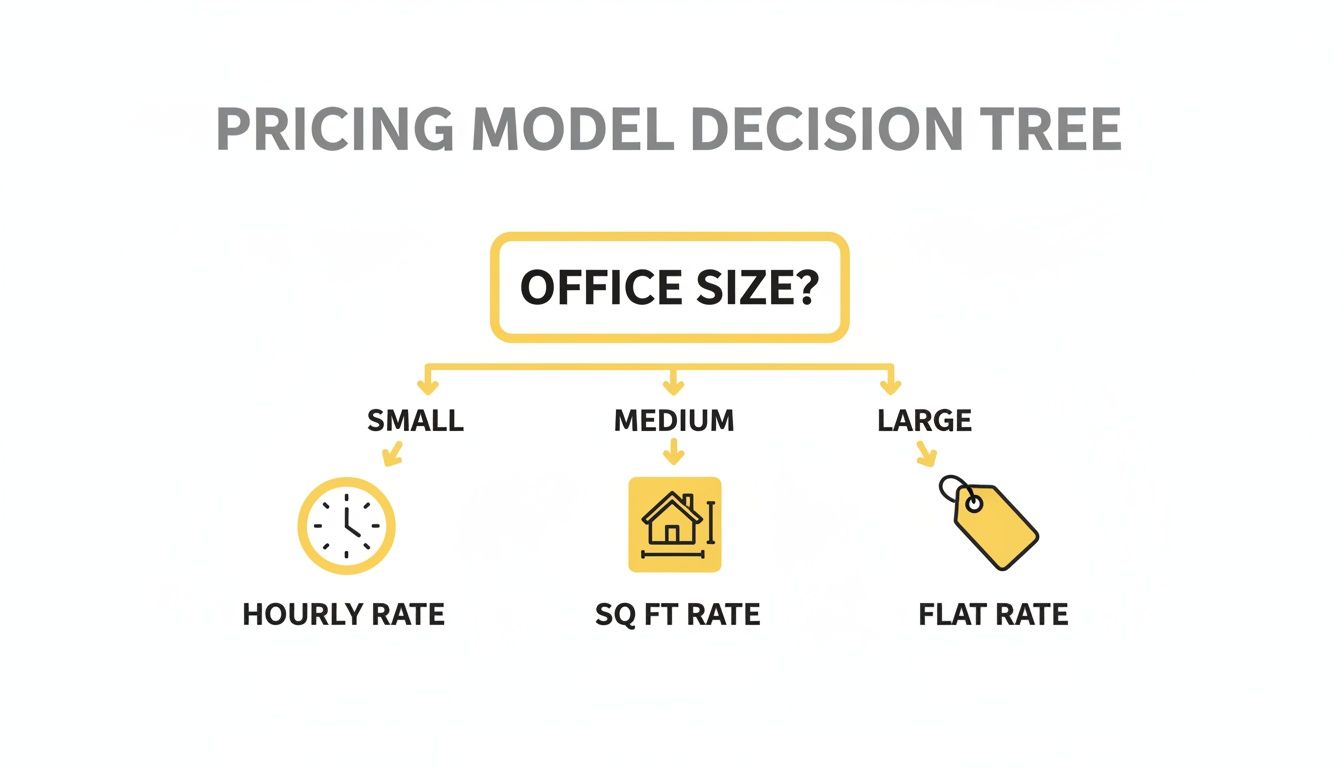
As you can see, you might use an hourly rate for smaller jobs but switch to a flat rate for larger, more predictable contracts. Matching your model to the job is key.
Once the cash starts flowing from your initial contracts, it's time to reinvest in equipment that saves labor and unlocks more profitable services. These are the tools that will truly set you apart from the low-ball competitors.
Let's walk through a real-world scenario. You're doing a walkthrough for a potential client, and they point out their large VCT (Vinyl Composition Tile) entryway, complaining that it always looks dull and scuffed.
This is your chance. Instead of just nodding along, you can say, "We can fix that. We have a professional floor buffer and a proven process for stripping and waxing VCT to restore that deep, wet-look shine." In that moment, you stopped being just another cleaner and became a problem-solver. That one machine could be the reason you win a lucrative, long-term account.
Other game-changing upgrades to consider as you grow:
Ultimately, your equipment roster is a direct reflection of your company’s capabilities. Investing in the right gear—and using the best cleaning business software to track it—sends a powerful signal of quality that attracts and keeps the high-value commercial clients you want.
So, you’ve got the best gear and your legal ducks are in a row. That’s great, but it doesn’t mean much without paying clients. This is the moment you stop being just a business owner and start becoming a marketer. Landing those first few commercial contracts is everything—it’s what brings in real revenue and proves your business model actually works.
Your mission is to be everywhere your ideal clients are, both online and in the real world. A smart B2B marketing strategy isn’t about casting the widest net possible. It’s about being strategically visible to the right people—the office managers, facility directors, and property owners who hold the purse strings.
Before you even think about spending a dollar on ads, your online presence needs to be rock-solid. In the B2B world, you can bet that decision-makers will vet you online long before they ever consider picking up the phone. Your digital storefront has to scream professionalism and trust from the very first click.
A clean, modern website that clearly explains your services is non-negotiable. But let's be honest, a simple "contact us" form just doesn't cut it anymore. To really make an impression, you have to offer immediate value. This is where an instant estimate tool like Estimatty becomes your secret weapon. It gives a busy office manager the power to get a ballpark price at 10 PM on a Tuesday, without waiting for you to call them back.
Next, you have to dominate your local search results. Get your Google Business Profile set up and fill out every single section. Upload high-quality photos of your team (in uniform!), your shiny equipment, and some killer before-and-after shots. Gently nudge your first few clients to leave reviews—that social proof is incredibly powerful when a potential B2B client is weighing their options.
While a killer digital presence is essential, you absolutely cannot ignore old-school, real-world tactics. When you're just starting out, your first clients are almost always going to come from your own backyard. You’ve got to get out there and shake some hands.
Pro Tip: Your opening line is critical. Ditch "Can I give you a cleaning estimate?" and try something that offers value. A great way to start the conversation is: "Hi, I run a local commercial cleaning company that helps businesses like yours maintain a professional and healthy workspace. Who would be the best person to chat with about your facility's needs?"
Connecting online is a direct line to decision-makers, and for that, LinkedIn is your best friend. You can easily search for "Facility Manager" or "Office Manager" in your city and connect with them directly.
Once you connect, resist the urge to immediately pitch your services. A softer, more personal approach always wins. Here’s a simple cold email template that I've seen get real results:
Subject: A cleaner, healthier office for [Company Name]?
Hi [Manager's Name],
My name is [Your Name], and I'm the owner of [Your Cleaning Business], a local company that specializes in keeping professional offices in the [Your City] area looking their best.
I saw you're the [Manager's Title] at [Company Name] and just wanted to briefly introduce our services. We help businesses like yours create a more productive and welcoming environment for your team and clients.
Would you be open to a 5-minute call next week to see how we might be able to improve on your current cleaning program?
Best,
[Your Name]
[Your Company Name]
[Your Phone Number]
[Link to Your Website]
One of the best things about the office cleaning business is how scalable it is on a lean budget. You can get a small team up and running with an initial investment of just $500-$2000 for supplies and insurance, which means you can see a return on your investment quickly.
The industry is also getting a major tech upgrade. By 2026, a staggering 80% of large firms will be using digital platforms for quality control and managing their workforce. This is a huge opportunity that levels the playing field. It allows smaller, scrappy operators to compete effectively by using smart tools like Estimatty—which can be set up in minutes with zero coding required.
Whether you're networking in person or reaching out with a cold email, the key is a blend of persistence and professionalism. Getting those first few clients is a numbers game. The more targeted actions you take, the faster you’ll land the profitable, recurring contracts that build a real business. For even more strategies, our guide on how to get more cleaning clients is packed with actionable tips.
You've got the playbook in hand, but I bet you still have a few questions rolling around in your head. It’s completely normal. Let's tackle the most common ones I hear from people just like you, so you can move forward with confidence.
The sky’s the limit, but let's talk real numbers. Flying solo, you can expect to pull in between $30 and $50 per hour. The real money, though, comes from locking in those recurring commercial contracts.
Think about it: a single small office, cleaned just twice a week, can easily bring in $600 to $1,200+ every single month. Once you have a handful of those, you're on your way. Building a small, reliable team makes a six-figure annual revenue a very achievable goal.
The key to hitting those numbers is pricing your services for profit, not just to get the job. When you're ready to expand, finding good people is crucial. Platforms like pipehirehrm.com are built for the cleaning industry, helping you staff up so you can confidently bid on bigger, more lucrative contracts.
Hands down, the most damaging mistake I see is fumbling the estimate. New owners either guess at a price—charging too little and working for free, or charging too much and losing the job—or they simply take too long to send one.
A busy office manager isn't going to wait 24 or 48 hours for your estimate. They can't. By the time you get back to them, they’ve already heard from two of your competitors and are close to making a decision. You've lost before you even had a chance to compete.
This is where you can gain a massive, almost unfair, advantage. Using a tool that gives instant estimates on your website makes you look like a polished, professional operation from day one. It captures that lead's interest immediately, 24/7, making you the company to beat.
Honestly, no. You don't need a decade of mopping floors to launch a successful cleaning business. What you absolutely do need is a rock-solid work ethic and a business owner's mindset. The actual cleaning techniques are easy to master.
You can find tons of great training videos online. Another pro tip? Go work for a local cleaning company for a month or two. You'll get paid to learn exactly how they operate, price jobs, and manage clients. The skills that truly determine your success are things you can't learn from a manual:
Start by landing a few smaller offices to get your systems down and build your confidence. Stick to standard janitorial work and become the best at it. The low barrier to entry is what makes this such a golden opportunity. For more on building a winning team, the folks over at get.pipehirehrm.com/blog have some great insights.
Making the jump from residential to commercial is a smart move, but it’s a whole new ballgame. It’s not just about cleaning a different type of space; you have to fundamentally change your approach.
First, your gear needs a serious upgrade. Consumer-grade vacuums won't survive the nightly grind of commercial work. You need heavy-duty equipment built for the job. Your pricing also has to change. Forget hourly rates; commercial cleaning is almost always estimated by the square foot or as a flat monthly fee. You can find some great articles on this over at the estimatty.com/blog.
Next, call your insurance agent. Your liability coverage will need to be increased to meet the stricter requirements of commercial buildings. Finally, your marketing needs a B2B overhaul. You’re no longer targeting homeowners on Facebook. Your new clients are office managers and property directors, and you’ll find them on LinkedIn or at local chamber of commerce events. This is where fast, professional estimates become your secret weapon for handling the higher volume of leads and closing more commercial deals.
Ready to stop chasing leads and start converting them automatically? Estimatty is the AI-powered sales tool that delivers instant, accurate estimates to your website visitors and callers 24/7. Turn more inquiries into booked jobs without lifting a finger. See how it works at https://www.estimatty.com.