October 9, 2026
How to Find Commercial Cleaning Contracts That Win
Learn how to find commercial cleaning contracts that actually close. Expert strategies to land new clients and grow your cleaning business in 2026.

Saturday, October 10, 2026
Learn how to increase qualified leads for your cleaning business. Discover AI estimators, speed-to-lead tactics, and scoring strategies that book more jobs.

Most cleaning business owners are told to get more traffic, collect more inquiries, and let the sales team sort out the rest. That advice sounds sensible until your phone fills with requests outside your service area, jobs too small to price profitably, vague “how much?” messages, and prospects who never answer a callback. More leads can create more waste when your intake system can't identify fit or respond while buying intent is still fresh.
The practical answer to how to increase qualified leads isn't publishing more content or increasing ad spend. It's building a sub-five-minute, AI-assisted qualification process that captures the job details your team needs, gives the prospect a useful next step, and escalates complicated work to a person. The result you want isn't a larger inquiry count. It's more serviceable opportunities, fewer unproductive callbacks, and a higher rate of booked jobs from the attention you're already earning.
Raw lead volume is a vanity metric if your cleaners can't service the jobs, your pricing doesn't cover the labor, or your receptionist reaches prospects after they've already hired someone else. A qualified lead should meet clear operational rules before it reaches your calendar.
For a residential company, that usually means the prospect is inside your service area, owns or controls a suitable property, wants a service you provide, can describe the property's approximate size and condition, and accepts the pricing logic behind the estimate. For commercial work, add facility type, cleaning frequency, access requirements, surfaces, occupancy, and decision-maker status. A name and phone number aren't qualification. They're contact details.
Timing changes the value of every inquiry. A severe timing problem exists in lead management. Leads contacted within five minutes can be up to 100 times more likely to convert than those contacted after 30 minutes, while average response times can stretch into many hours, according to lead response timing data. A perfect qualification framework won't rescue a prospect who has already moved on.
Write your acceptance criteria in plain language and make the system enforce them.
A structured approach to what lead qualification means helps turn those rules into a repeatable workflow. For paid campaigns, practical lead scoring for ad traffic can add another layer, but scoring shouldn't become a mysterious number that nobody trusts. It should reflect whether the team can reach, price, schedule, and profitably service the inquiry.
Practical rule: Rejecting a poor-fit inquiry quickly is productive work. Sending it to a cleaner for three unanswered callbacks is not.
The shift is from volume to velocity and fit. Track how quickly an inquiry receives attention, whether it meets your service rules, and whether it books. If an advertising channel produces many submissions but few qualified appointments, increasing its budget only scales the problem.
Long quote forms ask prospects to do administrative work before they've received any value. Every extra field creates another chance to abandon the page, especially on a phone while someone is comparing cleaners. Form-completion data indicates that only about 45% of visitors who start a traditional form finish it, implying roughly 55% abandonment, according to form completion research.
A conversational estimator changes the sequence. Instead of presenting a wall of fields, ask one useful question at a time and make each answer move the prospect closer to an estimate or booking.
Start with the minimum viable information:
The order matters. Ask location and service type early because they can disqualify a request immediately. Ask detailed access questions later, once the prospect understands what happens next. Progressive profiling lets you collect the operational information that matters without demanding a complete job brief before offering help.
An AI estimator such as Estimatty can use those answers to provide an immediate estimate range, send the result by SMS or email, and notify the team when a prospect needs human attention. Its role isn't to guess at every unusual job. Its role is to standardize routine intake, identify missing variables, and keep qualified prospects engaged while a person handles exceptions. Learn more about AI estimates software for cleaning businesses.
A prospect is more willing to answer a second question after receiving a clear first step. Show the service area, explain what affects pricing, and provide an estimate range when the captured information supports one. If the job needs a manual review, say exactly why, such as unusual surfaces, commercial access, or a condition that affects labor.
The form should also offer SMS or email delivery, a direct booking path, and a human handoff. Don't optimize for completed submissions if those submissions lack enough information to schedule the work. Measure visitor-to-start, start-to-completion, qualified-lead rate, estimate acceptance, booking rate, and lead-to-job revenue.
The best conversational flow feels like a helpful receptionist, not a disguised data-entry form. It reduces friction without removing commercial intent.
Speed-to-lead is an operational discipline, not a marketing slogan. A visitor requesting an estimate is often comparing providers while actively thinking about the cleaning job. If the first response arrives after a voicemail exchange, a night of waiting, or a next-day callback, the prospect may no longer be available or interested.
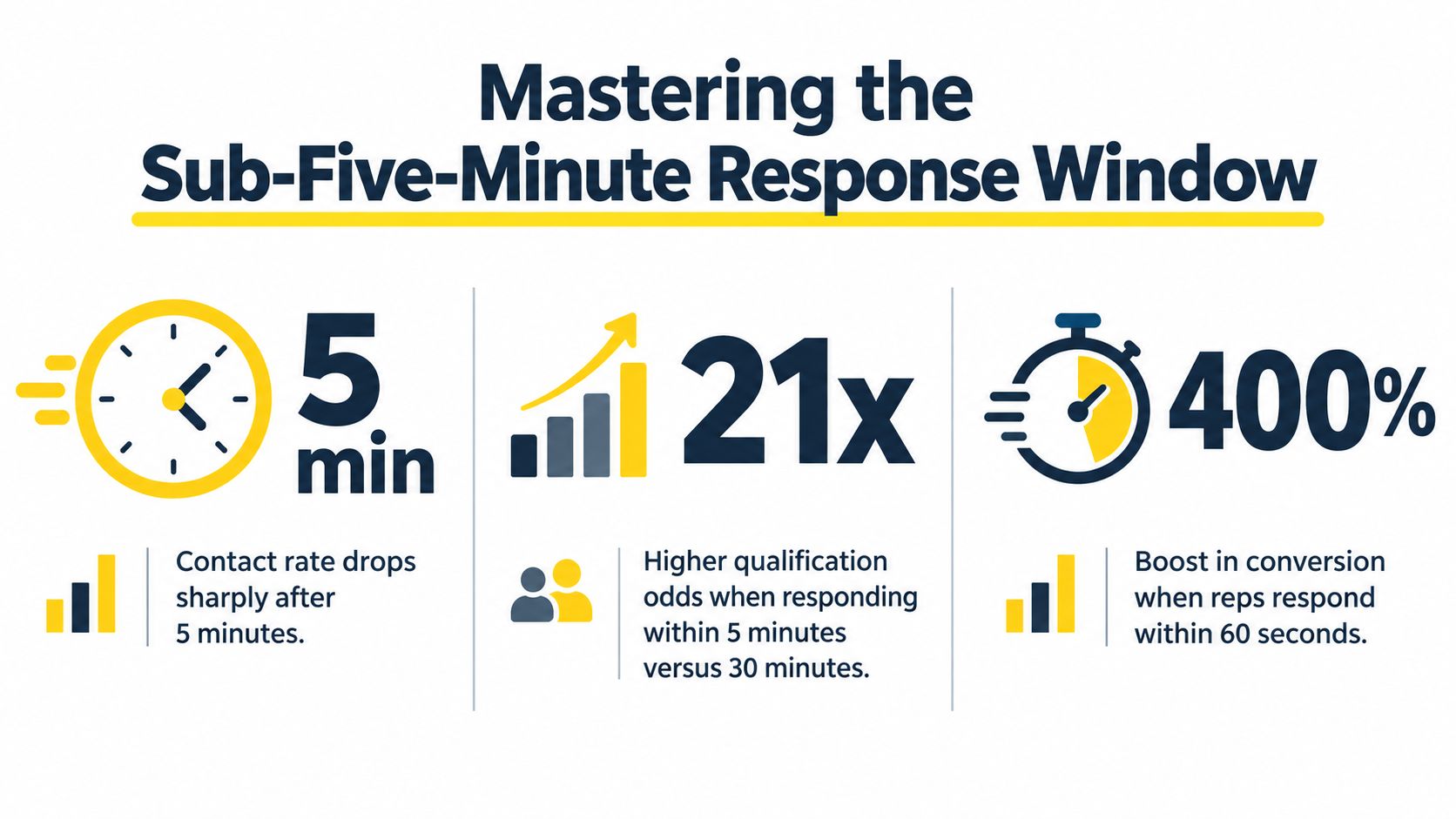
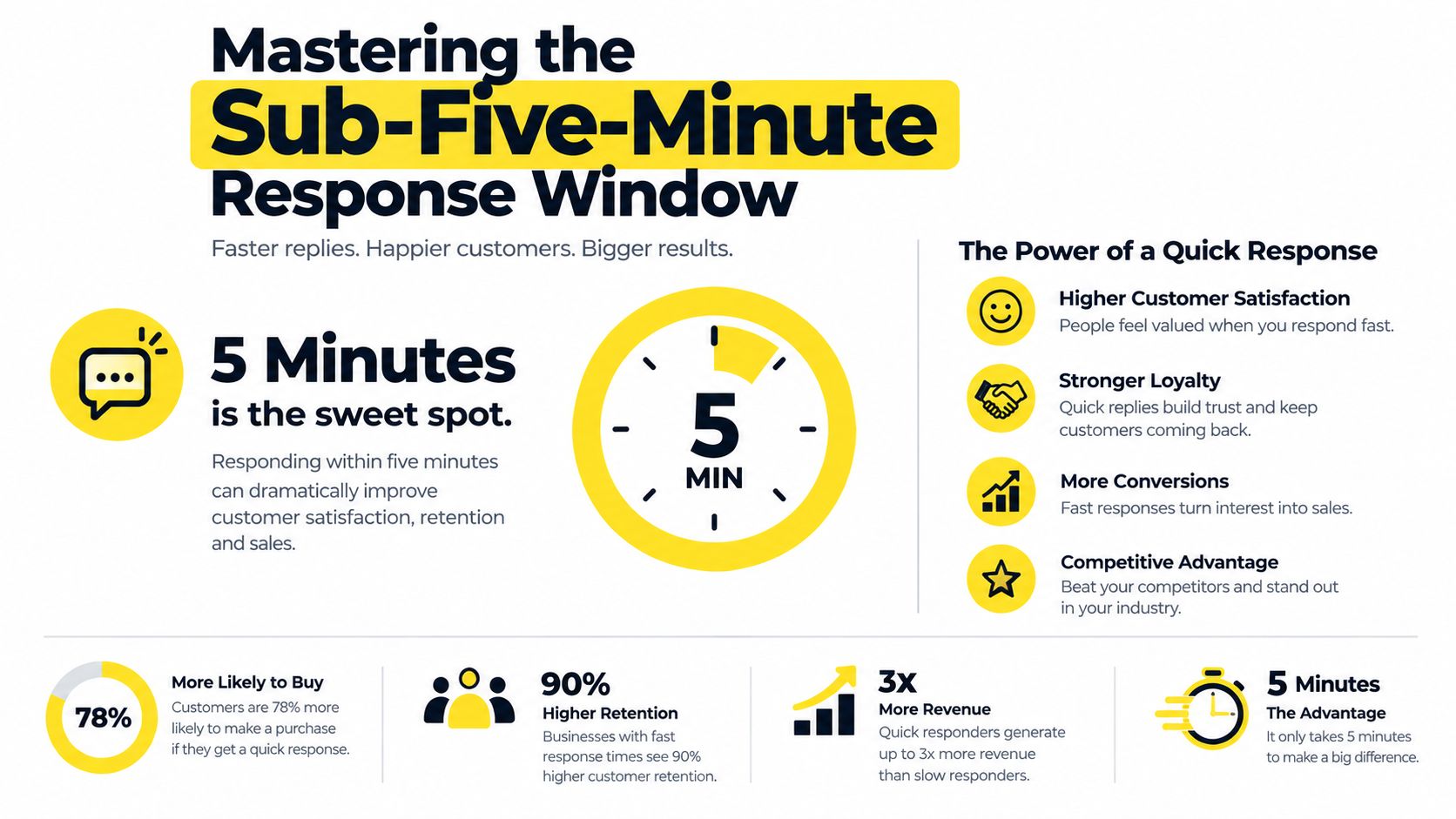
The 2007 Lead Response Management Study analyzed more than 15,000 web-form leads and over 100,000 call attempts across six companies. It found that contacting an inbound lead within five minutes instead of waiting 30 minutes made the prospect approximately 100 times more likely to be reached and 21 times more likely to be qualified, as summarized in lead response findings.
Don't tell the team to “respond quickly” and hope a busy cleaner remembers. Create an automated sequence tied to the moment an inquiry arrives.
The operational target should be a first response within 60 seconds, with a hard service-level limit of five minutes. That distinction matters. An average response time can look acceptable while after-hours inquiries wait until morning. Report the median and the 90th-percentile response times separately so those delays can't hide.
A missed call is an inquiry, not a dead end. The system should acknowledge it, invite the caller into a voice or text intake flow, and collect enough information to identify whether a human needs to intervene. After-hours engagement doesn't mean pretending every job can be priced automatically. It means preserving the opportunity until the right person can act.
InsideSales' analysis examined more than 55 million sales activities involving 5.7 million inbound leads across more than 400 companies. It found that conversion rates were approximately eight times higher when the first response occurred within five minutes than when it occurred after five minutes and within 24 hours, while only 0.1% of inbound leads were engaged within five minutes, as reported in response-time research.
The workflow should therefore separate contact, qualification, and booking. A successful acknowledgment isn't a qualified lead. A completed intake isn't a booked job. Each event needs its own timestamp and outcome.
For practical implementation details, use this guide to improve response time as a checklist for automations, routing, and reporting. The system earns its keep when it protects the first few minutes without forcing your cleaners to abandon billable work.
Automation works best when it handles predictable questions and humans handle ambiguity. The mistake is treating every cleaning inquiry as equally simple, then either sending routine requests to an overloaded receptionist or pushing complex jobs through a rigid bot that can't understand the operational risk.
Recent small-business research reports that 68% of small businesses use AI regularly, while many still expect to maintain or expand human service teams for complex escalations, according to small-business AI research. That combination fits cleaning operations. AI can extend coverage, while people protect trust and margin.
A routine recurring home cleaning can often follow an automated path when the property fits your service area, the scope is familiar, and the prospect accepts the estimate range. A move-out job may need a person if the condition is uncertain or the customer has a strict deadline. Commercial facilities, unusual surfaces, accessibility needs, complaints, complex access instructions, and multi-site requests should usually trigger earlier human review.
A simple routing matrix keeps this practical:
| Inquiry type | First response | Human handoff |
|---|---|---|
| Routine recurring home service | Automated intake and estimate | When the prospect requests changes or has unanswered questions |
| Deep or move-out cleaning | Automated intake with condition questions | When scope, deadline, or property condition is unclear |
| Commercial facility | Automated acknowledgment and data capture | Early, especially when access, staffing, or procurement is involved |
| Complaint or service recovery | Immediate acknowledgment | Promptly, before offering a new estimate |
| Unusual surfaces or access needs | Collect the exception details | Before confirming price or appointment |
The handoff should include the transcript, captured property details, estimate shown, unanswered questions, and the reason for escalation. A receptionist shouldn't have to ask the customer to repeat the entire conversation. That repetition makes automation feel like a barrier rather than service.
Tell the prospect what happens next. “A team member will review the access details and confirm the estimate” builds more confidence than a silent transfer. Give the human agent the authority to correct an incomplete estimate, explain a price change, and finalize the booking.
Connect the intake record to your CRM or scheduling workflow so no qualified conversation sits unassigned. A Zapier CRM integration for cleaning workflows can help pass captured details to the tools your team already uses, provided the destination preserves timestamps and ownership.
The right design is selective automation. Let AI answer availability questions, capture job variables, send preliminary estimates, and handle common objections. Let people resolve uncertainty, protect customer trust, and close work where a generic answer could create a bad appointment.
Broad advertising can bring attention from people who aren't ready, aren't nearby, or don't need the service you sell. A local cleaning business should prioritize the search terms that reveal place, service, and timing. “House cleaners near me,” “move-out cleaning,” and “cleaning service available today” tell you more than a broad cleaning-related phrase because they connect a need to an action.
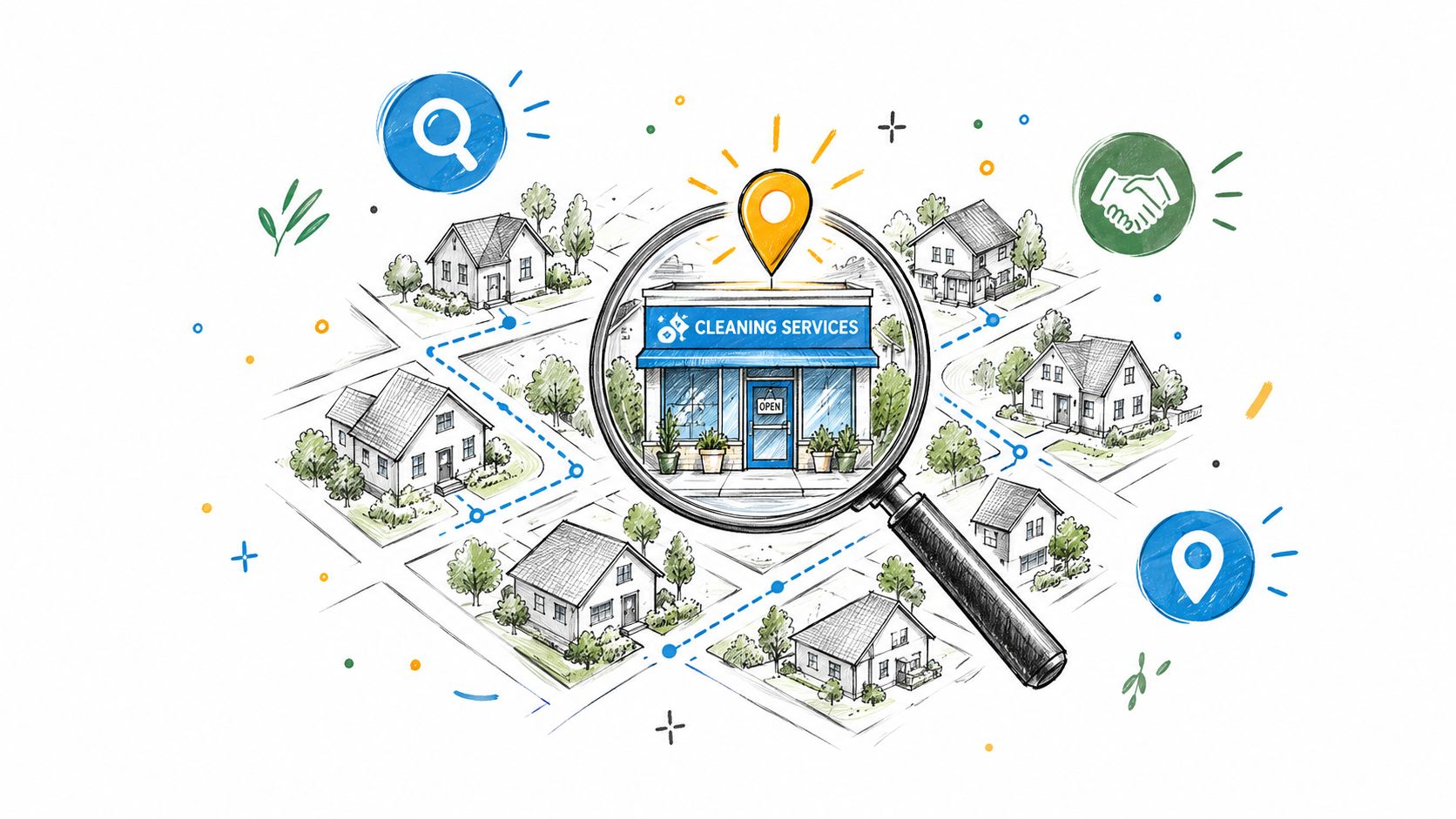
Google's local-search research found that 18% of smartphone local searches led to a purchase within a day, compared with 7% of non-local searches, highlighting the value of location and timing signals in Google's local-search research. The research measures purchases broadly, not cleaning bookings, so use it as a qualification principle rather than a promise of cleaning conversion.
Create pages that match the actual request:
Each page should lead to the same qualification engine, but the first questions should reflect the service. A move-out visitor shouldn't see the same opening flow as a recurring home-cleaning prospect. Use location pages carefully, with real service-area information and clear boundaries, rather than creating thin pages that promise coverage you can't provide.
Local partnerships add a second source of intent. Property managers can refer turnovers, real estate agents can send pre-listing and move-out work, and moving companies can introduce customers who need cleaning before or after a move. Give partners a simple referral path and route those inquiries with a source label so you can compare their qualified-booking rate with paid channels.
For teams creating short local ads, a tool such as ShortGenius Meta ad creator can help produce variations for service, neighborhood, and urgency themes. The creative still needs to match the landing page and the service area. A polished ad that sends the wrong audience into your intake flow only increases the cleanup work.
The winning combination is high-intent acquisition plus immediate qualification. Search and partnerships bring the right context. Your estimator and human team determine whether the job is serviceable.
A form submission report can make a weak campaign look healthy. It counts names, not jobs. Cleaning operators need a measurement chain that starts when the inquiry arrives and ends when the work is booked, assigned, completed, and profitable.
A benchmark compilation reports that leads contacted within five minutes qualified at a 41% rate, compared with 1.9% for leads contacted after 24 hours, according to response-interval benchmarks. The figures make the reporting requirement clear. If you don't segment outcomes by response interval, you can't see how much opportunity your process is losing.
Record these events with timestamps and a consistent lead ID:
Median response time tells you what usually happens. The 90th percentile shows whether evenings, weekends, or unassigned queues are damaging customer experience. Review both.
Once a week, sample accepted leads and inspect the conversation. Look for false positives, such as jobs outside the service area or appointments that were never economically viable. Look for false negatives too, including inquiries rejected because a prospect didn't understand a question or couldn't provide square footage immediately.
Compare channels on qualified booking rate, not just cost per submission. A partner may produce fewer inquiries but better-fit jobs. An ad may generate attention while a service-specific local page produces the customers your team can schedule. Even content production decisions should follow business outcomes. If you use video to support local campaigns, evaluate the asset against qualified inquiries rather than relying on studio-quality video pricing or production polish as a proxy for performance.
Use lead source tracking for cleaning businesses to preserve the original channel through estimate delivery and booking. Then change one part of the process at a time, such as the first question, required fields, escalation trigger, or follow-up message. The goal isn't a busier dashboard. It's a system that gives your team fewer dead-end conversations and more jobs worth accepting.
Estimatty helps cleaning businesses engage website visitors and callers immediately, capture property and service details, deliver estimates by SMS or email, and route complex prospects to a human for booking. Visit Estimatty to replace slow forms and after-hours voicemail with a qualification process designed for faster, better-fit bookings.