
November 21, 2026
10 AI Voice Agent Services for Businesses Compared
Compare 10 AI voice agent services for businesses: real pricing, use cases, integrations, and honest limits so you can match one to your call volume.

Monday, November 23, 2026
Compare Carpet Cleaning Bozeman prices, cleaning methods and drying times for Montana winters, then get a clear estimate before you book.

Carpet cleaning in Bozeman runs $60 to $80 per room and $0.20 to $0.30 per square foot. The number you pay still depends on the area, the carpet type, and the add-ons on the estimate.
That range sits on top of an expensive housing market. U.S. Census Bureau QuickFacts reports that 44.7% of Bozeman housing units were owner-occupied in 2020–2024, with a median owner-occupied home value of $687,900, median gross rent of $1,717, and median monthly owner costs of $2,339 on mortgaged homes. Fewer than half of city units are owner-occupied, so a large share of carpet cleaning Bozeman work is turnover, deposit, and property-manager work, not only a homeowner protecting a high-value interior.
Winter and smoke season are what most local price pages skip. Snowmelt and mud change how dirty a hallway is, and an unheated room changes how long it stays damp. A wildfire week changes whether you should clean at all that day. An estimate that ignores fiber, soil, heat, and same-day use will look cheap and then miss.
Carpet cleaning Bozeman pricing is built per room or per square foot, and even a small visit carries a minimum because the truck, setup, and labor don't shrink with the hallway.
These are benchmarks, not a rate card every company in town must use. Compare a per-room figure with a per-room figure, and a bundle with a bundle. A national per-square-foot band is not the same thing as a local published estimate.
| Benchmark | Basis | Price |
|---|---|---|
| HomeBlue Bozeman estimate, 2024 | Per room | $60-$80 |
| HomeBlue Bozeman estimate, 2024 | Per square foot | $0.20-$0.30 |
| Gallatin Valley Chem-Dry small-house bundle, 2026 | Four rooms and closets, one hallway, one flight of stairs, one landing | $380 |
| Cleanfax 2026 benchmarking survey (national) | Per square foot, 47% of residential companies | $0.31-$0.50 |
| Industry pricing data (national) | Residential minimum service charge | $99-$150 |
| Industry pricing data (national) | Typical whole-house job | $175-$300 |
HomeBlue's 2024 Bozeman estimate puts the work at $60-$80 per room and $0.20-$0.30 per square foot. That local band sits under the national cluster. In Cleanfax's 2026 carpet and floor cleaning benchmarking survey, 47% of companies offering residential carpet cleaning charged $0.31-$0.50 per square foot. The national minimum and whole-house ranges in the table explain why a single small room rarely bills on area math alone. Travel distance, local wages, and how booked the week is all push a Bozeman estimate off those marks.
Take a 300-square-foot hallway priced on the HomeBlue band. Area math gives $60-$90. That lands below the national minimums in the table, so the estimate is the minimum charge, not $60. The provider still drives out, sets up the wand, mixes chemistry, and writes up the job.
Area math alone underprices a single room, a landing, or a small apartment.
Practical rule: Calculate the area price first, compare it with the minimum, and use whichever figure is higher. Then list every extra on its own line.
Stairs, heavy winter soil, furniture moving, pet treatment, and same-day service belong on separate lines. In Bozeman that itemizing matters more than in a mild market. A room cleaned after spring snowmelt carries a different soil load than the same room in August, and a booking after a smoky week may need odor treatment priced as its own line rather than folded into a standard rate. A customer can see why the total moved. A single unexplained number is how callbacks start.
National wage data for cleaning occupations shows a wide spread between the lowest-paid and highest-paid workers. A new cleaner and an experienced carpet technician shouldn't share one labor assumption inside the estimate.
When recruiting gets harder, payroll pressure pushes minimums and per-room rates up with it. I'd hold three labor tiers, entry, experienced, and specialist, and I'd raise the minimum before I padded every room rate.
An online carpet cleaning estimate calculator only works if the inputs are real. Write these down before you ask:
Skip any of those and the estimate is a guess with a dollar sign on it. One more input matters in this valley: when the carpet last got wet, and what it absorbed. A hallway still holding mud-season moisture, or a room that sat through a smoke week with the windows open, changes both the chemistry and the drying plan, and an honest estimate prices that difference up front.
No single process suits every carpet. Fiber, soil load, and how much water the floor can tolerate pick the method. Price follows that choice, because chemistry, passes, and dry time are not the same job.
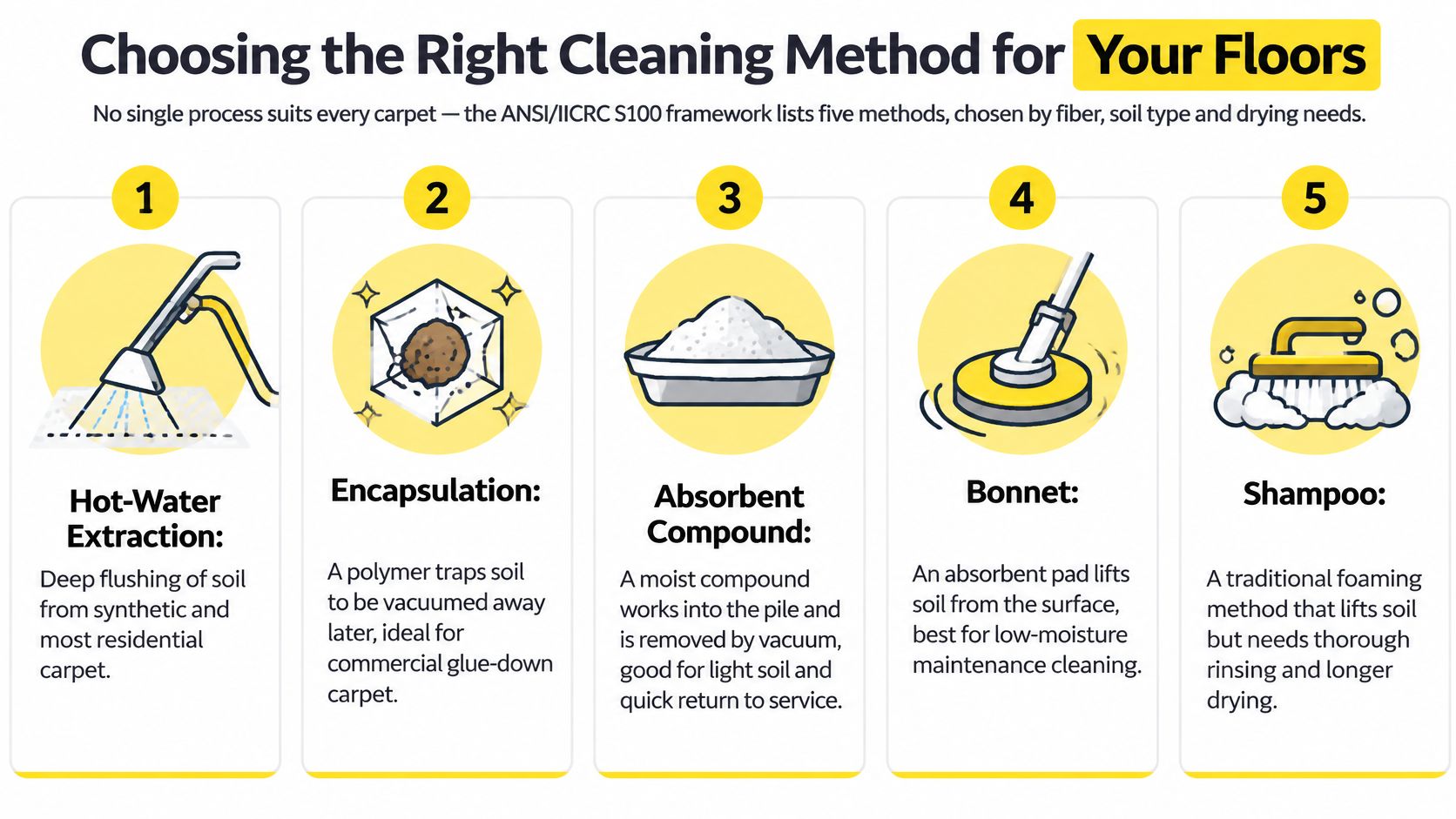
The ANSI/IICRC S100 framework covers inspection, fiber and soil identification, chemistry, extraction, and drying. It recognizes hot-water extraction, encapsulation, absorbent compound, bonnet, and shampoo as appropriate in different circumstances. Hot-water extraction injects heated solution, often about 150-200°F, works it into the pile, and recovers it with high vacuum.
| Method | Best for | Moisture left | Drying |
|---|---|---|---|
| Hot-water extraction | Heavy soil and deep traffic lanes | Higher, managed by strong vacuum recovery | Longer if airflow is limited |
| Encapsulation | Maintenance cleans between deep cleans | Low | Faster; often ready the same day |
| Bonnet cleaning | Light surface soil and quick turnarounds | Low | Fast |
| Absorbent compound | Low-moisture cleaning where water must stay minimal | Low | Fast; usually same-day return to service |
Hot-water extraction is the right call for deep traffic lanes and suspended soil. It is also the method that leaves the most water if recovery is weak. Inadequate vacuum or no airflow stretches drying and raises the chance of browning, wicking, odor, and backing damage. "Steam" isn't the problem. Unmanaged moisture is.
Encapsulation uses polymer crystals that lock soil so a later vacuum lifts it. The carpet stays drier, which suits maintenance between deep cleans and a lot of glue-down commercial floor. Bonnet cleaning, a spinning absorbent pad, handles light surface soil and a fast turn. Absorbent compound, a moist powder worked into the pile and vacuumed back out, fits rooms where water has to stay minimal.
A maintenance clean on carpet that's already in decent shape shouldn't be priced or performed like a restoration flush of black traffic lanes.
Wool is the special case I slow down for. It absorbs more water and dries slowly, so the safe setup is moderate temperature, chemistry around pH 5-8, no oxygen bleach, and tight control of water volume. Plan extra airflow before you promise a same-day walk-on. The same caution applies to thick pile and any carpet over a pad that already feels cool and dense.
Area rugs are a different decision again. A wall-to-wall synthetic can take extraction in place. A loose rug with a delicate face often needs a wash method matched to the construction, which is why the step-by-step rug washing methods from Tip Top Furniture & Mattresses are worth reading before anyone soaks a good rug in a driveway. If the rug stays in the house, an area rug steam cleaning estimate should be its own line, not a throw-in on the room price.
Choose a deep clean when traffic lanes are dark, soil is embedded, or you're prepping a sale or a move-out. Choose a low-moisture maintenance clean when the carpet is already in good condition and you need it walkable quickly. Mixing those two into one flat "per room" number is how estimates go wrong.
Walk a south-facing entry in March and the carpet tells you the week. Meltwater, road grit, and dog mud stop in the first six feet, then get walked down the hall. That pattern, not a random stain, is what drives repeat carpet cleaning Bozeman work from late fall through spring.
A climate summary built on 1991-2020 NOAA normals puts average annual snowfall near 91 inches, with December at 16.2 inches, February at 13.0 inches, March at 13.1 inches, and April at 12.9 inches, according to the Bozeman climate summary. Those four months alone are a long dirty season. Average relative humidity runs about 95% in January, 92% in February, and 91% in December, then falls to 51% in August. Cold air that holds that much moisture doesn't help a damp pad finish drying.
Snow, meltwater, mud, and moisture don't stay in the mudroom. They load entryways and hallways in houses, apartments, offices, and rentals. Frequency goes up because the soil keeps arriving, not because the last clean "didn't hold."
I split the year like this when I'm building an estimate:
The National Weather Service publishes daily Bozeman reports for temperature, precipitation, snowfall, and humidity. That's the local check when someone wants a clean the morning after a heavy storm. Book the entryway and the high-traffic paths after those events, and ask the provider to estimate winter soil separately from routine soil. A flat "three rooms" price hides the extra passes those entries need.
Drying is the part of the appointment that decides whether the clean holds or turns sour. Steam cleaning is not automatically risky in a Bozeman winter. Leaving water in a cold pad is.
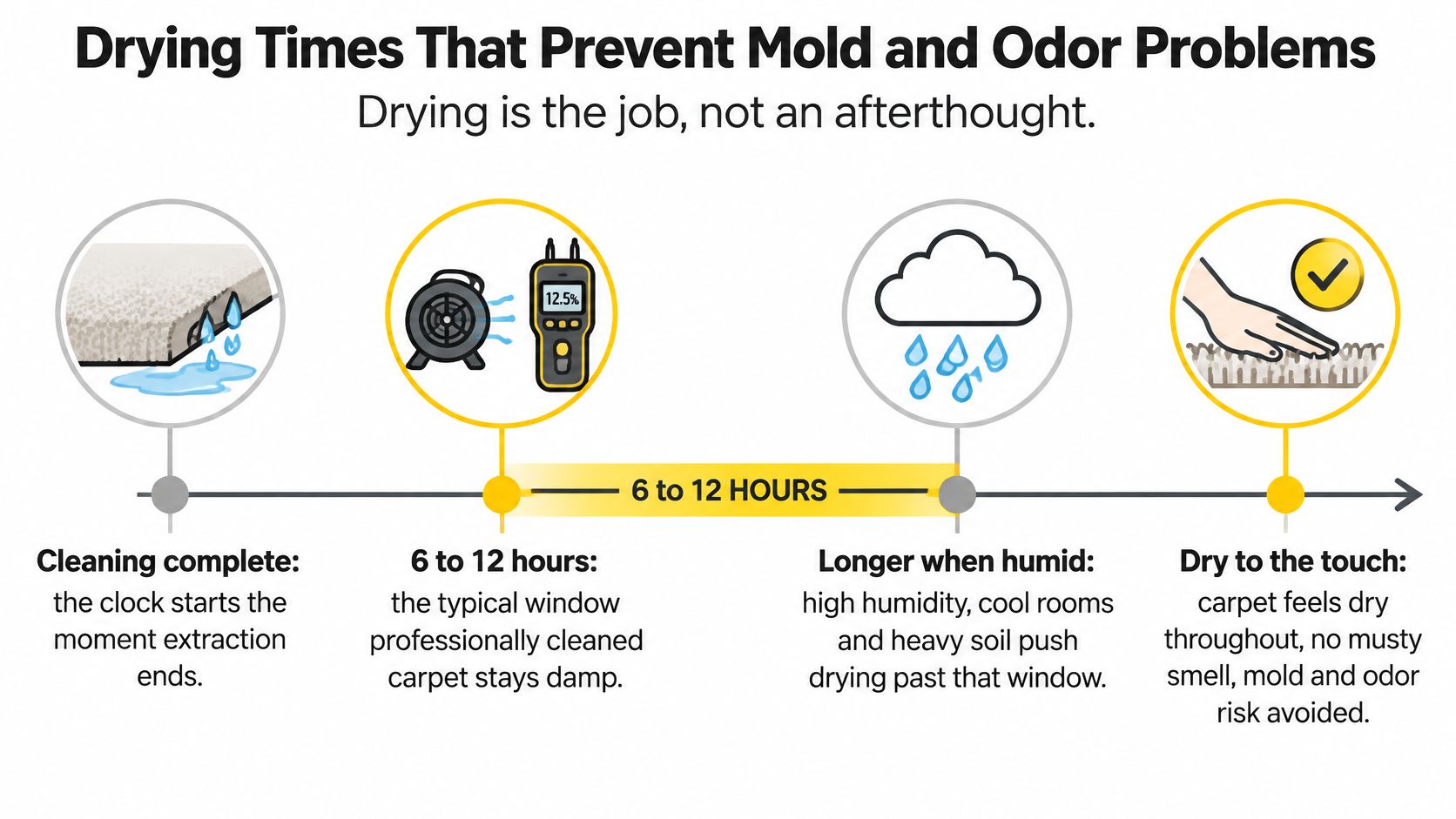
Treat six to 12 hours as the typical working range for a standard clean in a heated home, with the understanding that low temperature, still air, thick pile and a damp pad can push a job past it. If carpet or padding stays wet, remove what cannot be dried rather than letting it sit and wick odor back into the room.
| Situation | Expected drying | Action |
|---|---|---|
| Standard clean in a heated home | Six to 12 hours | Run airflow and keep doors open |
| Cold or unheated winter property | Past the usual window; heat and airflow set the finish | Heat the room before cleaning and add airflow |
| Pet odor treatment | Longer than a standard clean | Allow extra drying time and confirm dry before reoccupying |
| Damp materials with mold risk | Prompt drying, with removal if drying fails | Dry fully; moisture control is the main mold strategy |
| Water-damaged carpet | Outside a routine cleaning window | Stop extraction and refer to water-damage remediation |
A heated house with doors open and a fan moving air usually lands inside that range. A cold rental, a shaded north room, or a place where the heat has been turned down between guests does not behave the same way. Heavy soil means more solution and more passes. Thick pile hides moisture at the base, and the pad under it can stay cool long after the face yarns feel ready.
Winter is the hard season in Bozeman because outdoor air is cold, indoor heat can be uneven, and entry lanes arrive wet. Smoke season creates a different problem: when outdoor air is poor, the estimate has to account for timing and preparation, not just room count. A price built from three room names misses the part where drying, access, ventilation and soil load decide the result.
Do these before you worry about a fancy finish:
The hours after extraction are where a good job proves itself, and airflow plus a moisture check matter more than the shine on the fibers.
Routine cleaning and a flood are different jobs. If water has spread past the carpet, come up from below, or the floor is still wet after the drying window, stop extraction and refer it to water-damage remediation. A true saturation event calls for steps like the ones in this guide to how to dry flood-soaked carpet, not another pass with detergent.
If the carpet is still wet past the window, more detergent will not fix it. Dry it, or remove it.
Before the appointment, ask what drying equipment shows up, what the expected window is for your heat and pile, and what happens if the pad does not dry. Standards for inspection and drying belong in that conversation, and the checklist in this cleaning industry standards piece gives you the right questions to ask on the doorstep. I would postpone a winter clean in a cold house rather than promise a same-evening walk-on I cannot dry.
During an active smoke event, don't vacuum and don't book extraction. Both stir settled particles back into the air. Postpone carpet work until outdoor air improves. Timing is part of the answer, not a footnote under the price.
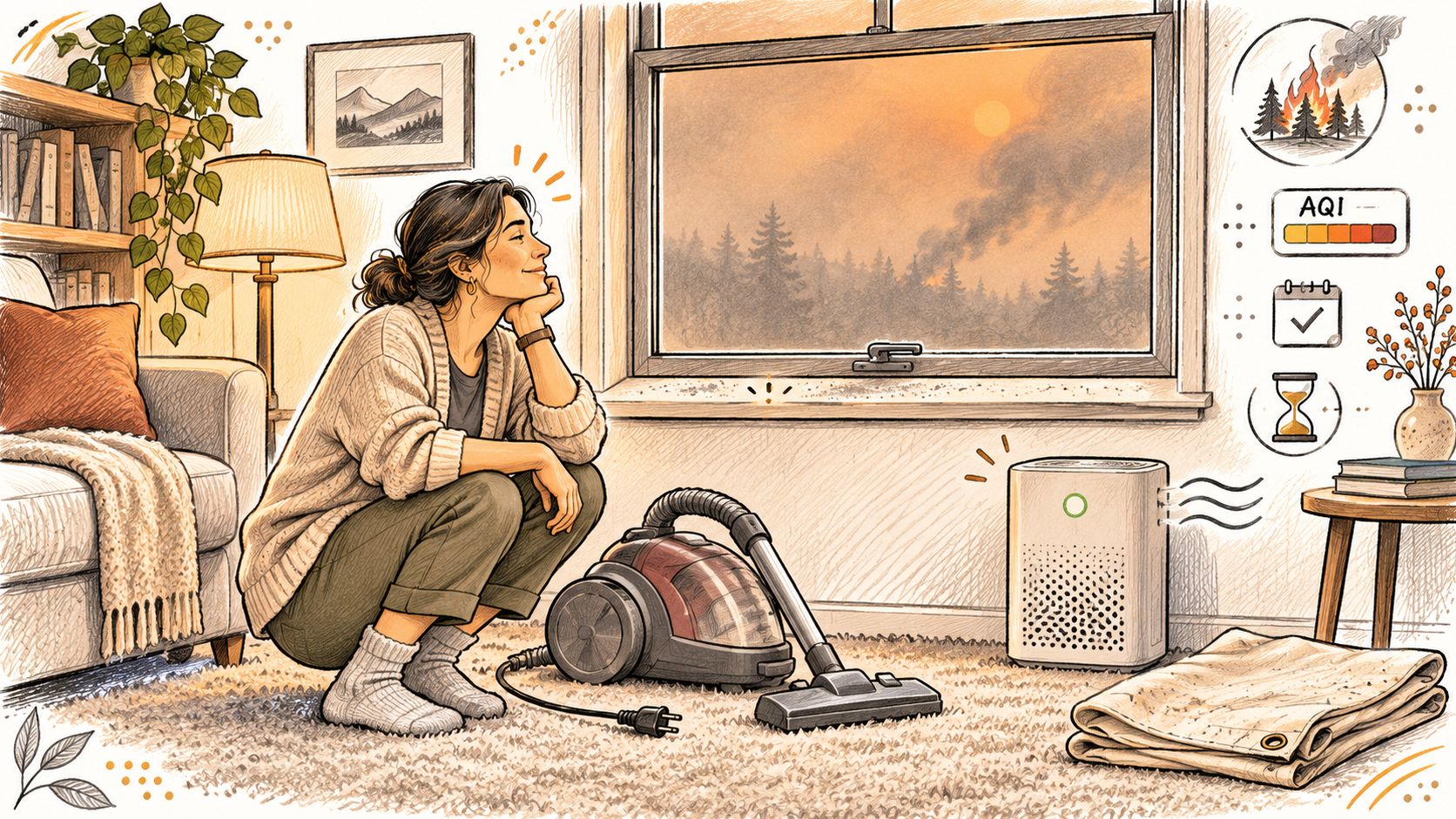
Montana DPHHS indoor air guidance says smoke can affect indoor air and recommends closing windows, using HEPA air cleaners, and upgrading central HVAC filters to MERV 13 or higher when the system allows it. Do that first. A wand doesn't clean the air that's still coming in.
Extraction can lift settled particulate from the pile. It does not replace filtration, source control, a look at the ducts, or cleaning of hard surfaces and upholstery. If the estimate treats smoke like a pet stain and only prices three rooms, it's incomplete.
Work the event in this order:
Deodorization and filter replacement can sit on the estimate as their own add-ons, with chemistry matched to residue rather than a perfume that covers it. A clear look at professional cleaning chemicals helps you see why a smoke residue and a food spill shouldn't share one bottle. If odor remains after the pile is clean and the air is filtered, the carpet wasn't the whole problem.
The decision in front of you is the estimate, not a vague "we can come Thursday." A complete intake is what lets a company apply the area price, the minimum, and each extra without guessing, and it's what sets the drying plan. An unheated house or a room that must be usable the same day changes the window before anyone mixes a solution.
Gather this before you request it:
Gallatin Valley Chem-Dry listed a 2026 small-house bundle at $380 covering four rooms and closets, one hallway, one flight of stairs, and one landing. That's a useful local comparison only if your layout matches the bundle. If you have pets, a wool stair runner, or a cold guest wing, a bundle total hides the lines that change the job. Compare estimates line by line. Check that each one shows the area price, the minimum, and every extra. The lowest total with missing lines is usually the one that grows on site.
Our instant price tool asks for service type, when the last clean was done, home size in square feet, beds, baths, pets, and add-ons. Online booking lets customers pick a service, enter home size, select bedrooms and bathrooms, and add options such as oven cleaning. Those inputs are the same ones that keep a carpet estimate honest. More on how to set that pricing up lives on Estimatty's blog, including a walkthrough for an online carpet cleaning estimate.
Write down the square footage, the stairs, the fiber, the pets, and whether the house will be warm. Request the estimate. Compare the lines before you book.
Estimatty gives residential cleaning companies instant estimates, online booking, and 24/7 voice sales on the website they already have, so a Bozeman carpet or house-cleaning inquiry doesn't sit in voicemail while the soil and the drying window change. The agent captures square footage, surfaces, pets, and add-ons, then sends a consistent estimate by SMS and email. Visit Estimatty to see how that intake turns into a booked job.