November 8, 2026
Cleaning Costs Per Hour in 2026: Rates and Pricing Tips
Learn cleaning costs per hour for 2026: US wage benchmarks, billable rate math, pricing models and ways to stop revenue leaks. Price jobs with confidence.

Saturday, November 7, 2026
Learn how to get an accurate carpet cleaning quote online: what details to share, what drives the price, and how to compare quotes before you book.

You've got guests coming on Friday, a dark traffic lane running from the front door to the kitchen, and a pet stain you keep pretending is a shadow. You're not calling three companies during work hours. You're searching on your phone tonight and you want a price before you book. That's normal now. In the Tinuiti February 2024 survey of more than 1,000 U.S. homeowners, 86% said they began searching for home-service companies online, while 58% preferred scheduling by phone. A good carpet cleaning quote online respects both habits. It gives you a fast, itemized estimate, then keeps a human within reach.
A estimate built only on room count is guessing. Two living rooms can differ by 100 square feet, one can be wool and one synthetic, and one can hide pet urine in the padding. Those differences change chemistry, dwell time, labor, and risk, so they belong in the form before anyone quotes you a number.
Start with cleanable carpeted area, not the size printed on a real estate listing. Measure each room's length times width, then add the rooms together. Subtract big built-ins if you want, but don't subtract a sofa you're asking the crew to move. Next, name the fiber and construction if you know it. Wool, Berber loop, plush cut pile, and tight commercial loop don't take the same solution strength or agitation.
Treat every carpet as identical and the estimate will be wrong in the most expensive direction, after the technician is already standing in your hallway.
Soil level drives the work sequence. Mark traffic as light, normal, or heavy, and say where the lanes are. Heavy lanes need thorough dry soil removal, pre-spray, agitation, and extra extraction passes. If you're deciding whether a room needs more than a standard clean, the deep cleaning methods for dirty carpets walkthrough helps you judge soil before you submit anything.
List stains by type, not just count. Coffee, red dye, rust, and pet urine need different spotters, and urine that's reached the pad may need subsurface treatment. Disclose pets and past accidents even if the spots look gone. Odor work is its own line item, and finding it on arrival is how prices jump.
The IICRC S100 standard calls for evaluating carpet characteristics and condition, selecting suitable chemistry and equipment, and conducting pre- and post-cleaning inspections. It also flags filtration soil, the dark lines along baseboards, under doors, and beneath floor-length draperies, which homeowners rarely mention unless asked. Check those edges before you start the form.
| Input | How to measure or describe it | Why it moves the price |
|---|---|---|
| Carpeted area | Length times width per room, summed | Drives the base charge |
| Carpet type | Wool, Berber, plush or commercial loop | Changes chemistry, dwell time and risk |
| Soil and traffic | Light, normal or heavy, with traffic lanes noted | Sets pre-vacuuming and extra passes |
| Stains and odors | Number and type of stains, including pet urine | Adds spot treatment and odor work |
| Pets | Number of pets and any past accidents | Can trigger odor treatment |
| Furniture | Which pieces stay in place during cleaning | Adds moving labor |
| Stairs | Number of steps or flights | Usually priced per step or per flight |
| Extras | Hallways, closets, rugs and upholstery counted separately | Each adds its own line item |
| Access | Stairs to entry, parking distance, occupied or empty home | Affects labor time and scheduling |
Gather that list on your phone before you open any form. Five minutes with a tape measure beats three rounds of follow-up questions, and it gives you identical inputs to reuse with every provider you compare.
Work through the form in the order the crew will work through your home. I would enter the pricing fields first and the contact details last, so you can abandon a vague form before it captures your phone number and gives you nothing back.
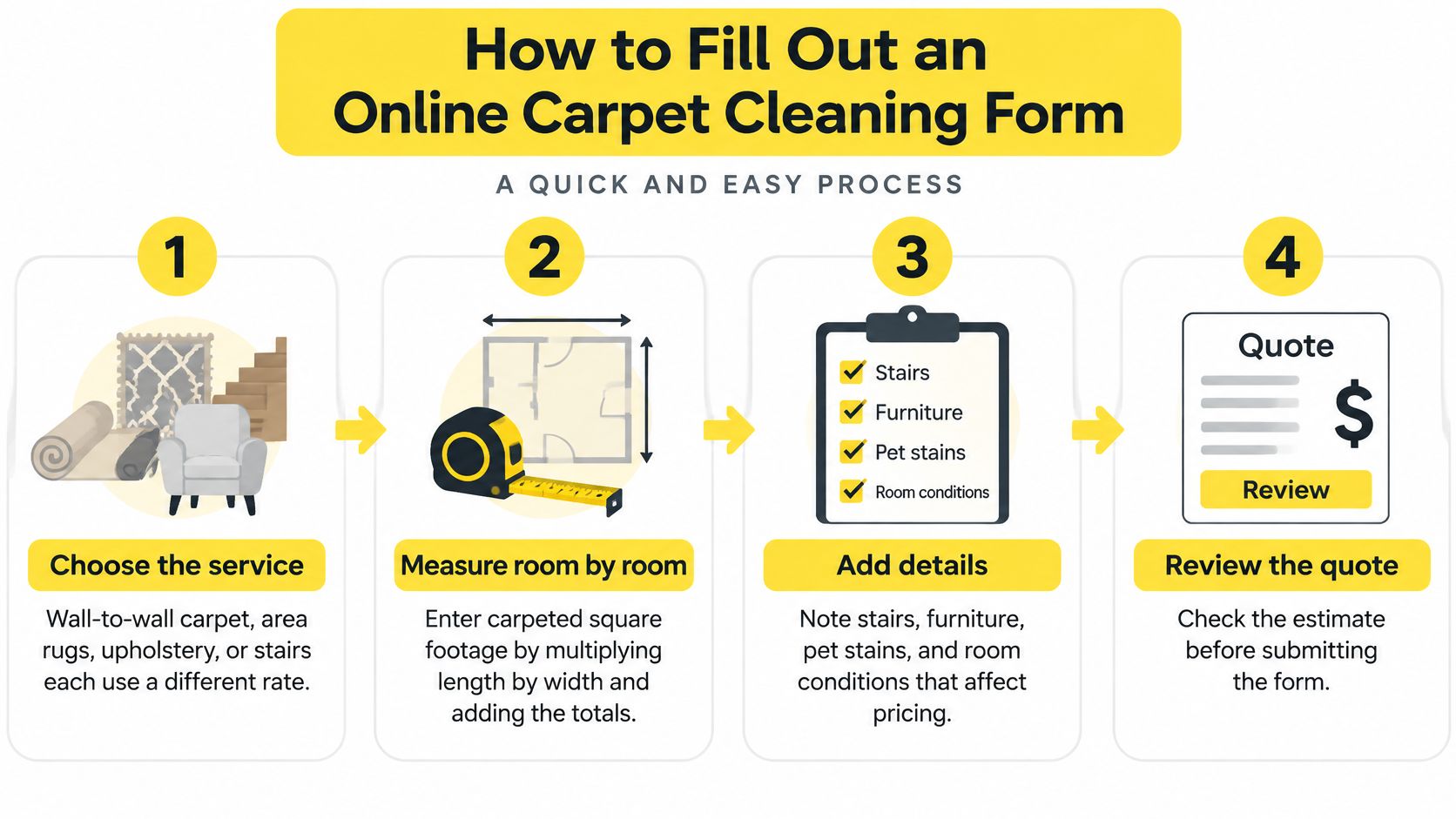
Our instant price tool asks for service type, when the last clean was done, home size in square feet, beds, baths, pets, and add-ons, then returns an instant estimate by SMS and email in under a minute. Online booking also lets you pick a service, enter home size, select bedrooms and bathrooms, and add options such as oven cleaning when you're bundling house cleaning with carpet work.
Some answers should stop the automation. Unknown or wool fiber, severe odor, heavy staining, water damage, or a very large area should trigger human review before anyone promises a firm total. If you're building or evaluating a form yourself, these estimate form templates show how the fields should be structured.
Same-day and after-hours requests change both availability and price. Treat the fast number as a starting estimate with stated assumptions, not a locked appointment, until the provider confirms the slot.
A 12-by-14-foot bedroom covers 168 square feet. At the cited hot-water extraction rate of $0.20 to $0.50 per square foot, the estimate comes to about $34 to $84 before extras. DoorstepHQ's carpet cleaning estimate guide also gives a typical per-room range of $25 to $75. Published 2024 benchmarking identifies $0.31 to $0.40 per square foot as a common residential and commercial range, according to Mark Studios' carpet cleaning research.
The math changes when a minimum charge applies. One published pricing model uses a 250-square-foot minimum service size. At typical rates, a 10-by-10-foot bedroom would calculate to roughly $20 to $50, but the minimum may replace that raw calculation because the crew still has travel, setup, and equipment costs. See Rapid Eye Inspections' carpet cleaning cost statistics.
| Pricing method | Typical range | Source or note |
|---|---|---|
| Per square foot, residential | $0.20 to $0.50 | Common trade benchmark |
| Most common band, residential and commercial | $0.31 to $0.40 per square foot | Published 2024 benchmark |
| Commercial per square foot | Below $0.10 to above $0.50 | 2024 benchmark; commercial rates differ from residential |
| Per room | $40 to $125 | Consumer cost data |
| Per room, hot-water extraction | $25 to $75 | Trade guidance; varies by market |
| Area rugs | $2 to $8 per square foot | Material affects the rate |
| Minimum billable area | 250 square feet | One published pricing model |
| Average full professional visit | $183; typically $123 to $242 | HomeAdvisor, 2025 |
Consumer cost data puts the average professional visit at about $183, with most homeowners paying $123 to $242. It also reports per-room pricing of $40 to $125 and area-rug cleaning at $2 to $8 per square foot (ServiceTitan's carpet cleaning industry statistics). Rugs cost more per square foot because they are handled individually. Upholstery is priced separately too, so compare upholstery cleaning methods before adding a sofa to a carpet estimate.
For 1,000 square feet, the common $0.31 to $0.40 band works out to about $310 to $400, before stairs, furniture, stains, tax, or travel. Commercial work uses separate pricing bands: the 2024 Cleanfax benchmarking survey reports rates from below $0.10 to above $0.50 per square foot. Compare the scope and pricing units on a sample cleaning service price list before treating two totals as equivalent.
Sanity check: A total far below these ranges may reflect a narrower scope or a minimum charge that has not been included.
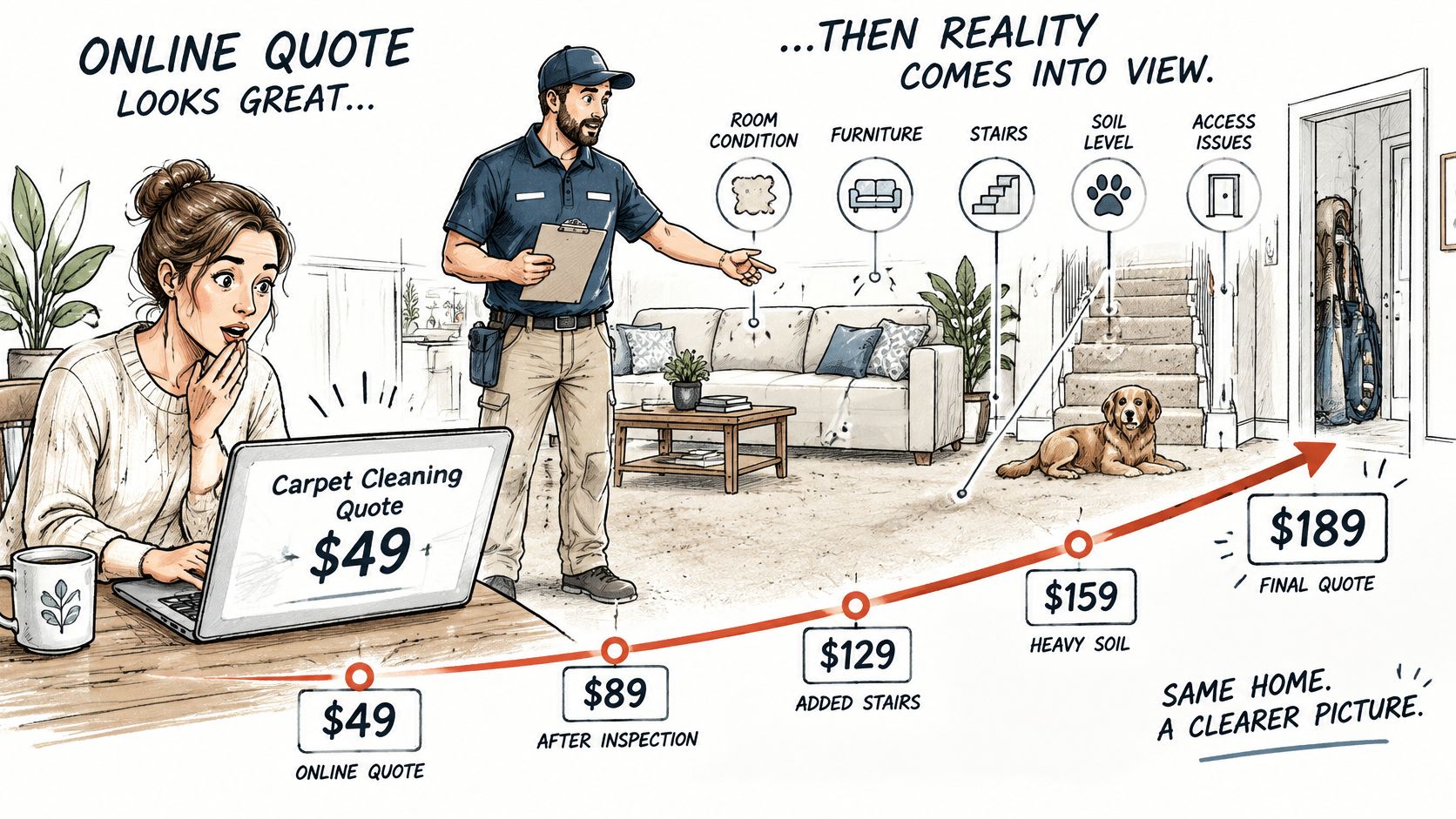
The cheapest headline number is often the least honest one. It climbs on arrival because the form priced a generic room, and the technician finds the actual room, with filtration lines at the baseboards, a urine spot in the pad, and a sectional nobody mentioned.
If the gap between the online number and the doorstep number is where trust dies, this short video is worth watching before you book anyone.
Maximum certainty isn't the goal. A firm, low price for a carpet nobody has seen is artificial precision, and artificial precision produces either a rushed job or an awkward renegotiation in your entryway. I'd take a stated range with named assumptions over an exact number with none.
A trustworthy estimate shows its range, lists what's assumed, and keeps every optional add-on on a separate line. It also names the conditions that force a visual inspection, such as wool or unknown fiber, severe odor, extensive staining, water damage, or an unusually large area. That inspection threshold protects you as much as the provider, since nobody should promise stain removal on a fiber they haven't identified.
When the technician's findings expand the job beyond what you submitted, that's a scope question, and how a company handles it matters. This breakdown of how to handle scope creep shows what a fair revision process looks like from the business side.
Ask three questions before you accept any estimate:
Price transparency needs proof behind it. BrightLocal's 2025 survey examined 1,026 U.S. adults and found that consumers use reviews to shortlist and verify local businesses, according to BrightLocal's local consumer review survey. Look for recent reviews that mention final-price accuracy and how surprises were handled, not just friendliness.
The moment a customer realizes the doorstep price isn't the screen price is the moment this image captures.
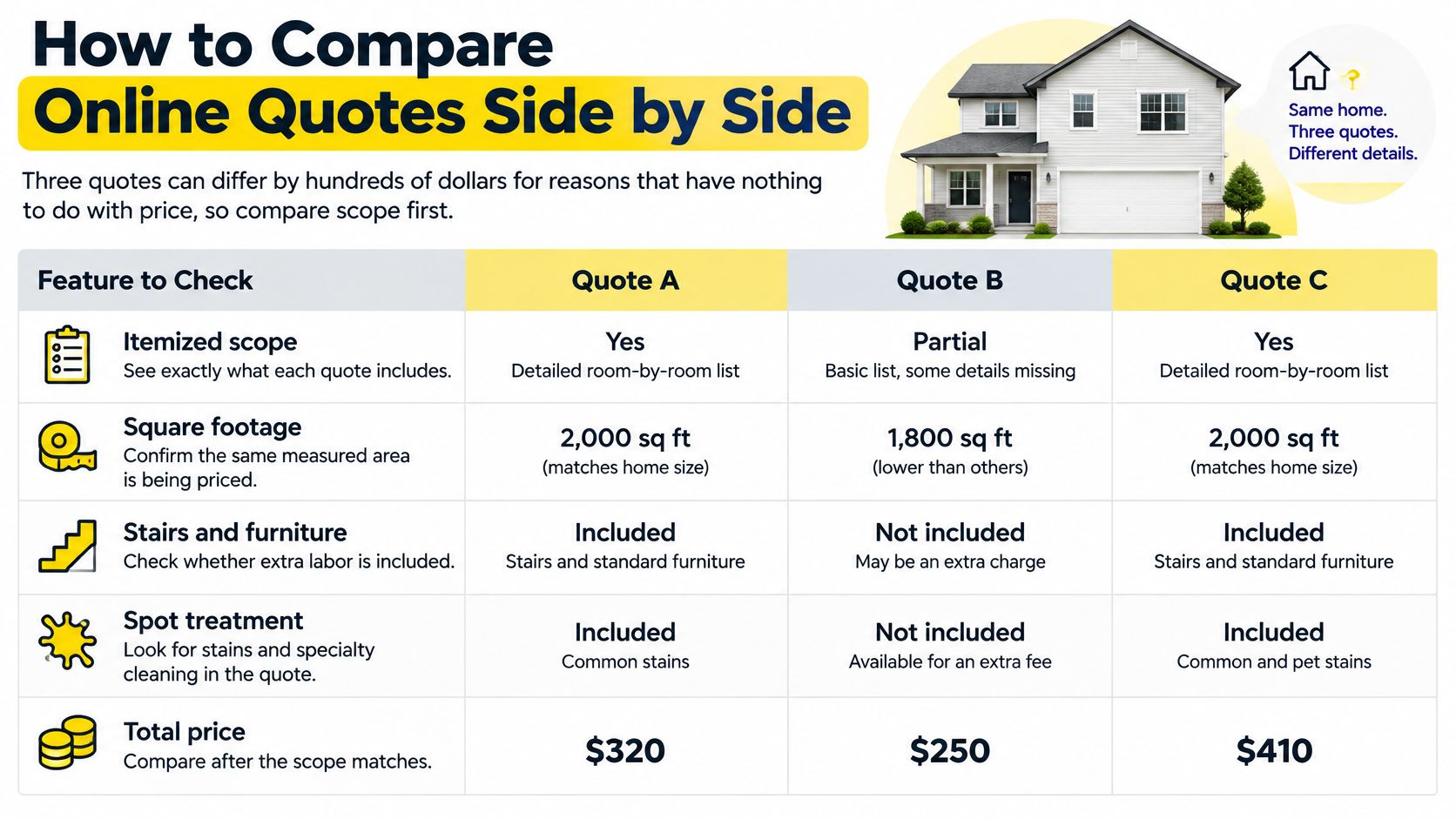
Three estimates for the same home can differ by hundreds of dollars for reasons that have nothing to do with the hourly rate. One includes stairs and protector. One excludes stain treatment. One priced 600 square feet because you typed room count instead of measurements. Compare scope first, then compare totals.
| Criterion | Strong sign | Red flag |
|---|---|---|
| Itemized scope | Each line shows area, extras and rates | One flat total with no breakdown |
| Inclusions and exclusions | Written list, including tax and travel | Silent on fees or stains |
| Inspection threshold | Names the conditions that trigger a visit | Promises the price regardless of condition |
| Review evidence | Recent reviews mention final-price accuracy | Few reviews, or none that mention pricing |
| Response time | Clear reply window by text or email | No stated timeline |
| Licensing and insurance | Easy to find on the site | Not mentioned or hard to verify |
| Re-clean or cancellation policy | Written and specific | Vague or missing |
A fast reply matters when you're comparing providers at 10 p.m. before a move-out deadline. We give residential cleaning business websites instant estimates, online booking, and 24/7 voice sales, which removes the voicemail tag that kills most comparisons. But speed from a business with no visible proof is a weak signal on its own.
BrightLocal's 2025 review research reports that 89% of consumers expect businesses to respond to both positive and negative reviews, while 74% check at least two review sites before making a purchase decision, according to BrightLocal's State of Reviews 2025. Follow that pattern. Check two sites, read how the owner answers a complaint about price, and weight reviews that mention whether the final bill matched the estimate.
Verify the rest before you book:
If you want the cost side in more depth before you decide, this cleaning service cost guide breaks down what drives residential pricing beyond carpet. Pick the estimate with the clearest scope and the strongest proof behind it. The lowest number only wins when everything else matches.
Submit the same measured details to at least two providers so both estimates cover the same job: square footage, stairs, and stain notes. If the scopes differ, the lower total is not a useful comparison.
For context, HomeAdvisor reports an average professional carpet-cleaning cost of $183, with a typical range of $123 to $242, in its carpet cleaning cost guide. A whole-home quote far below that range may cover less work or exclude a minimum charge. Ask the provider to explain the difference in writing.
An online estimate can price the details you provide, but it cannot see carpet condition, hidden stains, or access constraints. A clear quote states its assumptions and names the conditions that could change the price. Estimatty works with a cleaning business's existing website to provide instant estimates and online booking; customers enter job details online, and the owner visits for high-value jobs or after a booking.
For more pricing walkthroughs, visit the Estimatty blog. Book with the provider whose written scope, price-change terms, and policies you can understand before anyone arrives.