September 21, 2026
Inside and Out Cleaning: A Practical Pricing Guide
Learn what inside and out cleaning really includes, how pricing works, and which add-ons actually pay off for residential and commercial estimates.

Thursday, September 10, 2026
Master terms and conditions for quotes in your cleaning business. Learn to draft clear estimates, set validity periods, and automate acceptance with AI tools.
A customer visits your website after business hours, answers a few questions in an AI chat, and receives an instant cleaning estimate by SMS. They reply, “I accept,” and you schedule the job. Later, they insist the price included inside cabinets, heavily soiled walls, and an additional room. Your team sees a simple service request. The customer sees a fixed promise. Without clear terms and conditions for quotes, you may be left absorbing the difference.
Cleaning businesses need speed, but speed without defined acceptance, scope, expiry, and cancellation rules creates avoidable exposure. The practical answer isn't to bury prospects in legal language. It's to make every estimate clear enough that a customer knows what they're accepting and your team knows what it must deliver.
Most cleaning owners think the important part of an estimate is the price. In practice, the wording around that price can determine whether it functions as a binding offer or only an approximation. Consumer guidance in New Zealand explains that a quote generally becomes legally binding once accepted, and the provider can't charge more unless the customer agrees to extra work or the scope changes. The same guidance distinguishes a quote from an estimate, which doesn't fix the final price. New Zealand consumer guidance on quotes and estimates makes that distinction directly.
That difference matters when an instant estimate is sent through a website, SMS, or email. If the document presents a firm service, a defined price, and a clear acceptance button, a customer may reasonably treat it as an offer. Calling the document an “estimate” won't automatically protect you if the actual wording behaves like a fixed-price quote.

A vague estimate creates several familiar disputes:
Independent pricing guidance for trades notes that underpricing by 20% to 40% can happen when owners miss overhead, labor time, or materials. That range is cited in pricing guidance on estimate disclaimers and terms. The lesson for cleaning operators is simple: a fixed price should follow a documented calculation, not a hopeful guess.
Quotation accuracy deserves the same attention. A 2025 systematic review found that 16.9% of quotations were incorrect, including 8.0% major errors and 7.8% minor errors, according to the review of quotation errors. Although that research examined quotations in a technical literature context, the operational principle transfers well. Any customer-facing price should be checked against the source details, scope assumptions, quantities, and conditions before it goes out.
Practical rule: If a customer could reasonably ask, “Was that included?”, the estimate needs a written answer before acceptance.
A useful distinction between a proposal and a quote can also prevent confusion about intent. The comparison of proposals and quotes helps frame whether your document is selling a possible approach or offering a defined service at a stated price. For an automated cleaning workflow, that distinction must be reflected in the language, not just the document title.
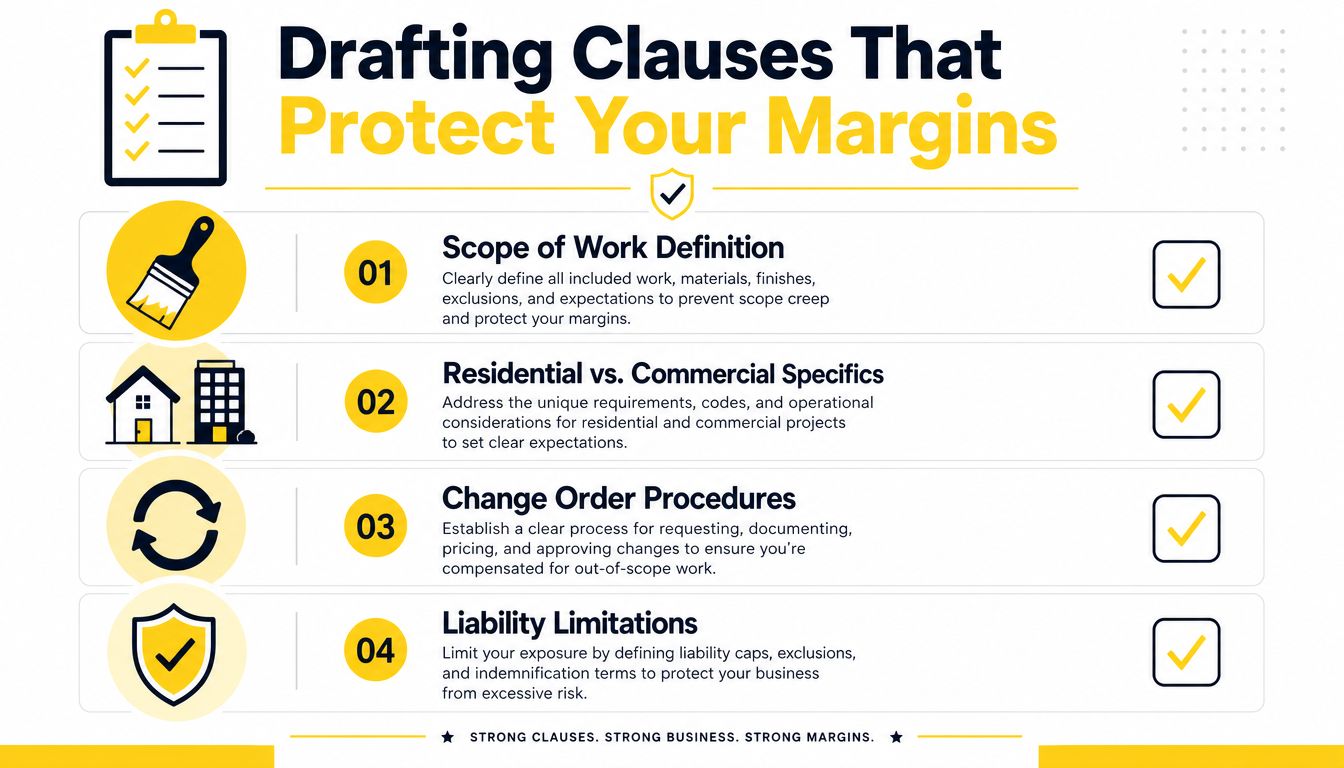
Good terms aren't designed to intimidate customers. They remove uncertainty before the first cleaner arrives. The strongest clauses are short, specific, and connected to facts your intake process can capture.
Define the property, service type, included areas, frequency, and relevant conditions. “Residential deep cleaning” is too broad on its own. A stronger description identifies the rooms or areas included, the accessible surfaces covered, and the tasks excluded unless separately approved.
Use plain language such as:
The point isn't to list every imaginable task. It's to identify the assumptions that affect labor time and safety.
Residential work often depends on access, occupancy, pets, parking, and the condition of individual rooms. Commercial cleaning requires different details, such as operating hours, floor types, restrooms, shared spaces, security procedures, and approved access points. A single generic clause usually leaves too much room for interpretation.
For a commercial account, specify the premises, service frequency, consumables, waste-handling expectations, and who can authorize changes. For a residence, identify whether the customer must provide access, whether the property will be occupied, and how concealed or inaccessible areas are treated.
A broader legal reference can help owners compare wording approaches. Kons Law's resource on terms for business law clients is useful when reviewing general commercial terms, but cleaning operators should still adapt clauses to their services and local requirements.
A variation clause should explain what happens when the actual job differs from the accepted scope. It should state that the team will pause affected work, describe the additional service, provide the revised price or time basis, and obtain customer approval before proceeding where practical.
Don't rely on “extra charges may apply.” That phrase tells the customer almost nothing. A customer should know how approval happens, whether SMS or email confirmation is sufficient, and what occurs if they decline the added work.
Finally, connect the clauses to your operating document. A detailed guide to cleaning services contracts can help you align the estimate with the service agreement used after booking.
An estimate without an expiry rule can become an unwanted promise. Labor availability, product costs, access requirements, and service capacity can change while a prospect delays. If the original document doesn't say when the offer ends, your team may face an awkward choice between honoring outdated pricing and explaining why the price changed.
A common market standard is 30 days, reflected in a sample clause stating that a quote remains valid for thirty days unless extended. The client acceptance clause example also emphasizes acceptance methods, payment terms, milestones, and separate approval for scope changes. You can choose another period, but it should be visible, consistent, and tied to your actual pricing assumptions.
| Method | Operational strength | Main weakness |
|---|---|---|
| SMS reply | Fast and familiar for customers | The reply may not identify which version of the estimate was accepted |
| Email confirmation | Creates a searchable written record | Customers may reply without acknowledging attached terms |
| Electronic signature | Clearly connects the customer to a document | Adds friction if the process is too long |
| Click-to-accept | Works well inside a web workflow | Requires clear presentation of the terms and reliable records |
An expiry date should appear beside the price, not hidden in a footer. Use language that explains the consequence without sounding aggressive: “This estimate is valid until [date]. After that date, pricing and availability may need to be reconfirmed.”
Public-sector procurement documents show why the mechanics matter. One example used a 120-day quotation validity period and formed the resulting contract through a purchase order or letter of acceptance under general conditions. The public procurement quotation example demonstrates that validity, acceptance channel, and incorporated terms should be stated together.
Local rules can also affect the structure. In Ohio, consumers generally have the right to a verbal or written estimate for repairs or services expected to cost more than $25, and authorization is generally required before work exceeds the estimate by more than 10 percent. A written quotation can instead be binding for five days, as summarized in Ohio estimate and quotation guidance. Those rules concern Ohio services, not every cleaning business, so check the law that applies where you operate.
For digital workflows, your estimate form should make the expiry date, acceptance action, and linked terms impossible to miss. Cleaning estimate form templates can help you structure the information before automating delivery.
A digital acceptance is only useful if you can later show what the customer accepted, when they accepted it, and which terms were attached. That standard applies whether the customer signs a document, replies to an SMS, clicks a web button, or interacts with an AI chat widget.
Traditional signatures remain easy to explain. The customer signs a dated document that identifies the property, services, price, expiry, and conditions. The trade-off is friction. A prospect who wants a quick booking may abandon a process that requires downloading, printing, scanning, or navigating multiple screens.
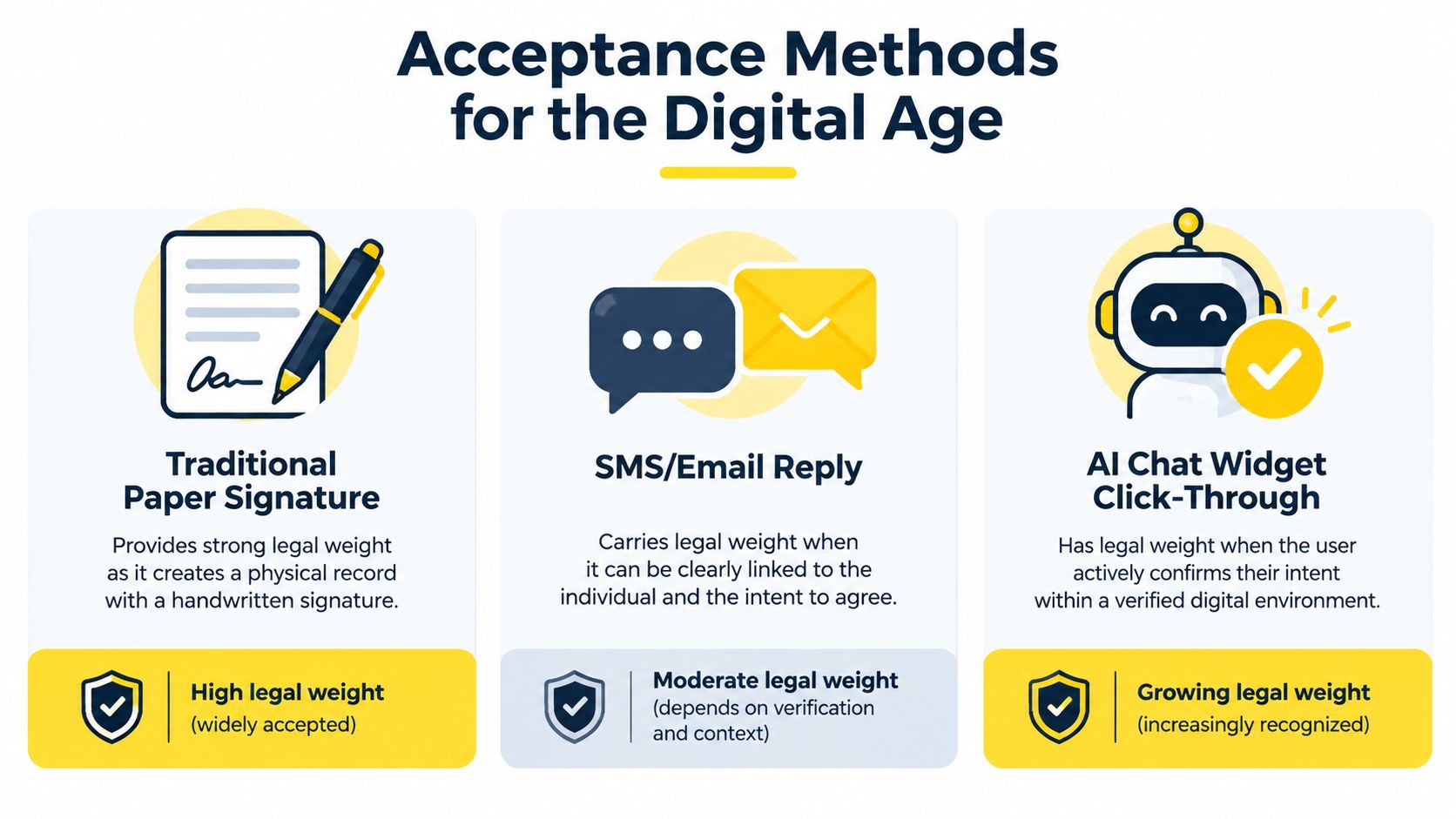
SMS and email can work well when the message identifies the estimate clearly and captures an unambiguous response. A useful SMS might include the service summary, total price, expiry date, a link to the full terms, and a prompt such as “Reply ACCEPT to approve this estimate and the linked terms.” Keep the full record, including the estimate version and timestamp.
Email needs similar discipline. Don't assume that attaching a PDF proves the customer read every condition. Place the key acceptance language in the email body, link to the complete terms, and ask the customer to confirm the exact service and property details.
Click-to-accept can reduce friction further, especially when the customer sees a checkbox next to language confirming agreement to the estimate and terms. The system should record the customer identity or contact details, the accepted version, the time, and the relevant property information.
AI can collect square footage, surfaces, urgency, access details, and requested add-ons quickly. It can't rescue inconsistent business rules. If one receptionist waives a cancellation condition, another adds a room without repricing, and the AI uses a third version of the terms, your speed creates more disputes instead of fewer.
The strongest workflow uses pre-approved clauses and controlled fields:
Owners moving from site visits to digital sales can use this guide to transitioning from in-home estimates to online estimates to plan the customer experience without removing human review where a property falls outside standard assumptions.
Legal certainty still depends on jurisdiction and wording. Guidance on when a quotation becomes legally binding notes that essential terms and clear acceptance are important, and recommends covering validity, payment, variations, liability, and cancellation. Treat that as a drafting prompt, not a substitute for advice about your own location.
Your team's time is inventory. Once a cleaner is assigned to a property, that capacity can't always be sold to someone else at short notice. A no-show or late cancellation therefore affects payroll planning, routing, and the opportunity to accept another booking.
A cancellation policy should be visible before the customer commits. It should state when notice is required, whether a deposit or card authorization applies, what happens after a late cancellation, and whether an emergency exception is available. The policy must also explain how the customer cancels, such as by replying to the booking message or contacting a specified number.
A fair policy protects both sides. It shouldn't punish a customer for an unavoidable emergency without a defined review process, but it also shouldn't leave your business negotiating from scratch every time someone cancels.
Use separate treatment for:
A customer who sees the policy before booking can make an informed decision. That transparency also gives your staff a professional response when someone says, “I didn't know there was a cancellation condition.” The team can point to the accepted estimate rather than improvise a new answer.
Local obligations may require specific disclosures. For example, Minnesota law requires a repair shop to provide a written estimate before repairs begin when a customer requests one, as described in consumer guidance on repair estimates. Cleaning services aren't automatically governed by the same rule, but the broader point is useful. Document the price and terms before work starts, and check the rules that apply to your service category.
Your cancellation of service guidance can help turn these decisions into a consistent customer-facing policy rather than a series of one-off conversations.
An instant estimate only helps if its terms survive the sale. Before automating, build and review a terms library, then define the facts the system must collect before issuing a price. Map the service scope, property type, access conditions, add-ons, expiry, acceptance method, payment expectations, variation process, and cancellation rules.
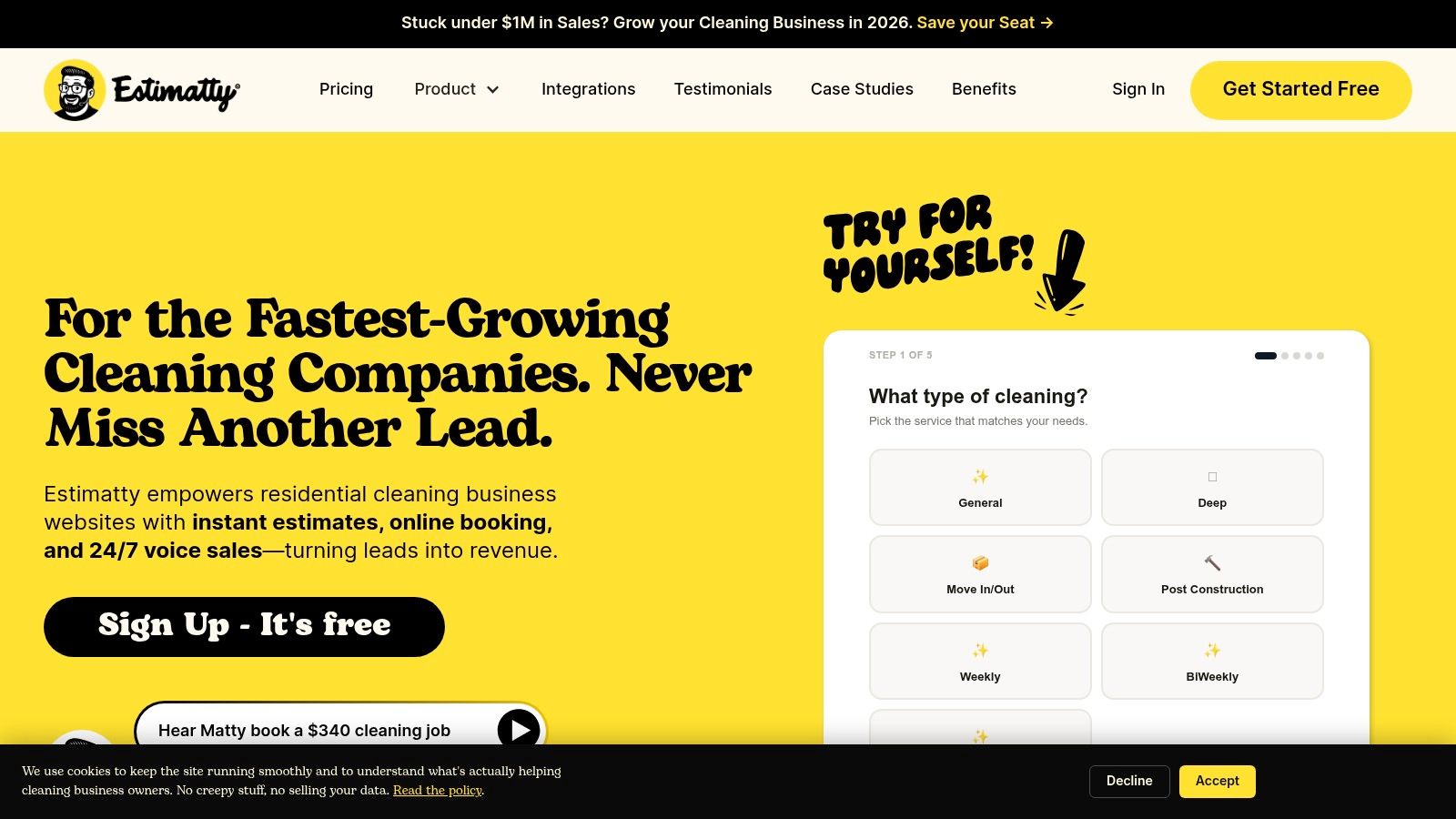
Estimatty is an AI-powered web and voice sales estimator built for residential and commercial cleaning businesses. It engages prospects through a website or phone call, collects details such as square footage, surfaces, and urgency, then sends estimates by SMS and email. Configure the workflow so the customer sees the applicable conditions and gives the required consent before receiving or accepting the estimate. Product information is available on Estimatty's website.
Run ordinary and difficult test cases before releasing the workflow. Check what happens when a prospect omits a bathroom, requests an add-on after acceptance, or accepts after expiry. Confirm that the customer message and internal alert state the same terms across the website, SMS, and email.
Teams that hire through tools such as pipehirehrm.com should carry these standards into onboarding. Cleaners and coordinators need to know what the estimate includes, who may approve variations, and when to stop and contact the office. Consistent wording protects margins only when the field team applies it at the property.
A short walkthrough can show owners how an automated sales conversation fits daily operations.
Have qualified local counsel review the terms, particularly when jobs span jurisdictions or involve recurring agreements. Automation distributes approved wording consistently, but it cannot determine whether a clause complies with the law where the work occurs.
Estimatty helps cleaning businesses collect job details, generate consistent estimates, and send relevant terms through web, voice, SMS, and email workflows. Visit Estimatty to see how you can standardize acceptance and protect your margins without making prospects wait for a response.