November 4, 2026
Booking Conversion Rate: How Cleaning Firms Can Raise It
Learn how to calculate booking conversion rate for cleaning businesses, compare it with real benchmarks, and fix the drop-off points that cost you jobs.

Thursday, November 5, 2026
Learn how an AI voice sales agent answers calls, qualifies leads and sends estimates 24/7, with ROI math, use cases and setup steps for cleaners.

It's 9 p.m., your crews are home, and a homeowner who needs a move-out clean on Friday calls your number and gets voicemail. She doesn't leave a message. She calls the next cleaner on Google, gets an estimate on that call, and books by morning. That's the leak an AI voice sales agent is built to close, not by sounding impressive, but by answering, asking the right questions, and pricing from rules you control.
An AI voice sales agent answers phone and web inquiries in a natural voice, asks structured questions, applies your pricing rules, and either books the job or hands the caller to a person. It works like a receptionist who never clocks out, except it prices only from rules you wrote. If the home fits your matrix, it estimates. If it does not, it escalates. That last rule matters more than voice quality. A pleasant agent that invents a number creates a pricing problem you have to fix on the invoice.
Callers still prefer talking through a job. In a 2025 Forethought survey of 2,243 U.S. adults, 65% said voice was the fastest way to resolve a customer-service issue. For a cleaning company, that means a prospect who will not fill out a long form will often describe bedrooms, bathrooms, and timing out loud if someone picks up. The agent's job is to turn that spoken detail into the same intake fields your office uses, not to improvise a friendly range.
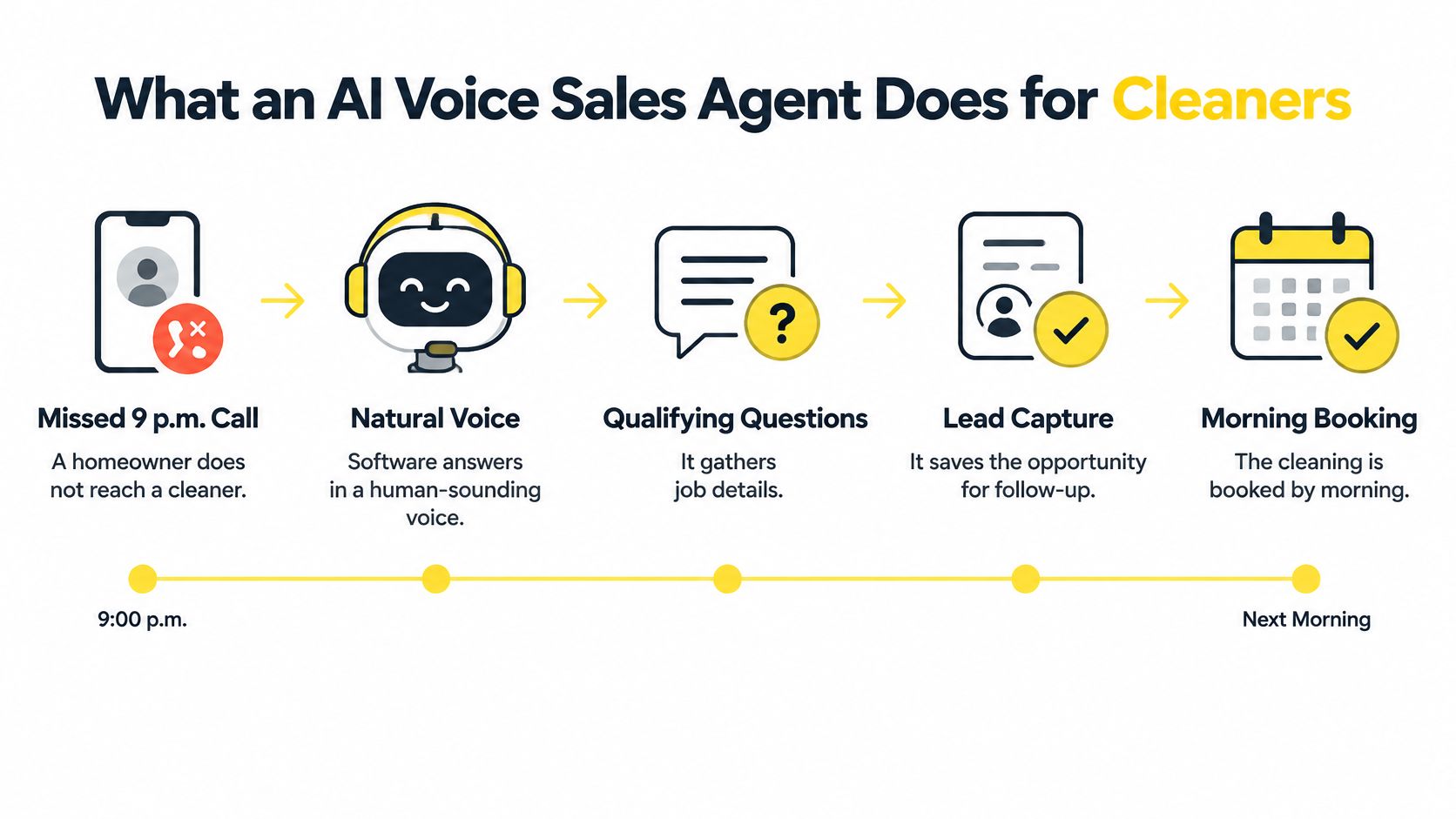
The useful shift is standardization before the call happens. Voice quality gets attention, but the pricing rules do the work. A voice agent captures structured intake on first contact: square footage, surfaces, urgency, frequency, add-ons, and preferred date. Those fields feed the pricing matrix your office already trusts. A caller who gives two bedrooms, two baths, and a Friday request gets the same base rate whether she calls at 10 a.m. or 10 p.m. The agent can send that estimate by SMS or email while intent is high, then ping the owner with the lead details. Estimatty's Matty agent follows this pattern: it answers questions, captures key details, sends instant estimates, and notifies the team in real time.
Revenue leaks in three familiar places. Calls hit voicemail after hours. Office staff give a vague range because they are missing square footage or condition. Follow-up happens the next day, after the prospect has booked elsewhere. A voice agent attacks all three by collecting the intake fields on the first contact and delivering the estimate before the caller shops around.
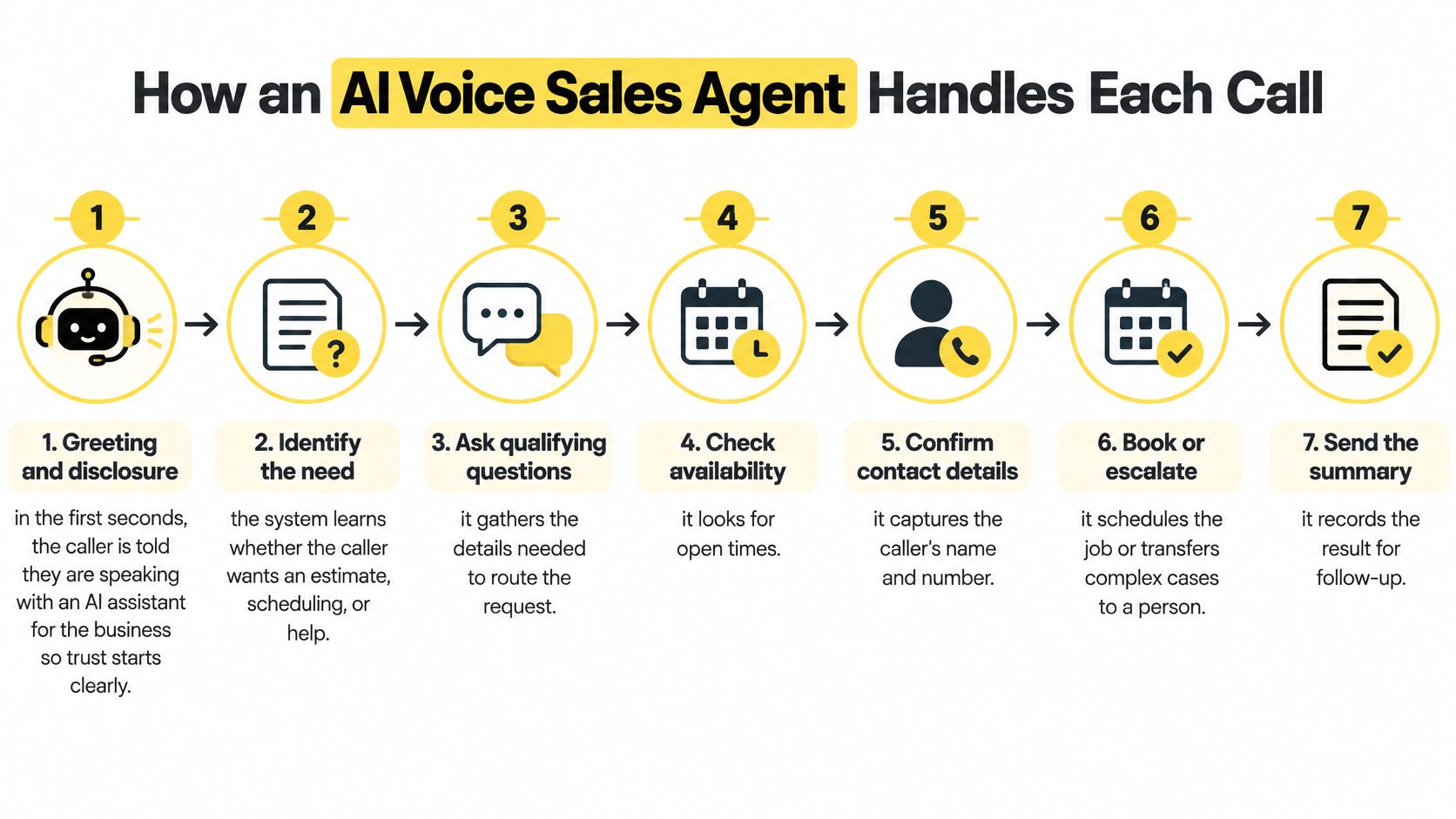
Handoff rules need to be written before launch. When the caller asks for a person, the agent should transfer the call. When the job is outside your service area or too complex for the matrix, the agent should collect the details and route the lead to your office. The agent handles the first pass. Your team still owns exceptions, custom quotes, and the close.
Owners who want the estimating logic behind the voice layer can review how AI estimates software for cleaning companies standardizes pricing before a call ever happens. If expansion runs through franchising, the same qualification discipline matters there too. The rules that keep cleaning estimates consistent can help you book more meetings with franchise candidates. The voice is the interface. The pricing matrix and handoff rules are the system.
Judge any agent on a single test call. You should hear a clear disclosure, watch every required field get captured, receive an estimate only when the intake is complete, and get a clean handoff the moment you ask for a person. Anything less is a demo, not a system.
Practical rule: If a mandatory field is missing or contradictory, the agent should collect a callback instead of estimating. A delayed accurate estimate beats an instant wrong one.
Dead air kills phone conversations. The agent has to coordinate speech recognition, language-model inference, pricing or CRM lookups, and text-to-speech before the caller hears a reply. A production latency study published by Springer found that concurrent intent detection and speech synthesis reduced median response latency by 41.8%, from 3,277 ms to 1,909 ms, across 30 benchmark sessions, with a reported 95% confidence interval for the reduction of 1,185–1,573 ms.
The practical takeaway is architecture, not trivia. Start processing partial transcripts while the caller is still speaking. Retrieve pricing rules during the answer, not after it. Stream the first audio instead of waiting for the full response. Monitor full-path P50 and P95 latency, not just model speed, and treat multi-second pauses as a conversion risk you'll see in abandonment. Owners comparing phone-based estimating flows can see how this fits a phone estimate workflow for cleaning leads before testing vendors.
The strongest evidence for a hybrid model comes from outside cleaning. A 2023 natural field experiment in Production and Operations Management at a large telecommunications company found that voice AI initially increased time in automated service and temporarily increased requests for human assistance, but persistently reduced customer complaints over time, with the clearest gains on relatively simple service requests. Speech-recognition failures increased both requests for human service and complaints.
Read that as an operating instruction. Automate routine, well-defined interactions. Keep an easy human path for complex requests, unusual properties, and callers the system struggles to understand. Accuracy isn't polish. It's the difference between fewer complaints and more of them.
| Call type | Agent collects | Hand off to a person when |
|---|---|---|
| Recurring home clean | Bedrooms, bathrooms, frequency, preferred day | Caller wants a fixed weekly rate outside your matrix |
| One-time deep clean | Square footage, surfaces, condition, urgency | Heavy build-up or a mess beyond standard scope |
| Move-out clean | Property type, rooms, deadline, key handover | Landlord or agent contract terms are involved |
| Commercial office clean | Square footage, floors, restrooms, hours | Multi-site contract or formal bid request |
| Post-construction clean | Project stage, debris, dust level, site access | A site visit is required before any estimate |
| Complaint or reschedule | Booking reference and reason | Any complaint about past service |
| Caller asks for a person | Name and callback number | Immediately, on request |
Review the right-hand column first. Those triggers decide whether the agent protects revenue or frustrates customers. A recurring clean inside your matrix is safe to estimate at midnight. A post-construction job with unknown debris is not, because no phone intake replaces a site visit.
Three owner benefits fall out of this mapping. You get 24/7 engagement for after-hours inquiries instead of a voicemail box. You get consistent estimates because the same rules apply on every call, regardless of who's on shift. You get fewer callbacks because square footage, surfaces, frequency, and urgency are captured before hang-up, not chased the next day.
Adoption context supports testing rather than waiting. In 2025, 59% of surveyed organizations were in the late stages of deploying conversational AI for sales, according to PPC Land's reporting on Twilio's survey of 457 business leaders across 15 countries. Your competitors aren't standing still, but deployment stage doesn't tell you which calls to automate. Your own handoff table does. Tighten it using clear lead qualification criteria for cleaning inquiries so the agent and your team apply the same standard.
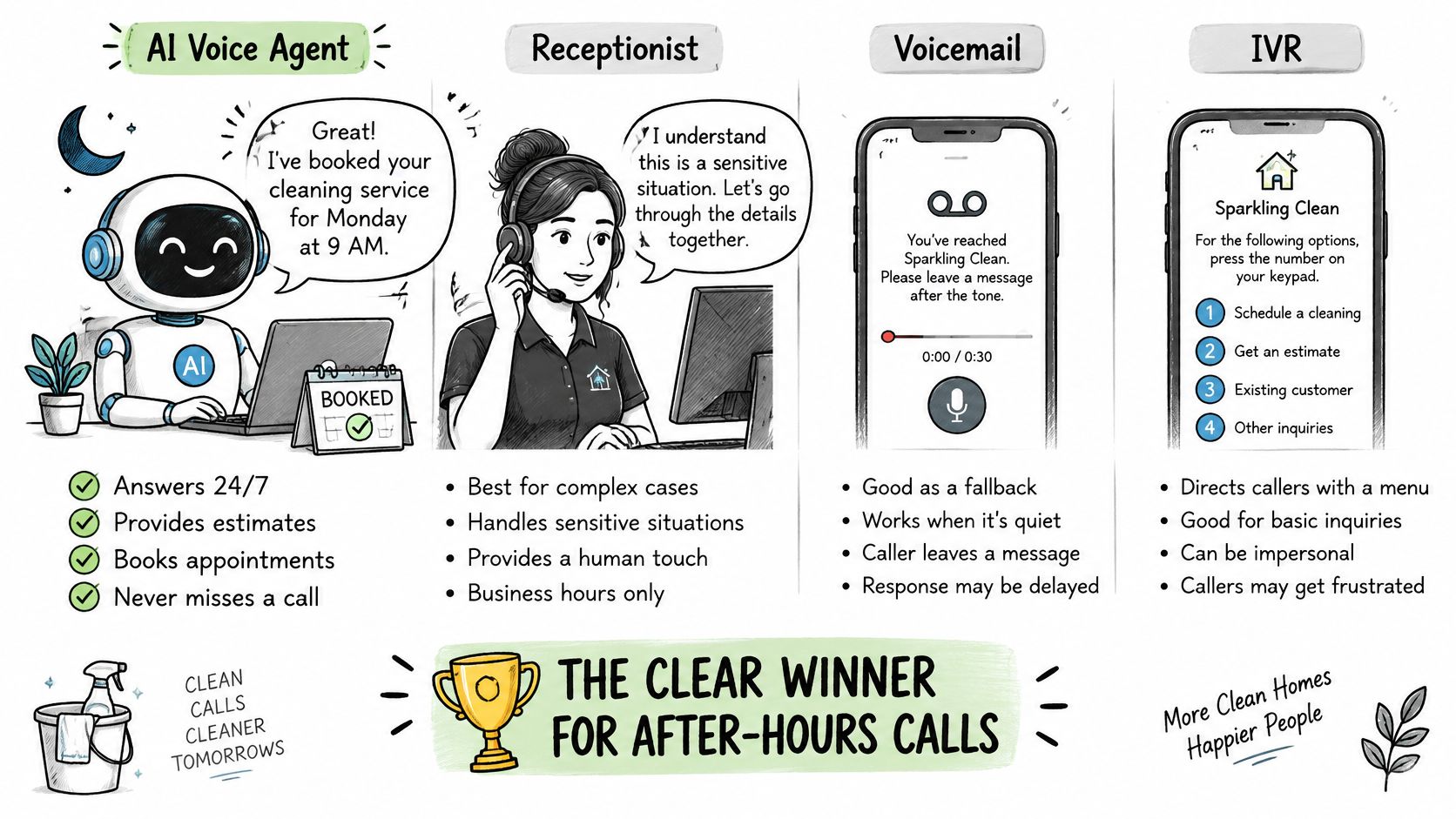
The verdict first. Use the AI agent for inbound estimates and scheduling. Keep a person for complex or sensitive cases. Treat voicemail as a fallback, not a channel. Each option fails differently, and you should pick based on which failure you can afford.
The comparison below shows how the four options differ on coverage, pricing consistency, and leftover work.
| Option | After-hours answers | Consistent estimates | Callback load |
|---|---|---|---|
| AI voice sales agent | Yes, when configured 24/7 | Yes, from your pricing rules | Low, details captured on the call |
| Voicemail | Records a message only | No | High, every lead needs a callback |
| Traditional IVR menu | Menu options only | Limited to menu choices | Medium, many callers still need a person |
| Human receptionist | Only if staffed | Varies by person | Medium, depends on notes |
Voicemail stores a name and number but no job details. Every lead becomes a callback, and many callers never leave a message at all. Traditional IVR offers menu choices. It can route a call, but it almost never produces an estimate, so the prospect's actual question, what will this cost, goes unanswered.
A human receptionist is strongest on judgment. A good one reads tone, handles a sensitive situation, and knows when a home sounds like trouble. The limits are coverage and consistency. Nights and weekends usually go unstaffed, and the estimate changes with the person answering and the notes they take.
The AI voice sales agent answers whenever it's configured to and estimates from the same rules every time. Its weakness is the mirror image of the receptionist's strength. When a home or contract falls outside the rules, it has no judgment to fall back on, which is exactly why the handoff triggers matter.
The agent wins the repetitive inbound estimate. A person wins discretion on unusual or sensitive calls. Build for both.
I've left vendor cost out of the table on purpose. Staffing hours and software prices differ too much for a generic number to help you. Compare your own payroll for coverage against your current phone bill and a specific agent price. If you're weighing live coverage models, it helps to compare AI receptionists and answering services side by side, and to review what a 24-hour phone answering service for cleaners covers before you commit.
The return comes from three sources. First, inquiries that were previously missed or answered too late now get a conversation. Second, estimates go out within minutes instead of the next business day. Third, your team spends less paid time on callbacks just to collect basic job details.
Say your company misses or receives after hours about 20 inquiries a week. The table below turns that into a monthly picture. Every input is an assumption for illustration. Replace each one with your call logs, your average ticket, and your actual close rate before you believe the output.
| Line item | Example value | How it is calculated |
|---|---|---|
| Inquiries missed or after hours per month | 87 | Assumed 20 per week multiplied by 4.33 weeks |
| Share of inquiries that reach an estimate | 40% | Assumed, replace with call-log data |
| Estimates that turn into booked jobs | 30% | Assumed, replace with the company's close rate |
| Average first-visit value | $150 | Assumed, replace with the average ticket |
| Jobs recovered each month | 10 | 87 × 40% × 30%, rounded down |
| Added revenue per month | $1,500 | 10 jobs × $150 average first visit |
Under those assumptions, roughly 10 recovered jobs produce about $1,500 in added monthly revenue from first visits alone. That excludes recurring revenue from clients who stay on a schedule, which for residential cleaning is often where the value sits. Run your own version with an AI voice agent ROI calculator for cleaning companies using your numbers, not these.
Three things aren't in that $1,500. The agent's running cost has to come off the top. Callback time saved has real value when your office person stops spending mornings chasing square footage. Consistent pricing also reduces disputes after the estimate, because the number the caller heard, the text they received, and the invoice all trace back to the same rules.
Some owners solve the follow-up problem with people instead, and it's worth knowing what it costs to hire appointment setters before deciding which mix fits your volume. Either way, measure a baseline before launch. Count missed calls per week, the percentage of inquiries that receive a price, and your average time to first estimate. After 30 days, compare the same three numbers. That's how you know whether the agent pays for itself, instead of hoping it does.
The legal boundary shapes the rest of the setup. Consent records and call direction are operational controls, not paperwork you file later.
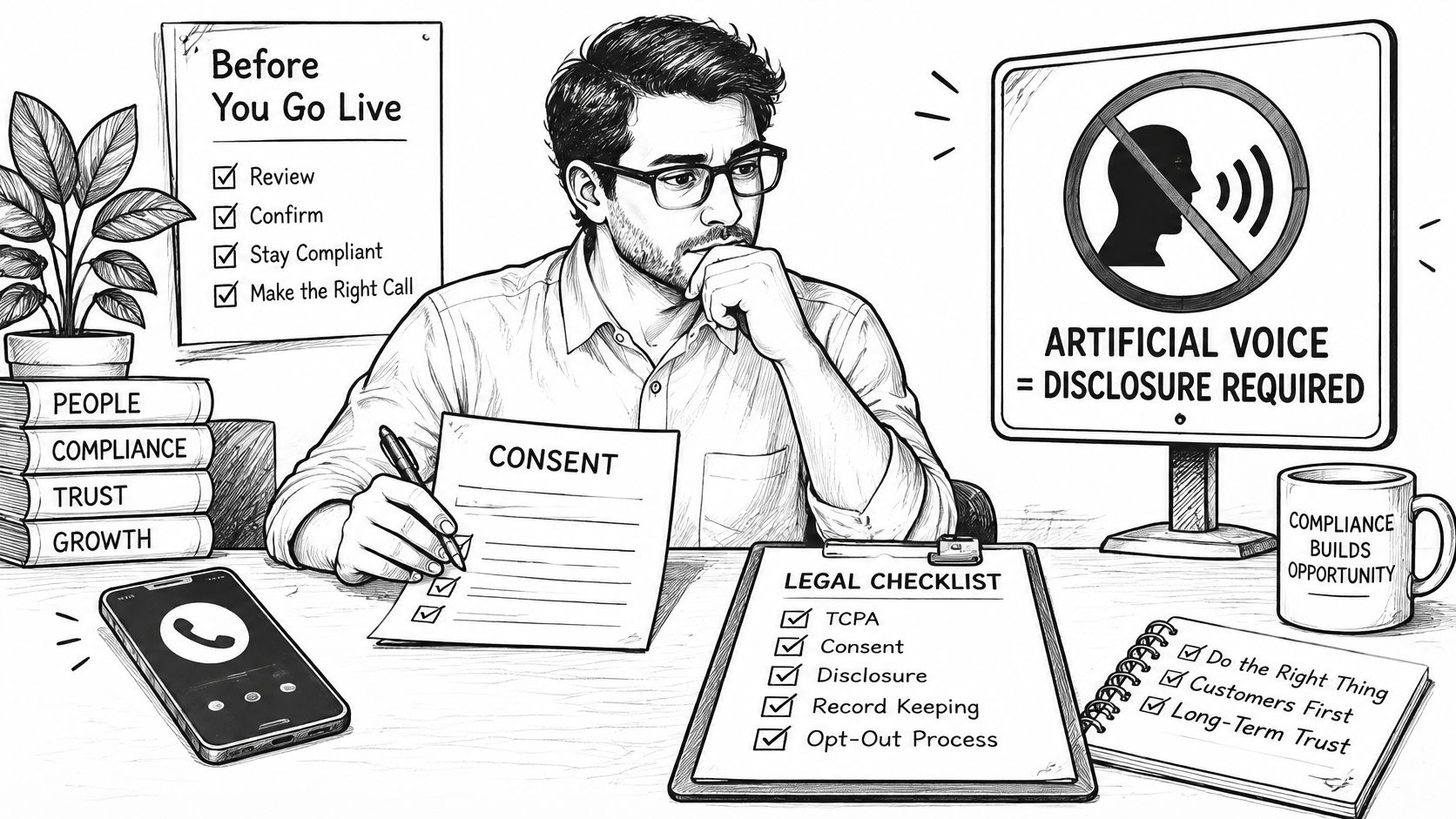
In February 2024, the FCC classified calls using AI-generated human voices as calls using an artificial voice under the Telephone Consumer Protection Act. Enforcement can run through civil action, carrier call-blocking measures, consumer lawsuits, and state attorneys general. The FCC clarification that the TCPA applies to AI technologies that generate human voices states that AI-generated or AI-simulated voices used in covered outbound calls require the called party's prior express consent, unless an emergency-purpose or other applicable exemption exists. Those calls must also provide identification and disclosure information for the entity responsible for initiating the call, with an opt-out method when the call contains advertising or telemarketing.
Call direction is the practical split. A prospect who calls your business is inbound, and an agent answering that call is the standard use case here. An agent that calls consumers first is outbound, and that activity needs prior express consent, caller identification, and opt-out handling when marketing is involved. Don't blur the two because the same software can do both.
Disclosure also affects whether callers stay on the line. A clear introduction in the first seconds does more for trust than a voice that sounds human. Callers want to know what they are talking to, what it can handle, and how to reach a person. The voice quality argument gets the attention, but the disclosure line is what keeps the call from feeling like a trick. That is a general trust practice, not a substitute for consent rules.
The video below walks through how disclosure and consent fit into a live deployment.
Use this sequence. Introduce the agent plainly in the first seconds. State what it can and can't do. Offer an immediate human handoff for pricing exceptions or sensitive situations, and transfer the call instantly when a caller asks for a person. Keep consent and phone-number records you can retrieve. Then test disclosure wording against abandonment and booking rates, because your callers will tell you which version works. Have counsel review your script and consent flow for your state before launch.
Most small cleaning companies don't lack a voice tool. They lack standardized pricing, escalation paths, and a review routine. That's the readiness gap, and better voice quality won't close it. If two people in your office would price the same home differently, an agent will automate the inconsistency faster.
Be skeptical of adoption headlines when making this decision. Vendor surveys on small-business AI use disagree sharply, and the differences usually come down to who was sampled and how "AI use" was defined. The Talkdesk small business AI survey release is one data point among many. Your readiness is a better signal than any market-wide percentage.
Score yourself candidly. Five written items means you're ready to test. Two or three means the next two weeks belong to documentation, not vendor demos.
Launch rule: If the pricing matrix and handoff rules are written this week, launch a 30-day trial. If they aren't, write them first.
For one example of this setup, Estimatty's AI or human agents answer calls under your business's brand name, handle questions, and book the job. When a caller asks for a human, the AI transfers the call instantly. The workflow reference lives at estimatty.com/blog, and prospects can book a demo call from the Estimatty website. I'd still book that demo only after your 20 test calls, not before your rules are written.
One last capacity check. If the agent works, booked work grows. Capacity planning becomes the next constraint, and an overbooked schedule damages trust faster than a missed call.
Write your pricing matrix and handoff rules this week, run your 20 test calls, then put a disclosed, rule-based agent on your inbound line for 30 days and judge it on estimate-to-booking rate and missed-call recovery. Estimatty offers a 24/7 AI voice sales agent built for residential cleaning companies that answers under your brand name, sends instant estimates, and transfers instantly to a person on request. Book a demo, bring your scorecard, and make the system prove itself on your own calls.