October 7, 2026
A Quote on Consistency and Success for Cleaning Businesses
Discover a powerful quote on consistency and success tailored for cleaning professionals, with practical tips to apply it to marketing and teams.

Friday, October 2, 2026
Use our AI voice agent ROI calculator to estimate savings and revenue lift from deploying an AI voice agent in your cleaning business. Includes formulas
A prospect calls your cleaning business after dinner, ready to book a recurring service. The call goes to voicemail. You return it the next day, but the prospect has already contacted another cleaner. Your labor report shows no obvious loss, yet the missed booking still reduces revenue.
That's why a useful AI voice agent ROI calculator can't stop at staff hours and call deflection. For a cleaning business, the stronger model combines labor savings, faster response times, after-hours lead capture, and additional booked work. The right question isn't only, “How much can automation cost?” It's also, “How much revenue am I currently allowing to disappear?”
A missed after-hours call can represent far more than an unanswered phone. It can be a recurring customer, a move-out cleaning, or a commercial account that calls several providers before choosing one. Consider the familiar cleaning-business scenario: a voicemail callback fails to recover a monthly contract worth $280. The cost doesn't appear as a line item, but the lost contract continues to affect revenue every month.
The conversion gap makes the problem measurable. One 2026 after-hours answering-service report found that voicemail callbacks converted at 23%, while callers who reached a live person during business hours converted at 34%. The same report recorded 9% conversion for after-hours callers who first reached the answering service, which shows that coverage alone isn't enough. The conversation must also qualify the customer and move the person toward a booking. (After-hours answering-service conversion data)
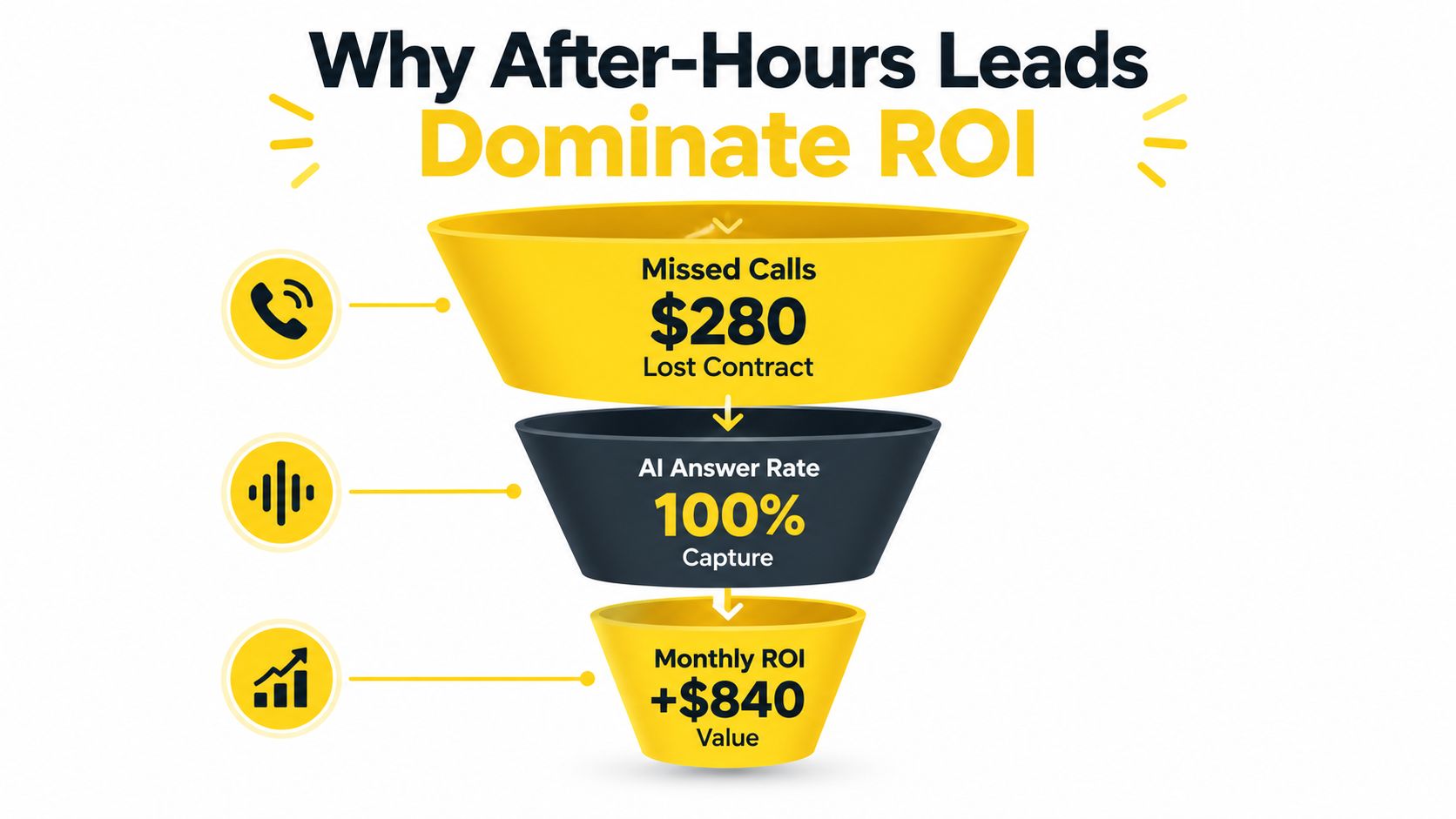
Cleaning leads often have immediate intent. Someone who needs a deep clean before guests arrive, a move-out service before a lease deadline, or recurring office cleaning may not wait for a callback. Contractor-call data shows the relationship clearly: calls answered in under five seconds converted at 42%, compared with 31% when answered within five to fifteen seconds, 22% within fifteen to thirty seconds, and 11% for voicemail callbacks. The same dataset reports 35% to 45% conversion for answered after-hours calls. (Contractor call conversion benchmarks)
That changes what you enter into the calculator. Don't treat an after-hours call as merely a call that an employee no longer needs to answer. Treat it as a lead with a different probability of becoming a booked job.
| After-Hours Conversion Benchmarks | Business Hours | After Hours |
|---|---|---|
| Live answer | 34% | Varies by coverage and handling |
| Voicemail callback | Lower than a live answer | 23% |
| Answering service | Live-answer benchmark available | 9% in the cited HVAC example |
The figures above come from industry examples rather than a guarantee for cleaning businesses. Your own booking rate should come from call recordings, CRM outcomes, and completed jobs. The after-hours answering-service analysis for small businesses offers useful context for deciding which calls deserve immediate coverage.
A voice agent that answers every call but collects incomplete details may produce impressive containment and weak revenue. For cleaning, the agent should capture the property type, approximate size, surfaces, urgency, service frequency, and preferred appointment window. It should then send an estimate or transfer a qualified prospect when human judgment is needed.
If more than half of your inbound calls arrive outside staffed hours, your calculator should prioritize recovered booking value before it emphasizes payroll reduction. Labor savings matter, but a single recurring account can outweigh the apparent savings from handling routine questions.
A cleaning company can show strong labor savings on paper and still lose money if the AI agent fails to turn missed inquiries into booked work. Use a formula that separates the revenue recovered from the operating cost avoided:
ROI = (Annual Savings + Annual Revenue Lift − Annual AI Costs) ÷ Annual AI Costs × 100
Annual savings may include reduced staff handling time, lower overtime pressure, and fewer manual callbacks. Annual revenue lift comes from qualified leads that receive an immediate response and become booked jobs. AI costs include usage, platform fees, setup, integrations, monitoring, and the human time required for escalation.
Build the baseline from at least three months of historical contact-center data. Track contact volume, containment, first-call resolution, average handle time, escalation quality, cost per contact, repeat rate, and attrition. These measures separate useful resolution from calls that end quickly. AI voice-agent KPI guidance
Pull the following inputs from your phone system and CRM:
Calculate direct savings separately:
Annual containment savings = calls handled by AI × avoided human cost per contact
Revenue requires a stricter definition:
Annual revenue lift = recovered qualified leads × booking rate after AI engagement × average realized job value
Use realized job value rather than the estimate amount. An estimate creates no revenue until the prospect books and the job is completed.
Published voice-agent ranges include roughly 50% to 70% containment, 70% to 85% first-call resolution, and less than 10% forced escalation. If transfers are part of the workflow, transfer success should reach 85% or higher to preserve the prospect's value. Treat these figures as testing limits, not cleaning-business forecasts.
A 240% first-year ROI result can serve as a comparison point because a 2025 industry survey reported average ROI for deployed voice AI at 240% within the first year. It is not a promise for your company. Compare it with your own missed-lead volume, after-hours booking rate, and realized job value before deciding whether your assumptions are conservative or optimistic. (2025 voice AI industry survey)
Keep direct savings and revenue lift in separate spreadsheet rows. Captiwate sales engagement ROI can help structure the revenue side, but your cleaning model should rely on completed-job outcomes. If labor savings account for nearly all projected returns, the model may be overlooking leads your team currently misses.
A calculator becomes useful when each input describes a real operating condition. “Response time” should mean the time from ring to meaningful engagement. “Conversion rate” should mean a completed booking or paid job. “Automation rate” should distinguish a fully resolved call from a call that ended because the customer gave up.
Start with the baseline. Document how many calls reach voicemail, how long callbacks take, how often callers receive an estimate, how often they book, and how much staff time each interaction consumes. Then model the AI scenario using the same definitions.
A solo cleaner often loses leads while driving, working inside a property, or handling an existing customer. The baseline problem isn't necessarily an excessive payroll bill. It's that the owner can't answer and perform the service simultaneously.
An AI-assisted workflow can answer immediately, collect service details, send an SMS estimate, and notify the owner when the prospect needs personal attention. The owner still decides whether the job fits the schedule and pricing rules, but no longer has to reconstruct every inquiry from a voicemail.
| Baseline versus AI Voice Agent Performance | Baseline | AI Voice Agent |
|---|---|---|
| Initial response | Delayed or dependent on availability | Immediate voice engagement |
| After-hours coverage | Voicemail or third-party answering | Always-on configured handling |
| Job details | Often reconstructed during callback | Collected during the first conversation |
| Estimate delivery | Manual follow-up | SMS or email workflow |
| Escalation | Callback may lose context | Planned transfer with captured details |
| Revenue effect | Missed opportunities remain invisible | Recovered opportunities can be tracked |
A multi-location team has a different issue. Several cleaners or receptionists may answer calls inconsistently, apply different qualification standards, or leave handoffs without enough context. A voice agent can standardize the opening questions and route the conversation according to location, service type, urgency, or account value.
That consistency is more important than a headline automation percentage. If the agent captures the wrong property details, sends an inaccurate estimate, or transfers without context, the apparent saving can become rework. The AI sales automation workflow for cleaning services provides a practical reference for connecting response, qualification, and follow-up.
Use the model as a mirror, not a sales promise. If you want to maintain the calculation outside a dedicated tool, you can build an ROI calculator in Excel and add separate rows for labor savings, recovered bookings, failed transfers, and oversight costs. Those rows show which assumption controls the outcome.
A credible ROI estimate begins with your own call history, not a vendor demonstration. Export contacts and group them by hour, day, service type, answer status, callback outcome, and booking result. Record at least three months of history, then keep the definitions unchanged after launch so the comparison remains credible. (AI voice-agent KPI guidance)
Start with high-volume conversations that affect booked revenue. For a cleaning company, these may include service-area questions, recurring-cleaning inquiries, move-out requests, estimate collection, and appointment scheduling. Keep complex complaints, unusual commercial requirements, and sensitive situations available for human handling.
Measure the funnel before and after deployment:
Revenue reporting should sit beside call-handling metrics. A strong containment rate can hide weak bookings if callers finish the conversation without understanding the price or next step. Compare after-hours leads with daytime leads, then apply your own cleaning-industry conversion benchmark to estimate the value of faster responses. The key question is how many otherwise missed inquiries become qualified, booked work.
For workflow design, a Zapier CRM integration for cleaning operations can connect captured details with lead records, notifications, follow-up tasks, and appointment workflows. Keep event names consistent across systems. Otherwise, the calculator may compare an answered call in one report with a qualified lead in another.
A simple visual report helps owners inspect after-hours performance, speed-to-lead, booking rate, and realized job value without confusing activity with revenue.
Create conservative, expected, and strong cases. Adjust containment, forced escalation, transfer success, booking rate, and average realized job value for each case. The conservative case should include failed transfers, incomplete details, and human oversight. It should also assume that faster response improves only some after-hours conversions, not every missed lead.
Interpret the result with three questions:
If a small booking-rate change removes the projected return, test after-hours handling and speed-to-lead before expanding the deployment. If the result stays positive under cautious containment and conservative job-value assumptions, the estimate gives the business a stronger basis for proceeding.
The buying decision should follow the shape of your numbers. Proceed when both sides of the model are credible: the agent reduces avoidable handling work, and it captures qualified demand that your team currently misses. A labor-only case may justify automation in a large operation, but a cleaning business often wins or loses on booked-job value.
Proceed with a focused deployment when your call records show frequent missed calls, clear repetitive questions, stable pricing rules, and a practical human escalation path. Start with the conversations where the agent can collect complete details without pretending to handle every exception.
Pilot before expanding when call quality is inconsistent, your booking data is incomplete, or the agent must connect to several systems. Define success using answer rate, qualified-lead rate, booking rate, transfer success, and realized revenue. Review recordings and failed handoffs regularly.
Delay the purchase when call volume is too limited to support the operational attention, when pricing changes constantly, or when no one owns the follow-up process. Automation can't repair an undefined service area, an unreliable schedule, or a team that ignores new leads.
A vendor should explain how it measures containment, not merely advertise an automation rate. Ask how it distinguishes planned escalation from forced escalation, how it passes conversation context to staff, how it handles uncertain pricing, and how you can audit calls that ended without a booking.
Also ask how usage costs behave during longer conversations, whether SMS and CRM actions are included, how staff can correct the knowledge base, and what happens when the system can't understand a caller. The guide to when to reach out based on signals is useful for thinking about timing, but your own lead and booking signals should control the decision.
Practical rule: Buy the workflow you can measure, not the automation percentage that looks best in a presentation.
Your final calculator should show direct savings, incremental booked-job value, total AI costs, failed-transfer costs, and oversight time. Update it with live results after launch. A case such as a cleaning company doubling sales after instant estimates illustrates why speed and estimate delivery deserve their own revenue line, rather than being buried inside “call savings.”
Estimatty provides an AI-powered web and voice sales estimator for cleaning businesses, collecting job details, applying configured pricing rules, and sending estimates by SMS or email. Visit Estimatty to evaluate whether instant, after-hours lead handling fits your ROI model.