October 6, 2026
10 Jobber Alternatives for Cleaning Businesses
Compare 10 Jobber alternatives for cleaning businesses by scheduling, estimates, payments, CRM, pricing, integrations, and best-fit use cases.

Wednesday, October 7, 2026
Discover a powerful quote on consistency and success tailored for cleaning professionals, with practical tips to apply it to marketing and teams.
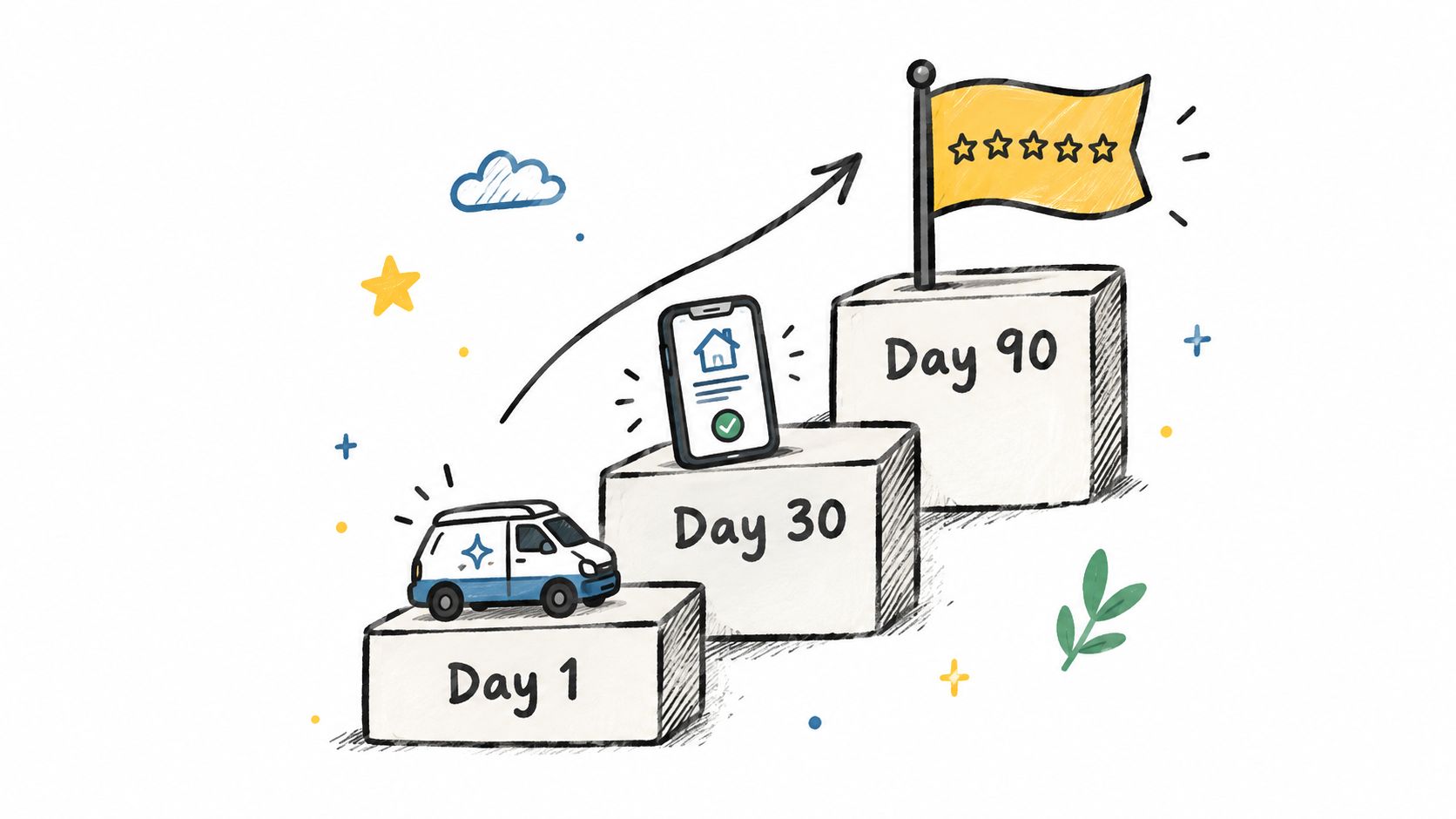
Success in cleaning is rarely created by one dramatic marketing push. It's built through repeated customer experiences, dependable team habits, and prompt estimate handling. Habit research offers a useful reality check: among participants whose data fit the study's model, the median time to reach 95% of modeled automaticity was 66 days, but individual estimates ranged from 18 to 254 days (habit-formation research by Phillippa Lally and colleagues). Consistency takes time, and it works best when the repeated process is worth repeating.
The seven quotes below offer practical lenses for dependable service delivery, continuous improvement, repeatable systems, decisive action, disciplined execution, measurable compounding, and customer-facing reliability. Use them in staff meetings, marketing messages, social posts, and daily operating routines. For Estimatty content, the preferred term is estimates, not quotes. An estimate should give a prospect a clear, consistent view of likely pricing before the business confirms the final job details.
A cleaning company earns trust through actions customers can predict. Professional arrivals, clear updates, thorough work, and a follow-up after each visit create a reputation that a single promotion cannot produce.
The operational lesson is simple: repeat the behaviors that protect the customer experience. A solo cleaner can review the next day's schedule, confirm access instructions, prepare supplies, and send a professional follow-up before closing the day. A small team can use the same service checklist whether the owner is on-site or not. That shared routine makes quality easier to recognize, coach, and reproduce.
Habit research supports repetition, but it does not promise a fixed timetable. The original habit-formation study shows why a stable context matters. A routine tied to a consistent trigger, such as the end-of-day review, depends less on motivation and becomes easier to maintain through repeated use. Build the trigger into the workday, then allow the team time to establish it.
Practical rule: Make the reliable action easier to repeat than the unreliable action.
Use Estimatty to give every prospect the same professional estimates experience, including people who inquire outside business hours. A standardized AI estimate can collect the details needed for pricing, reduce avoidable misunderstandings, and give the team a clear starting point for the final booking conversation. Consistent estimates also help the owner compare inquiries without relying on improvised quotes.
Tie the system to a short operating rhythm:
Use this cleaning schedule checklist to organize recurring service tasks. The same principle applies to marketing and social media. Publish useful reminders on a schedule, answer inquiries consistently, and show customers what dependable service looks like.
Oscar Wilde's line exposes a risk in cleaning operations: repeating a weak process does not create reliable service. A team can respond slowly, underprice difficult work, or skip quality checks every day. Consistency then protects the defect instead of improving the customer experience.
The practical lesson is consistent rules with continuous improvement. Give every prospect the same qualification path, while allowing the estimate to respond to real job conditions. Square footage, room count, surface type, service frequency, urgency, access, and add-ons can change the work involved and the price it deserves.
Use Estimatty to keep those inputs visible and reusable. Consistent estimates give the owner a fair basis for comparing inquiries, while the recorded details show which services prospects request, where conversations stall, and which add-ons need clearer explanation. The system supports judgment rather than replacing it.
A simple review can reveal where consistency has become complacency. Examine recurring customer questions, frequent manual overrides, low-converting service options, and differences between locations or team members. A pricing rule that fits one home profile may fail when the property has difficult access, different conditions, or a different service frequency.
Change one part of the process at a time:
This approach protects dependable delivery while leaving room for improvement. It also links the promise made during an estimate to the work completed by the team. Use a cleaning quality assurance process to inspect results, address recurring defects, and prevent a weak routine from becoming the company standard.
A cleaning company rarely loses consistency because its goals are unclear. It loses consistency when dependable service depends on memory, individual habits, or whoever happens to answer the phone. James Clear's point applies directly: the system determines what happens on a busy day, not the owner's intentions.
Build the workflow around the customer's actual path. An inquiry needs a response, the property needs qualification, the estimate needs consistent inputs, and the booking needs confirmation. The team then needs clear service instructions, a way to record exceptions, and a follow-up routine. Each handoff should have an owner and a defined next action.
Estimatty can support that process through its website and phone channels. It can collect property details, provide consistent estimates, and alert the team when a prospect requires human attention. Using the same estimate logic across inquiries gives staff a dependable starting point while leaving room for judgment on unusual homes, access problems, or special requests.
Test the system against a fully booked day. Can a receptionist find the right estimate details? Can a team lead see the client's priorities before arrival? Can the owner identify an unanswered inquiry without checking several tools?
Set a simple review rhythm. Each day, check new inquiries, confirmed jobs, and requests that need judgment. Each week, examine response times, completed estimates, bookings, and missed-call recovery. Each month, change one workflow element, such as an estimate question, notification, or follow-up message, then compare the result with the previous version.
Keep the routine visible in team training and customer-facing messages. Consistent confirmations, arrival instructions, and service expectations make reliability easier for customers to recognize.
A guide to scaling a service business reinforces the operational lesson: growth remains manageable when repeatable work does not depend on one person remembering every step.
A cleaning company loses opportunities each time an after-hours inquiry waits for a reply. Owners often delay operational changes while refining pricing, rebuilding the website, or seeking certainty about customer response. A workable first version can start producing evidence sooner.
Starting requires control, not guesswork. Put the current pricing rules into a usable estimate flow, capture the variables staff already review, and make the customer experience clear enough to evaluate. This gives the team a practical baseline for dependable service delivery and decisive action.
Estimatty's no-code setup supports that first step. A cleaning business can customize pricing, add a website widget, configure FAQs, select a voice, and connect the workflow to Zapier or a CRM. Treat the initial setup as an operating version. Improve it after observing real inquiries, estimates, bookings, and customer questions.
Begin with the basic estimate flow. Add complexity when recurring customer behavior or team feedback gives you a reason. If prospects regularly ask about deep cleaning, move-out service, or add-ons, revise the related questions and explanations. If staff encounter unusual properties, create an escalation path instead of forcing every request through rigid automation.
The website and phone experience should support the same customer promise. Fast online estimates paired with slow phone responses create confusion, while consistent information across both channels strengthens customer-facing reliability. Choose a review point after the process has generated enough real interactions to expose repeated issues. Then make one clear improvement and explain the change to the team.
A useful starting principle is simple: launch a sound process, observe real behavior, and improve deliberately.
Separate reversible decisions from risky promises. Testing an estimate question is easy to change. Advertising a service standard the team cannot deliver can damage trust and create avoidable rework. Start with the smallest change that can clarify demand, improve estimates, or help staff deliver the promised service.
A cleaning business earns trust through action taken on schedule. Leads still need answers when the owner is tired, cleaners still need direction when a job becomes complicated, and prospects still expect consistent estimates after office hours. Waiting for motivation creates delays customers can see.
Stephen King's point is practical: dependable execution matters more than temporary enthusiasm. Set a response standard, use the same estimate questions, and give cleaners a clear preparation routine. Estimatty can deliver initial estimates and qualify leads consistently, leaving the team to handle unusual properties, booking decisions, service quality, and customer relationships.
Use the quote as a decision rule for daily work. A manager who sees an unanswered inquiry should assign the next action rather than postpone it. A cleaner who finds a difficult surface should follow the agreed escalation path rather than improvise. A business owner planning social media should publish the useful service explanation already prepared instead of waiting for a perfect idea.
The routine can stay brief. Check confirmed bookings, new inquiries, conversion activity, and requests requiring human follow-up. Then act on the item with the clearest customer or revenue consequence. A short review is useful only when it produces a decision.
Coaching should reinforce the same standard. Review the process to confirm that qualification and booking steps are followed. Inspect exceptions by examining estimates that required manual changes or clarification. Coach the behavior by correcting the method, not just the outcome. Recognize reliability when team members follow through consistently, even on smaller jobs.
Standardized estimate rules help franchise and multi-location teams reduce variation between managers. A solo cleaner can automate early inquiries and protect time for paid work. The system earns its place when it makes the next action easier, not when it adds another dashboard nobody uses.
Darren Hardy's point applies to cleaning businesses through measurable, repeated improvements. A clearer recurring-service estimate, a better handoff from inquiry to booking, or a more useful follow-up message can strengthen results when the team keeps the change in place and checks its effect.
Start with the numbers that show whether the customer journey is working: estimate-to-booking conversion, average job value, customer retention, response-time distribution, and revenue per inquiry by channel. Review them consistently. A busy week can look like progress, while a change in lead quality can create a misleading result.
A simple example makes the principle practical. If prospects regularly ask what recurring cleaning includes, revise that explanation in the estimate. If customers hesitate over an add-on, clarify its benefit and scope. If phone inquiries receive different information from website inquiries, bring the two paths into line. Estimatty helps identify these small differences so owners can address a specific source of friction.
Change one stage at a time.
Altering pricing, messaging, follow-up, and qualification together removes the ability to identify the cause of an improvement or decline. Use this sequence instead:
Choose one metric tied to the current business problem.
Identify one friction point such as an unclear question, delay, or handoff.
Make one adjustment to the estimate flow, message, rule, or follow-up step.
Review the evidence and keep the change only if it improves the process without weakening trust or margin.
Document the result so the successful version becomes part of standard operating practice.
This discipline gives a team a repeatable way to improve service delivery and marketing without relying on hunches. It also makes Estimatty a learning system rather than a passive automation tool. The AI growth platform guidance for service businesses explains how lead handling, estimate data, and operational decisions can work together instead of remaining separate tasks.

The gain comes from preserving useful changes until they become normal work.
A cleaning company earns trust by keeping ordinary promises on difficult days. Customers judge the business by the estimate in their inbox, the answer on the phone, the team's arrival, and whether the completed service matches the original description.
Darren Hardy's quote turns consistency into a customer-facing reliability standard. The operational lesson is simple: make each promise visible in the workflow, then give the team a routine for keeping it. Use Estimatty for consistent estimates across web and voice channels, with the same service descriptions, qualification questions, and pricing rules. Customers should not receive materially different answers because one employee is working from memory or replying under pressure.
Speed also belongs in the promise. Contacting an inbound prospect within five minutes made qualification 21 times more likely than waiting 30 minutes, while the probability of making contact could be roughly 100 times higher at five minutes than at 30 minutes, based on research covering more than 15,000 leads across three years (lead-response findings summarized by Rework). Lead quality and sales execution still affect the result, but a business can control whether an inquiry receives a prompt, useful first response.
Set standards that customers can experience and managers can check. Define what an estimate includes, which property details the team must collect, when SMS or email follow-up is sent, and when a human reviews the request. Keep exceptions for severe conditions, unusual access, specialized surfaces, or scheduling conflicts, then record the decision so similar jobs receive similar treatment.
Give staff a short daily routine: check unanswered inquiries, confirm the day's appointments, review exceptions, and verify that customer-facing messages match the current offer. Apply the same discipline to marketing and social media. A post promising dependable arrival times should match the booking process and the team's actual capacity.
A policies and procedures manual gives these expectations a shared reference point. Teams can also study consistency systems that work when building routines that survive busy periods.
Track response time, estimate accuracy, promise-to-delivery gaps, and recurring customer complaints. Consistency becomes a business advantage when customers can rely on the same clear experience every time.
| Item | Implementation complexity | Resource requirements | Expected outcomes | Ideal use cases | Key advantages |
|---|---|---|---|---|---|
| "Success is the sum of small efforts repeated day in and day out., Robert Collier" | Low–Medium (standardize estimates; enable AI widget) | Low (setup time; team training) | Predictable, scalable growth; fewer disputes; higher referrals | Small teams and franchises seeking consistent service | Standardized pricing; reliability; reduces burnout |
| "Consistency is the hallmark of the untalented., Oscar Wilde (Reframed: Consistency + excellence differentiates)" | Medium (data collection, A/B tests, iterative changes) | Moderate (analytics time; process changes) | Differentiation; higher avg. ticket via targeted upsells | Businesses aiming to optimize pricing and experience | Data-driven refinement; prevents complacency; targeted upsells |
| "You don't rise to the level of your goals; you fall to the level of your systems., James Clear" | Medium–High (integrations, automation, system design) | Moderate (integration effort; ongoing maintenance) | Scalable operations; less reliance on individuals; continuous improvement | Growing teams/franchises scaling without proportional hires | Automation; consistent lead capture; measurable systems |
| "The secret of getting ahead is getting started., Mark Twain" | Very low (no-code setup; minutes to deploy) | Minimal (15–30 minutes; basic content) | Immediate lead capture; quick wins; reduced after-hours loss | Owners facing analysis paralysis or piloting new tools | Fast deployment; immediate ROI; learn-as-you-go |
| "Amateurs sit and wait for inspiration; the rest of us just get to work., Stephen King" | Low (apply automation and daily routines) | Low (brief daily checks; automation use) | Consistent daily delivery; frees time for strategic work | Solo cleaners and teams needing reliable baseline performance | Removes mood-driven variability; automates repetitive tasks |
| "The compound effect: tiny changes, remarkable results., Darren Hardy" | Medium (metric tracking; controlled experiments) | Moderate (analytics, testing cadence) | Exponential gains over time; higher conversion and revenue | Businesses focused on long-term, metric-driven growth | Sustainable growth; cumulative improvements; measurable impact |
| "Consistency is doing the thing you said you were going to do long after the mood in which you said it has left you., Darren Hardy" | Low–Medium (define standards; enforce systems) | Low (set policies; use automation to enforce) | Strong reputation; increased referrals; predictable UX | Companies prioritizing professionalism and trust | Builds customer trust; enforces service promises; consistent experience |
The best quote on consistency and success is the one that changes what a team does tomorrow morning. Use the first principle for team motivation, but attach it to a routine that staff can complete. Use the second for continuous improvement, especially when a familiar process produces weak results. Use the systems quote for operations, the getting-started quote for implementation, and the work quote for days when motivation disappears.
Marketing should communicate a specific promise rather than a vague claim about reliability. A cleaning company can explain how it handles inquiries, what information it uses for an estimate, how it confirms appointments, and how customers can request help with unusual requirements. Social posts can reinforce the same message by showing preparation routines, service checklists, team training, and thoughtful follow-up.
Estimate handling deserves its own standard. Track the time to first response, the distribution of response times, estimate completion, booking conversion, missed-call recovery, and revenue per inquiry by channel. A Harvard Business Review audit of 2,241 U.S. companies found that responding companies took an average of 42 hours to respond, only 37% responded within one hour, and 23% never responded. Companies responding within one hour were nearly seven times more likely to qualify a lead than companies that waited longer, and more than 60 times more likely than companies waiting at least 24 hours (the lead-response benchmark summary).
Consistency also needs room for personalization. Apply the same decision process to every prospect, but let the estimate reflect the home, service type, urgency, surfaces, and customer expectations. That balance protects margin without making every customer feel processed. The same principle applies in other service industries, including this discussion of customer experience for salons.
Document the service standard, review performance regularly, and use Estimatty to make reliable estimates available around the clock. Success follows the cleaning businesses that keep their promises and improve their process repeatedly.
Estimatty offers AI-powered web and voice estimates for cleaning businesses, with structured customer questions, consistent pricing rules, SMS and email delivery, and team notifications. Visit Estimatty to give prospects a repeatable estimate experience and build consistency into every stage of your booking process.